An FSSAI inspection does not announce itself with enough lead time to fix a documentation problem. A designated officer arrives, presents credentials, and asks to see your equipment maintenance records, calibration logs, sanitation schedules, and pest control documentation — in that order, within the first 30 minutes. What happens next depends entirely on whether those records are accessible, complete, and traceable.
Most food manufacturers fail FSSAI inspections not because their equipment is poorly maintained, but because they cannot prove it is well maintained. The maintenance happened. The records exist somewhere — across three logbooks, a shared drive folder, a supervisor’s WhatsApp messages, and a spreadsheet last updated six weeks ago. By the time the inspector finishes a cup of tea, the plant manager is still on the phone trying to locate a calibration certificate from eight months ago.
A CMMS changes the audit experience at its root. Every maintenance action — preventive, corrective, calibration, sanitation — creates a structured, timestamped, technician-attributed record the moment it is completed. When the inspector arrives, pulling the last 12 months of maintenance records for any piece of equipment takes under 10 minutes. This guide explains exactly how a CMMS builds that readiness continuously, not the week before an audit.
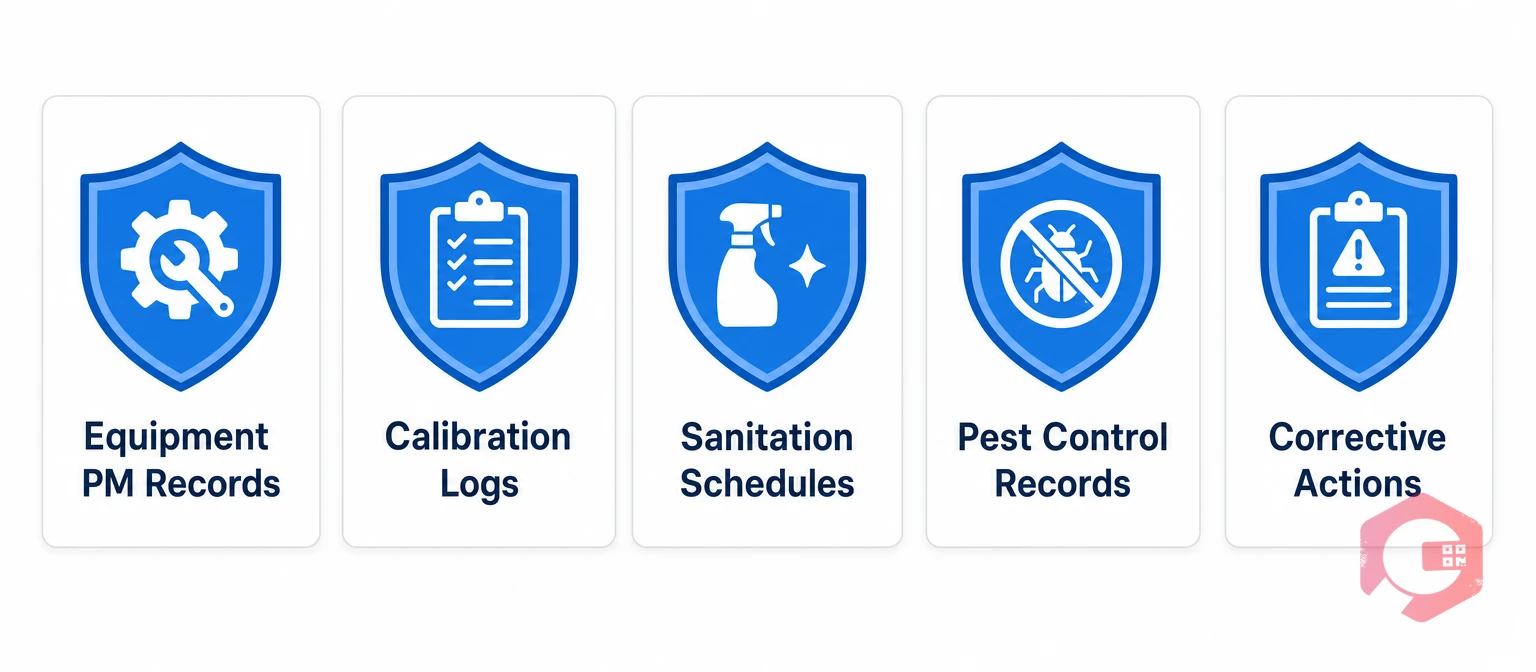
Understanding the inspection scope shapes how you configure your CMMS to produce exactly what auditors need. FSSAI inspections under the Food Safety and Standards Act 2006 and the Food Safety and Standards (Licensing and Registration) Regulations 2011 cover five categories of equipment-related documentation that a CMMS directly addresses.
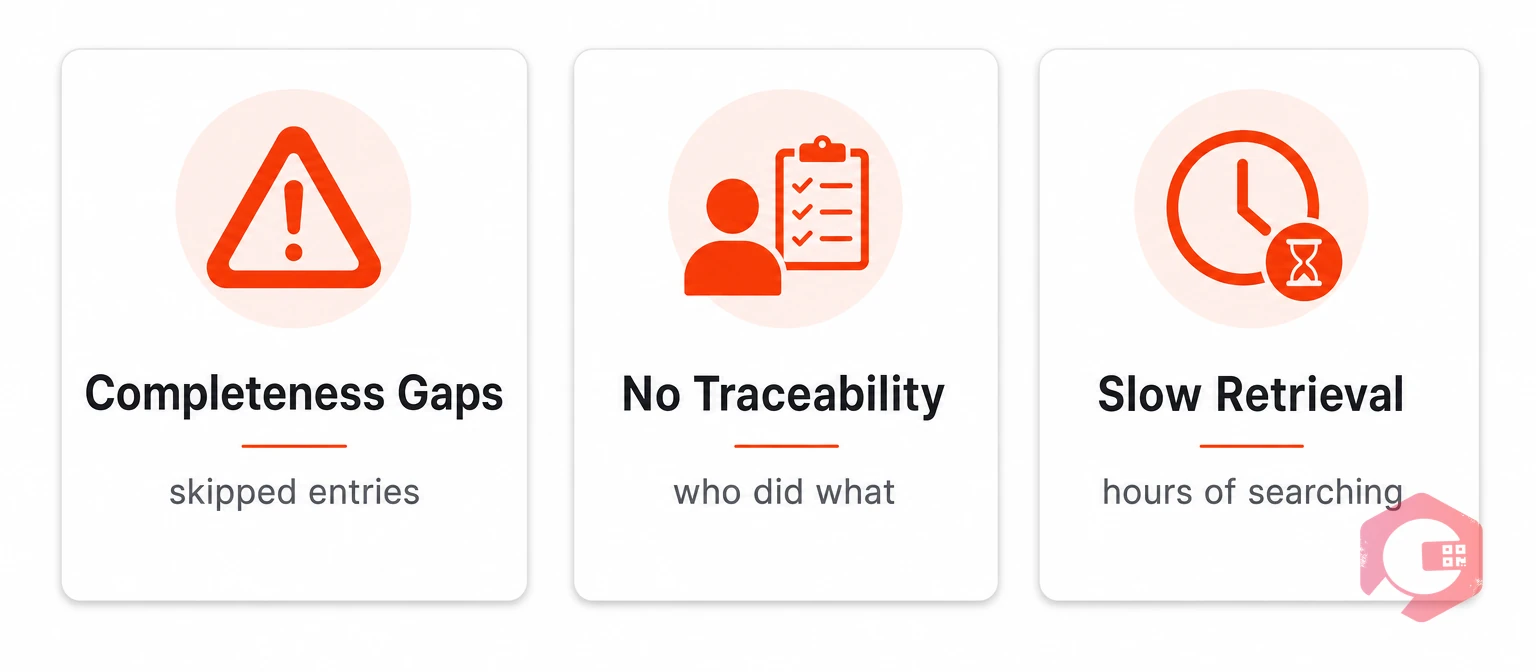
The failure mode is predictable and consistent across food manufacturers of all sizes. Records that are accurate during normal operations become unreliable at audit time for three reasons.
The first is completeness gaps. Paper logbooks depend on the discipline of every individual who uses them. A shift that ran short-staffed skips the log. A technician who completed a PM but could not find the logbook writes it up later from memory — or does not write it up at all. A CMMS with mandatory sign-off fields means the record cannot be marked complete without the required data. The work order cannot be closed without the checklist being filled. Completeness is enforced at the point of execution, not audited after the fact.
The second is traceability. An entry in a paper logbook that says “compressor serviced — OK” tells an inspector nothing about what was checked, what was found, what parts were used, or whether the person who performed the work was qualified to do so. A CMMS work order closure captures all of that — the specific checklist items completed, any readings taken, parts consumed from inventory, and the technician’s identity tied to their user account. That level of traceability is what converts a maintenance record into an audit-defensible document.
The third is retrieval speed. Even well-maintained paper records require physical search to produce for an inspector. Finding every maintenance and calibration record for a specific pasteurizer over the past 12 months from physical logbooks and filing cabinets takes time that disrupts operations and tests the inspector’s patience. A CMMS retrieves the same information in seconds by filtering work orders by asset, date range, and work order type.
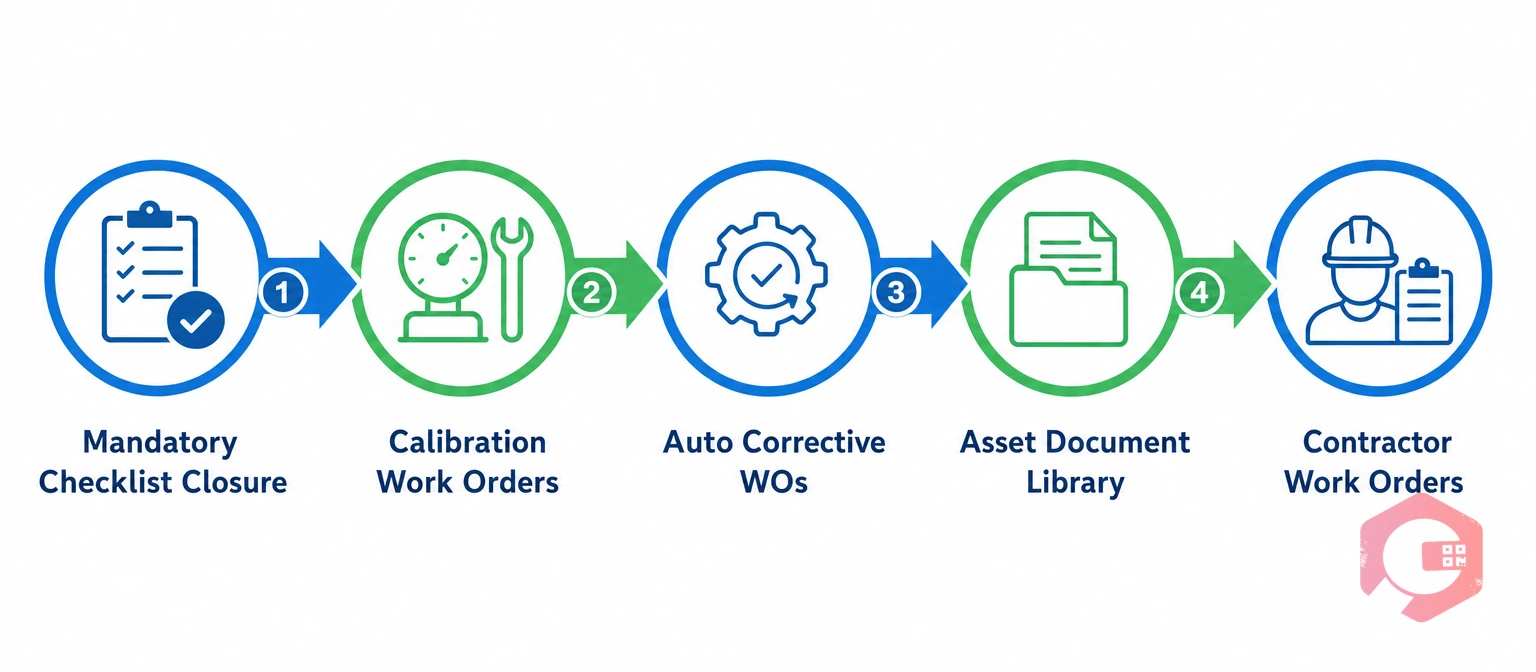
Audit readiness is not a project that runs in the two weeks before an inspection. It is a state that accumulates continuously through correctly configured CMMS workflows. These five configurations are what create that state.
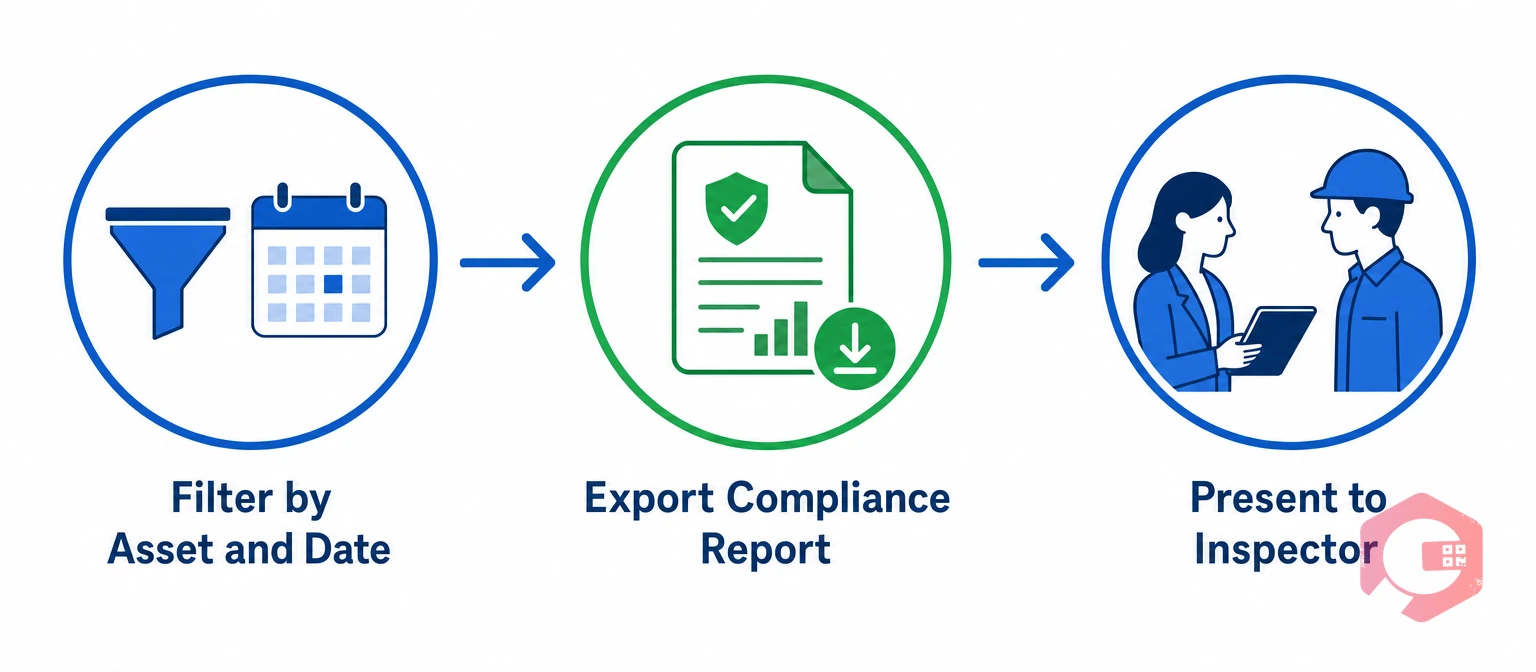
When an FSSAI inspector arrives and requests documentation, the response process in Cryotos follows a defined sequence that consistently produces complete records in under 10 minutes.
The quality manager opens the Cryotos BI Dashboard and navigates to the asset register. They select the equipment category the inspector has asked about — pasteurization equipment, cold storage, sanitation systems — and filter work orders by date range, typically the preceding 12 months. The filtered list shows every PM, corrective, calibration, and sanitation work order closed against those assets, with completion dates, technician names, checklist outcomes, and any attached certificates.
The list is exported as a structured PDF or Excel report — formatted with asset name, work order type, scheduled date, completion date, technician, checklist summary, and deviation notes. The work order management module retains every work order indefinitely, so historical records for any asset are always retrievable regardless of staff turnover or system updates.
For calibration specifically, the inspector can be shown the calibration work order for any instrument, with the attached certificate visible directly in the record. The asset management module stores the full calibration history — every calibration event, every certificate, every due date — against the instrument’s asset record. There is no separate calibration register to maintain.
The permit-to-work module provides the inspector with evidence that any maintenance work on live process equipment — CIP systems, high-temperature equipment, pressure vessels — followed a documented isolation and authorization procedure before work commenced. Every permit is time-stamped, tied to a work order, and carries the authorizing supervisor’s name.
The cost of FSSAI non-compliance is not limited to the penalty for an inspection failure. The operational disruption of an improvement notice — which requires documented corrective actions within a defined timeframe — diverts management attention and resources from production. A suspension order on a product line or facility section while documentation is brought up to standard is a direct revenue impact.
Beyond the regulatory consequence, the absence of systematic maintenance documentation creates operational risk that compounds over time. Equipment that is not tracked in a structured system is equipment whose maintenance history is unknown. Unknown maintenance history means unknown failure risk — which surfaces as unplanned downtime, product loss, and emergency repair costs that dwarf the investment in the CMMS that would have prevented them.
The food manufacturers who treat FSSAI audit readiness as a continuous operational state — rather than a periodic scramble — are the ones whose inspections end with a clean report, whose equipment failures are predicted rather than suffered, and whose maintenance costs trend down rather than up. Book a demo to see how Cryotos structures FSSAI-ready maintenance documentation for food manufacturers.
For a food manufacturing facility with an existing equipment list, the core configuration — asset register, PM templates with compliance checklists, calibration schedules, and sanitation work order workflows — can be completed in five to ten working days. The asset register is populated via bulk Excel import. Most facilities are generating audit-ready work order histories within their first month of operation.
Yes. Cryotos is designed for multi-site operations, with a location hierarchy that organises assets by plant, production line, and equipment category across multiple facilities. Each site maintains its own asset register and work order history, while management views aggregated compliance metrics across all sites from a single dashboard.
Yes. External contractor work orders are created and managed in Cryotos the same way as in-house maintenance work orders. Pest control visits, AMC service calls, calibration laboratory visits, and equipment repair contractors all generate work order records that are part of the same audit-ready documentation structure as internal maintenance.
Historical paper records can be digitized and attached as documents to the corresponding asset records in Cryotos — giving inspectors a single point of access to both historical and current maintenance documentation. Most food manufacturers maintain their paper records for the legally required retention period alongside Cryotos-generated digital records during the transition phase.


Cryotos AI predicts failures, automates work orders, and simplifies maintenance—before problems slow you down.