

The hidden costs of skipping asset maintenance software fall into five measurable categories: compounding unplanned downtime, premature equipment replacement, inventory capital bleed, compliance fines, and skilled-technician turnover. Most mid-sized plants bleed $250,000 to $2 million annually across these buckets — and virtually none of it shows up on a single P&L line.
This guide quantifies each cost with real numbers you can benchmark against your own operation, and gives you a one-sentence business case for whether software pays for itself in your context.
Key Takeaways

Asset maintenance software is a digital platform that tracks every physical asset across its full lifecycle — from purchase and installation through maintenance history, downtime events, spare parts consumption, warranty claims, and end-of-life replacement. Without it, most operations rely on spreadsheets, shared drives, paper logbooks, and WhatsApp groups. Those tools share a critical blind spot: they cannot tell you anything in real time.
Specifically, a plant running without dedicated software has four structural gaps that cost money every single week. It has no centralised failure history — so every breakdown gets diagnosed from scratch. It has no reorder signal for spare parts — so stockouts happen on critical components just when they're needed most. It has no PM compliance record — so missed preventive maintenance goes undetected until equipment fails prematurely. And it has no workload visibility — so technicians are constantly overloaded in some areas and idle in others, with no data to prove it.
Each of these gaps has a dollar value. The next five sections quantify them.
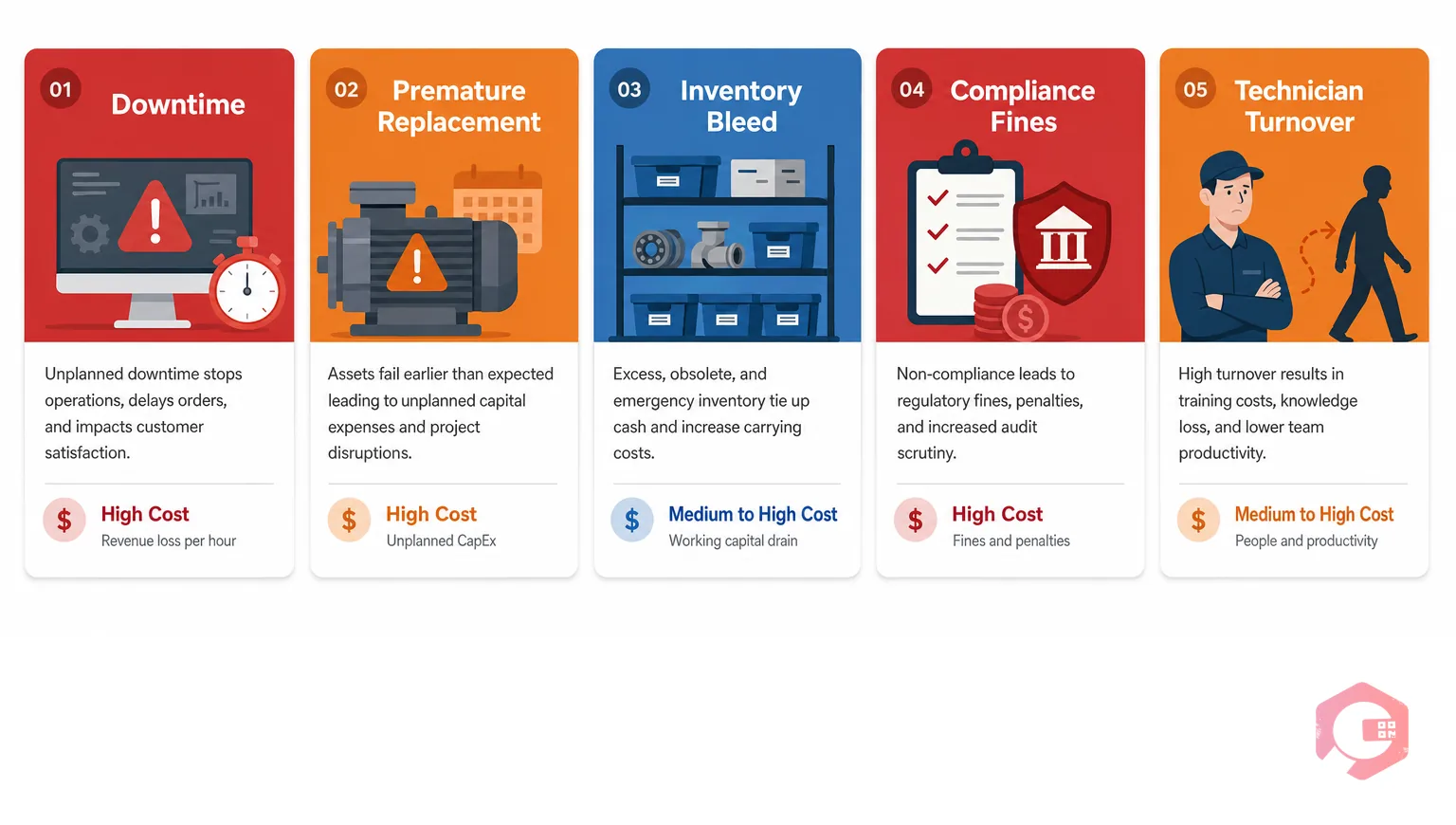
According to McKinsey research on industrial operations, unplanned downtime costs industrial manufacturers an estimated $50 billion globally every year — roughly $260,000 per hour for a mid-scale automotive plant. Without maintenance software, every breakdown costs more than it should. Diagnosis takes 30–90 extra minutes because technicians have no repair history to consult. Wrong parts arrive because parts lists are outdated spreadsheets. And repeat failures happen because nobody recorded what fixed the problem last time.
The compounding part is what makes this so expensive. A breakdown that should cost $4,000 in parts and 2 hours of labour becomes a $25,000 event when you add three hours of diagnostic time, a second trip for the right part, and the root cause going unresolved so the failure recurs next month. Run that pattern across 20 assets for 12 months and you have a six-figure problem that never appears as a single line item anywhere in your budget.
The downtime tracking module in Cryotos surfaces these patterns in real time — flagging repeat failures, tracking mean time to repair (MTTR) and mean time between failures (MTBF) by asset, and giving maintenance managers the data to eliminate the failures that keep coming back rather than just closing the tickets.
Equipment wears out faster without structured maintenance. That sentence sounds obvious, but the dollar figure it produces is not. ISO 55000 asset management research shows disciplined maintenance programs extend equipment service life by 20–40% compared to reactive-only approaches. A CNC machine budgeted for a 12-year life becomes an 8-year machine when preventive maintenance is inconsistent — not because the machine is inherently unreliable, but because the lubrication cycles were missed, the vibration alerts were ignored, and the small adjustments that would have caught bearing wear early never happened.
For a plant with $5 million in capital equipment and a standard 10-year depreciation schedule, replacing assets 25% earlier than planned adds roughly $125,000 per year to effective capital costs. Add the warranty claims that go unclaimed — industry estimates put unclaimed warranty work at $12,000–$20,000 annually for a mid-sized plant — and the total cost of running assets without software becomes substantial before you count a single hour of downtime.
The deeper issue is visibility. Without asset lifecycle management data, maintenance managers make replacement decisions based on age or gut feel, not performance data. Software gives you the evidence to make the right call: extend this asset, replace that one, and push warranty claims before they expire.
MRO inventory is one of the most expensive things a maintenance team manages poorly. Plants without asset maintenance software suffer two inventory problems simultaneously, and they compound each other: stockouts on the parts you need, and excess stock on the parts you don't.
The stockout problem is intuitive — a critical bearing goes down, the part isn't in stock, and you spend $8,000 buying it at emergency freight rates while the line sits. The dead stock problem is less visible: industry benchmarks from the Plant Engineering benchmarking surveys consistently show 20–30% of MRO inventory at most facilities is obsolete, duplicate, or mismatched to current equipment. For a $300,000 spare parts budget, that's $60,000–$90,000 locked in shelves generating no value — capital that could cover a year's software subscription with room to spare.
The inventory management module eliminates both problems by connecting spare parts directly to the assets they serve. Minimum-quantity thresholds trigger automatic reorder alerts before stockouts happen. Consumption data from completed work orders shows exactly which parts are actually used versus which ones were ordered optimistically years ago and have never moved. Within a year of implementation, most customers recover 15–25% of their MRO inventory value by identifying and stopping dead-stock replenishment.
Maintenance records are compliance records. Every PM checklist, every safety inspection, every work order that touches a regulated asset is a document that a regulator, auditor, or insurance assessor may ask to see — and without software, most plants cannot produce those records systematically.
The penalties for gaps in those records are not hypothetical. OSHA serious violations carry penalties up to $16,550 per violation. A single inspection finding five compliance gaps costs more than a year's software subscription for most operations. FDA 483 observations for pharmaceutical plants can delay a product launch by 6–18 months — a cost measured in millions, not thousands. ISO recertification failures run $25,000–$80,000 in consultant and re-audit fees. Insurance premium increases triggered by a poor maintenance record compound every year.
The business case here is different from the other hidden costs because it is not probabilistic — it is when, not if. Plants running long enough without digital maintenance records eventually face an audit that finds the gaps. The question is whether those gaps are caught internally before the regulator visits, or externally when the penalties apply. Software gives you the internal catch.
The hardest cost to put on a spreadsheet is the one that walks out the door. Maintenance technicians are skilled tradespeople with domain knowledge that takes years to develop — familiarity with specific assets, their quirks, their failure patterns, their repair shortcuts. When they leave, that knowledge leaves with them. And in maintenance operations without software, they leave faster.
Why? Because running maintenance without a system means constant firefighting, no searchable repair history to consult, and a paperwork burden that can consume 20–30% of each shift filling in forms that nobody reads. Experienced technicians find that environment exhausting. They leave for competitors who have invested in proper tools, and the plant pays 1.5x their annual salary — roughly $90,000 for a mid-level tech — to recruit and onboard a replacement who starts from zero on asset knowledge.
A plant losing two experienced technicians per year pays $180,000 in direct turnover costs, before counting the lost institutional knowledge or the mistakes a new technician makes in the first six months while learning which assets are finicky and how they actually behave. Preventive maintenance software captures that institutional knowledge in the system — work notes, repair histories, known failure patterns — so it stays available regardless of who is on shift.

Cryotos addresses all five cost buckets in a single connected platform. Real-time asset tracking with QR code scanning gives technicians complete asset history at the point of work — no more diagnosis from scratch. Downtime dashboards track MTTR and MTBF by asset in real time, surfacing repeat failures so they get resolved at the root rather than repeatedly patched. Inventory threshold alerts automatically flag reorder needs before stockouts happen, while consumption data from work orders identifies dead stock for removal. Built-in audit trails attach completed checklists to asset records automatically, creating inspection documentation that holds up under regulatory review. And mobile-first workflows with full offline mode let technicians log repairs, capture notes, and close work orders from the field — building the institutional knowledge base that makes the team more resilient when people leave.
Most customers see measurable payback within 6–12 months. The fastest returns come from eliminating repeat failures on high-downtime assets, recovering dead stock from MRO inventory, and avoiding the first compliance fine the software would have prevented. Most customers find it useful to map their own top two or three cost buckets before the first conversation — it focuses the ROI discussion on what matters most to your operation.
Most cloud-based platforms including Cryotos are priced per user per month, typically in the range of $30–$150/user/month. For a team of 20 users, annual cost runs $7,200–$36,000. Against the five hidden cost categories in this article — where a single avoided downtime event or one prevented compliance violation can recover the full year's subscription — the payback math is straightforward for most operations.
Payback typically lands between 6 and 14 months for plants that commit to using the system consistently. The fastest returns come from three sources: eliminating repeat failures on chronically unreliable assets, recovering dead stock from MRO inventory (which delivers a one-time cash return), and avoiding the first compliance fine that the audit trail would have prevented. Understanding your maintenance cost baseline before implementation gives you a clean benchmark to measure against.
They overlap significantly but aren't identical. A CMMS (Computerised Maintenance Management System) focuses on work order workflow — creating, assigning, and closing maintenance tasks. Asset maintenance software extends to the asset lifecycle itself: purchase records, depreciation tracking, warranty management, full performance history, and replacement planning. Most modern platforms including Cryotos combine both, so the distinction matters less than it once did. If you see either term used, check whether the platform handles both work orders and asset lifecycle records before comparing.
Inventory bleed — specifically dead stock — is consistently the most underestimated. Because the parts are physically there on the shelf, they don't feel like a cost. But $60,000–$90,000 of capital tied up in parts that match equipment you no longer own, or that duplicate stock held at another site, is real money that a system can recover in the first year. Most managers are surprised by how much their MRO inventory value drops when they run their first consumption analysis.
Yes, particularly once you account for the compliance and turnover costs. A ten-person maintenance team that loses one experienced technician per year and pays $90,000 to replace them is spending more on that single cost than a full software platform costs annually. Even for smaller operations, the break-even point is typically one avoided failure event or one avoided compliance finding — both of which happen within the first year for most plants. Cryotos offers pricing that scales with team size, so smaller operations don't pay enterprise rates for capabilities they won't use.
The five cost buckets in this article are not independent — they compound. A missed PM accelerates asset wear, which causes more unplanned downtime, which overloads technicians who then make more inventory errors, which creates more compliance gaps. Plants running without software don't experience these as five separate problems; they experience them as a single grinding operational inefficiency that never quite gets resolved.
The business case for change is simple: take your worst-performing asset by downtime frequency, estimate what it costs you per incident, and multiply by how many times it has repeated in the last 12 months. If that number exceeds the annual cost of software, you have your business case — and that's before counting inventory recovery, compliance avoidance, and reduced turnover. Book a free demo with Cryotos and we'll walk through your numbers together.


Cryotos AI predicts failures, automates work orders, and simplifies maintenance—before problems slow you down.



