A high-risk work order is a maintenance job where one missed control can kill, seriously injure, or start a major fire. Every high-risk work order should carry seven mandatory risk controls before anyone picks up a tool. They are a task risk assessment, a signed permit, verified isolation, competent people, environment checks, supervised execution, and a verified close-out.
Most facilities record these controls on separate paper forms. That is where gaps appear. A Computerized Maintenance Management System keeps the controls inside the work order itself, so the job cannot move forward until each one is confirmed.
Key Takeaways

A work order is high-risk when the task can cause death, permanent injury, fire, explosion, or a major release if a control fails. Maintenance teams flag these jobs by hazard type, not by cost or priority code.
Controls follow the hierarchy of controls: eliminate the hazard, substitute it, engineer it out, apply administrative controls, and use PPE last. ISO 45001 requires organizations to apply this order. Many teams jump straight to PPE and skip the strongest protections.
A job earns the high-risk label from its hazard, not from its priority.

The Seven-Lock Control Method is a fixed sequence of seven controls that a high-risk work order must pass before work starts. Skip one lock and the chain breaks.
The Seven-Lock Control Method:
To see how your current permits measure up, run them against the safety compliance checklist.
A task risk assessment is the first mandatory control because it decides every other control on the job. The assessor lists hazards, rates severity and likelihood, and applies the hierarchy of controls before approval.
The assessment belongs on the work order, so the crew reads it at the job site, not in a filing cabinet. No assessment on the work order means no approval.
A permit to work is a written authorization that defines what work is allowed, where, when, and under which controls. The UK HSE’s HSG250 guidance treats it as a formal system. It states the work to be done and the precautions to take. It is more than a form to sign.
Dedicated permit-to-work software routes approvals to mobile devices and ties each permit to its work order. A permit without an expiry time is an open invitation to skip checks.
Lockout/tagout is a procedure that isolates hazardous energy and locks it off before anyone services equipment. OSHA estimates that complying with its control of hazardous energy standard prevents about 120 fatalities and 50,000 injuries each year.
A common mistake is locking out but never testing. Teams that follow lockout/tagout properly require a recorded test result before the job can proceed.
Only trained, authorized workers should be assigned to a high-risk work order, and their certificates must be valid on the day. Hot work, confined space entry, electrical work, and work at height each need specific training.
Role-based access and expiry reminders in a CMMS can stop a lapsed certificate from reaching the job. Competence counts as a control only when the system checks it.
Atmosphere testing, fire protection, and a rescue plan must be in place before entry or ignition. They cannot wait until something goes wrong. OSHA’s confined space rules require atmospheric testing and rescue arrangements before permit-required entry.
Many confined-space deaths are would-be rescuers, which is why the rescue plan sits on the permit.
Stop-work authority is the right and duty of every worker to halt a job they believe is unsafe. A supervisor must also re-approve the permit whenever scope, weather, crew, or conditions change.
The 1988 Piper Alpha disaster, which killed 167 men, shows the cost of failure. The Cullen inquiry found weaknesses in the permit system and shift handover. The night crew did not know a safety valve had been removed from a pump they started.
A high-risk work order closes only after the permit is cancelled, isolations are removed in order, and the area is handed back safe and clean. The closing signatures prove who confirmed what, and when.
Auditors, insurers, and investigators ask for the timestamped record first. A control with no record is hard to defend.
Most high-risk incidents trace back to a control that existed on paper but failed in practice. Maintenance teams see the same five mistakes again and again.
Each mistake disappears when the system, not memory, enforces the order of steps.
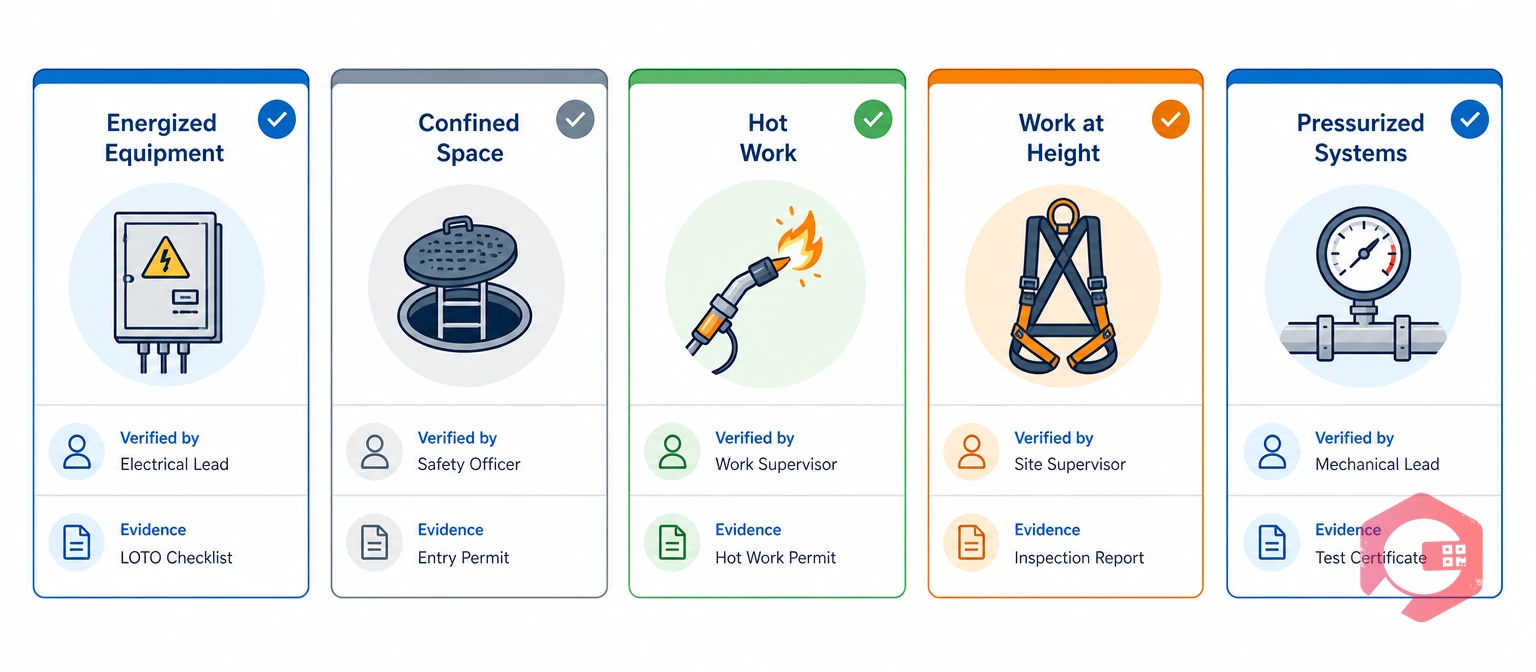
This matrix shows which controls apply to each hazard, who verifies them, and what evidence the work order should hold.
| Hazard | Mandatory controls | Verified by | Evidence on work order |
|---|---|---|---|
| Energized equipment | Lockout/tagout, zero-energy test, qualified electrician | Authorized person | Lock IDs, test result |
| Confined space | Atmosphere test, attendant, rescue plan | Entry supervisor | Gas readings, entry log |
| Hot work | Cleared area, fire watch, gas check | Permit issuer | Checklist, fire watch sign-off |
| Work at height | Anchor points, harness check, rescue plan | Site supervisor | Inspection photos, sign-off |
| Pressurized systems | Depressurize, drain, blind or double isolate | Area authority | Isolation points, pressure reading |
Adapt the limits and roles to your site rules and local regulations.
This scenario is illustrative, not a named customer case. A three-shift manufacturing plant issued hot work and isolation permits on paper, separate from its maintenance system.
With Cryotos work order management, each high-risk job can carry its risk assessment, permit, and checklist as required steps.
Supervisors can no longer sign after the fact, because every approval carries its own timestamp. Safety managers pull permit and sign-off records from reports instead of searching clipboards before an audit.
Maintenance teams using Cryotos have reported up to 30% reduction in unplanned downtime and 25% faster repair turnaround, gains that come from the same disciplined work order flow.
At minimum, a high-risk work order needs a task risk assessment, a signed permit, verified isolation, competent people, environment and rescue checks, supervised execution, and a verified close-out. Local law may add requirements, so check OSHA, the HSE, or your regional regulator.
A trained authorized person who is independent of the crew doing the work should approve it. Many sites add a second signature from the area owner for hazardous locations.
No. A work order tells the team which job to do, while a permit to work authorizes it to start under specific controls. Linking the two keeps one record for the whole job.
Review them at every shift change and whenever scope, conditions, or crew change. Many permits expire after one shift, which forces that review.
No. Match the controls to the hazard. Low-risk jobs follow standard safe-work steps, and applying a full permit to every job creates permit fatigue, which teaches people to ignore the process.
Mandatory controls protect people only when the system enforces them. Schedule a free demo to see how Cryotos keeps every control inside the work order.


Cryotos AI predicts failures, automates work orders, and simplifies maintenance—before problems slow you down.