
Traditional CMMS stores asset records, schedules work orders, and logs maintenance history. An AI-powered CMMS does all of that — and then actively analyses patterns in that data to make recommendations, predict failures, and automate routine decisions.
The distinction matters because data sitting in a database is only useful if someone reads it and acts on it. Most maintenance teams don’t have the bandwidth to analyse thousands of work orders for trends, cross-reference asset history against manufacturer tolerances, and proactively reschedule PMs — all while managing today’s breakdown queue. AI does that analysis continuously, in the background, and surfaces what actually needs attention.
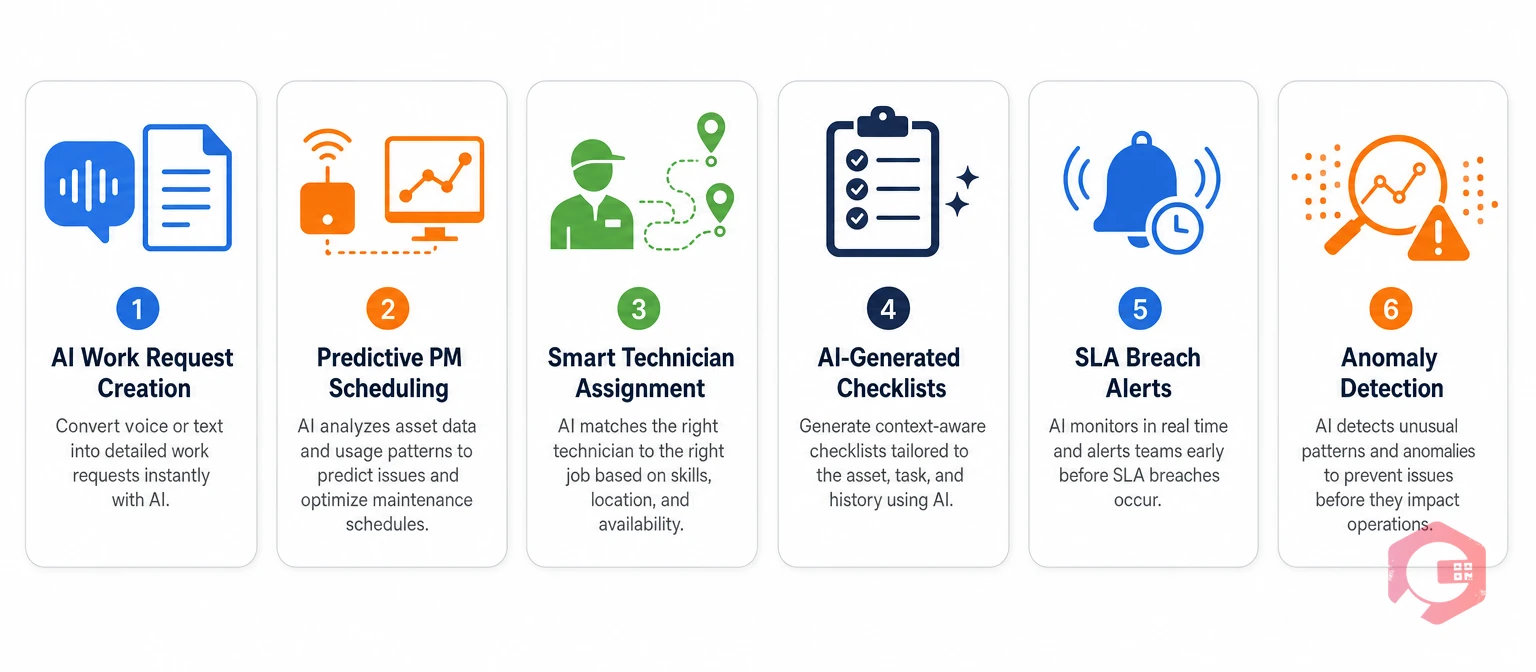
In practical terms, an AI-powered CMMS like Cryotos can: accept a voice or text description of a problem and auto-generate a structured work order; predict which assets are approaching failure based on runtime, sensor readings, and maintenance history; route work orders to the right technician based on skills, certifications, and current workload; and generate asset-specific checklists automatically rather than relying on a one-size-fits-all template.
In a conventional CMMS, a technician spots a problem, fills in a work request form, and submits it to a supervisor who then categorises, prioritises, and assigns it. Each handoff introduces delays. Cryotos AI eliminates this bottleneck by letting technicians describe a problem in plain language on the mobile app. The AI interprets the description, assigns the correct asset, applies the right priority level, and creates a complete work order — in seconds. A plant that adopted this feature reported cutting work order creation time from an average of 8 minutes per ticket to under 90 seconds.
Similarly, AI-driven scheduling in Cryotos shifts PM from calendar-based to condition-based — triggering PMs only when sensor data, runtime hours, or usage patterns indicate a genuine need. The result is fewer unnecessary work orders and fewer surprise breakdowns.
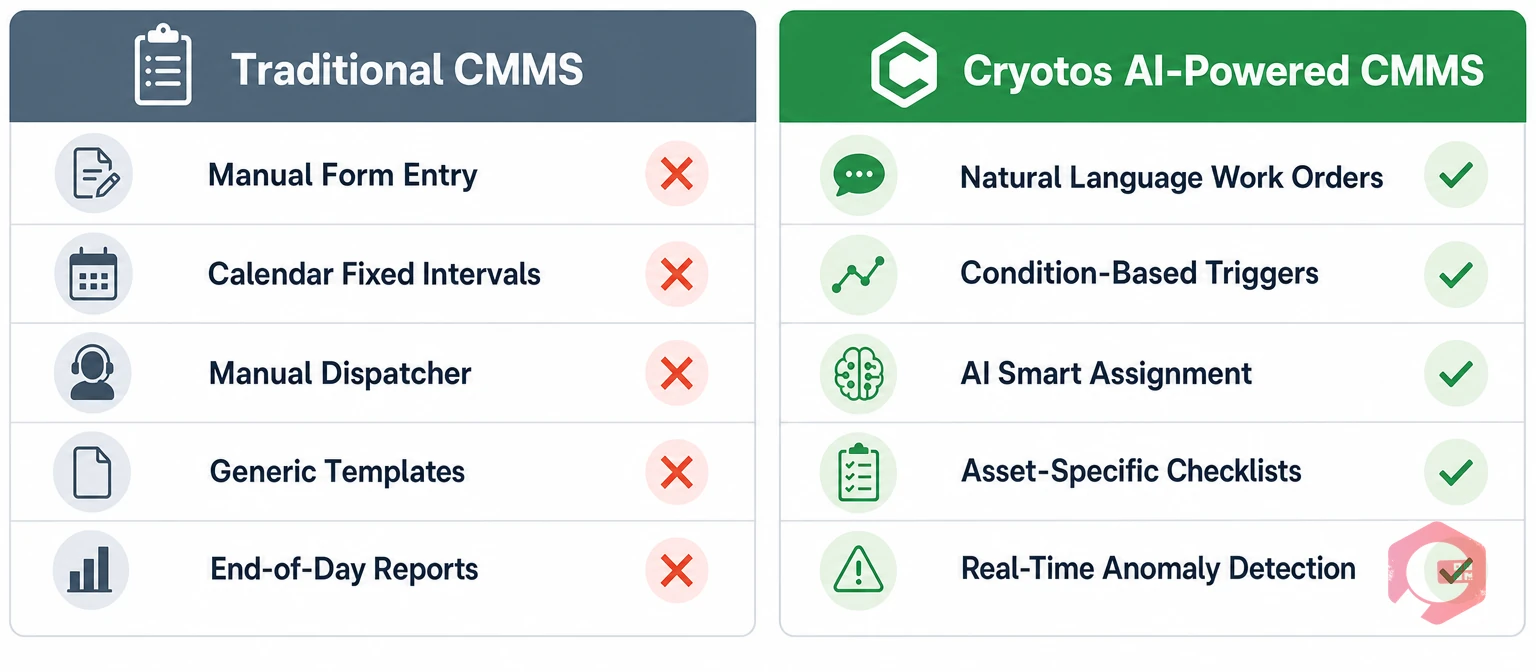
Where traditional CMMS relies on manual form entry, calendar-based fixed intervals, manual dispatcher assignment, generic templates, and end-of-day reports — Cryotos AI delivers natural language work orders, condition-based triggers, AI smart assignment, asset-specific checklists, and real-time anomaly detection with continuous learning from your facility’s own data.

Not all CMMS platforms labelled "AI-powered" apply AI in the same way. Before committing to a platform, verify five things:
AI in a CMMS handles data-heavy tasks that are too slow or error-prone to do manually at scale: interpreting plain-language work requests, predicting asset failures from sensor trends, routing work orders to the right technician, and surfacing anomalies in maintenance data before they become problems. In Cryotos, these functions are built into the core platform — not sold as add-on modules.
Yes — arguably more so than for large teams, because small teams have less administrative capacity to absorb manual scheduling and reporting work. A five-person maintenance team using Cryotos AI can operate with the planning depth of a team twice its size.
Most CMMS platforms use AI for one or two features — typically predictive alerts or basic dashboards. Cryotos applies AI across the full maintenance workflow: work request intake, PM scheduling, technician assignment, checklist generation, SLA monitoring, and reporting.
No. While IoT integration unlocks predictive scheduling and condition-based triggers, the AI features — work order creation, smart assignment, checklist generation, and SLA alerts — all work without sensor connectivity. Teams can start with core AI features on day one and add IoT sensors as their programme matures.
If your maintenance team is still spending hours each week on manual work order entry, fixed-interval PMs, and after-the-fact reporting, the gap between where you are and where AI can take you is measurable — and closeable. Book a free demo today and see the platform in action with your own data.

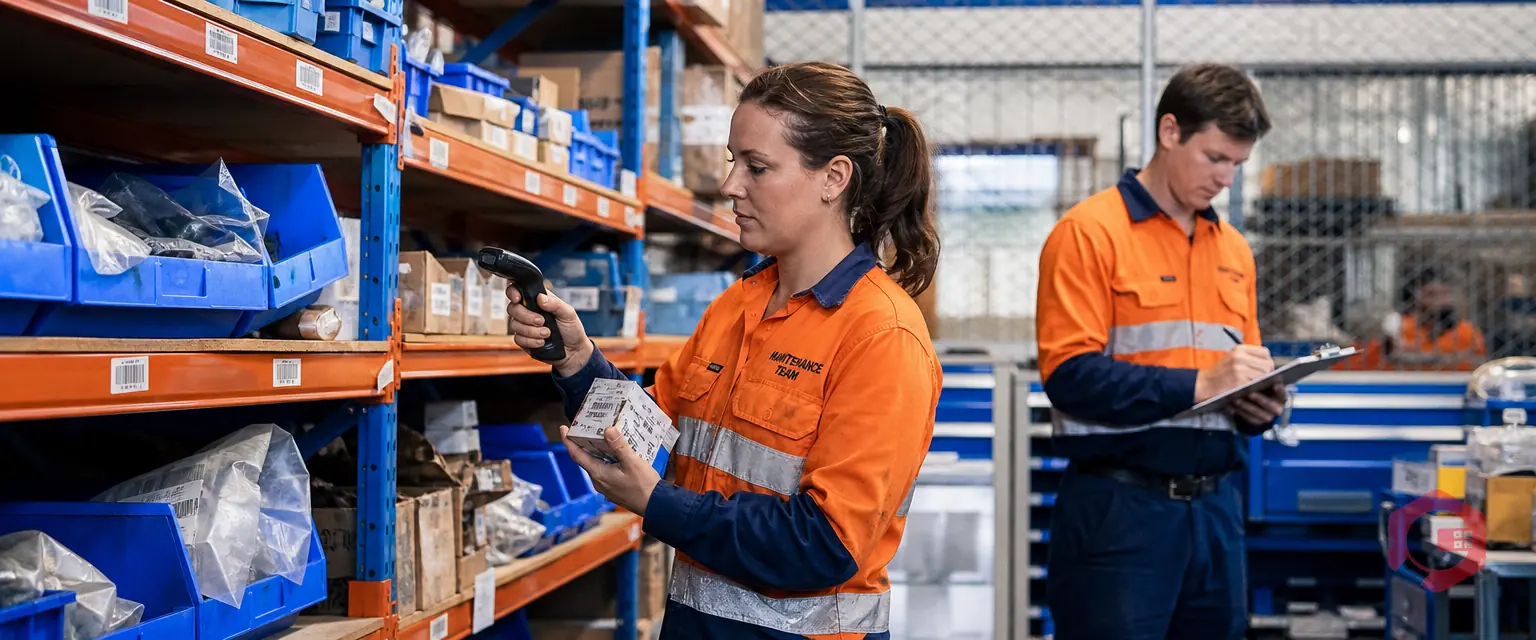


Cryotos AI predicts failures, automates work orders, and simplifies maintenance—before problems slow you down.



