

A CMMS request for proposal (RFP) is a formal document that asks vendors to show how their software meets your maintenance needs. Buyers use it to compare every Computerized Maintenance Management System on the same criteria, cost, and rollout plan.
Most maintenance teams write one when they replace spreadsheets, add sites, or need a clear audit trail. Below, you will learn what a CMMS RFP contains, how the process runs, and how to score responses.
Key Takeaways

An RFP tells vendors what you need, how you will judge them, and when you will decide. Each vendor replies with its software, price, rollout plan, and support terms.
This document type comes from standard purchasing practice, as this overview of a request for proposal explains. Buyers use it for maintenance software because maintenance data drives cost, risk, and asset decisions. New to the category? Read about what a CMMS does.
Teams that follow ISO 55000 asset management rules often write an RFP to show the purchase supports their lifecycle and risk goals.
A request for information (RFI) is an early, informal questionnaire used to build a vendor shortlist. An RFQ asks for a price on a scope you already set. An RFP weighs the solution, approach, and price together.
| Document | Purpose | Use it when |
|---|---|---|
| RFI | Learn which vendors and solutions exist. | You are still exploring the market. |
| RFP | Compare solutions, approach, and price. | Your needs are clear and three to six vendors are in play. |
| RFQ | Get a firm quote on a known scope. | You chose a solution and need price and terms. |
Many buyers run all three in order: an RFI to shortlist, an RFP to evaluate, and an RFQ to negotiate with finalists. You rarely need all three, but you should know which one you are issuing and why.
A company needs a formal RFP when the purchase is complex, costly, or subject to audit. Smaller buyers with simple needs can often skip it.
Skip the formal route when you run one site, need a fast start, or already trust a vendor. Plan for two to twelve months from first meeting to signature, depending on size and approvals.
Before you write requirements, it helps to see how digital work order management works in practice, so your questions reflect real workflows.
A strong CMMS request for proposal covers background, goals, requirements, budget, timeline, evaluation rules, and submission steps. Maintenance teams get sharper answers when they organize requirements in three layers.
The Three-Layer CMMS RFP Requirements Framework:
Then add the standard sections vendors expect:
Vendors need user counts, roles, locations, asset volume, and your hosting preference. Missing user estimates often lead to wrong quotes and unfair comparisons.
Clear outcomes and constraints, with room for vendors to propose the method, produce the most comparable responses.
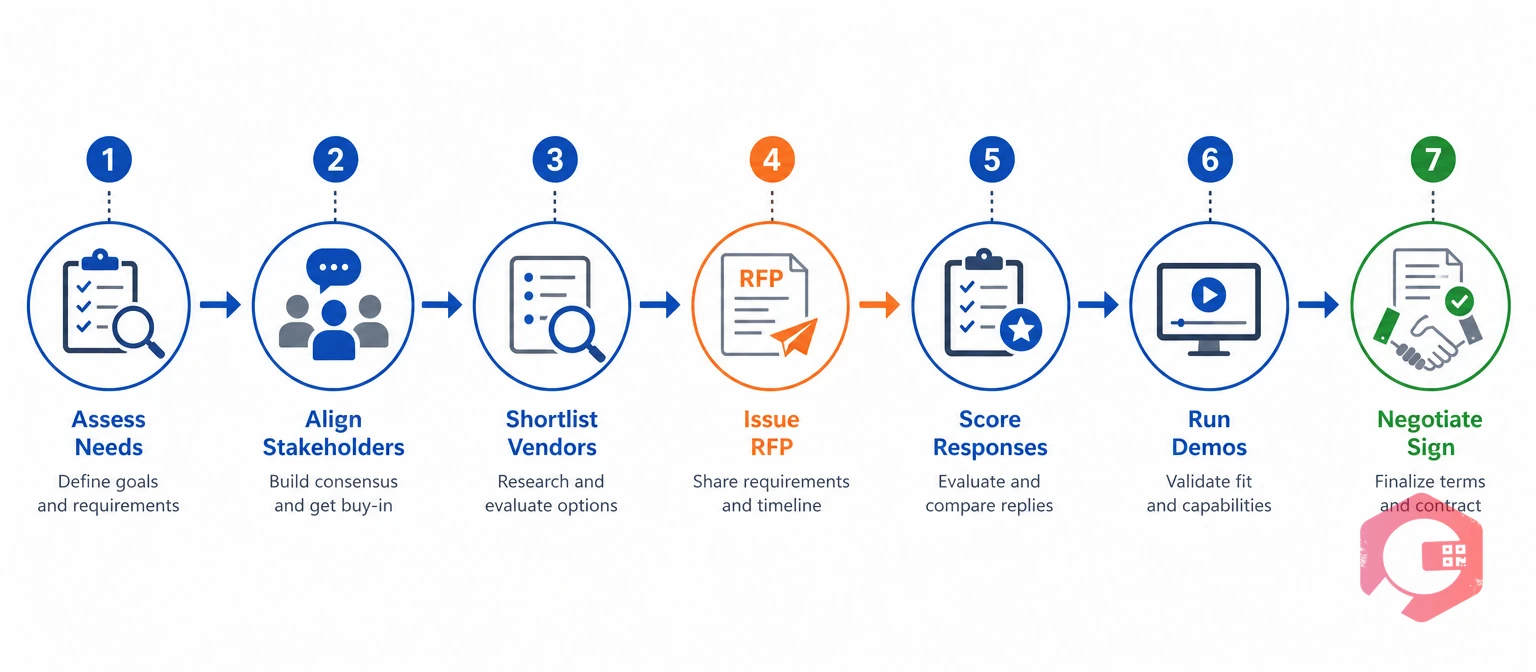
The CMMS request for proposal process runs from a needs review to a signed contract, and it works when you treat it as a project, not a document.
Allow vendors three to four weeks to reply so they can write a thorough answer.
Strong RFP questions are specific enough to compare and open enough to show how each vendor thinks. Group them by topic. Reviewers can then score each area quickly.
Pair each question with a yes/no or rating field, then add a short free-text box for nuance.

A weighted scorecard is a table that gives each evaluation criterion a percentage of the total score. Agree on the weights before vendors respond, and share them in the RFP.
| Criterion | Illustrative weight | What to score | Proof to request |
|---|---|---|---|
| Functional fit | 30% | Coverage of must-have workflows without custom code. | Scripted demo and written answers. |
| Ease of use and adoption | 15% | Technician workflow on a phone, including offline use. | Live device demo or user trial. |
| Integration and security | 15% | ERP links, APIs, access control, and hosting. | Integration guide and security documents. |
| Implementation and training | 10% | Plan, timeline, and named resources. | Sample project plan and references. |
| Support and vendor stability | 10% | Service levels, roadmap, and customer base. | References from similar sites. |
| Total cost of ownership | 20% | Three- to five-year cost, including services. | Itemized pricing sheet. |
These weights are an example, so adjust them to your situation. Technician adoption deserves real weight, because a mobile CMMS app that crews skip delivers no usable data.
Watch for red flags while scoring: vendors that ignore must-haves, quote prices far below the field, give vague technical answers, or cannot offer references from similar sites.
The most common CMMS request for proposal mistakes are over-specifying features, skipping stakeholders, and having no scoring rubric.
Fixing these six issues before you issue the RFP improves both response quality and decision speed.
Cryotos is a mobile-first maintenance platform built for fast adoption and real-time visibility. It gives RFP teams clear answers to the questions evaluators ask most.
Bring your ranked requirement list and two or three real scenarios, such as a failed pump or a missed inspection. A scripted demo built on those scenarios shows how the workflow feels for technicians and managers.
Maintenance teams using Cryotos have reported up to 30% reduction in unplanned downtime and 25% faster repair turnaround. Evaluators can map each requirement to a live demo of asset maintenance management in Cryotos.
RFP stands for request for proposal. In CMMS buying, it is the document that asks vendors to propose software, pricing, and implementation for your maintenance needs.
Long enough to state goals, requirements, and rules clearly, and short enough that vendors will respond. Private-sector RFPs often run 15 to 20 pages, and public-sector ones run longer because of legal terms.
Three to six is typical. Fewer than three limits your choice, and more than six makes scoring slow and uneven.
Yes. A budget range helps vendors propose the right scope and saves time for both sides.
Allow three to four weeks for a thorough response, and close the question window one to two weeks before the deadline.
A clear CMMS request for proposal turns a long vendor search into a fair, documented decision. Schedule a free demo to see how Cryotos answers your requirements in a live walkthrough.



Cryotos AI predicts failures, automates work orders, and simplifies maintenance—before problems slow you down.



