

AI tools using existing permissions change how fast authorized data becomes visible, not what is technically allowed to be seen. When an AI assistant queries email, a CRM, a document library, or a ticketing system, it rarely receives a brand-new universal entitlement. Instead, it acts through delegated user access, an application identity, or a dedicated agent account, and the connected system still makes the authorization call.
For IT, that single detail reshapes the risk conversation. Permissions that once took a person several manual steps to exercise can now be exercised in seconds through natural-language search, summarization, and correlation across systems. The access model hasn't changed. Its speed and reach have, and IT now has to confirm that "already permitted" still means "currently appropriate."
Key Takeaways
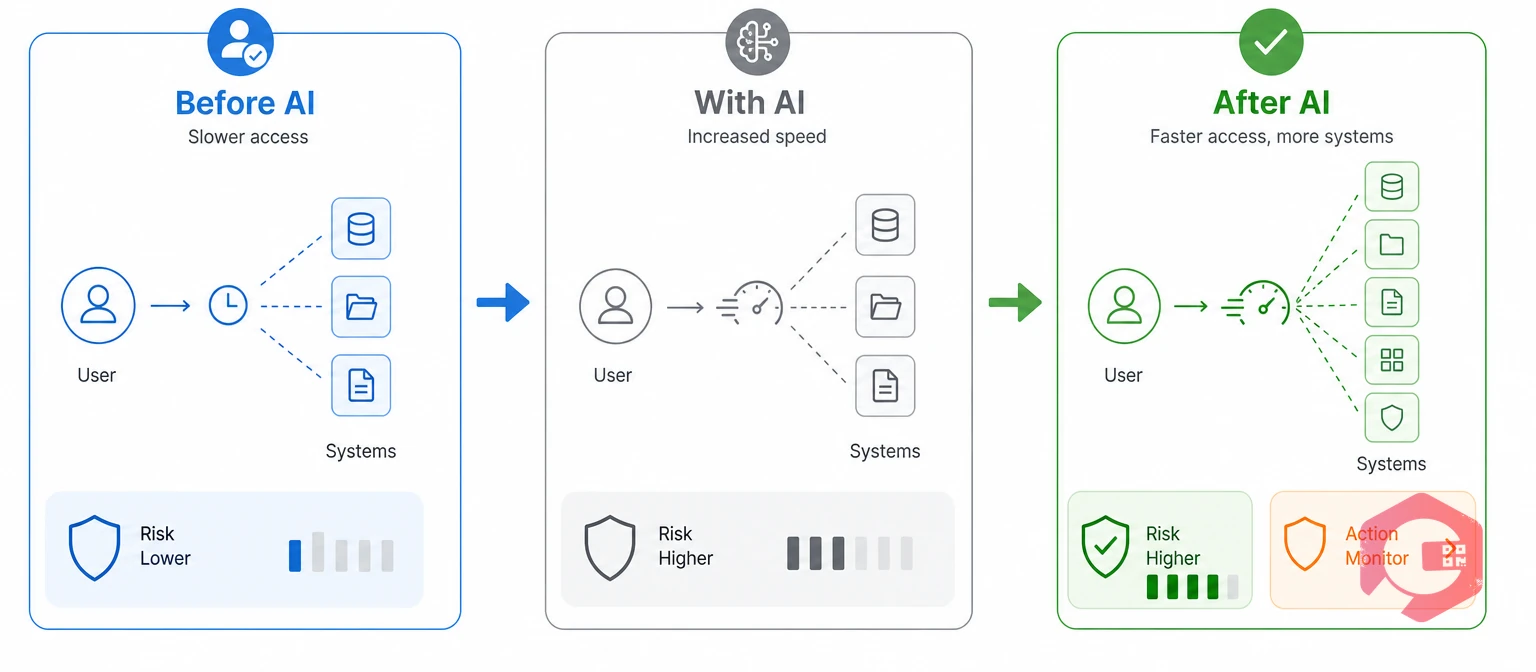
Traditional access models assume people open files, click through applications, run reports, and request records one system at a time. AI compresses those steps into a single natural-language question, and the tool may search many locations, combine the results, and present sensitive context immediately.
If historical permissions are overly broad, group memberships are stale, or shared repositories are open by default, AI surfaces the practical effect of that access far faster than any conventional interface did. The security question is no longer only whether access is technically authorized. It's whether that authorization still reflects current business need at AI speed and scale.
Most facilities and back-office teams built their sharing habits around slow, manual retrieval. An AI assistant removes that natural friction, which is exactly why access reviews that used to be an annual formality now need to happen on a tighter, ongoing cycle.
Existing permissions means authorization is still enforced by the connected system or identity platform, not by the AI model itself. The AI may act on behalf of the signed-in user, use a service principal or application identity, or operate under its own governed agent identity.
The effective access boundary depends on four things: the identity presented at query time, the scopes or roles granted to that identity, the target system's own authorization logic, and any conditional or data-level policies layered on top. Change any one of those four, and the AI's effective reach changes with it.

A typical enterprise AI request moves through six steps, and each one is a control point IT can inspect:
Skip the authorize-and-log steps and every other control becomes cosmetic, because the model will happily reason over whatever it was handed.
IAM teams pick up several new responsibilities once AI sits between users and enterprise data:
AI raises the value of cleaning up data access before deployment, not after. Overshared folders, inherited site permissions, broad distribution groups, stale project access, tenant-wide links, and poorly classified documents may already be technically authorized. AI simply makes them far easier to discover and combine into one answer.
Data owners need stronger classification, clear ownership, retention rules, sensitivity labeling, and periodic access recertification. The goal isn't to hide data from AI specifically. It's to make sure the underlying access model actually reflects who needs what today.
Least privilege is the principle that any identity — human, application, or AI agent — should hold only the access required for its current task, no more. It's the single control most likely to limit the blast radius of an over-broad AI query.
Maintenance organizations already manage this trade-off around who can see and act on asset and work order data. Platforms built on role-based access control, such as Cryotos, a Computerized Maintenance Management System (CMMS), whose user role and access-level management feature scopes exactly what each identity can view or change before an AI layer ever touches it — which is the same discipline general IT teams now need for every connected system.
If your team is scoping how an AI knowledge layer should query maintenance and asset records, Cryotos's AI-powered knowledge base is built to retrieve only what a user's existing role already permits.

Four elements keep an AI layer honest about what it's allowed to touch:
The AI Access Governance Framework:
Together, these four elements keep an AI layer inside the same boundaries that already govern people and applications, instead of quietly creating a faster, less-supervised path around them.
These map to established frameworks such as the NIST Cybersecurity Framework, which asks organizations to identify, protect, detect, respond to, and recover from risk across every connected identity:
AI can surface information a user could technically reach but rarely knew existed. Reduce broad access, recertify groups, classify sensitive content, and review inherited permissions before scaling AI retrieval.
A service identity can carry broader access than any individual user it serves. Prefer delegated or narrowly scoped agent identities, and separate read privileges from write privileges wherever the connector allows it.
Untrusted content retrieved by the AI can attempt to influence its behavior, a risk listed in the OWASP Top 10 for LLM applications. Treat retrieved content as data, enforce tool-level policy outside the model, and require independent authorization for sensitive actions.
New connectors, role changes, and agent updates can expand effective access over time, while a generic shared service account obscures who actually initiated an action. Inventory, change control, expiry, and identity correlation in logs address both problems together.
Maintenance organizations using Cryotos to phase in AI-assisted work order and asset queries have followed the same sequence: tighten role-level access first, then layer retrieval on top of it. Maintenance teams using Cryotos have reported up to 30% reduction in unplanned downtime and 25% faster repair turnaround, because the AI layer was already working from clean, correctly scoped data.
No, not when it's implemented correctly. A properly governed AI tool is bound to the requesting identity's existing scopes, whether that's the signed-in user, an application identity, or a dedicated agent account, and the connected system still enforces its own authorization rules.
Because authorization that was safe at manual speed can expose more than intended at AI speed. Stale groups, overshared folders, and broad distribution lists become discoverable in seconds instead of staying buried, so access has to be reviewed against current business need, not just technical approval.
Per-request authorization combined with end-to-end audit logging. Checking policy at the moment of each query, and recording exactly who asked, what was retrieved, and what changed, limits both the blast radius of an over-broad query and the time it takes to investigate one.
Yes, whenever the platform supports it. A named, owned agent identity with lifecycle controls and expiration makes it possible to scope, monitor, and revoke AI access independently of the human user, which is far cleaner than folding AI activity into a person's existing account.
When AI tools query enterprise systems through existing permissions, IT doesn't lose the value of its identity and access program. Those controls become more important, because AI makes authorized access faster, broader in presentation, and easier to combine across sources. The central task is straightforward: confirm that "already permitted" still means "currently appropriate," and pair AI adoption with least privilege, per-request authorization, clean data permissions, and strong logging. Schedule a free demo to see how role-based access and AI retrieval work together inside Cryotos.



Cryotos AI predicts failures, automates work orders, and simplifies maintenance—before problems slow you down.



