

Inventory accuracy is the percentage of stock records that match what's physically present in your warehouse — calculated as (Counted Items ÷ Expected Items) × 100. Industry benchmarks put a healthy rate at 95–99%, yet most warehouses run between 70–80% without realising it. That gap silently drives stockouts, emergency orders, production delays, and — most critically — broken promises to customers.
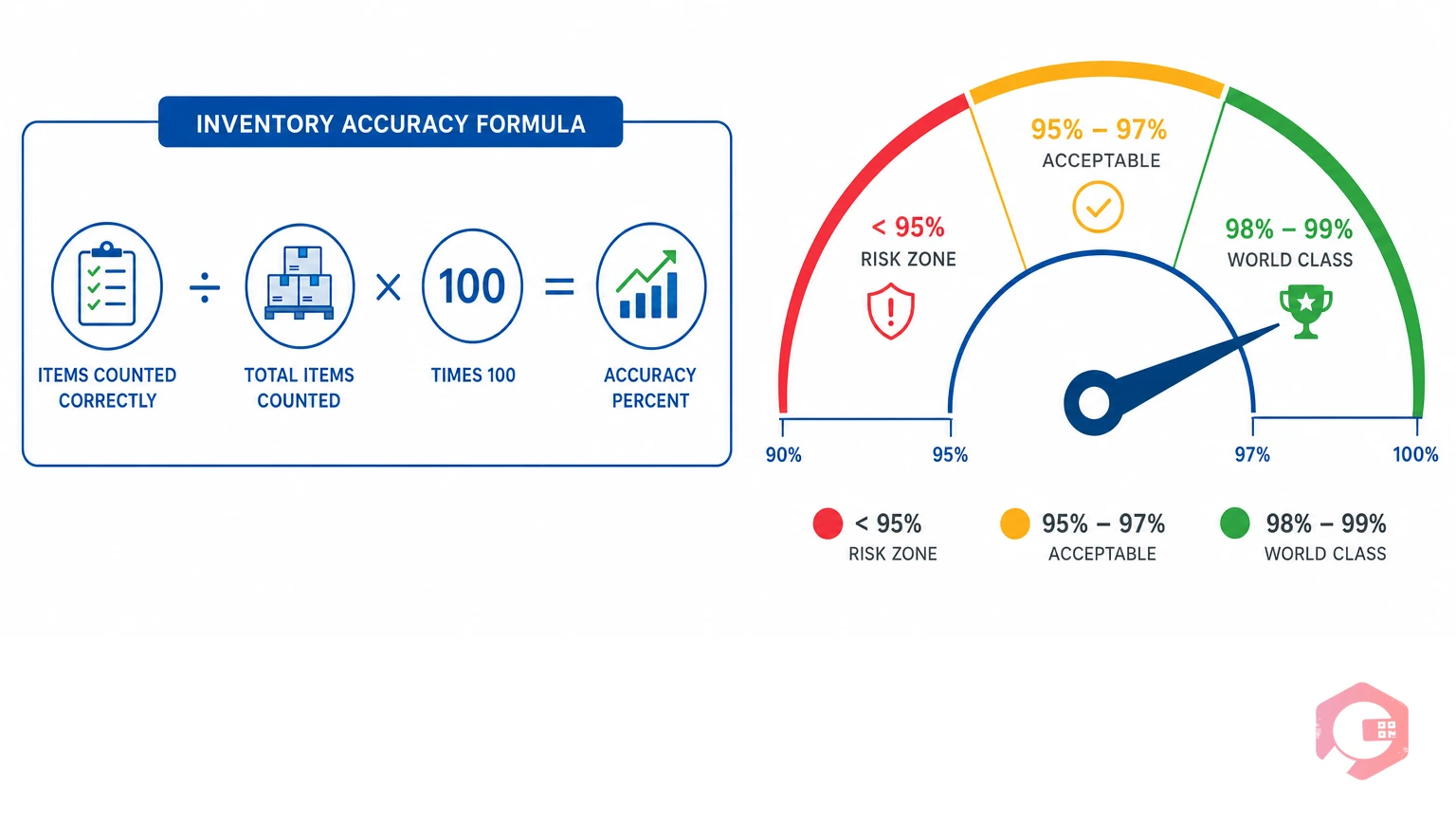
Inventory accuracy measures how closely your recorded stock levels match your actual physical stock at any given moment. It's expressed as a percentage and calculated using this formula:
Inventory Accuracy Rate (%) = (Items Counted Correctly ÷ Total Items Counted) × 100
For example, if you count 950 units of a part but your system shows 1,000, your accuracy rate is 95%.
World-class warehouses target 98–99% accuracy. Anything below 95% is a red flag. According to a McKinsey supply chain report, inventory distortion costs the global retail industry alone over $1.77 trillion annually.
Most teams treat inventory inaccuracy as an internal operations issue. It isn't — it's a customer experience problem that shows up at the worst possible moments. Research from Gartner shows that supply chain failures are now among the top three drivers of customer churn in B2B relationships. A facility that improves accuracy from 80% to 98% can typically cut MRO purchasing costs by 15–25% in the first year.

Before you can fix the problem, you need to know where it starts. These are the most common culprits: manual data entry errors, poor receiving processes, unsystematic storage, infrequent auditing, no barcode or QR scanning, unauthorised stock access, return and scrap mishandling, and disconnected systems.
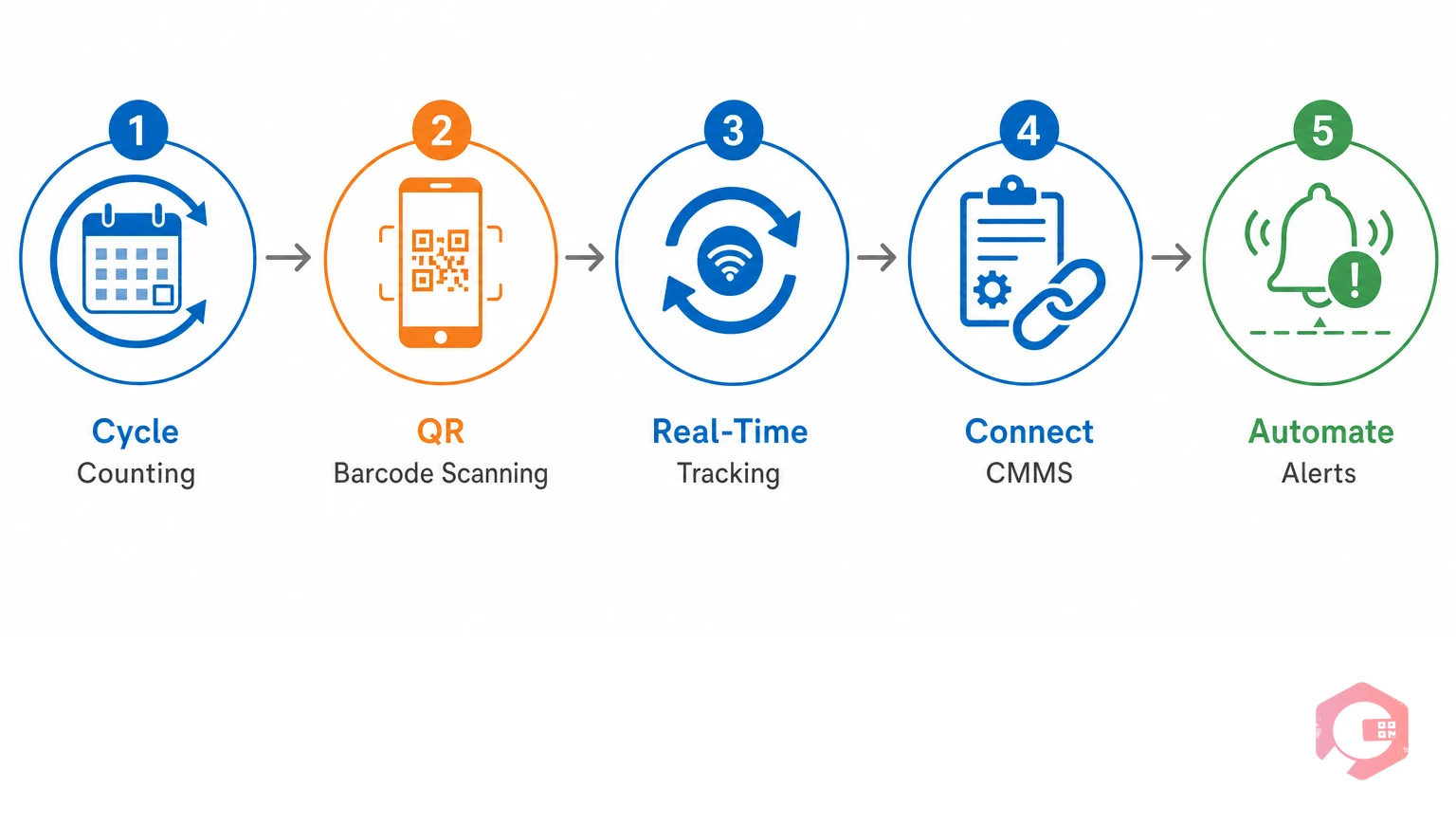
These methods work in combination — the more you stack, the faster your accuracy rate climbs.
Replace your once-a-year physical count with rolling cycle counts — auditing a small subset of SKUs every day or week. This catches errors while they're still small and distributes the workload evenly across your team.
Every shipment should follow the same steps: verify quantity against the purchase order, scan or log each item before it moves, and flag discrepancies before the delivery is accepted.
Replacing manual entry with scan-based transactions eliminates the most common error source entirely. According to Plant Engineering, facilities using barcode scanning report 40–60% fewer inventory discrepancies compared to manual systems.
Move away from batch updates to real-time logging. Every pick, put-away, transfer, and return should update your system the moment it happens.
In maintenance environments, work orders consume spare parts. If your CMMS software and inventory system are separate, every completed work order creates a reconciliation gap. Connecting the two means parts are automatically deducted from inventory when a work order is closed — no manual entry required.
Par levels define the minimum stock threshold for each item before a reorder is triggered. When combined with automated alerts, you eliminate both stockouts and overstocking.
Technology only works if people use it consistently. Document clear standard operating procedures for receiving, storage, picking, and returns — then train every team member who touches inventory.
Physical bin audits check that what's on the shelf matches the label and the system. Schedule monthly spot audits on your highest-turnover storage locations.
Every field a human types is a potential error. Replace as many manual touchpoints as possible with system-generated or scan-triggered entries.
Track accuracy rate, stockout frequency, reorder cycle time, and carrying cost as standing KPIs. A live inventory management dashboard gives your team an early-warning system.
When a technician closes a work order in Cryotos, the parts used are deducted from inventory in real time. When stock drops below a par level, the system fires a reorder alert. QR code scanning on bins and shelves means every pick and put-away is logged instantly from a mobile device, even in offline mode. You can also connect Cryotos to your ERP (SAP, Microsoft Dynamics 365) so inventory data stays consistent across every system in your operation.
A rate of 95% is generally considered the minimum acceptable threshold, while world-class operations target 98–99%.
Use this formula: Inventory Accuracy (%) = (Items Counted Correctly ÷ Total Items Counted) × 100.
The most common causes are manual data entry errors, poor receiving processes, unauthorised stock withdrawals, infrequent auditing, and disconnected systems.
A CMMS connects maintenance work orders directly to inventory records, so parts are automatically deducted when a work order closes — eliminating the manual withdrawal logging gap.
If your team is ready to move from manual reconciliation to real-time inventory accuracy, Cryotos CMMS gives you scan-based tracking, automated alerts, and a live dashboard — all connected to your maintenance workflows. Book a free demo today.




Cryotos AI predicts failures, automates work orders, and simplifies maintenance—before problems slow you down.



