
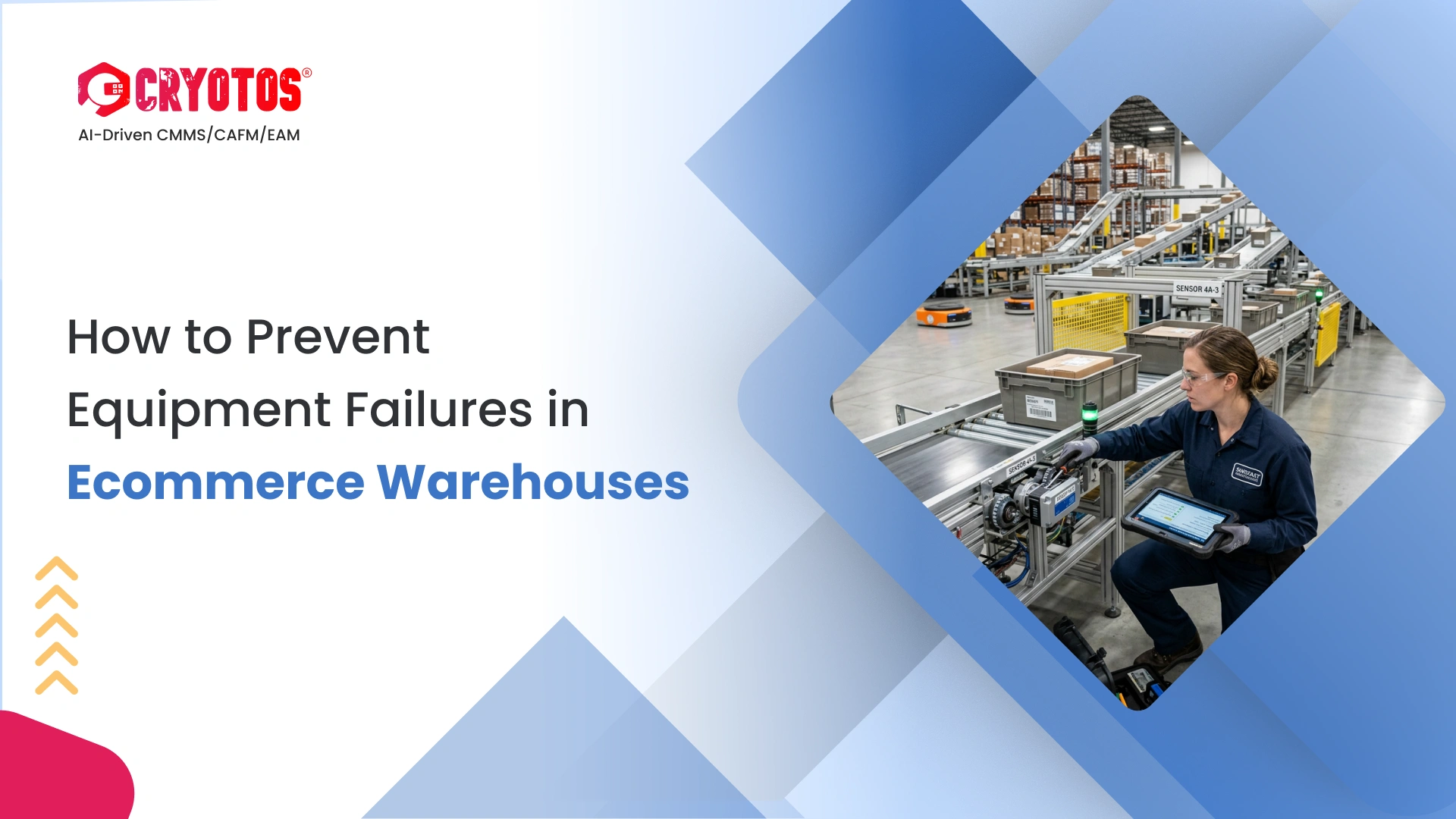
Equipment failure in an ecommerce warehouse means more than a broken machine — it means missed shipments, furious customers, and revenue walking out the door. Preventing equipment failures in ecommerce warehouses requires a proactive maintenance strategy that combines scheduled inspections, operator training, spare parts management, and real-time monitoring. Unplanned equipment downtime costs industrial operations an average of $260,000 per hour — and for ecommerce, that figure peaks during high-volume seasons. The good news: most warehouse equipment failures are predictable and preventable.
The four most common causes of ecommerce warehouse equipment failure are:
A factory producing widgets can absorb a two-hour conveyor outage. An ecommerce fulfillment center processing 20,000 orders a day cannot. The pressure is constant, the windows for maintenance are narrow, and customer expectations have zero tolerance for delays.
Holiday rush periods are exactly when your equipment is most likely to fail — because it's running hardest. Conveyor systems operating 22+ hours a day, packaging machines running back-to-back shifts, and forklifts covering three times their normal mileage all accumulate wear at an accelerated rate. A single conveyor failure during this window can halt processing of 15,000+ orders per hour, triggering cascading delays across your entire fulfilment network.
Emergency repair costs average 3–5 times the cost of planned maintenance, according to industry estimates. Add overtime labour, expedited parts shipping, carrier penalty fees for late shipments, and customer refunds — and a single unplanned breakdown during peak season can cost tens of thousands of dollars before the shift ends.
Not all equipment carries equal risk. These five asset types cause the most operational disruption when they fail in a fulfilment environment.
Conveyors are the backbone of high-volume fulfilment — and the highest-impact failure point. Belt wear, misalignment, and motor burnout are the primary failure modes, all of which are detectable weeks in advance with basic vibration and temperature monitoring.
Forklift failures disrupt inbound receiving and outbound staging simultaneously. Battery degradation in electric forklifts, hydraulic leaks, and tyre wear are common culprits. The Health and Safety Executive recommends daily pre-shift inspections as the minimum standard for powered industrial trucks.
Sealers, labellers, and void-fill machines fail when calibration drifts or consumables run dry without warning. Even minor misalignment in a labeller can cause thousands of mis-labelled parcels — a costly problem to correct after the fact.
For warehouses storing temperature-sensitive products — pharmaceuticals, perishables, electronics — HVAC failure can render entire inventory batches unsellable within hours. Filter blockages and refrigerant leaks are the most common preventable failures.
Dock levellers, doors, and seals degrade steadily under daily loading and unloading cycles. A stuck dock door during a peak dispatch window can hold up an entire outbound trailer schedule.
Most warehouse equipment failures are preventable. These six strategies cover everything from scheduling to technology — and together, they form a complete prevention framework.
Reactive maintenance — fixing things after they break — is the most expensive strategy available. Preventive maintenance (PM) schedules servicing based on time intervals or usage thresholds, catching problems before they cause downtime. A warehouse that switches from reactive to preventive maintenance typically sees a 20–25% reduction in maintenance costs within the first year, according to Plant Engineering research.
A simple maintenance frequency table keeps every asset on schedule without relying on memory or guesswork:
Operators spend more time with equipment than anyone. A conveyor making an unusual noise at 6 a.m. on a Tuesday is an early warning sign — but only if your operator knows what to do with that information. Build short, 15-minute monthly briefings around the warning signs specific to each equipment type. Encourage reporting without fear of blame and make it easy to log an issue from a mobile phone in under 60 seconds.
Waiting three days for a conveyor belt or a hydraulic seal during peak season is a choice — usually a bad one made months earlier when spare parts weren't stocked. Identify your five highest-risk single points of failure and keep one replacement unit on the shelf. Use your spare parts inventory management system to set up reorder alerts, so stock never drops to zero during busy periods.
IoT sensors fitted to conveyors, motors, and HVAC units continuously track vibration, temperature, and power consumption. When a reading drifts outside its normal range, the system alerts your maintenance team before the equipment fails. A McKinsey analysis found that predictive maintenance enabled by IoT can reduce equipment failures by up to 70% and cut maintenance costs by 25%. For ecommerce warehouses running automated sortation, this kind of early warning is no longer optional — it's standard practice.
Spreadsheets, whiteboards, and email chains cannot scale across a multi-asset warehouse operation. A Computerised Maintenance Management System (CMMS) gives you one place to schedule PMs, assign work orders, track spare parts, log breakdowns, and view your entire asset fleet's health status in real time.
A CMMS doesn't just organise your maintenance calendar — it closes the gaps that cause equipment to fail. Here's how a platform like Cryotos CMMS maps directly to the prevention strategies above:
Warehouses using Cryotos report a 30% reduction in downtime and 25% faster repair times — directly improving on-time fulfilment rates during the periods that matter most.
If your ecommerce warehouse is still running maintenance on gut feel and spreadsheets, peak season will find the gaps. Explore Cryotos preventive maintenance software at cryotos.com and see how a structured PM programme keeps your fulfilment operation running when it matters most.
What is the most common cause of equipment failure in ecommerce warehouses?
Deferred maintenance is the leading cause — equipment that misses its scheduled servicing accumulates wear until it fails unexpectedly. Operator error and inadequate spare parts stock are close behind. Most warehouse equipment failures are predictable and preventable with a structured preventive maintenance programme.
How often should ecommerce warehouse equipment be inspected?
High-usage equipment like forklifts and conveyors should receive daily pre-shift checks and weekly detailed inspections. HVAC and dock equipment typically require monthly and quarterly service. The exact frequency depends on manufacturer recommendations, operational intensity, and the equipment's criticality to fulfilment flow.
What is the difference between preventive and predictive maintenance?
Preventive maintenance follows a fixed schedule — service equipment at set time or usage intervals regardless of its current condition. Predictive maintenance uses real-time sensor data (vibration, temperature, power draw) to service equipment only when condition data indicates it's needed. Both approaches reduce failures; combining them gives the best results.
How does a CMMS help prevent equipment failures?
A CMMS automates PM scheduling so nothing gets missed, routes work orders to the right technician instantly, tracks spare parts inventory to prevent stockouts, and logs every breakdown with root cause data. Over time, this creates a maintenance history that helps you predict which assets are most likely to fail next — and act before they do.



Cryotos AI predicts failures, automates work orders, and simplifies maintenance—before problems slow you down.



