
Reducing safety risks in facility management means identifying, evaluating, and controlling the physical, environmental, and operational hazards that put workers, visitors, and assets at risk inside a managed facility. According to the U.S. Occupational Safety and Health Administration (OSHA), American employers report more than 2.3 million workplace injuries every year - and facility environments consistently rank among the highest-risk settings. The good news: most of these incidents are preventable with the right processes, training, and maintenance technology in place.
This guide walks you through the most common hazards facility managers face, a practical 5-step framework for reducing them, and how a modern CMMS can automate the safety workflows that prevent incidents before they happen.
Facility safety risk management is the structured process of identifying hazards within a built environment, assessing the likelihood and severity of harm, and implementing controls that reduce risk to an acceptable level. It covers everything from routine equipment inspections and emergency evacuation plans to contractor oversight and compliance with regulations like OSHA 29 CFR 1910 and ISO 45001.
For facility managers, risk management is not a one-time audit - it is an ongoing operational discipline. When done well, it reduces workers' compensation claims, avoids regulatory fines, protects asset life, and creates a workplace where people feel genuinely safe. When ignored, a single preventable incident can cost hundreds of thousands of dollars and cause lasting reputational damage.
Before you can reduce safety risks, you need to know exactly what you are dealing with. These are the six hazard categories that appear most consistently across commercial, industrial, and institutional facilities.
Slips, trips, and falls account for the largest share of facility injuries each year. The National Safety Council estimates these incidents cost U.S. employers more than $70 billion annually in medical bills, lost productivity, and legal costs. Wet floors, poor lighting, uneven surfaces, loose cables, and cluttered walkways are the main culprits - and most are completely preventable with regular inspection schedules.
Faulty wiring, overloaded circuits, poorly maintained HVAC units, and aging mechanical equipment create serious shock and fire risks. Facilities that skip routine electrical inspections or defer equipment servicing are playing a high-stakes game. A structured preventive maintenance programme eliminates most of these risks before they escalate.
Cleaning agents, refrigerants, lubricants, and industrial chemicals are present in almost every type of facility. Improper labelling, inadequate storage, and missing Safety Data Sheets (SDS) turn everyday materials into serious exposure risks. OSHA's Hazard Communication Standard (HazCom) requires facilities to maintain up-to-date SDS records and train workers on safe handling - a requirement many facilities still manage with paper binders.
Fire suppression systems, emergency exits, extinguishers, and alarm panels all need scheduled inspection and testing. A fire safety audit typically reveals that most facilities have at least one critical deficiency - a blocked exit, an expired extinguisher, or a suppression system that hasn't been tested in over a year. Monthly and annual inspection cadences are non-negotiable for life safety compliance.
Contractors are involved in some of the most hazardous facility activities - electrical work, roof repairs, confined space entry, and heavy equipment operation. Yet many facilities have no formal process for vetting contractor safety records, issuing work permits, or monitoring on-site activity. This gap is where serious accidents happen. A Permit-to-Work (PTW) system closes it by requiring documented approval, hazard assessment, and safety sign-off before any high-risk work begins.
Post-pandemic awareness has brought indoor air quality (IAQ) into sharper focus. Poor ventilation, mould, CO? build-up, and airborne particulates are genuine health hazards - especially in healthcare, education, and food-processing facilities. Ergonomic risks such as repetitive strain, poor workstation design, and heavy manual lifting round out the picture. Both categories are frequently overlooked in traditional facility safety programmes but carry significant long-term liability.
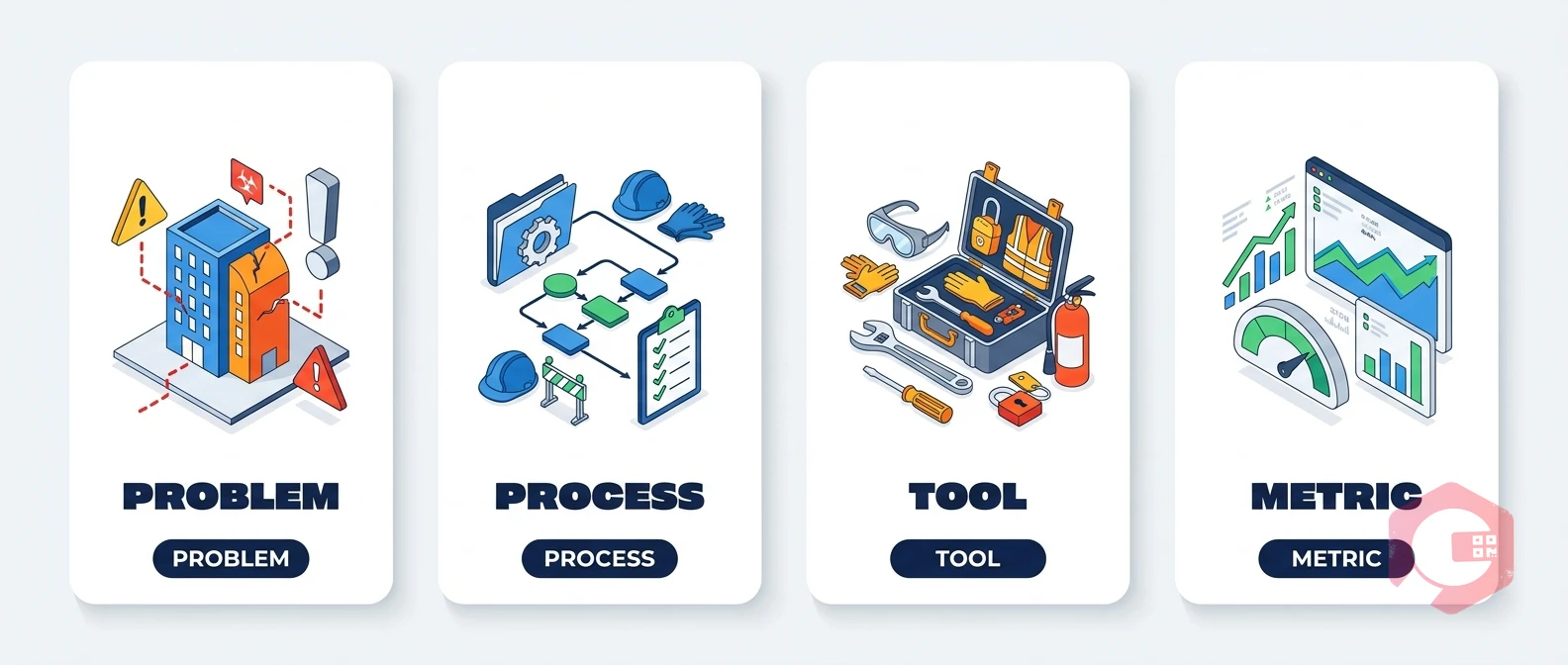
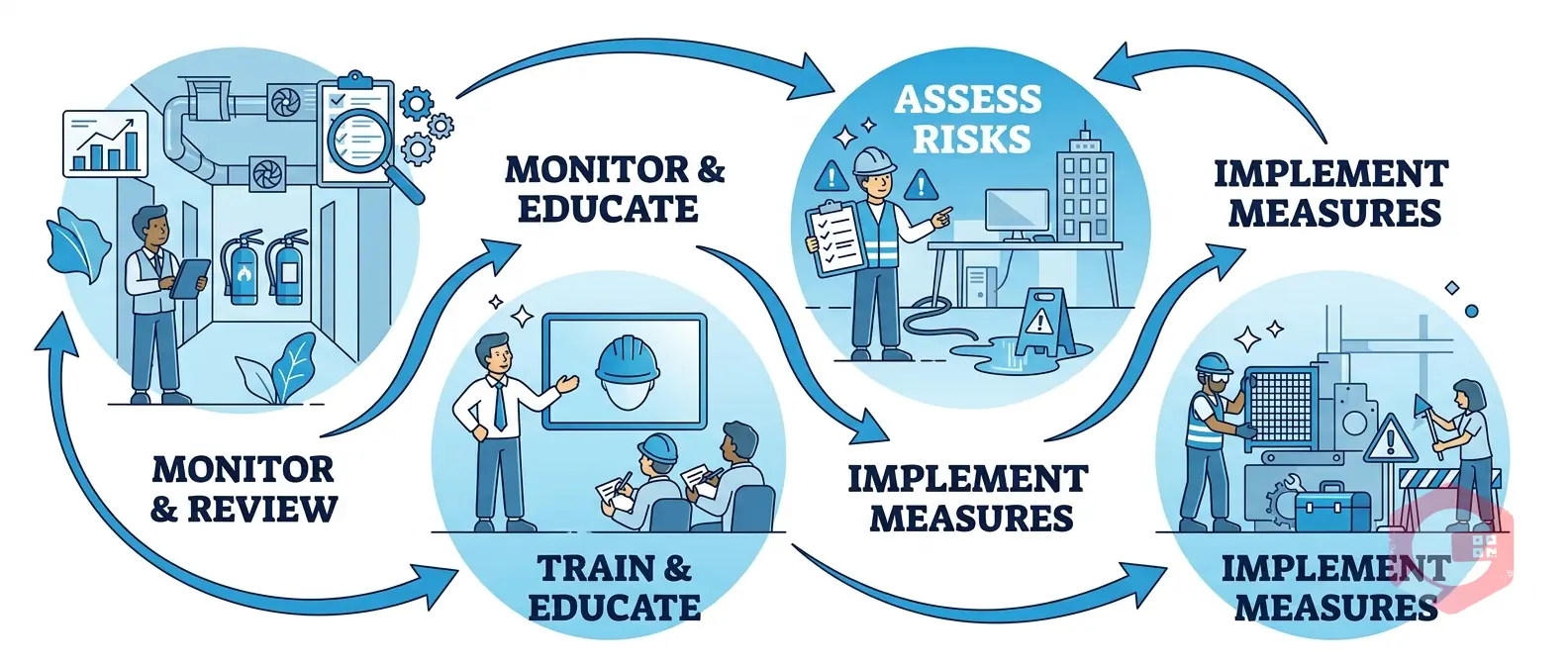
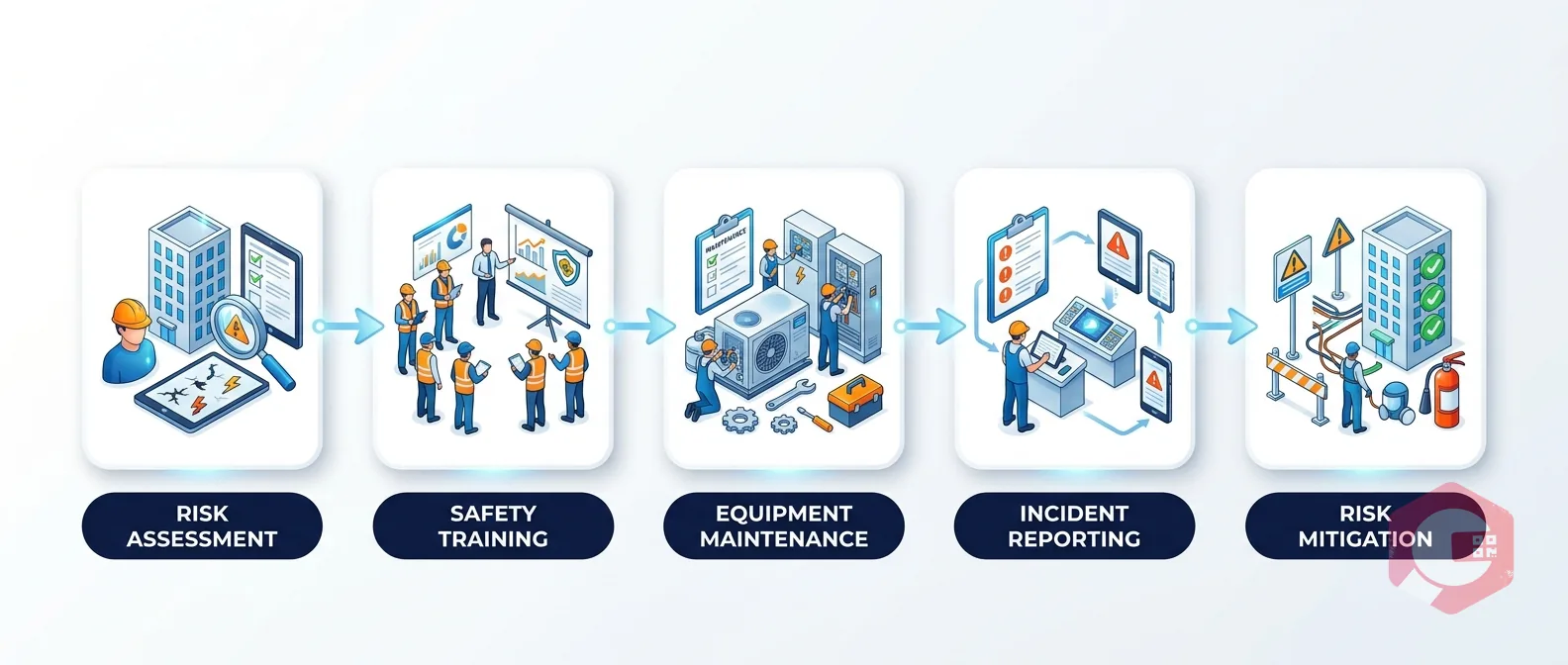
The following framework gives facility managers a repeatable process for driving down safety risk - not just responding to it. Each step builds on the previous one to create a closed-loop safety system.
Start with a formal walkthrough of every area in your facility, cataloguing each hazard, its likelihood of causing harm, and the severity of that harm. Use a risk matrix (likelihood severity) to prioritise which hazards require immediate action versus those that can be scheduled. Document your findings digitally so they are searchable, shareable, and auditable. Repeat this assessment at least annually - and any time the facility undergoes significant changes in layout, occupancy, or operations.
A large proportion of facility safety incidents trace back to deferred maintenance. When equipment is serviced on a reactive basis - only after it breaks - the window for a hazardous failure is wide open. Preventive maintenance (PM) closes that window by scheduling inspections and servicing before failure occurs. Build your preventive maintenance schedule around manufacturer recommendations, regulatory requirements, and historical failure data. Prioritise assets with the highest safety consequence: elevators, fire suppression systems, electrical panels, HVAC units, and pressure vessels.
For any task involving energised equipment, confined spaces, hot work, or working at height, a formal Permit-to-Work process is essential. PTW requires workers and supervisors to document hazards, confirm controls are in place, and sign off before work begins. Pair this with Lockout/Tagout (LOTO) procedures - the systematic isolation of energy sources before maintenance - to protect technicians from unexpected equipment start-up. Together, PTW and LOTO are the two most effective controls for preventing serious injuries and fatalities in facility maintenance.
Procedures only work if people follow them. Regular safety training keeps awareness high and ensures new team members understand your protocols. But training alone is not enough - you need a culture where workers feel comfortable reporting near-misses and unsafe conditions without fear of blame. According to McKinsey, organisations with a strong safety culture experience significantly fewer lost-time incidents and report higher overall operational performance. Schedule quarterly safety briefings, recognise proactive hazard reporting, and make safety a standing agenda item in team meetings.
What gets measured gets managed. The safety KPIs every facility team should track include: Total Recordable Incident Rate (TRIR), Lost Time Injury Rate (LTIR), Near-Miss Reporting Rate, Mean Time to Close a Safety Work Order, and PM Compliance Rate. Review these metrics monthly. When a near-miss occurs, use a root cause analysis - such as the "5 Whys" method - to understand what failed and update your procedures accordingly. Closing this feedback loop is what separates reactive safety management from a genuinely proactive programme.
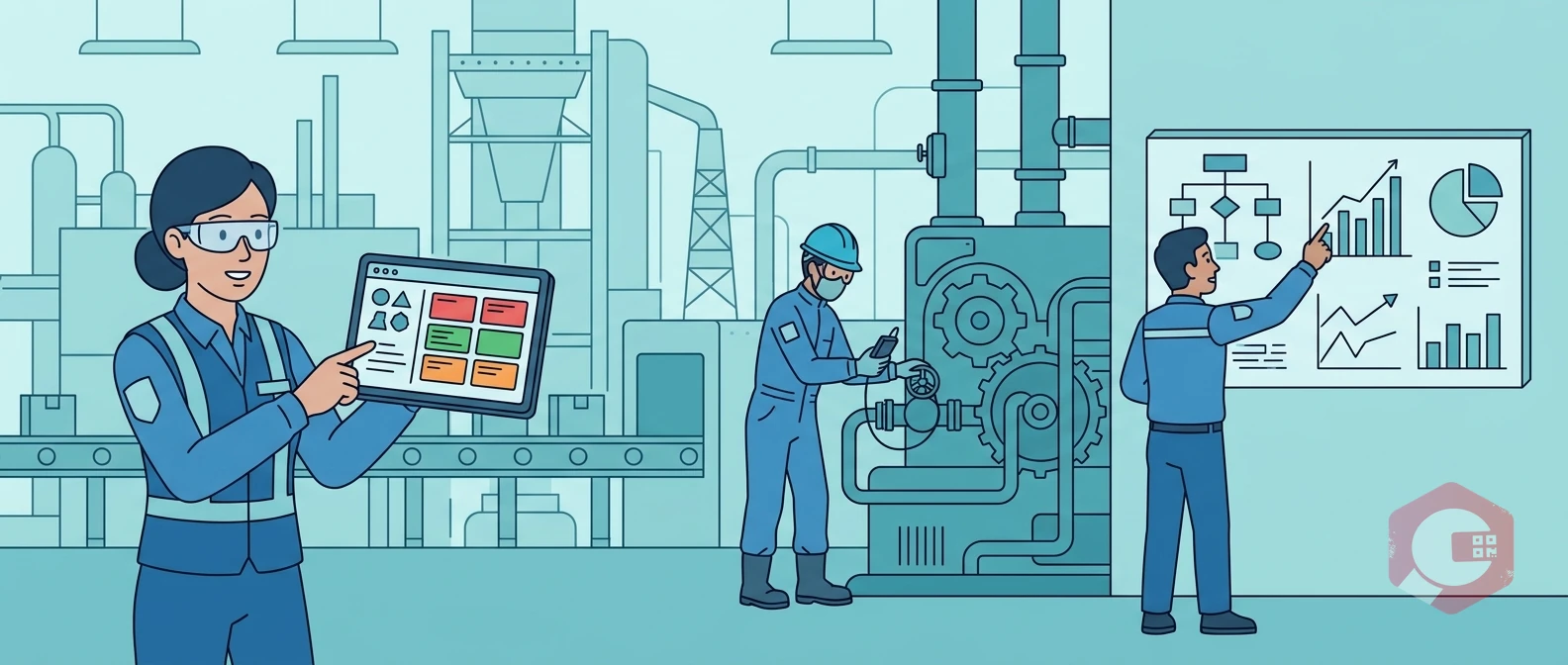
A Computerised Maintenance Management System (CMMS) transforms facility safety from a manual, paper-driven process into a systematic, data-driven one. Industry data shows facilities using a CMMS report up to 25% fewer safety incidents, largely because recurring inspections and safety work orders stop falling through the cracks.
Here is how a CMMS directly reduces safety risk in facility management:
Use this matrix to prioritise which hazards in your facility need immediate action. Rate each hazard on Likelihood (1-3) and Severity (1-3). Multiply the scores: anything scoring 6-9 is Critical and requires immediate corrective action.
Document every hazard in your CMMS with its priority score, assigned owner, and target close date. Review open items weekly in your safety meeting until they are resolved.
The most common safety risks in facility management are slips, trips, and falls; electrical and equipment hazards; chemical and hazardous material exposure; fire risks; contractor safety gaps; and poor indoor air quality. Slips and falls alone cost U.S. employers more than $70 billion annually. Most of these risks can be significantly reduced through regular inspections, preventive maintenance, and formal work permit procedures.
A facility manager is responsible for identifying and controlling physical and environmental hazards within the built environment, ensuring regulatory compliance (OSHA, ISO 45001, local fire codes), maintaining equipment in safe working condition, managing contractor safety, and building a culture where workers proactively report unsafe conditions. In most organisations, the facility manager is the primary accountable party for workplace safety outcomes.
A CMMS helps with safety compliance by automating scheduled inspections so they are never missed, creating a documented audit trail for every work order and safety check, enforcing Permit-to-Work and LOTO procedures through mandatory digital checklists, and generating compliance reports for regulatory bodies. When an OSHA inspector arrives, a CMMS gives you instant access to years of documented maintenance and safety activity - instead of searching through paper records.
The most important facility safety KPIs are: Total Recordable Incident Rate (TRIR), Lost Time Injury Rate (LTIR), Near-Miss Reporting Rate, PM Compliance Rate (percentage of scheduled PMs completed on time), and Mean Time to Close Safety Work Orders. Tracking near-miss rate is particularly valuable - a high near-miss rate is an early warning signal of a serious incident waiting to happen, and gives you the chance to intervene before someone gets hurt.
Reducing safety risks in facility management is not a project with a finish line - it is a continuous system of inspection, maintenance, training, and data review. If your team is still relying on paper checklists and reactive work orders to manage safety, you are leaving significant risk on the table. Cryotos CMMS gives facility managers the tools to automate preventive maintenance, enforce permit-to-work procedures, track safety KPIs in real time, and close safety work orders faster - all from a single platform. Book a free demo today and see how Cryotos can help your facility run safely and efficiently.
Cryotos AI predicts failures, automates work orders, and simplifies maintenance—before problems slow you down.