Inventory reconciliation through cycle count is the process of systematically counting a subset of your inventory at regular intervals and comparing those counts against your system records to identify and correct discrepancies — without halting all operations for a full physical count. Instead of shutting down the warehouse once a year, teams use cycle counting to keep inventory data accurate on an ongoing basis, catching errors as they happen.
For maintenance teams managing spare parts, MRO materials, and critical components, inaccurate inventory is a direct driver of unplanned downtime. According to a Gartner report on inventory management, organizations without continuous reconciliation processes experience 20–30% more stockouts on critical items.
Inventory reconciliation is the practice of comparing physical stock quantities against what your system of record — whether a CMMS, ERP, or warehouse management system — says you should have. Any difference between the two is a discrepancy that must be investigated and resolved.
Even well-managed stores drift out of accuracy over time. The most common causes include informal part withdrawals, data entry errors during receiving or issuing, supplier short-shipments, damage or expiry that isn't recorded, theft, and mislabeling. The Reliable Plant research community estimates that businesses without structured inventory reconciliation carry 20–30% excess safety stock to compensate for unreliable counts.
A cycle count is a planned inventory counting activity in which a specific subset of items is physically counted, verified against system records, and reconciled on a defined schedule. Think of it as continuous quality control for your stock data.
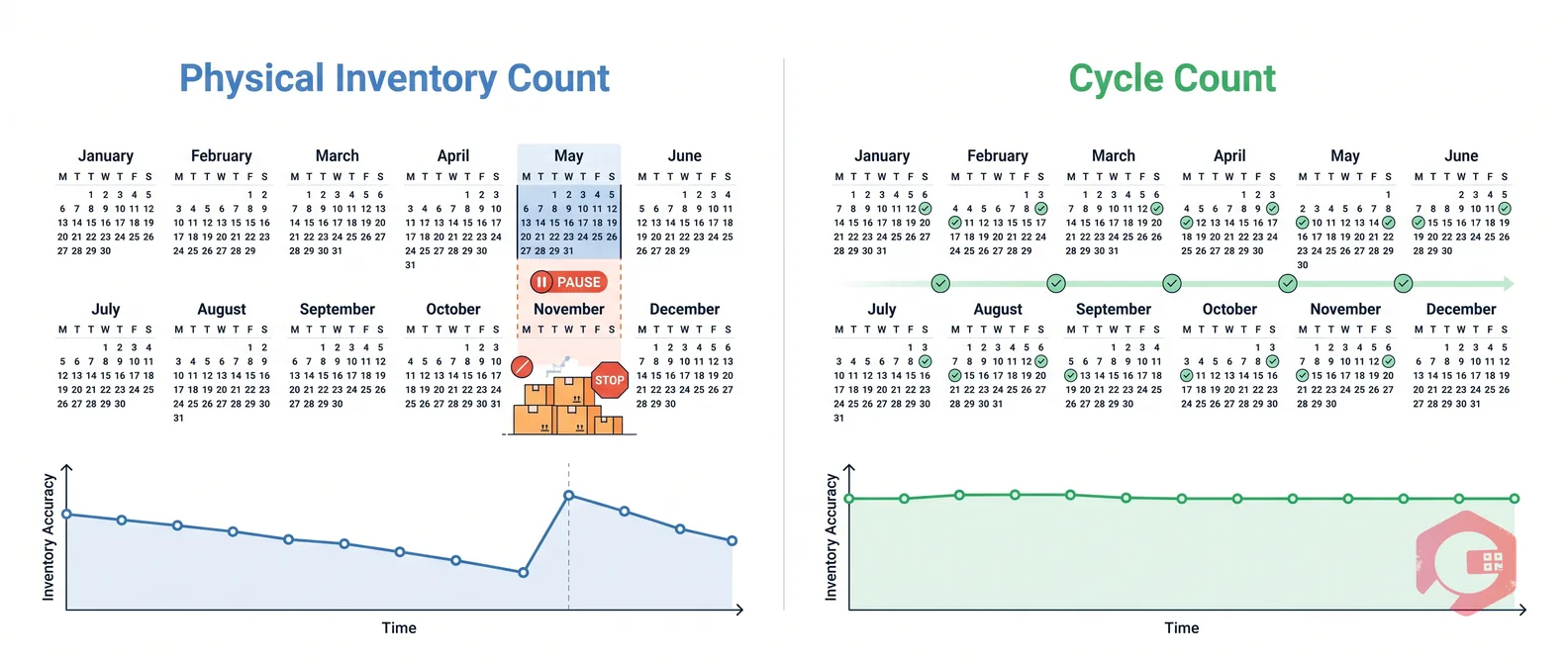
The fundamental difference between a cycle count and a full physical inventory count is scope and frequency. A physical inventory count is a complete, all-at-once count of every item, typically conducted once or twice a year — high disruption, snapshot accuracy. Cycle counting is continuous and focused — low disruption, ongoing accuracy.
The three most widely used methods are ABC Inventory Cycle Counting (most common — counts high-value Class A items most frequently), Random Cycle Counting (unpredictable selection that helps catch fraud or systematic errors), and Zone-Based Geographic Counting (divides storeroom into physical zones counted on a rotating basis).
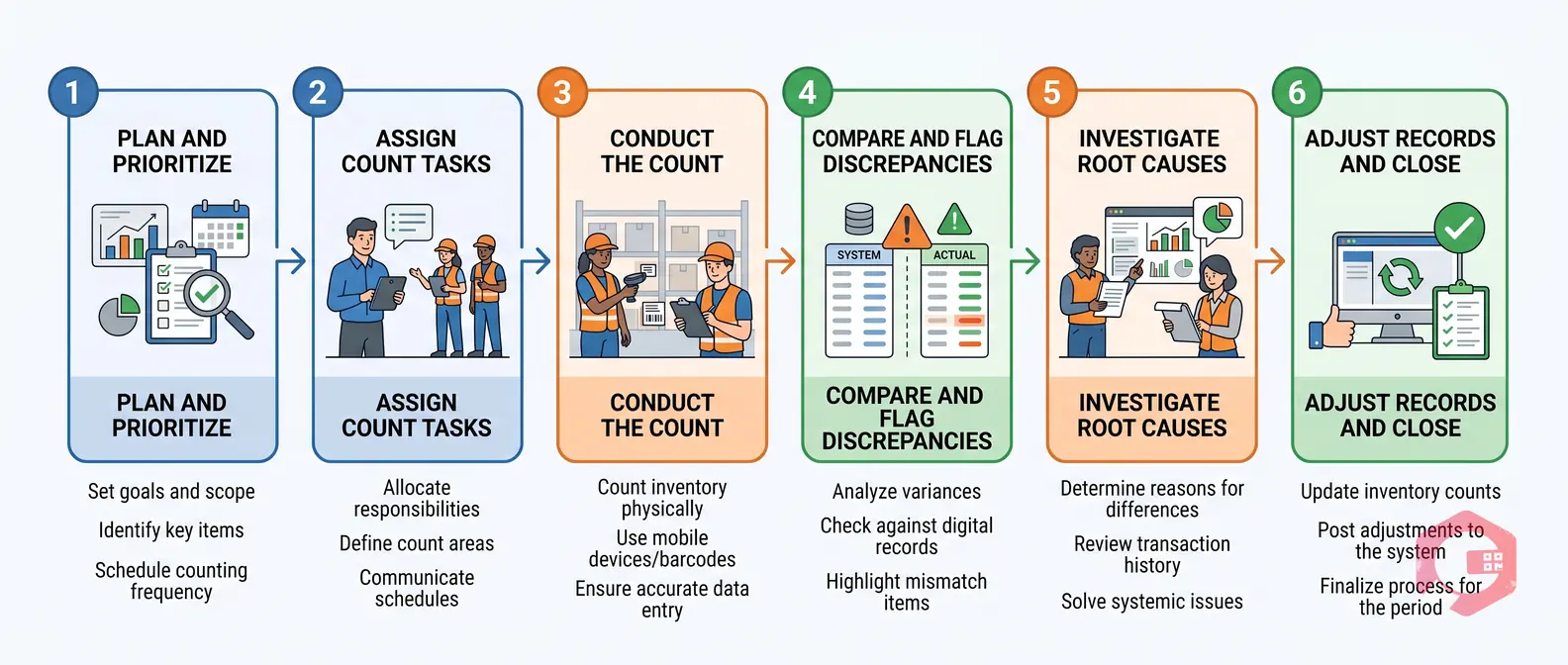
Define which items will be counted, who will count them, and how the count will be recorded. Apply your ABC classification to prioritize count frequency. Your inventory management software should generate the count list automatically based on your configured cycle rules.
Assign specific items or zones to specific counters. In a CMMS environment, create count tasks with the item list, location, and special instructions attached. Send notifications via mobile app or WhatsApp so counters receive their assignments with enough lead time.
Counters physically verify quantities at each location and record the result through a mobile CMMS app, barcode or QR scan. The count should happen without prior knowledge of the system quantity where possible — a blind count reduces the human tendency to count until the number matches the record.
Once the physical count is recorded, the system automatically compares it against the book quantity and flags any variance. Most systems allow you to set a tolerance threshold — a variance of one unit on a bin of 500 is probably measurement noise, while a variance of 10 on a bin of 15 is a significant problem requiring investigation.
For every discrepancy above your tolerance threshold, investigate before adjusting. Common root causes include parts issued without being logged, receiving errors, parts moved between bins without a transfer transaction, and unreported damage. Document the root cause against the discrepancy — patterns across multiple count cycles tell you where your inventory process has systematic weaknesses.
Adjust the system record to match physical reality. In a CMMS, this creates an inventory adjustment transaction recording what was adjusted, by how much, by whom, and why — a complete audit trail. Trigger reorders if quantities have fallen below minimum thresholds, then feed root cause data into your process improvement backlog.

For Class A items — spare parts tied to your highest-criticality assets — monthly counts are the minimum, with weekly counts for high-transaction items. For Class B items, quarterly counts strike the right balance. For Class C items, annual counts are generally sufficient.
Cryotos CMMS brings cycle counting into the same platform where work orders, preventive maintenance, and asset records live — creating a closed loop between parts consumption, inventory levels, and reconciliation activities.
Maintenance teams using Cryotos report measurable improvements in inventory accuracy within the first 90 days of structured cycle count implementation. Explore how Cryotos automates inventory reconciliation through cycle counts and keeps your spare parts data working as hard as your maintenance team does.
Inventory reconciliation through cycle count is the process of regularly counting a subset of physical inventory and comparing those counts to system records to identify, investigate, and correct discrepancies — without requiring operational shutdowns.
A full physical inventory counts every item simultaneously, typically once or twice a year, requiring operations to pause. Cycle counting counts a portion of items on a regular rolling schedule without disrupting normal operations.
Class A spare parts: monthly minimum (weekly for high-transaction items). Class B: quarterly. Class C: annually. Teams following this ABC-based frequency typically achieve inventory accuracy above 95%.
Informal part withdrawals, receiving errors, mislocation, unreported damage, and miscounted quantities from previous counts. Root cause investigation after each discrepancy is essential to prevent recurrence.
Yes. Cryotos can automate the scheduling, assignment, and recording of cycle counts entirely — generating count tasks automatically, notifying counters via mobile, recording results through QR scanning, and flagging discrepancies for investigation with full audit trails.




Cryotos AI predicts failures, automates work orders, and simplifies maintenance—before problems slow you down.