

Level of Repair Analysis (LORA) is a structured decision process for failed parts. It works out whether a failed component should be repaired on-site, sent to a higher repair level, or scrapped and replaced. The method compares the cost, downtime, and logistics of each option. It then assigns each part to whichever option costs the least over its full lifecycle, without hurting equipment uptime. Most industrial and defense teams turn this into a repeatable check instead of a one-off judgment call.
Key Takeaways

Level of Repair Analysis (LORA) is a process that decides whether to repair, replace, or escalate a failed part. The method started in defense and aerospace logistics. Planners used it to decide where in the supply chain each part should be fixed. Manufacturing and facilities teams now use the same logic for industrial gear. It turns a decision that used to depend on whoever was on shift into a fixed standard.
A Computerized Maintenance Management System (CMMS) supports this goal in a simple way: cut total lifecycle cost while keeping equipment running. LORA does this by scoring each repair option on cost, downtime, and reliability. It does not default to "always repair" or "always replace." The logic sits close to reliability-centered maintenance (RCM). Many teams run both side by side. RCM decides which failures matter most. LORA decides where each resulting repair should happen. According to the Wikipedia overview of level of repair analysis, the method is widely used across defense logistics planning to set support strategy before equipment even enters service.

A LORA is only as good as the data behind it. Weak or missing data is the top reason a level-of-repair call looks right on paper but fails in the field.
Most of this data already sits somewhere in a maintenance operation. The problem is that it is scattered across spreadsheets and memory. Centralizing asset records and asset tracking data in one system is what makes a LORA repeatable.
Organizational-level maintenance is on-site repair by the equipment operator's own team. A LORA checks this option against three others, each with its own cost and turnaround.
| Maintenance Level | Who Repairs It | Typical Trigger | Cost and Turnaround |
|---|---|---|---|
| Organizational | On-site plant technicians | Simple faults, basic tools, spares on hand | Lowest cost, fastest turnaround |
| Intermediate | Regional or central workshop | Needs equipment not on-site | Moderate cost, days to fix |
| Depot / OEM | Manufacturer or certified depot | Complex, warranty, or safety-critical faults | Highest cost, weeks to fix |
| Replace / Discard | Not repaired — unit is scrapped | Repair cost exceeds replacement value | One-time cost, instant availability |
Placing each part on the right row — rather than defaulting every job to one level — is the main output of a LORA.
Use the mean maintenance cost calculator to weigh an asset's running repair cost against its replacement value before you pick a level.
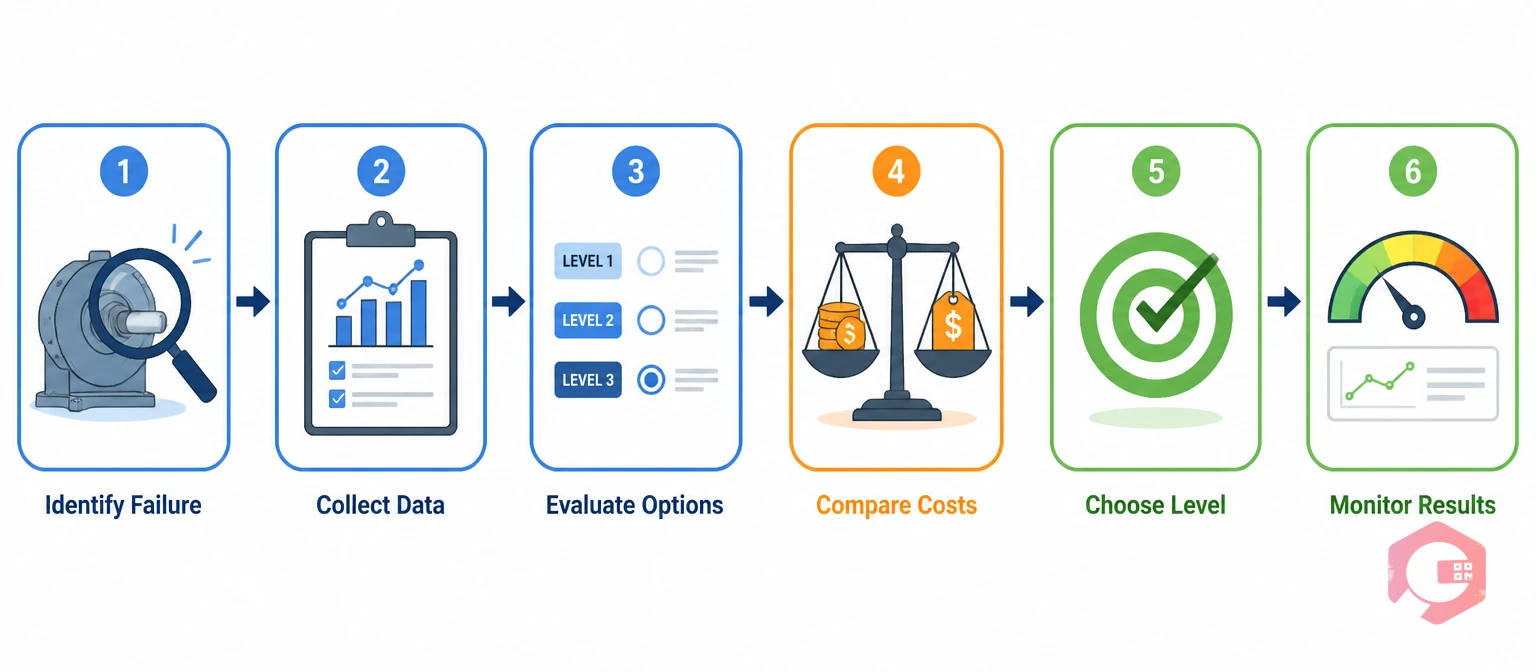
A Level of Repair Analysis follows a set order. Each step feeds the next. Skip one, and the final call often ignores a real cost.
The LORA Decision Process:
This order turns a one-time judgment call into a decision the whole team can repeat for the next failure of the same type.
Lifecycle cost is the full cost of an asset from purchase to disposal. A LORA weighs several factors together to reach that number for each repair level.
Most maintenance teams find that downtime and logistics cost — not the repair invoice — are what actually separate a good level-of-repair call from a poor one.

A formal LORA swaps out inconsistent, technician-by-technician calls for one standard the whole team can follow.

A LORA is only as strong as the data behind it. Most LORA programs run into the same few problems.
A CMMS does not run a Level of Repair Analysis by itself. The calls on cost, risk, and reliability still belong to maintenance engineers and reliability leads. What a CMMS does is pull together the asset, work order, and inventory data a LORA needs, so the call rests on full records instead of scattered notes.
Asset and failure history give the analysis its raw material. Work order data shows real repair time and cost by level. Inventory records confirm spare-parts supply before a repair route gets picked. Reporting and BI dashboards then surface the cost and downtime pattern that backs up — or challenges — a level assignment already in place. Maintenance teams using Cryotos have reported up to 30% less unplanned downtime and 25% faster repair turnaround once routing calls run on real data instead of memory. This lines up with guidance from the ISO 55000 asset management standard, which frames good asset decisions as a balance of cost, risk, and performance across an asset's full life.
Most facilities that run LORA well treat the CMMS as the evidence base, not the decision-maker. The call stays a human judgment, backed by data the system keeps current. The Society for Maintenance and Reliability Professionals (SMRP) lists this kind of data-backed repair routing among the best practices that separate mature reliability programs from reactive ones.
A repair-versus-replace call is a two-option comparison for one asset. A Level of Repair Analysis is broader. It checks every maintenance level, from on-site repair through OEM depot work and disposal, and applies that check the same way across a whole fleet of similar parts, not just one asset at a time.
Most LORA setups check four levels: organizational (on-site), intermediate (regional workshop), depot or OEM (manufacturer facility), and replace or discard. Some teams merge intermediate and depot into one "off-site" group, depending on their support network.
No. A CMMS pulls together the asset, cost, and inventory data a LORA needs, but comparing repair options on cost and risk stays a call made by maintenance engineers or reliability leads, using that data as their base.
Revisit a level assignment any time operating conditions, failure rates, or repair costs shift by a meaningful amount. Most teams do this as part of an annual maintenance strategy review, or right after a part's failure pattern changes. A level picked under one duty cycle can quietly turn wrong as usage or logistics costs move.
A Level of Repair Analysis turns scattered repair calls into one standard every technician and site can follow. Schedule a free demo to see how Cryotos centralizes the asset, cost, and inventory data your team needs to run LORA decisions with confidence.


Cryotos AI predicts failures, automates work orders, and simplifies maintenance—before problems slow you down.



