

5 Whys RCA is a root cause analysis method that asks "why" a problem happened, repeatedly, until you reach the real cause instead of a symptom. Maintenance teams use 5 Whys RCA to stop firefighting the same failure over and over and start fixing what's actually broken. Paired with Kaizen — the practice of small, continuous improvements — 5 Whys RCA becomes more than a one-time fix; it becomes the start of a standing process change. Cryotos, a Computerized Maintenance Management System (CMMS), builds 5 Whys RCA directly into the work order screen, so the investigation and the improvement live in the same place your technicians already work.
Key Takeaways

5 Whys RCA is a root cause analysis technique that asks "why" a problem occurred, typically five times, until the answer points to a controllable cause rather than a symptom. The method came out of Toyota's lean production system, the same discipline behind Total Productive Maintenance (TPM), and it remains one of the simplest tools in a maintenance team's kit because it needs no software, training class, or facilitator.
A classic five whys chain looks like this:
Each answer moves one step closer to a fixable cause. That's what separates root cause analysis (RCA) from a quick repair — a fixed fuse gets the machine running again, but a missing filter is what actually caused the failure.
A root cause is the earliest point in a failure chain where a change would have prevented the problem entirely. A symptom, by contrast, is just where the failure became visible. Most maintenance teams get good at fixing symptoms fast; 5 Whys RCA forces the conversation back to the earliest fixable point instead.
Kaizen is the practice of making small, continuous improvements to a process instead of waiting for a large periodic overhaul. On its own, 5 Whys RCA only produces an answer. Kaizen is what turns that answer into a change that sticks — an updated checklist, a shorter PM interval, or a training note added to the work instructions.
Maintenance teams that treat 5 Whys RCA as a one-off exercise usually see the same failure again within a few months. The Lean Enterprise Institute frames Kaizen the same way most reliability programs do: improvement is a habit, not an event. Cryotos customers who close the loop between RCA and a standing PM update have reported up to 30% reduction in unplanned downtime and 25% faster repair turnaround, because the same failure stops coming back.
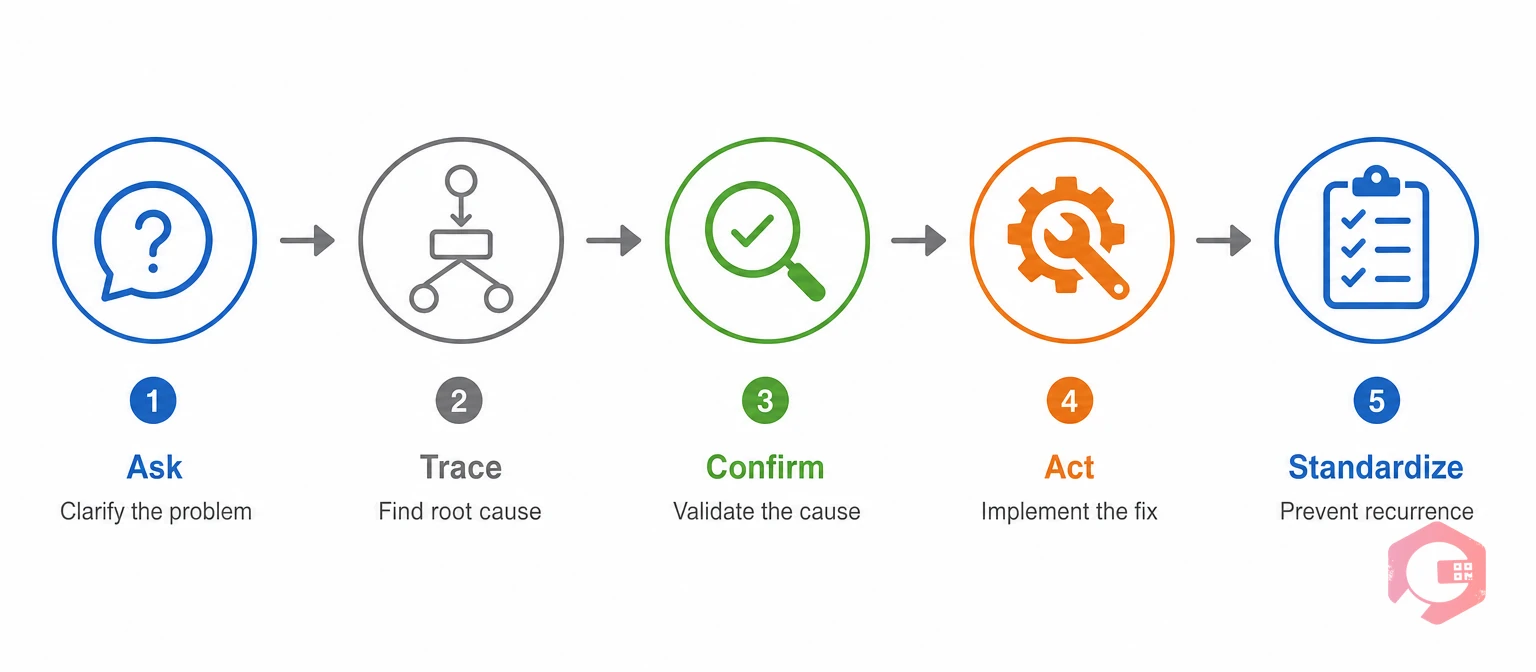
The RCA-to-Kaizen Loop:
Most teams handle Ask, Trace, and Confirm without a problem. Standardize is the step that gets skipped under deadline pressure, and it's exactly the step that makes 5 Whys RCA a Kaizen tool instead of a one-time report.
Ready to put a root cause behind every recurring failure? See how work order management in Cryotos keeps RCA notes and follow-up actions attached to the same job.
Running a 5 Whys RCA takes five steps: define the problem, ask why, keep asking, confirm the cause, then assign a fix. None of the steps require special software, though logging them on the work order keeps the record attached to the asset.
One habit separates teams that get real value from 5 Whys RCA from teams that don't: writing the chain down as it happens instead of reconstructing it from memory afterward. A technician who logs each "why" on the spot, right on the work order, produces a record the next shift can actually trust.
A recurring conveyor motor failure is a useful test case for 5 Whys RCA because the obvious fix — replace the motor — never stops the failure from coming back. Most facilities go through two or three motors before anyone runs the analysis all the way through.
The root cause isn't "the bearing failed" — it's a PM frequency that never adjusted after the line sped up. Once the team switches that motor's root cause analysis investigation checklist item to a run-hours trigger instead of a calendar date, the failure stops recurring instead of just getting fixed again.
Cryotos captures 5 Whys RCA directly on the work order, so the investigation never lives in a separate spreadsheet. A technician closing out a repair can log each "why" against the same job, attach a photo or sensor reading as evidence, and assign the resulting Kaizen action — a new PM trigger, an updated checklist step — without leaving the record.
That matters because most facilities lose the RCA the moment it's written somewhere other than the work order history. Six months later, nobody remembers why the PM interval changed, and a well-meaning technician reverts it. Keeping 5 Whys RCA and the corrective action in the same system closes that gap.
Because the work order already carries the asset ID, downtime timestamps, and parts used, the 5 Whys RCA chain sits next to the evidence instead of next to it in a separate file. When the same asset comes up for review at the next planning meeting, the whole history — cause, fix, and outcome — is already there.
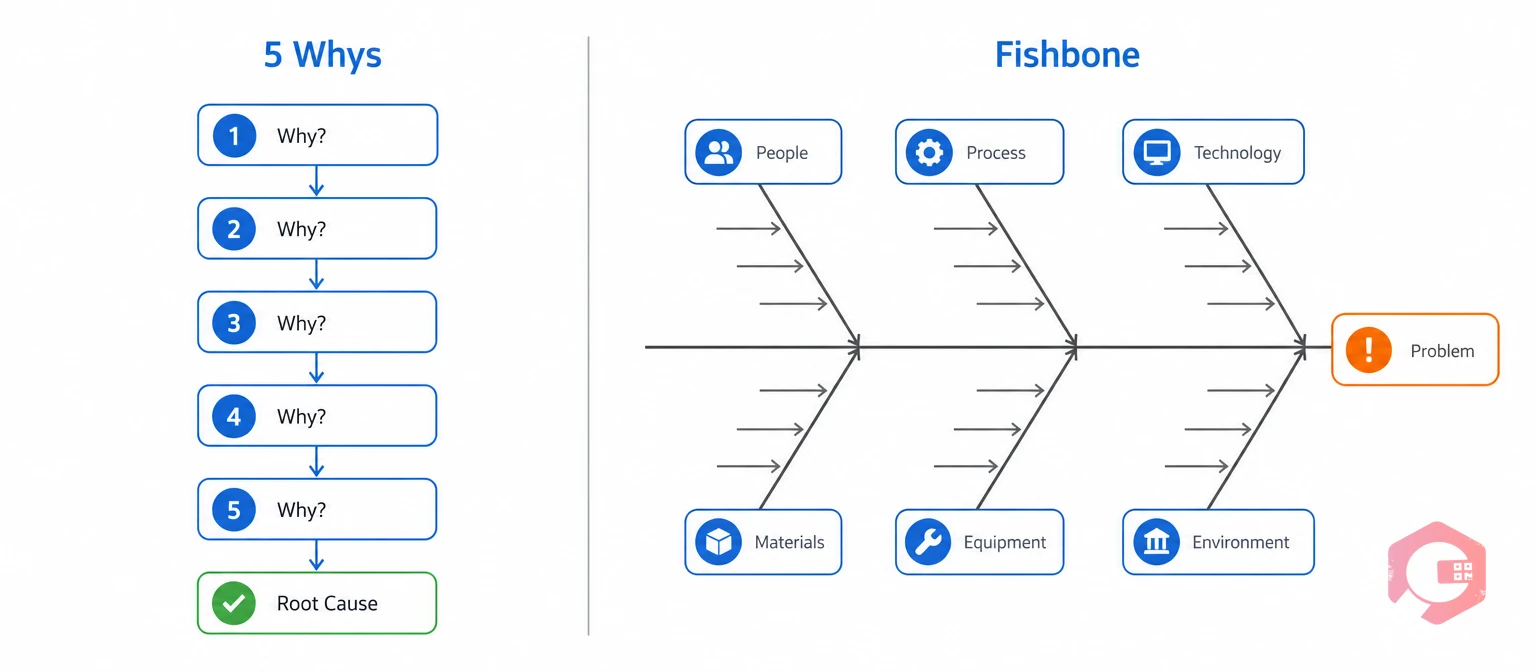
5 Whys RCA works best for a single, linear failure chain, while a fishbone diagram works better when several factors contribute to the same problem at once. Both are root cause tools; the difference is how many causal paths you're tracking.
| Method | Best For | Limitation |
|---|---|---|
| 5 Whys RCA | Quick, single-chain failures with one dominant cause | Struggles when several causes overlap |
| Fishbone Diagram | Multi-causal problems spanning method, machine, material, and manpower | Takes longer and usually needs a group workshop |
| Combined approach | Complex recurring failures with several contributing factors | Needs more time and a facilitator comfortable with both tools |
For most maintenance work orders, start with 5 Whys RCA. Escalate to a fishbone diagram — sometimes alongside an FMEA — only when the first "why" branches into more than one plausible answer.
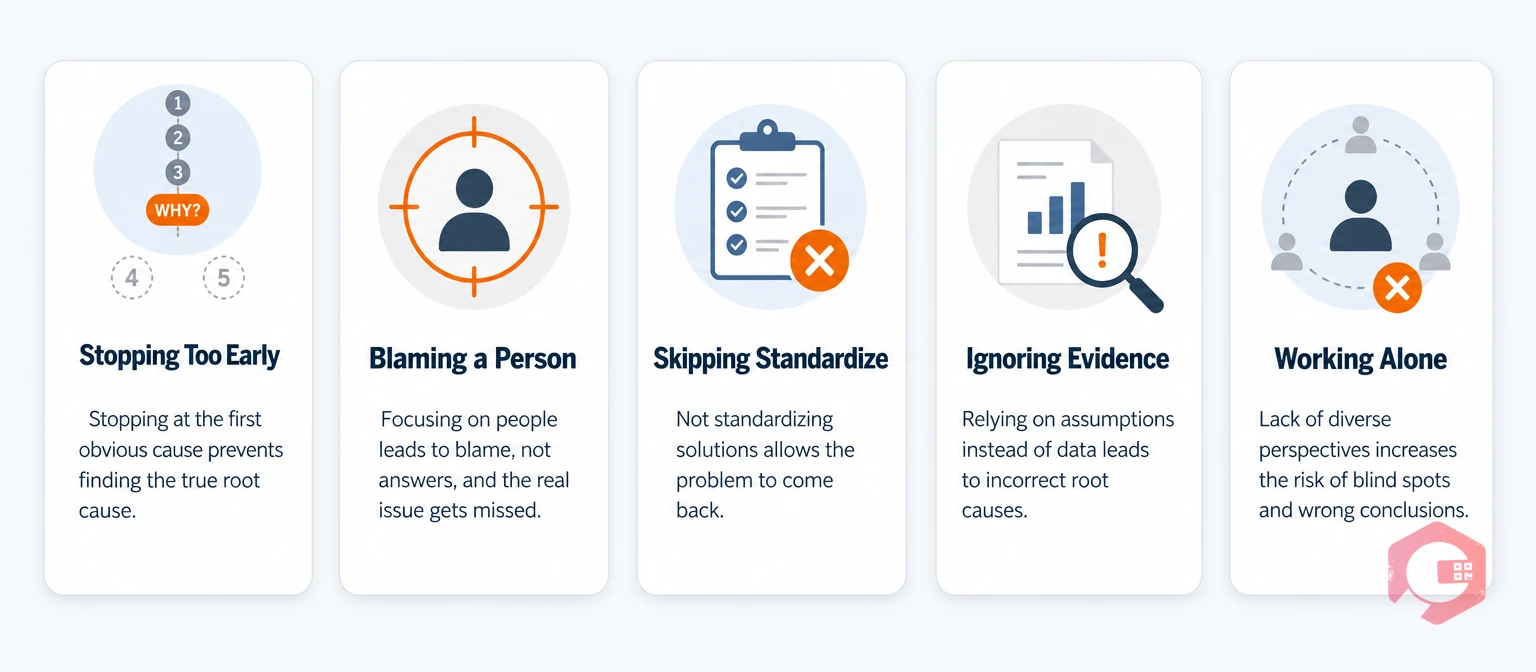
The most common mistake in 5 Whys RCA is stopping at the first plausible answer instead of continuing to ask why. A worn bearing sounds like a root cause, but it's rarely the actual one.
OSHA's incident investigation guidance makes the same point for safety events: an investigation that stops at the first cause rarely prevents a repeat. The same discipline that keeps a safety investigation honest keeps a 5 Whys RCA useful — evidence over assumption, every time.
The 5 Whys technique asks "why" a problem happened, repeatedly, until the answer points to a cause the team can actually control. It's one of the simplest forms of root cause analysis and needs no special software or training to start.
Five is a guideline, not a rule — some problems resolve in three whys, others take seven. Keep asking until the answer names a process or design gap you can fix, not a person or a one-off event.
5 Whys RCA finds the cause; Kaizen turns that cause into a standing process change. Without that second step, the same root cause tends to produce the same failure again within a few months.
5 Whys RCA traces one causal chain and works well for straightforward, single-cause failures. A fishbone diagram maps several possible causes across categories at once, which suits complex problems with more than one contributing factor.
Yes — Cryotos lets technicians log each "why" on the work order itself, attach supporting evidence, and assign the resulting corrective action without switching to a separate document or spreadsheet.
A recurring failure is rarely a mystery — it just needs someone to keep asking why until the real cause shows up. Schedule a free demo to see how Cryotos turns every 5 Whys RCA into a standardized Kaizen action your team won't have to repeat.




Cryotos AI predicts failures, automates work orders, and simplifies maintenance—before problems slow you down.



