

Fishbone diagrams work best for simple, single-cause plant incidents where you need to brainstorm contributing factors quickly. Bowtie analysis works best for complex or high-consequence incidents where you need to map both the causes and the consequences of a hazard on one page. Most plants need both tools, not one instead of the other. This guide compares fishbone and bowtie side by side, then shows where each fits into a CMMS-driven incident investigation.
Key Takeaways
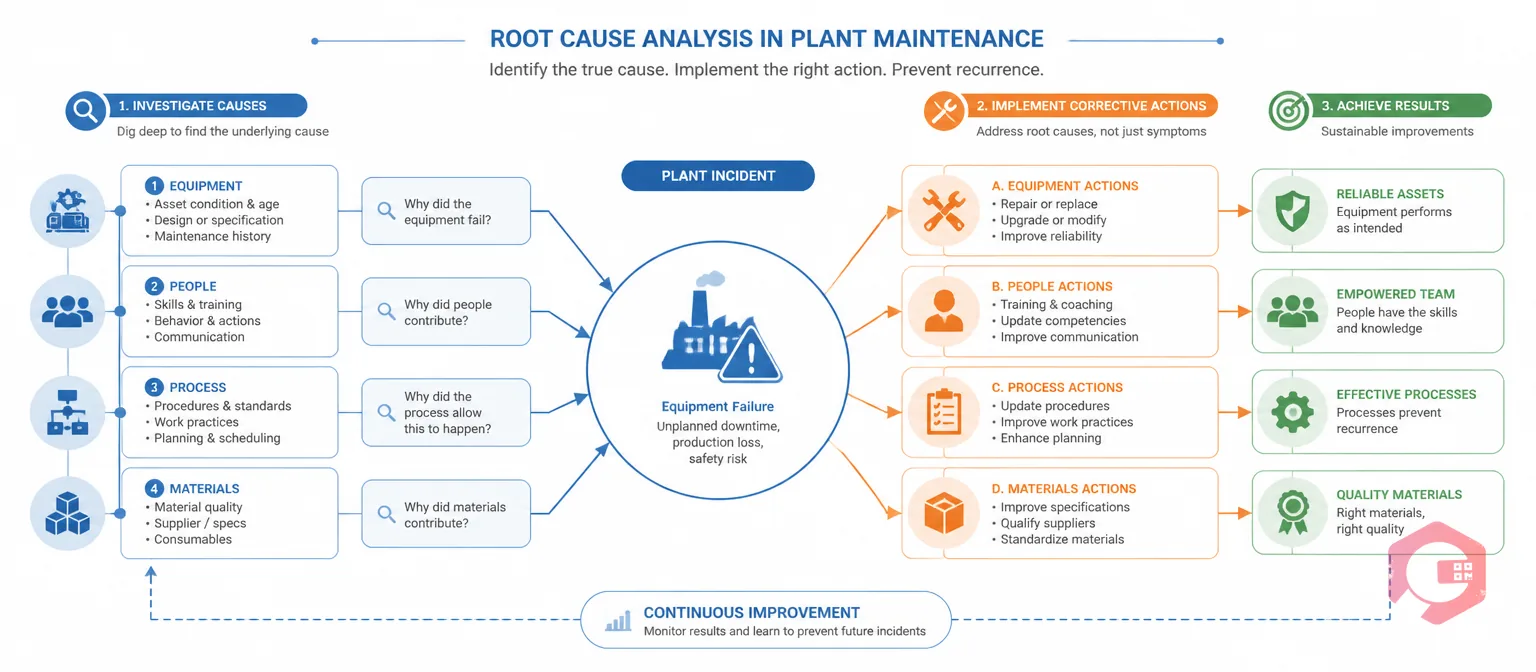
Root cause analysis is the structured process of tracing an incident back to its underlying cause. It looks past the surface symptom. It finds what actually triggered the failure. Root cause analysis, done well, rarely stops at the first plausible answer. A pump failing isn't the root cause. A missed lubrication interval, a design flaw, or a training gap usually is. Fishbone and bowtie are two of the most common structured methods plants use to get there.
Picking the wrong method wastes time. A five-minute fishbone session on a complex, multi-system failure will miss how the causes interact. A full bowtie analysis on a simple gasket failure burns hours that could go to five other open work orders. OSHA's guidance for smaller operations makes a similar point about proportionality. The depth of an investigation should match the severity of what happened. It shouldn't exceed it out of habit.
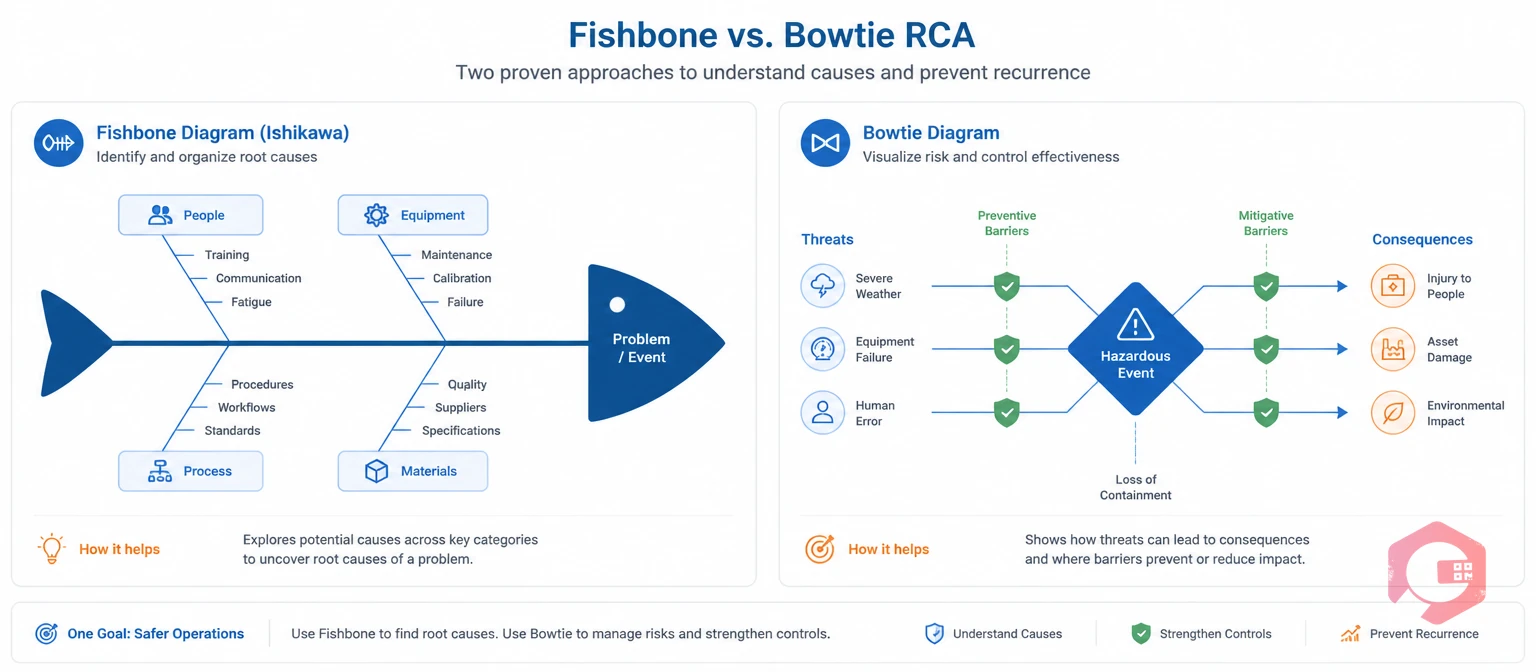
The table below lays out where these two methods diverge.
| Aspect | Fishbone (Ishikawa) | Bowtie |
|---|---|---|
| What it maps | Causes only, grouped by category | Causes, the hazard, barriers, and consequences |
| Best for | Single-cause or moderately complex failures | High-consequence or multi-cause events |
| Time to complete | 30–60 minutes in a team session | Several hours to a full day |
| Shows barriers/controls | No | Yes, explicitly on both sides |
| Typical use case | Equipment breakdown investigation | Major hazard review, process safety event |
Neither method is "better" in the abstract, and treating one as the default for every failure misses the point of having two tools. A plant that only owns a bowtie template will over-invest in small failures. A plant that only owns a fishbone template will under-investigate its highest-risk hazards.

Fishbone analysis, also called Ishikawa analysis, sorts potential causes into standard categories like people, equipment, process, and materials. It works well right after a breakdown, while the team is still on site and memory is fresh.

Bowtie analysis is a diagram that puts a hazard at the center, showing causes and barriers on one side and consequences and barriers on the other. It answers two questions a fishbone can't: what stopped this from being worse, and what could still make it worse next time.
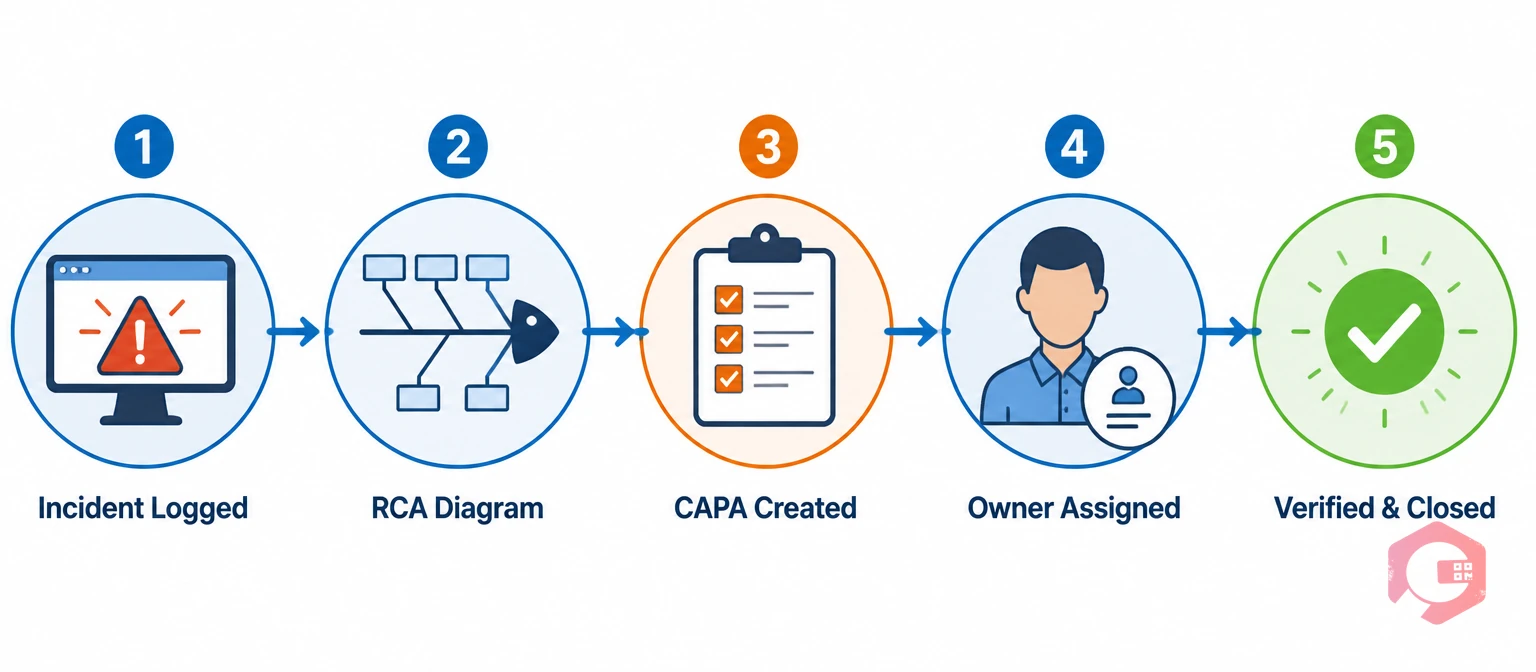
A diagram on a whiteboard is a good start. It's not an investigation until the findings turn into tracked, verified corrective action. This is where most RCA programs quietly fail — not in the analysis, but in the follow-through.
A fishbone or bowtie session produces a list of contributing causes and recommended fixes. Written on paper or in a slide deck, that list has no owner, no deadline, and no verification step. Six months later, nobody can say whether the fix actually happened.
Cryotos integrates Five Whys RCA directly into work order management, so a technician can start a root cause investigation from the same record where the failure was logged. Fishbone and bowtie findings map the same way — each identified cause becomes a linked corrective or preventive action with an assigned owner and due date, not a line item in a report nobody reopens.
Maintenance teams using Cryotos have reported up to 30% reduction in unplanned downtime and 25% faster repair turnaround, and RCA follow-through is a meaningful part of that number. A BI dashboard tracks open CAPA items by age and priority, so a stalled action surfaces before it becomes the reason the same failure repeats. FMEA analysis can layer on top of either method for teams that need to score failure modes by severity and likelihood before deciding where to invest.
For safety-critical failures uncovered through a bowtie review, routing the corrective work through a root cause analysis investigation checklist keeps the documentation consistent across every investigator on the team, regardless of which method they used to get there.
Both methods fail the same way when teams skip the basics. Watch for these patterns.
Most maintenance teams don't need a formal flowchart to decide which method to use. A few questions usually settle it fast.
The Four-Question RCA Method Selector:
Reliability programs built around reliability-centered maintenance principles often use fishbone for routine failure triage. They reserve bowtie for the handful of hazards that could cause serious harm. That split keeps investigation effort proportional to actual risk. Practitioners following Ishikawa's original methodology will recognize this approach. Fishbone was designed to be fast, team-based, and iterative from the start.
Yes, and it's common practice. Many teams start with a quick fishbone session to brainstorm candidate causes, then build a bowtie diagram if the incident turns out to be more complex or higher-consequence than it first appeared.
Neither standard mandates a specific diagramming method. Both expect a documented, systematic investigation proportional to the severity of the incident. Either fishbone or bowtie can satisfy that expectation, depending on the case and how well the team documents its reasoning along the way.
A thorough bowtie session for a significant incident typically takes several hours to a full day, often across more than one meeting as the team gathers evidence and confirms barrier status on both sides of the hazard. Rushing a bowtie to fit a single one-hour meeting usually means barriers get assumed instead of verified.
Most small teams can run on fishbone alone for the majority of their failures. Keep a bowtie template ready for the rare high-consequence event — you don't want to be learning the method for the first time during a serious incident.
The right RCA method is the one that matches the risk in front of you, not the one that's easiest to reach for out of habit. Keep both templates on hand, train the whole team on when to reach for each, and the choice stops being a debate every time an incident happens. Schedule a free demo to see how Cryotos turns fishbone and bowtie findings into tracked corrective actions that actually get closed.




Cryotos AI predicts failures, automates work orders, and simplifies maintenance—before problems slow you down.



