Lockout tagout tryout (LOTOTO) is a hazardous energy control procedure that adds a required test step after locks and tags are applied. Before anyone touches the machine, the authorized worker tries to start it and tests every energy source to prove it is dead. The try step closes the gap between "I isolated it" and "I proved it is isolated."
OSHA already requires this check under 29 CFR 1910.147, yet the tryout is the step crews most often rush or skip. Below, you'll learn what LOTOTO means, how a proper tryout works, why teams skip it, and how to make the try step part of every job.
Key Takeaways

Lockout tagout tryout is the full energy control sequence many plants teach as three words: lock, tag, then try. The extra "TO" is a reminder that the job is not safe until someone proves it. Automotive and heavy manufacturing sites made the term popular, and it has spread to food, pharma, and utilities.
LOTOTO builds on standard lockout tagout practice. Under the OSHA Control of Hazardous Energy rules, the authorized employee must verify isolation and de-energization before work begins. NFPA 70E adds the same idea for electrical work with a simple rule: test before you touch.
The tryout step is the physical proof that every isolation point worked and no stored energy remains. It turns an assumption into a tested fact.
LOTO and LOTOTO describe the same legal duty, but they place very different weight on the final check. The table shows how the two labels play out on the shop floor.
| Aspect | LOTO (as often practiced) | LOTOTO |
|---|---|---|
| Steps named | Lock and tag | Lock, tag, and try |
| Verification | Required but often implied | Called out as its own step |
| Typical failure | Worker trusts the switch position | Worker must prove zero energy |
| Records kept | Lock and tag applied | Try method and result logged |
| Crew mindset | "It's locked, so we're safe" | "It's proven, so we're safe" |
The difference between LOTO and lockout tagout tryout is cultural more than legal. The broader lockout-tagout practice has always included verification, but naming the try makes it much harder to forget.
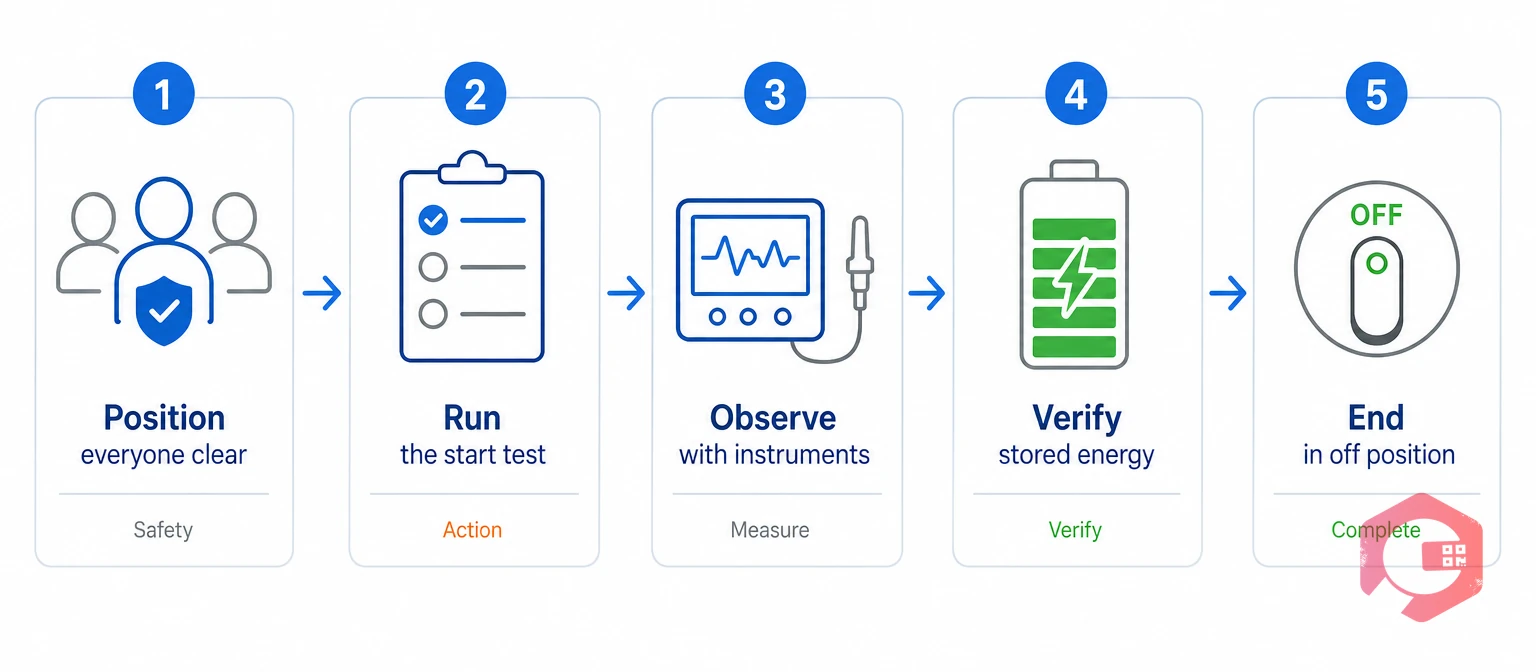
A proper tryout tests every energy source listed in the procedure, not only the main electrical feed. Most facilities follow a fixed sequence so nothing gets missed under time pressure.
The PROVE Tryout Method:
Live-dead-live testing is a three-step meter check that proves the tester works before and after reading the circuit. Without it, a tester with a dead battery can make a live circuit look dead.
Want a simple way to check your crews on the floor? Use the free safety compliance checklist to audit your lockout tagout tryout routine during the next shutdown.
The tryout step gets skipped because it feels redundant once the lock is on, and nothing visible happens when it's done right. Maintenance teams rarely skip it on purpose; small pressures add up until the try quietly disappears.
A common mistake in most facilities is teaching LOTO as "lock and tag" for years, then adding tryout later as a footnote. The words people learn first shape the habits they keep.
Skipping the try is rarely laziness; it is usually a system that never made the step visible.
When the tryout is skipped, the crew works on equipment they believe is safe but have never tested. That is how hidden energy reaches a worker's hands.
OSHA estimates that following its lockout tagout standard prevents about 120 deaths and 50,000 injuries each year. Even so, the standard appears on OSHA's list of most frequently cited standards year after year.
Each of these failures stays hidden until someone tests for it, and the tryout is the only step in the sequence built to find them.

A real job shows how a full lockout tagout tryout fits into a normal repair. Picture a technician replacing a worn drive belt on a case packer with electric motors, an air-driven pusher, and a spring-loaded guard door.
The air test is the moment that matters in this example. Without the try, the trapped air could have driven the pusher forward while the technician's hand was inside the frame.
The surest way to stop skipped tryouts is to make the try a recorded, required step that blocks work until it's done. Training helps, but systems hold the line when people are tired or rushed.
Each machine-specific procedure should state exactly how to try each isolation point. Name the button to press, the gauge to read, and the meter to use, because "verify zero energy" leaves too much room for a glance.
When lockout jobs run through a Computerized Maintenance Management System, the tryout can be a mandatory item. Digital maintenance checklists can require a meter reading, a photo of the gauge at zero, and a signature before the job moves to "in progress."
For high-risk work, permit to work software can hold a permit in pending status until every isolation point has a logged tryout result. Supervisors then see which jobs are proven and which are still waiting.
OSHA requires a periodic inspection of energy control procedures at least once a year. Use that review, along with a regulatory compliance checklist, to watch a real tryout and confirm the crew follows the written method.
Maintenance teams using Cryotos have reported up to 30% reduction in unplanned downtime and 25% faster repair turnaround. A try step built into that workflow costs seconds, and it can save a life.
OSHA does not use the term LOTOTO, but the try step is still a legal requirement. Section (d)(6) of the OSHA 1910.147 standard says the authorized employee must verify isolation and de-energization before starting work. LOTOTO simply gives that duty a name.
Many plants use tryout to mean the start attempt and verification to mean testing with meters and gauges. LOTOTO treats both as one step, because a machine that won't start can still hold stored energy.
The primary authorized employee usually runs the tryout for the group. Best practice is that every worker on the hasp either performs the try or watches it happen, so nobody relies on an assumption.
Stop, step back, and do not start work. Recheck every isolation point, find the missed source, update the written procedure, and report the event as a near miss, so others learn from it.
A start button or selector left in the run position can restart the machine as soon as power returns. Returning controls to off or neutral protects the next person who removes the locks.
A tryout that is written, required, and recorded is a tryout that actually happens. Schedule a free demo to see how Cryotos builds lockout tagout tryout steps into every work order and permit.


Cryotos AI predicts failures, automates work orders, and simplifies maintenance—before problems slow you down.