Risk-based inspection (RBI) is a method that ranks equipment by risk and sets inspection plans to match. Risk is how likely a failure is, multiplied by how bad the failure would be. API 580 gives the framework for an RBI program. API 581 supplies the calculations that turn risk into inspection intervals.
Risk-based inspection does not check every vessel and pipe on a fixed calendar. It puts effort on the few items that carry most of the risk. This guide explains how RBI works, how API 580 and 581 differ, how intervals are set, and how to keep the plan on schedule.
Key Takeaways
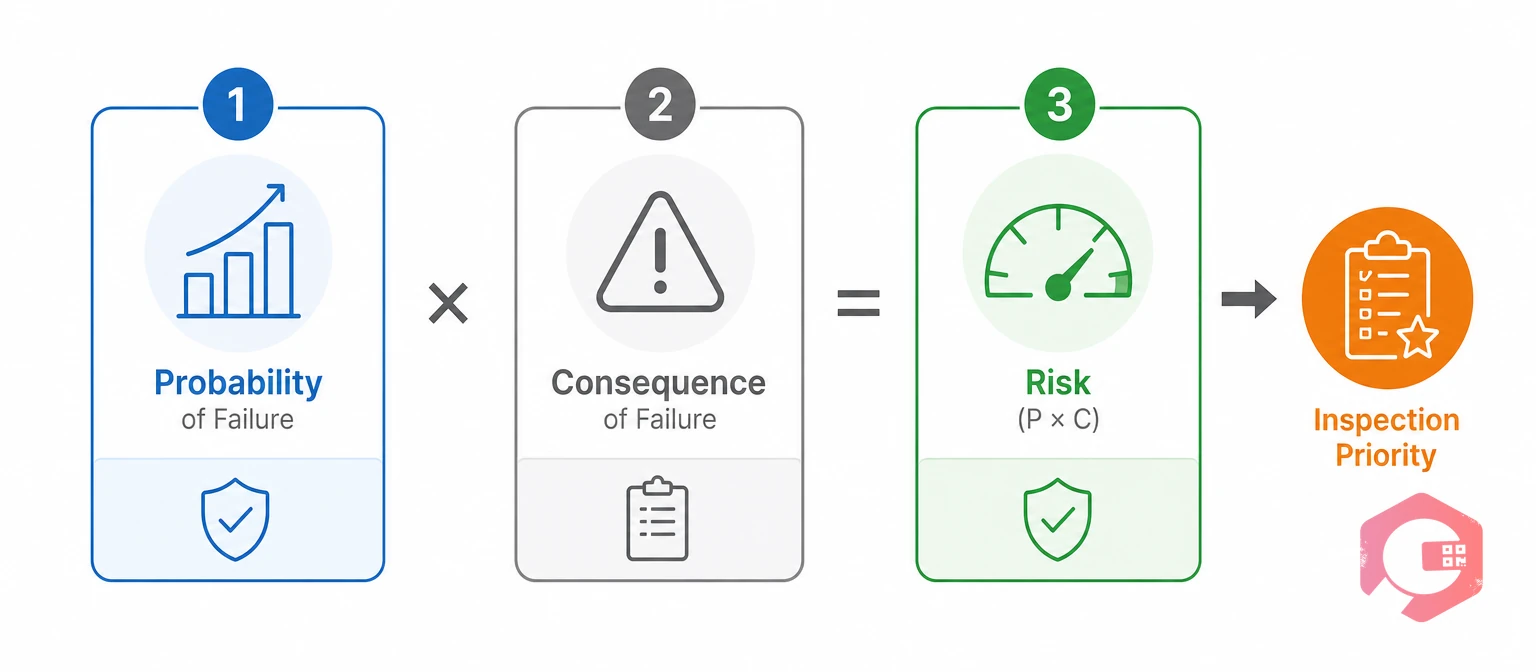
Risk-based inspection sets inspection priority and frequency from the risk each item of equipment poses. It is used mainly for pressure equipment in refining, chemical, and oil and gas plants. That includes vessels, piping, heat exchangers, and storage tanks. It grew out of an API joint industry project in the 1990s, and this overview of risk-based inspection gives a short history.
Time-based programs inspect every item on the same schedule. That spends as much effort on a low-risk air receiver as on a high-risk overhead line.
API 580 notes that most of a unit's risk usually sits in a small share of its equipment. This is often summarized as 80% of the risk in 20% of the items. RBI moves effort toward that 20%.
RBI puts inspection effort where a failure would do the most harm.

API RP 580 is the recommended practice that sets principles and minimum elements for an RBI program. API RP 581 is the companion document that gives a quantitative method for calculating risk.
In short, 580 describes what a sound program must contain. 581 shows one way to calculate the numbers.
| Attribute | API RP 580 | API RP 581 |
|---|---|---|
| Purpose | Sets principles and minimum elements of an RBI program | Provides a quantitative method to calculate risk |
| Type of guidance | Framework that allows qualitative, semi-quantitative, and quantitative analysis | Equations, tables, and data for quantitative analysis |
| Main outputs | Program structure, roles, documentation, reassessment | Probability, consequence, risk values, and inspection planning dates |
| Typical user | Inspection managers and program owners | RBI analysts and inspection engineers |
Both come from the American Petroleum Institute. They cover pressure equipment in oil, gas, and chemical plants.
The codes API 510 (pressure vessels), API 570 (piping), and API 653 (storage tanks) set default intervals. They allow a documented RBI assessment to justify others.
API also offers an individual RBI certification for practitioners. Use API 580 to design the program, and API 581 to run the numbers.

API 581 calculates risk as probability of failure multiplied by consequence of failure. Each part has defined equations and data tables.
Probability of failure (PoF) is the chance that equipment loses containment in a set period. API 581 builds it from three parts:
Consequence of failure (CoF) is the harm that follows a loss of containment. API 581 models a release of the fluid and estimates the effect of fire, explosion, or toxic exposure. Results appear as affected area, financial loss, or both.
PoF falls into categories 1 to 5, and CoF into categories A to E. Together they place each item on a five-by-five risk matrix. The damage factor is where inspection results enter the calculation.
Want a feel for failure frequency in your own plant? Try the failure rate calculator from Cryotos.
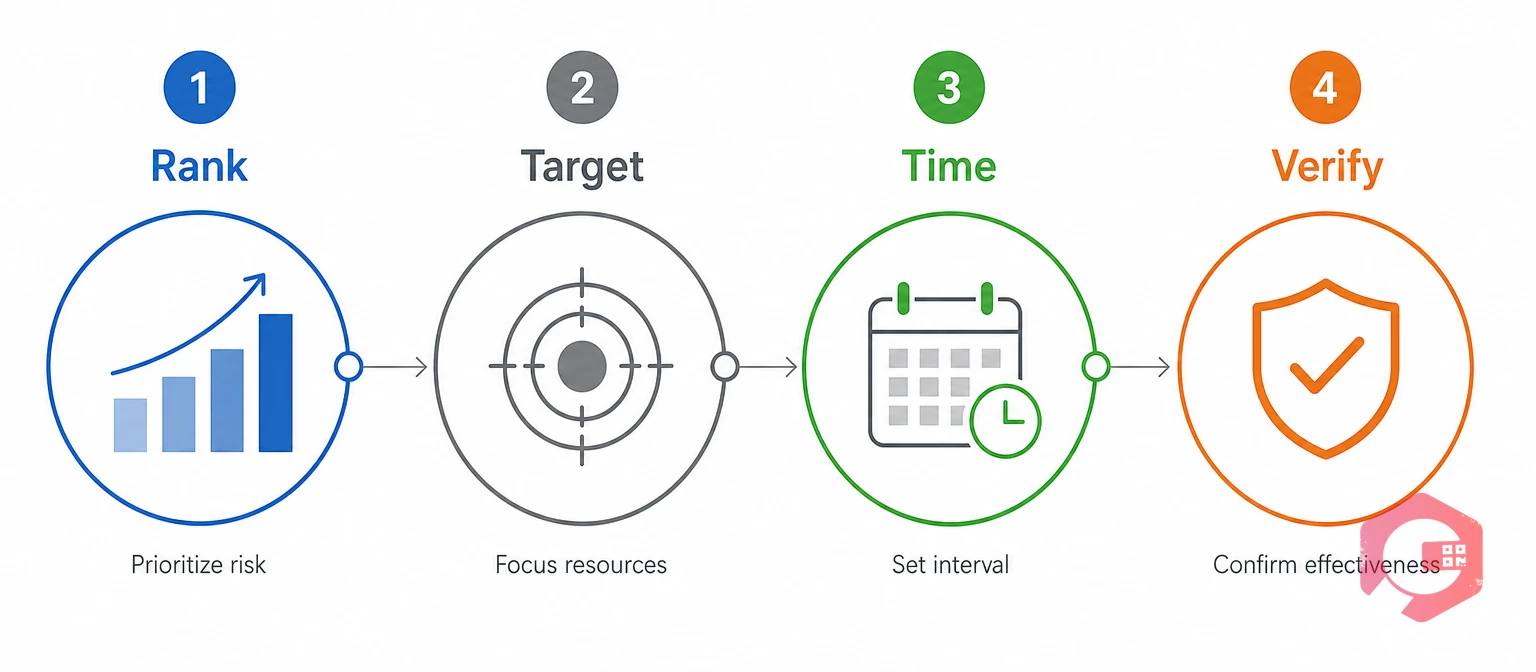
Risk-based inspection sets an interval by finding the date when calculated risk is expected to reach the site's risk target. The risk target is the level of risk the site accepts before action is required. Damage such as wall thinning grows with time, so risk rises each year. Inspection is planned before risk crosses the target.
The Risk-to-Interval Method:
API 581 rates planned inspections from A (highly effective) to E (ineffective). An inspection that finds the expected damage cuts uncertainty and lowers calculated risk. The next interval can then lengthen. A weak inspection changes little.
Default API 510 rules cap internal inspection intervals at half the remaining life or 10 years, whichever is shorter. A documented RBI assessment can justify other intervals. It must follow API 580 and use qualified people. The regulator or insurer may need to accept it.
The U.S. Bureau of Safety and Environmental Enforcement runs a risk-based inspection program for offshore facilities. Regulators already use this logic. An RBI interval is a calculated result, so reassess it after process changes, major findings, or new inspection data.
A risk register lists each item with its damage mechanism, risk categories, and inspection plan. This example is illustrative, not data from a real plant, and matrix labels vary by site.
| Equipment | Main damage mechanism | PoF | CoF | Risk level | Example plan |
|---|---|---|---|---|---|
| Overhead piping | Thinning | 4 | D | High | Thickness scans at a short interval |
| Storage vessel | External corrosion under insulation | 3 | C | Medium high | Remove insulation at suspect areas |
| Heat exchanger | Water-side thinning | 3 | B | Medium | Tube inspection at a medium interval |
| Air receiver | Minor external corrosion | 2 | A | Low | Visual check at the longest interval |
Intervals follow risk, not equipment age or type. The air receiver can go years between detailed checks, while the overhead piping gets frequent attention.
Each row ends in a scheduled task. If that task slips, the ranking stops reflecting reality. Inspection results are what keep the damage factor accurate.
Most RBI programs fail on data and follow-through, not on math. Maintenance teams that successfully run RBI avoid five common mistakes:
Fixing these habits costs far less than a surprise failure.
A risk-based inspection plan lowers risk only when inspections happen on time and results return to the RBI team. Many programs struggle here. This is where Cryotos helps.
Illustrative scenario, based on patterns common in process plants rather than a named customer. A plant finishes an RBI study of its vessels and piping, and then three problems appear:
OSHA's process safety rule expects each record to show the date, the inspector, the equipment ID, the test, and the results.
A Computerized Maintenance Management System (CMMS) does not calculate API 581 risk. RBI software and engineers do that. A CMMS makes sure the plan is carried out and recorded. Cryotos does this in five ways:
Maintenance teams using Cryotos have reported up to 30% reduction in unplanned downtime and 25% faster repair turnaround. These are general results across maintenance programs, not RBI-specific figures. For RBI, the practical gain is a complete, current inspection record for every asset.
Risk-based inspection is a way to plan inspections by risk instead of by calendar. Equipment that is more likely to fail, or would cause more harm if it did, is inspected sooner and more thoroughly.
API 580 sets the principles and minimum elements of an RBI program. API 581 provides a quantitative method to calculate probability, consequence, and risk. Most programs use both.
API 581 projects risk forward in time. The interval ends on the date risk is expected to reach the site's risk target. The effectiveness of the planned inspection adjusts that date.
Yes, when a documented RBI assessment supports it. The assessment should follow API 580 and be done by qualified people. Any regulator or insurer involved should accept it. Intervals can also get shorter.
No. RBI software calculates risk and recommends intervals. A CMMS schedules the inspections, collects results, and keeps records. The two work together.
A risk-based inspection plan is only as strong as its execution. Schedule a free demo to see how Cryotos schedules inspections, captures field readings, and flags overdue work.


Cryotos AI predicts failures, automates work orders, and simplifies maintenance—before problems slow you down.