

A maintenance planner and a maintenance scheduler are two distinct roles in a preventive maintenance programme, and confusing them is one of the most common reasons maintenance teams underperform. The planner prepares the work — defining scope, gathering parts, writing instructions, and estimating labour. The scheduler coordinates execution — assigning technicians, sequencing jobs, managing windows, and communicating timing to production. Both roles are essential, and when one person tries to do both without clear boundaries, both suffer.
According to a study by the Reliable Plant, facilities with dedicated planning and scheduling functions report 20–25% higher wrench time than those running combined or informal roles. This guide breaks down each role's responsibilities clearly — including what each role should never do — so you can structure your maintenance team for maximum output.
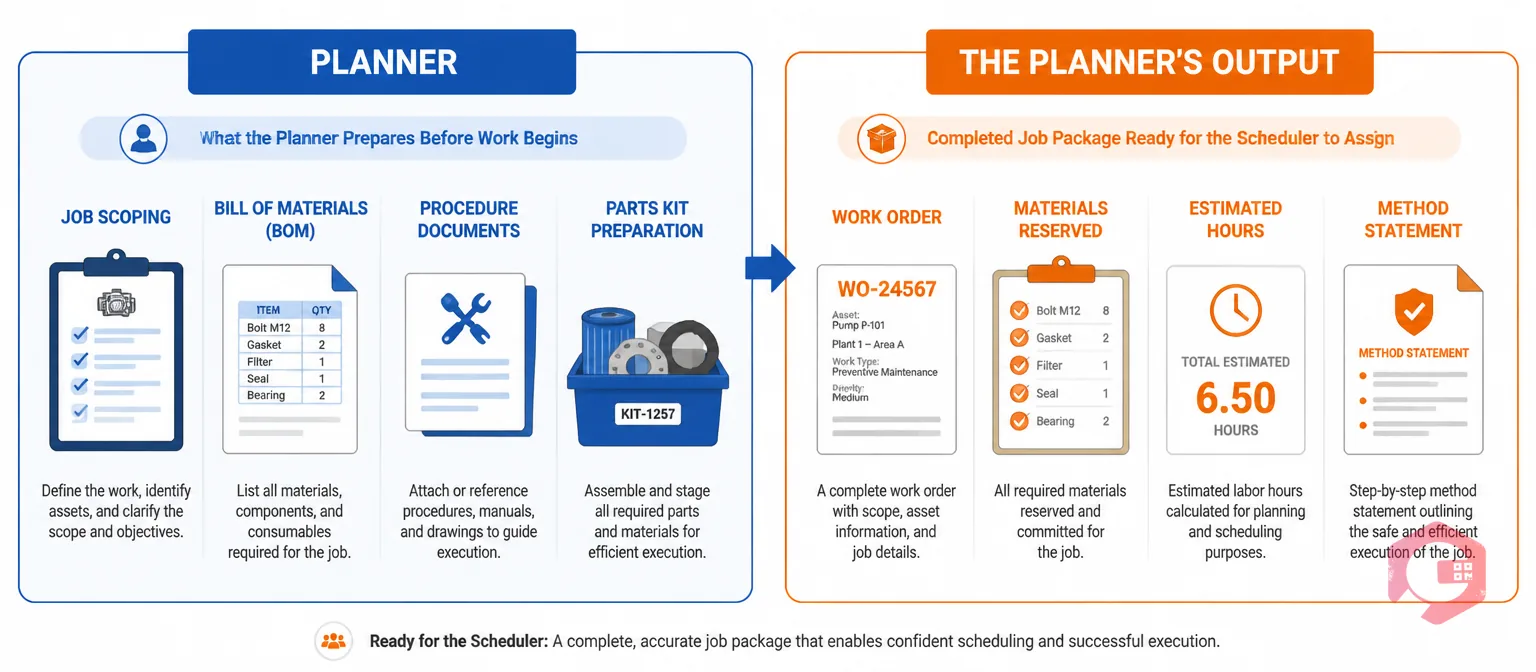
A maintenance planner is responsible for preparing maintenance work so that technicians can execute it efficiently and completely the first time. The planner answers the question: what needs to be done, and what is needed to do it?
Planners work ahead of execution — typically one to three weeks out. They review work order backlogs, scope each job, identify the tools, parts, permits, and skills required, and write step-by-step job plans. A good planner removes every obstacle that would cause a technician to stop, wait, or improvise mid-job.
In facilities with formal work order management systems, planners are also the custodians of job plan libraries — building reusable templates that improve every time the same task is completed. They capture feedback from technicians after each job and update plans with better instructions, corrected parts lists, or revised time estimates.
A maintenance scheduler is responsible for coordinating when and by whom approved, planned work gets executed. The scheduler answers the question: who does this, when, and in what order?
Schedulers work in a shorter time horizon — typically one to two weeks, with a specific focus on the weekly and daily schedule. They take planned work orders from the planner's queue and match them to available technicians, open production windows, and parts availability. They sequence jobs to maximise efficiency, minimise travel time, and reduce unnecessary machine downtime.
Schedulers are the primary communication link between maintenance and operations. They negotiate shutdown windows with production supervisors, manage crew capacity across shifts, and adjust the schedule in real time as priorities change or emergencies arise. In facilities using a preventive maintenance software platform, schedulers often manage the scheduling board, capacity views, and daily dispatch lists.
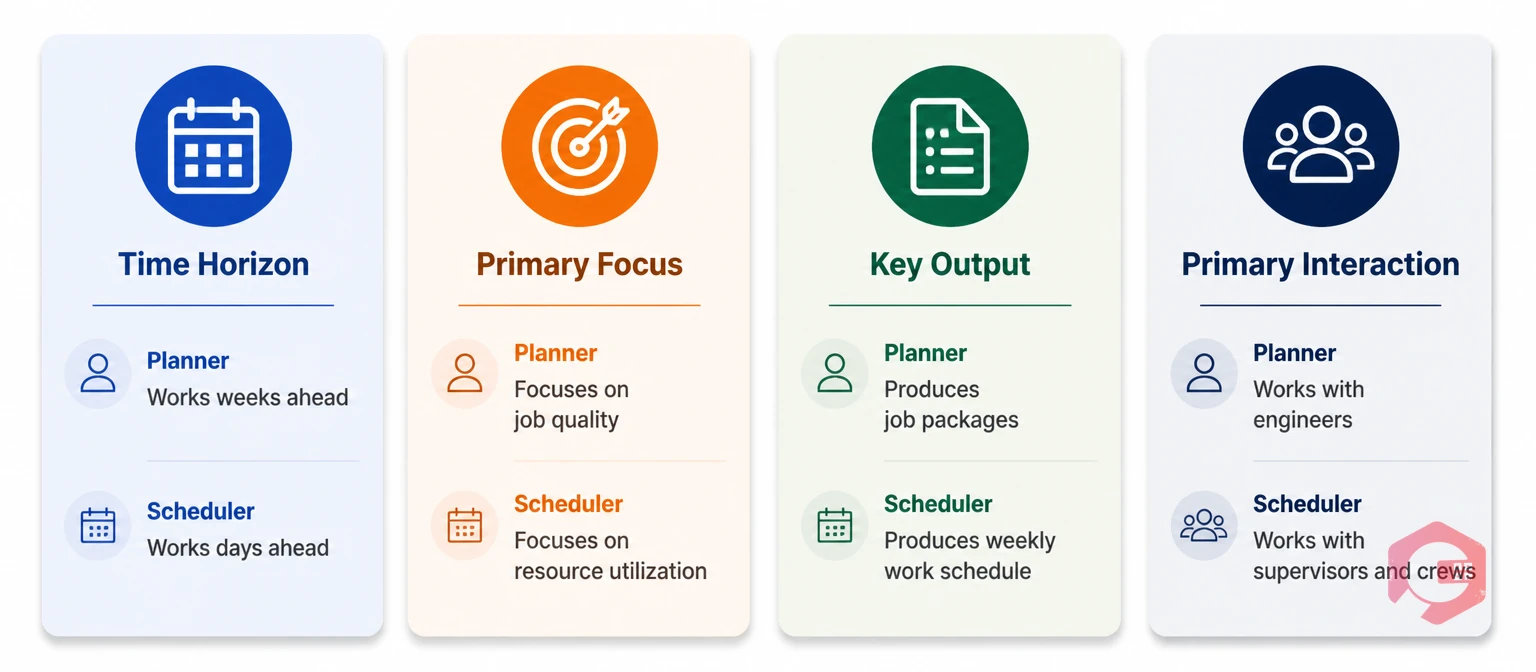
The clearest way to understand the distinction is to look at both roles across common dimensions. Here is a structured comparison:
| Dimension | Maintenance Planner | Maintenance Scheduler |
|---|---|---|
| Primary question | What needs to be done and what is needed? | Who does it, when, and in what order? |
| Time horizon | 1–3 weeks ahead | 1–2 weeks, daily focus |
| Output | Job plans, parts kits, permit lists, work packages | Weekly schedule, daily dispatch list, crew assignments |
| Primary data source | Work order backlog, asset history, OEM manuals | Technician availability, production schedule, parts status |
| Key relationship | Technicians (job quality feedback) | Production supervisors (timing and access) |
| Success metric | Job plan quality, first-time completion rate | Schedule compliance rate, wrench time |
| Reactive work involvement | Plans emergency work packages after the fact | Manages crew reallocation in real time |
The planner's value is in preparation quality. Every hour a planner spends on a thorough job plan typically saves two to four hours of technician time on the floor. Here is what planners should own:
Planners are most effective when they stay out of execution. Crossing these lines reduces planning quality and confuses accountability.
The scheduler's value is in maximising the productive output of the maintenance crew. A skilled scheduler ensures that technicians always have approved, fully planned work ready to execute — and that production never loses access to assets longer than agreed. Here is what schedulers should own:
Schedulers operate in the short term. Overstepping into planning or supervision creates gaps in both functions.
In smaller facilities with five to fifteen technicians, having a dedicated planner and a dedicated scheduler is often not economically practical. One person frequently covers both functions — and this can work, but only with strict discipline about keeping the two mindsets separate.
The most common failure mode is that the combined planner-scheduler spends all their time reacting to the week's schedule (the scheduler mindset) and never builds the backlog of planned work (the planner mindset). Within a few months, unplanned work dominates the schedule, wrench time drops, and the team is effectively reactive.
If you run a combined role, protect planning time explicitly. Block two to four hours per day as planning-only time — no schedule adjustments, no emergency calls. Use this time to scope new work orders, build job plans, and manage the ready backlog. Many facilities use the morning for planning and the afternoon for scheduling coordination.
A maintenance management software platform makes the combined role more manageable by automating routine scheduling tasks — generating PMs on schedule, surfacing the ready-to-schedule queue, and tracking parts availability — so the planner-scheduler can focus on judgement rather than administration.
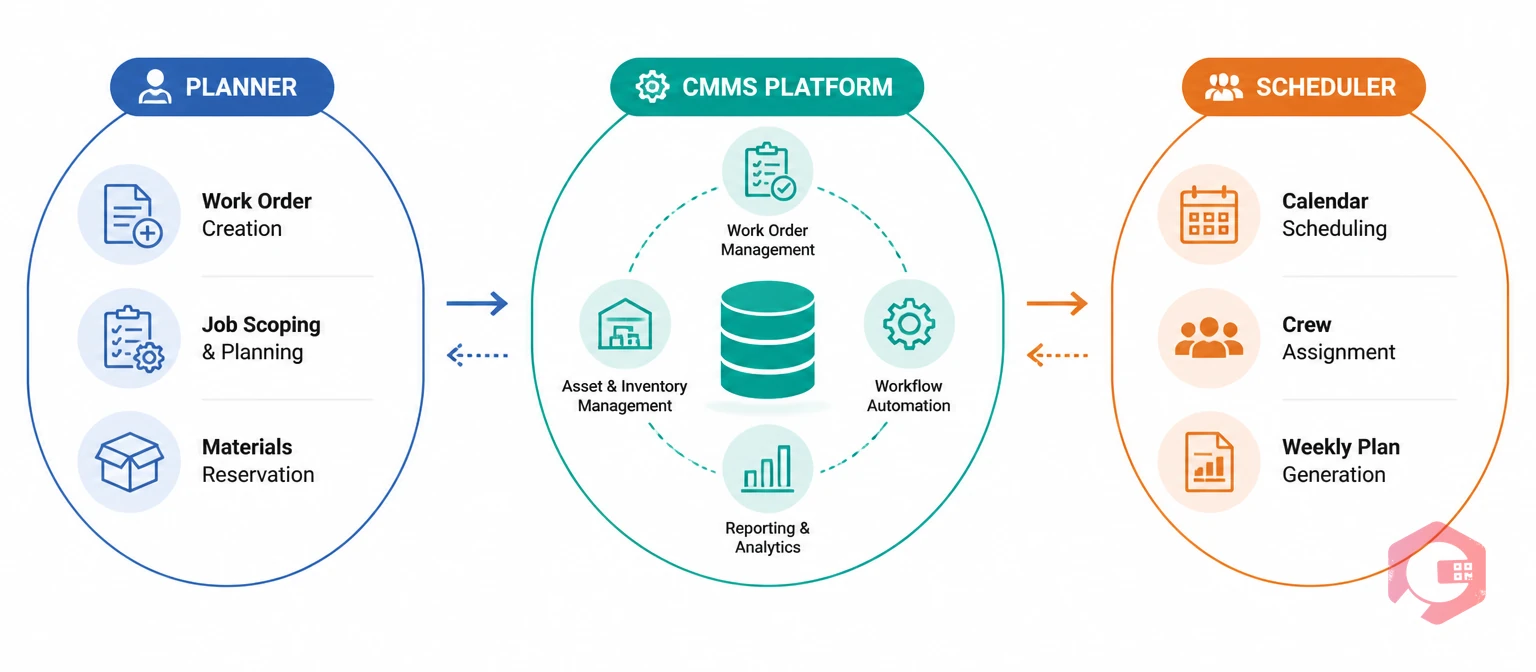
A CMMS does not replace planners or schedulers — it gives both roles the data and tools they need to do their jobs more effectively. Here is how a well-configured work order management system supports each function:
For the planner, a CMMS provides complete asset history so job plans are based on actual failure patterns rather than guesswork. It stores job plan libraries and makes them reusable across similar assets. It links parts requirements directly to work orders, with real-time visibility into storeroom stock. Cryotos's maintenance checklists allow planners to build step-by-step inspection and repair procedures that technicians complete on mobile — with numeric readings, photos, and sign-off fields built in. After each job closes, the planner can review technician notes and update the job plan immediately.
For the scheduler, a CMMS provides real-time visibility into technician availability, open work order status, and preventive maintenance due dates. Cryotos's drag-and-drop PM scheduling calendar gives schedulers a visual tool for building the weekly plan without manual spreadsheet work. Automated WhatsApp and email notifications keep technicians and production supervisors informed of schedule changes without the scheduler manually contacting each person. The BI dashboard tracks schedule compliance, wrench time, and backlog size in real time — giving schedulers the KPI data they need to improve week over week.
According to Reliability Engineering resources, organisations that digitise their planning and scheduling workflow report 15–20% improvements in planned maintenance percentage (PMP) within the first year. Cryotos customers have reported a 30% reduction in unplanned downtime and 25% faster repair times, outcomes that depend directly on strong planning and scheduling discipline supported by the right platform.
The planner prepares the work — scoping jobs, writing instructions, identifying parts, and managing permits. The scheduler coordinates execution — assigning technicians, securing production windows, and sequencing jobs. Planners work two to three weeks ahead; schedulers focus on the current week and daily dispatch.
Yes, in smaller facilities one person often covers both roles. The key is to protect dedicated time for each function. Without explicit planning time blocked on the calendar, the scheduling demands of the current week will crowd out the preparation work that prevents next week's problems.
Key planner metrics include job plan quality (measured by rework rate and technician feedback), first-time completion rate, percentage of work orders fully planned before scheduling, and parts availability rate at job start. Measuring planners on schedule compliance is a mistake — that is the scheduler's metric.
World-class maintenance organisations target 90% or higher schedule compliance. A rate below 75% consistently indicates systematic problems — either too much reactive work overwhelming the schedule, inaccurate job plans generating delays, or parts not confirmed before jobs are scheduled.
A CMMS gives planners access to complete asset history, job plan libraries, and real-time parts availability. It gives schedulers a visual scheduling board, automated PM generation, and live capacity views. Together, these tools reduce the administrative burden on both roles and give them the data needed to make better decisions — replacing manual spreadsheets with a single source of truth for all planned maintenance work.
When the boundaries are unclear, reactive work tends to dominate. The person nominally covering both roles spends their day on today's schedule and emergencies, never building the backlog of planned work. Over time, unplanned maintenance percentage climbs, wrench time drops, and the maintenance team becomes permanently reactive — addressing failures rather than preventing them.
If your maintenance team is running both roles informally or struggling to separate planning from scheduling, Cryotos CMMS gives you the platform to formalise both functions. From job plan libraries and parts kitting to drag-and-drop scheduling and real-time PM dashboards, Cryotos supports the full planning and scheduling workflow in one place. Book a free demo today and see how your team's wrench time and schedule compliance can improve within the first 90 days.




Cryotos AI predicts failures, automates work orders, and simplifies maintenance—before problems slow you down.



