

Multi-technology asset management means tracking and maintaining thermal, solar, and wind assets in one system. It replaces separate tools built for just one plant type. Operators running mixed power portfolios face a real challenge. Turbines, boilers, inverters, trackers, and gearboxes all age and fail differently. Yet leadership still needs one clear view of risk, cost, and reliability across every site.
When each plant type runs its own spreadsheet or SCADA-only setup, problems build fast. Asset data turns inconsistent. Spare-parts visibility lags behind. Portfolio-level decisions slow down. A unified Computerized Maintenance Management System (CMMS) closes that gap. It standardizes how every asset gets registered, monitored, maintained, and reported, no matter which technology generates the power.
Key Takeaways

Multi-technology asset management matters because thermal, solar, and wind assets don't fail the same way. A thermal plant runs rotating equipment. Turbines, boilers, and generators respond to vibration and heat. Solar sites run static electrical gear instead. Inverters, trackers, and combiner boxes degrade through electrical stress. Wind sites add gearboxes, blades, and nacelles. These parts face mechanical fatigue at height.
A single asset platform is one register, one work queue, and one report layer spanning every generation technology. Many operators build these programs around the ISO 55000 asset management standard. That standard sets the framework most enterprise asset registers follow. Treating each plant type as its own silo creates more than paperwork — it drives up real cost and risk.
Most maintenance teams that consolidate onto one platform see faster decisions within two quarters. Comparing uptime and cost no longer means merging three spreadsheets by hand. A power plant maintenance software platform gives every site the same operating layer. It doesn't matter how the electricity gets generated.
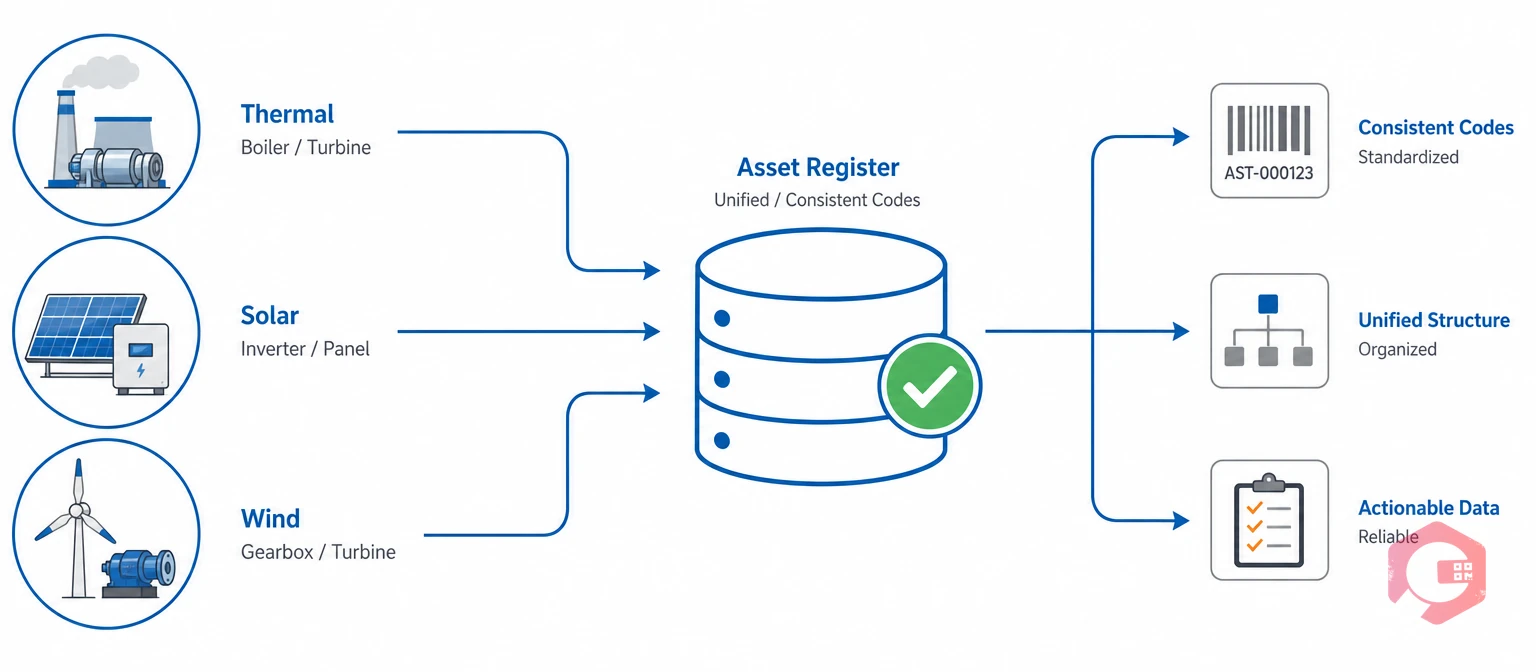
Multi-technology asset management depends on one thing above all: a unified asset register. It assigns every asset one consistent code, criticality rating, and location tag. This covers boilers, turbines, inverters, trackers, gearboxes, and blades alike. That consistency makes cross-site searching, filtering, and reporting possible.
| Plant Type | Example Critical Assets | Suggested Code Prefix | Typical Criticality Driver |
|---|---|---|---|
| Thermal | Boilers, turbines, generators | TH- | Rotating equipment vibration and heat risk |
| Solar | Inverters, trackers, combiner boxes | SL- | Electrical degradation, string-level output loss |
| Wind | Gearboxes, blades, nacelles | WD- | Mechanical fatigue, height-access safety risk |
Consistent codes and criticality ratings help portfolio managers work faster. They can filter every high-criticality asset across the fleet in one query, not three. Pairing that register with asset tracking and QR code scanning helps too. Field technicians pull up the right record instantly, no matter which plant type they're standing in.

Standardizing maintenance means keeping every plan visible in one system. This applies across thermal, solar, and wind sites, even though triggers differ by technology. A thermal turbine's plan might run on operating hours. A solar inverter's plan might run on calendar dates. A wind gearbox's plan might run on vibration thresholds instead.
Meter-based maintenance is a schedule trigger based on runtime, cycles, or sensor data instead of a calendar date. It fits rotating thermal equipment and wind gearboxes well, since usage varies site to site.
Digital checklists adapted per asset type keep every plan auditable. That beats scattering plans across separate, technology-specific tools. Teams using preventive maintenance software built for multi-site work see a real payoff. They often consolidate three or more legacy tools into one shared calendar.
Curious how your repair speed compares across plant types? Calculate your fleet's MTTR and see where standardized work orders could cut repair time.
Multi-technology asset management also depends on real-time condition data, not just historical records. Real-time monitoring routes sensor data, meter readings, and alarms into one workflow instead of three disconnected dashboards. Vibration and temperature trends flag issues in thermal rotating equipment. Inverter and string-level data flag weak solar arrays. Gearbox and blade data flag wind assets nearing failure.
National labs have published renewable energy research on this pattern. Inverter and string-level monitoring often catches solar degradation weeks before failure. The same early-warning logic applies to vibration monitoring on thermal equipment.
Turbines, inverters, and gearboxes share almost nothing on the parts list. But consumables like filters, lubricants, and fasteners cross every site. Cross-site part transfer means moving available stock between plants before placing a new order. It cuts both lead-time risk and carrying cost.
Routing condition alerts and inventory checks through the same IoT and condition monitoring integration pays off fast. A flagged asset checks part availability automatically, before a technician even gets dispatched. Maintenance teams using Cryotos report up to 30% less unplanned downtime. They also see 25% faster repair turnaround once condition data connects directly to work orders and inventory.
Multi-technology asset management gets tested hardest at the compliance stage, since requirements differ so much by site. Thermal sites answer to emissions monitoring. Solar sites answer to electrical safety codes. Wind sites answer to height-and-rotating-equipment hazards, including OSHA's fall protection and lockout-tagout requirements.
Audit-ready documentation is a permit, checklist, and inspection record any compliance team can produce on demand. An approval workflow tied to digital checklists keeps that record consistent. It works the same at a boiler house or a wind tower.
Most facilities that pass audits without a scramble treat mobile checklists and document management as one connected system. Paper is not just a backup to a digital record — it disappears from the workflow entirely.
Multi-technology asset management pays off most clearly at the benchmarking stage. That's when portfolio managers finally compare technologies apples to apples. Benchmarking means comparing uptime, MTTR, planned-versus-unplanned ratios, and cost per MWh side by side. This only works with one shared data model, not three incompatible formats. Without that model, a manager can't tell if a thermal plant's higher repair cost reflects real risk or just poor tracking.
Recent U.S. electricity generation data shows thermal, solar, and wind sources together making up a growing share of the grid. That raises the stakes for comparable cost and reliability tracking across all three. Most operations that benchmark well rely on scheduled reports and one shared dashboard. They skip the manual exports from three separate systems every quarter.

A unified CMMS platform ties everything together. It runs every plant type through the same seven-stage layer. It doesn't matter if the electricity comes from a boiler, an inverter, or a turbine blade.
The Unified Generation Asset Framework:
The platform standardizes process and visibility across plant types. It doesn't replace site-specific expertise. A thermal technician, a solar electrician, and a wind rope-access crew each bring skills no software can replicate. Reliability-centered maintenance principles still guide the judgment calls. The CMMS just makes sure that judgment gets recorded and compared across the whole fleet.
Multi-technology asset management means tracking, maintaining, and reporting on thermal, solar, and wind assets in one system. It replaces separate, plant-specific tools. Operators get a single register, work queue, and report layer, no matter the generation technology.
Yes. A CMMS built for multi-site work gives each asset type its own maintenance logic, checklists, and criticality rules. Everything still lives inside one shared register and report layer. The system doesn't force one strategy onto every technology — it standardizes the process around each one.
Teams compare uptime, MTTR, MTBF, planned-versus-unplanned ratios, and cost per MWh side by side. That only works once every site logs data the same way. A shared dashboard and scheduled reports make that portfolio-wide view possible, without manual spreadsheet rollups.
The biggest risk is losing the ability to compare sites fast. Fragmented systems create inconsistent asset data, duplicate work orders, and delayed spare-parts visibility. Those gaps often show up as higher unplanned downtime, long before anyone notices the reporting problem itself.
Running thermal, solar, and wind assets on separate systems adds cost and risk. A unified platform is built to remove both — that's the outcome multi-technology asset management is built to deliver. Schedule a free demo to see how Cryotos brings every generation technology in your portfolio onto one asset management system.


Cryotos AI predicts failures, automates work orders, and simplifies maintenance—before problems slow you down.



