

Manufacturing safety training for maintenance teams is a structured program that equips technicians with the knowledge and procedures to work safely around energised equipment, confined spaces, electrical systems, and chemical hazards. OSHA estimates that compliance with its energy control standard alone prevents approximately 50,000 injuries and 120 fatalities annually in U.S. manufacturing. Yet maintenance teams remain one of the highest-risk groups on any plant floor — because their work is non-routine, high-hazard, and often performed under time pressure. This guide covers what effective safety training looks like, which modules matter most, how to build a program, and how to close the gap between training records and actual compliance.
Key Takeaways
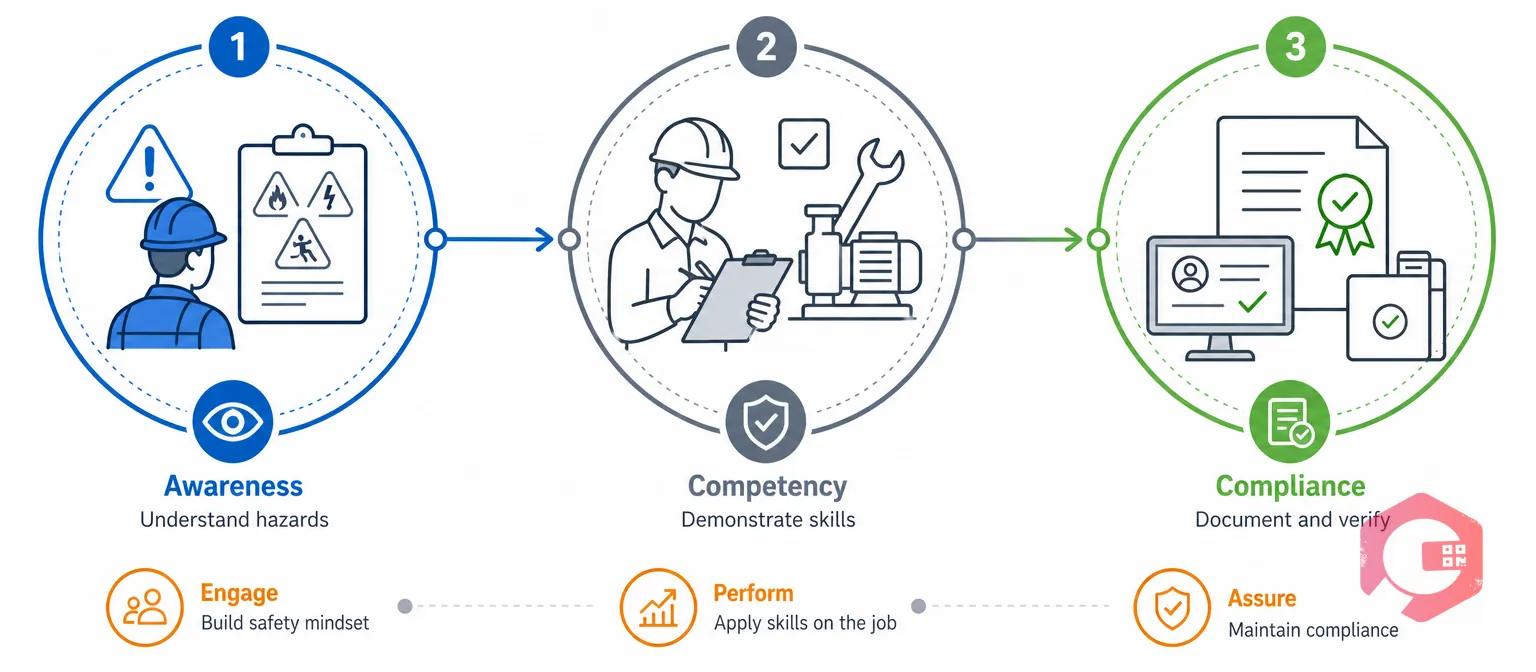
Manufacturing safety training is a systematic process of educating maintenance personnel on the specific hazards, regulations, and control measures that apply to their tasks — verified through demonstrated competency, not just attendance. The distinction matters. A sign-in sheet proves a technician was present. It does not prove they can correctly apply a lockout hasp on a 480V motor starter, identify an arc flash boundary, or complete a confined space entry permit without prompting.
Competency-based assessment is the standard that separates genuine manufacturing safety training from a compliance checkbox. Every high-risk task requires the technician to demonstrate the skill on actual equipment, under realistic conditions, to a qualified assessor — not pass a written test.
Regulatory frameworks define the minimum training requirements. In the United States, OSHA's General Industry Standards (29 CFR 1910) specify training content, frequency, and documentation requirements for energy control (1910.147), confined spaces (1910.146), electrical safety (NFPA 70E), and hazard communication (1910.1200). ISO 45001 Clause 7.2 adds an international requirement: organizations must retain documented evidence of competence — not just training records.
Production workers follow predictable, repetitive routines. Maintenance technicians do not. They enter confined spaces, isolate live electrical systems, work at height on mezzanines and conveyors, and handle chemicals most plant staff never encounter. OSHA's "Fatal Four" — falls, electrocution, struck-by, and caught-in/between — apply directly to routine maintenance tasks in ways they do not apply to production roles.
Generic safety inductions cover fire exits and housekeeping. They do not cover how to write a confined space entry permit, which PPE category applies to a specific arc flash boundary, or how stored hydraulic pressure can release after a main isolator is locked out. That gap is where maintenance incidents happen.
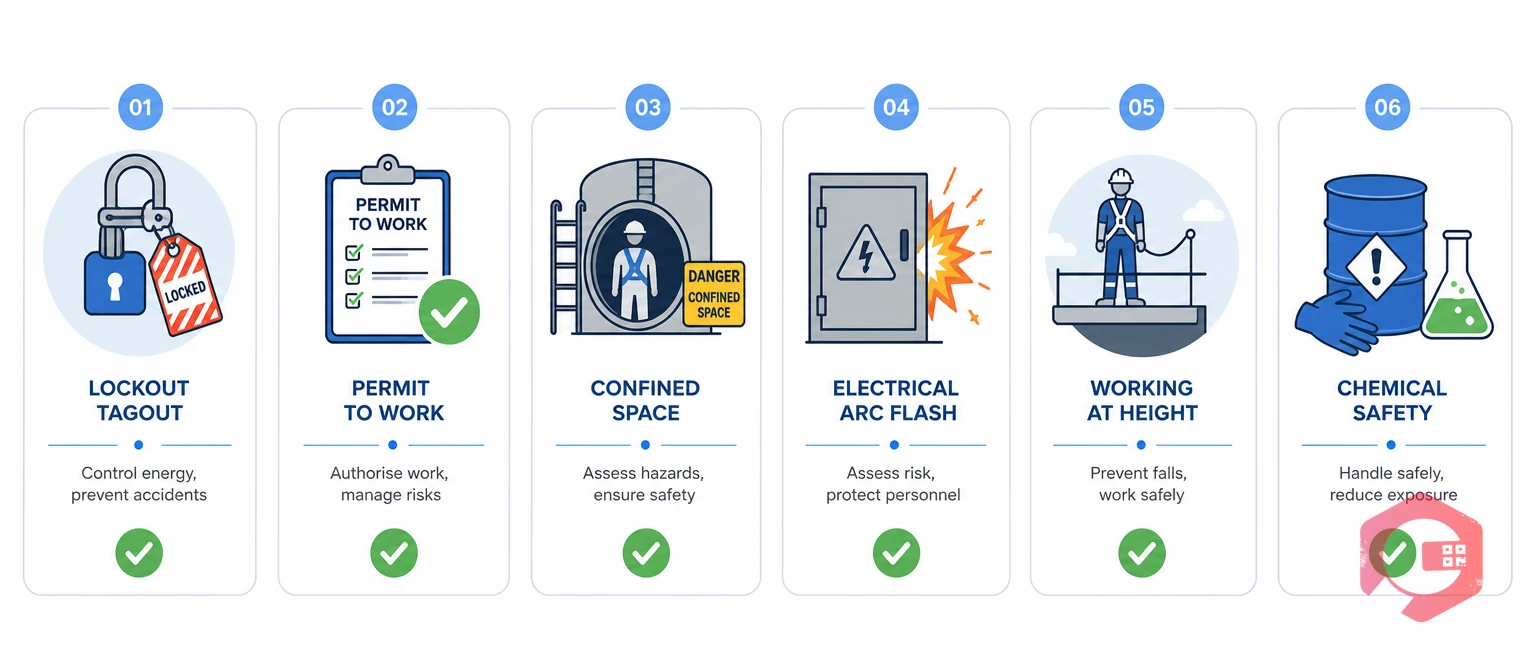
Six modules account for the majority of maintenance fatality risk. Sequence them from highest consequence to lowest — start with energy control and work upward.
Lockout/Tagout (LOTO) is the procedure for isolating all energy sources before maintenance work begins — electrical, hydraulic, pneumatic, gravitational, thermal, and stored mechanical. OSHA's energy control standard (29 CFR 1910.147) requires machine-specific written procedures, not generic plant-wide instructions. Training must cover energy source identification for each asset, lockout device application, group lockout for multi-technician tasks, and the try-out verification step — physically attempting to start the machine after isolation to confirm zero-energy state.
Conduct LOTO training on the actual machines in your plant. A training prop does not transfer to the floor the way equipment-specific practice does. Competency assessment: the technician correctly performs the full isolation sequence on their assigned equipment without prompting.
A Permit to Work is a formal written authorization required before any high-risk maintenance task begins — covering confined space entry, hot work, electrical work above low voltage, and work at height above 2 metres. Training must cover all three PTW roles: the Permit Issuer (typically the shift supervisor who signs and retains authority to cancel), the Permit Receiver (the lead technician who briefs the work team), and the Performing Authority (every technician on the team who must understand permit conditions before work starts).
Cryotos's permit to work software digitizes the full PTW workflow — from permit creation and approval routing to real-time status tracking and automatic closure — eliminating the most common failure mode: a technician starting work before the permit is formally approved.
Permit-required confined spaces — vessels, tanks, silos, pits, and ducts — account for some of the highest multi-fatality incident rates in manufacturing. Training must cover atmospheric hazards (oxygen deficiency, flammable and toxic gases), atmospheric testing before and during entry, ventilation requirements, the attendant's role, and non-entry rescue procedures. Attendants must never enter a space to rescue an entrant without trained rescue personnel and equipment in place.
Electrical maintenance technicians require training aligned with NFPA 70E — the Standard for Electrical Safety in the Workplace. Training covers arc flash hazard analysis, incident energy calculations, arc flash boundary establishment, PPE category selection, and verification of de-energization before any contact with electrical components. Refresh this training whenever equipment is modified or arc flash hazard analysis is updated.
Working at height training covers the fall protection hierarchy (elimination, passive protection, fall arrest), correct fitting and pre-use inspection of safety harnesses, ladder safety, and scaffold inspection. Competency assessment requires the technician to calculate required fall clearance and correctly identify a suitable anchor point for their specific task.
Chemical safety training covers GHS classification, Safety Data Sheet (SDS) interpretation, storage and segregation rules, and emergency spill response — using the specific chemicals found in your plant, not generic examples. According to the Society for Maintenance and Reliability Professionals (SMRP), chemical exposure and working-at-height incidents are two of the most frequently under-reported maintenance hazard categories in manufacturing facilities.
Maintenance teams using Cryotos have reported up to 30% reduction in unplanned downtime and 25% faster repair turnaround when safety prerequisites are built directly into work order workflows — linking training compliance to task authorization rather than relying on paper records.
See how Cryotos connects permit workflows, safety checklists, and work order release in one platform — including digital regulatory compliance checklists tied directly to each work order type.
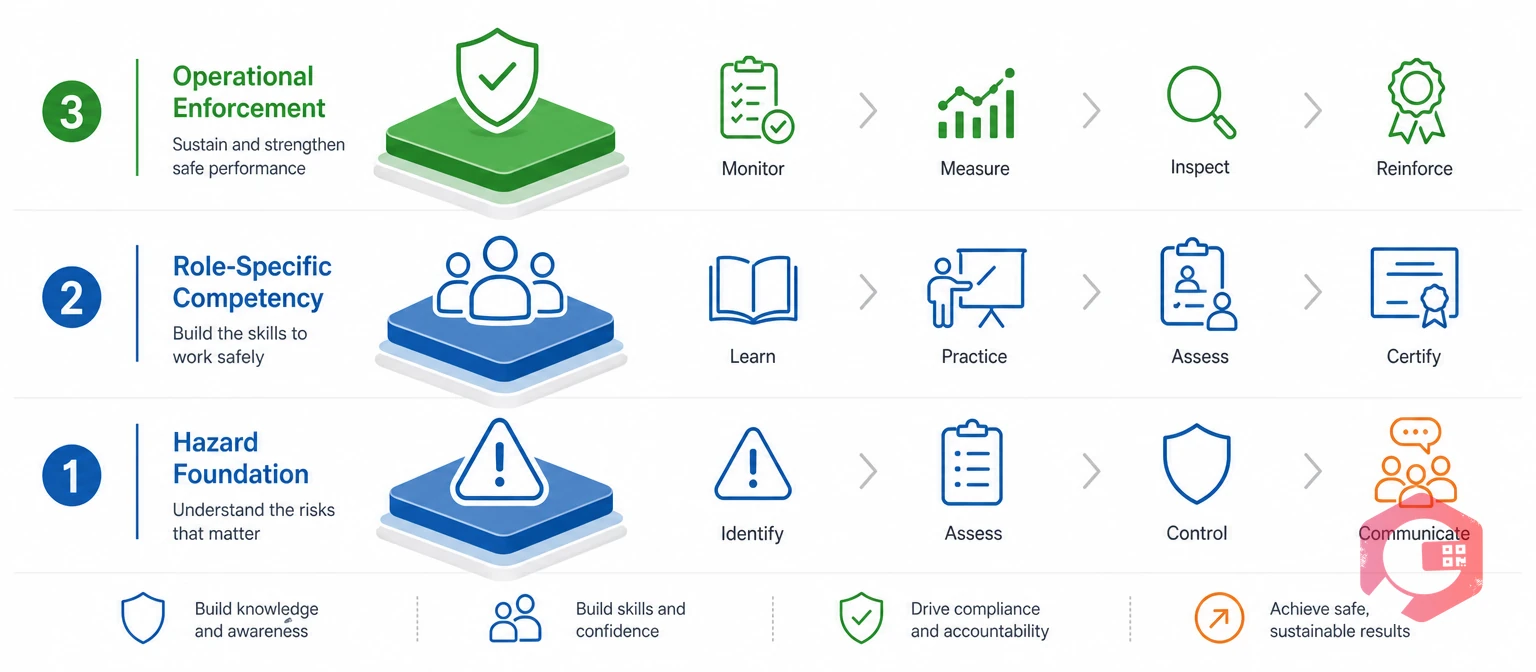
Most manufacturing safety training programs fail at implementation because they treat training as an event rather than a system. A practical program needs structure across three layers that build on each other.
The 3-Layer Safety Training Stack:
Training cadence: monthly toolbox talks on one specific hazard or recent near-miss; quarterly competency checks for LOTO, confined space, and electrical; annual recertification for regulatory requirements; immediate retraining after any recordable incident or significant equipment change.
Tracking and enforcing manufacturing safety training compliance is where most programs break down. A complete safety training record for each technician must include the training date, specific competencies assessed, the assessor's name, the result, and the next recertification date — retrievable on demand during an audit. Paper folders and spreadsheets fail consistently at the fourth requirement. Expiry dates get missed. Records get misfiled. Auditors find gaps that a digital system would have flagged months earlier.
A Computerized Maintenance Management System centralizes all certification data, sends automated alerts before expiry, and produces audit-ready compliance reports. Critically, it connects training status to work order release: when an electrical safety certification expires, every work order requiring that certification is flagged in the queue before a planner assigns it.
Use the safety compliance checklist to verify documentation coverage for every technician at least quarterly. Auditors checking against OSHA 29 CFR 1910, ISO 45001 Clause 7.2, or NFPA 70E look for four things: evidence training occurred, evidence it was relevant to the hazard, evidence competency was assessed (not just attendance), and evidence records are current. The last point is where most facilities are found non-compliant — not because training didn't happen, but because the records don't prove it.
Contractors working on your site carry the same regulatory requirements as direct employees. Verify contractor certifications against the same standard: current, task-specific, site-orientation completed, and linked to the permit or work order before work begins.
At minimum: Lockout/Tagout for all energy types specific to the assets the technician maintains, Permit to Work for their role (issuer, receiver, or performing authority), confined space awareness or entry training if applicable, electrical safety aligned with NFPA 70E, working at height, and chemical safety including SDS interpretation. Training should be role-specific and verified through demonstrated competency on the actual equipment — not generic e-learning modules with a sign-off sheet.
LOTO, confined space, and electrical safety require annual recertification at minimum, with quarterly competency checks recommended for tasks performed regularly. Monthly toolbox talks maintain hazard awareness between formal sessions. Any recordable incident or near-miss should trigger immediate retraining for all technicians performing similar tasks — not just those directly involved. Equipment changes or updates to machine-specific procedures also require targeted refresher training before the modified asset returns to service.
LOTO is a physical energy isolation procedure — it covers how to identify, isolate, and verify zero-energy state on a specific piece of equipment before maintenance begins. A Permit to Work is a management authorization system — it controls which high-risk tasks can proceed, who has reviewed the hazard controls, and who has formal authority to start, suspend, or cancel work. Both are required for most high-risk maintenance tasks: LOTO is how you isolate the energy; the PTW is the formal documented authorization that the isolation has been verified and the task is safe to proceed.
A CMMS enforces compliance by linking training records directly to work order authorization. When a technician's confined space certification expires, the system flags any work orders requiring that certification before they are assigned — not after the work is complete. Pre-task safety checklists embedded in work order templates require the technician to verify permit status, LOTO application, and PPE selection before the job can be marked as started. This closes the gap between a training record existing in a folder and training compliance actually being enforced at the task level.
Manufacturing safety training works when it is built into daily operations — not filed away as a compliance record. Schedule a free demo to see how Cryotos links safety training records, permit workflows, and maintenance checklists to work order authorization across your maintenance team.


Cryotos AI predicts failures, automates work orders, and simplifies maintenance—before problems slow you down.



