A minimum stock threshold is the lowest quantity of a spare part or supply item that your maintenance team should ever hold before triggering a replenishment order. When on-hand inventory falls to or below this level inside your CMMS, the system fires an automatic alert — giving your team time to reorder before a stockout halts a critical repair. According to a Plant Engineering industry survey, unplanned equipment downtime costs manufacturers an average of $260,000 per hour, and a missing spare part ranks among the most common causes of extended repair delays.
Key Takeaways
This guide walks through exactly what minimum stock thresholds are, how to calculate them using a data-driven formula, how a CMMS automates the entire process, and the mistakes that silently inflate your stockout risk.
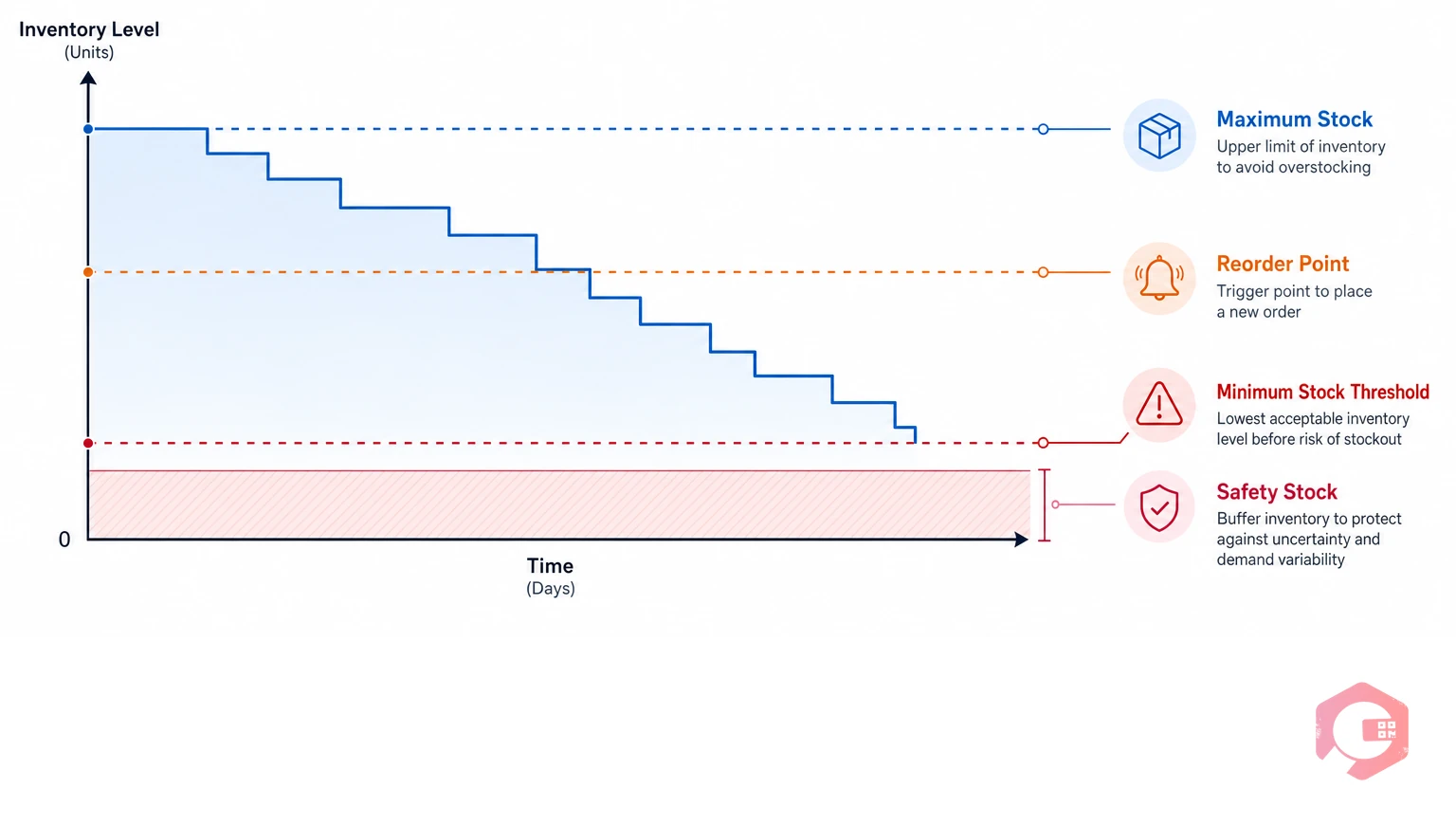
A minimum stock threshold — also called a minimum stock level — is a predefined quantity set in your inventory system that signals: "If we drop to this number, we need to reorder now." Think of it as the fuel warning light in your vehicle. When the gauge hits the orange zone, you do not wait until the engine sputters. You stop at the next station.
In a maintenance context, the "engine" is your production floor. The "fuel" is the spare parts, consumables, and MRO materials your technicians need to close work orders on time. When a part's on-hand count hits the minimum threshold, your CMMS should respond immediately — not after a manual stockcheck three days later.
These three terms are frequently used interchangeably, but they mean distinct things in inventory control:
The practical difference: your minimum threshold tells the system to alert you. Your reorder point tells procurement to act. Your safety stock tells the warehouse how much to keep as a cushion. All three need to be set — and all three need to be reviewed on a regular cycle. Cryotos inventory management lets you configure all three per part per location, with automated alerts firing at each trigger level.
Setting accurate minimum stock thresholds protects maintenance operations on three fronts simultaneously: downtime prevention, cost control, and compliance readiness. Each one compounds the others.
When a breakdown work order is raised and the required part is not in stock, every hour spent waiting for an emergency delivery is an hour of lost production. Maintenance operations research consistently identifies parts availability as one of the top three contributors to mean time to repair (MTTR). A correctly set threshold means the part is already on its way before the machine fails — not ordered in a panic after it does.
Emergency procurement — sourcing a part outside normal purchase channels because stock ran out — typically costs 20–40% more than a planned order. Maintenance teams that set and maintain accurate thresholds report up to 25% lower procurement costs year-over-year, simply by eliminating the rush-order premium. There is a secondary saving too: when thresholds are too high, you carry excess stock that ties up capital and risks shelf-life expiry on consumables.
For regulated industries — pharmaceutical manufacturing, food and beverage, healthcare facilities — maintaining documented evidence of controlled inventory management is a compliance requirement. A CMMS with configured minimum thresholds produces an auditable record: which parts are controlled, at what levels, and when alerts were triggered. That evidence satisfies ISO 55000 asset management requirements and internal maintenance audits without extra reporting effort.
Maintenance teams using Cryotos have reported up to 30% reduction in unplanned downtime and 25% faster repair turnaround — largely driven by parts being available at the point of need rather than chased down after a breakdown.
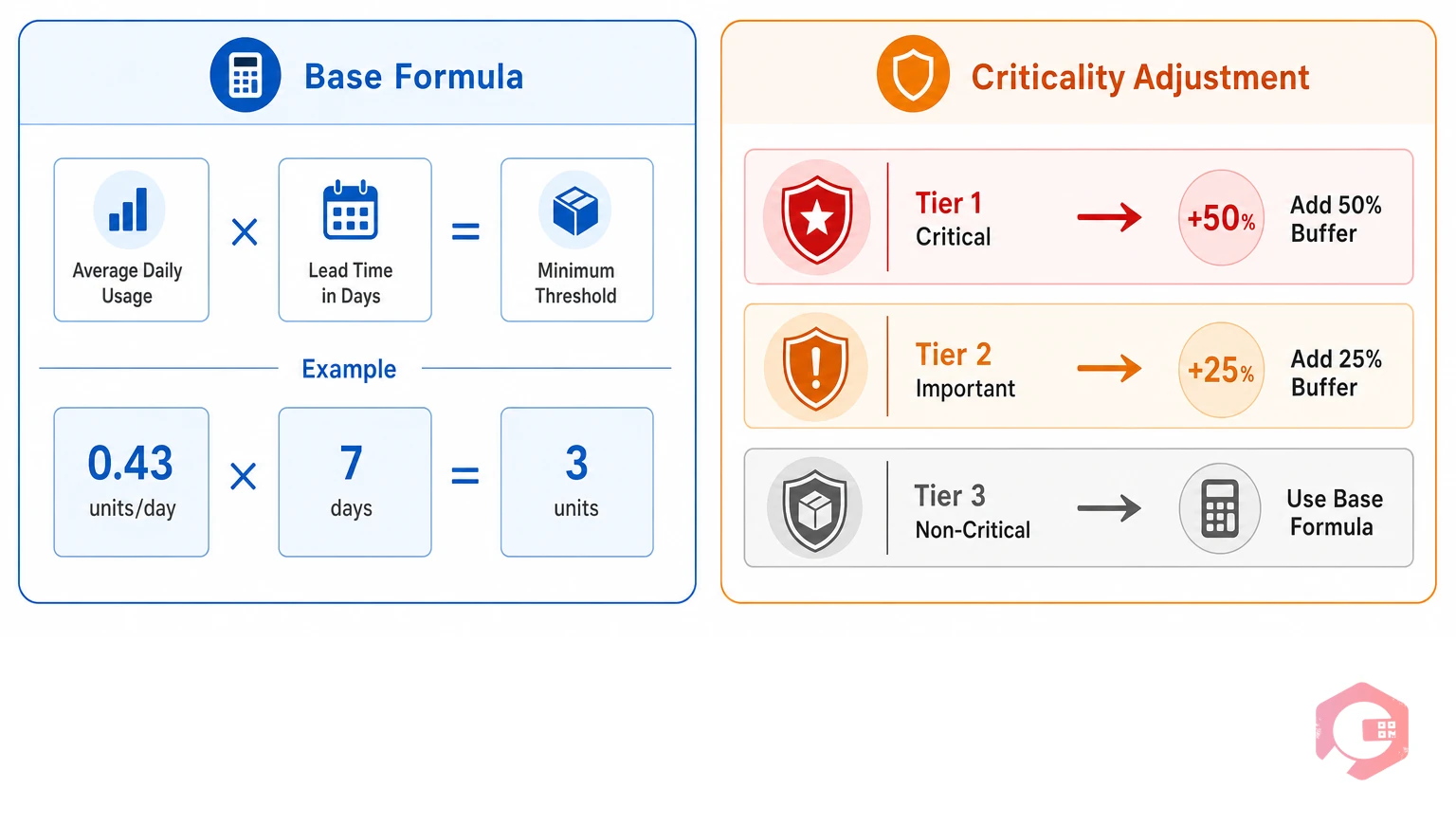
The core formula for a minimum stock threshold is: Minimum Stock Threshold = Average Daily Usage × Supplier Lead Time in Days. This baseline tells you the minimum quantity needed to keep operations running through the full replenishment cycle under normal conditions.
Asset criticality is the adjustment factor that turns a generic formula into an operationally safe threshold. Without it, a single formula treats a $2 O-ring the same as a $4,000 pump impeller for a production-critical asset — a dangerous oversimplification.
Three variables feed into this formula. Getting each one right makes the difference between a threshold that protects you and one that gives you a false sense of security.
Pull 12 months of consumption data for the part from your CMMS work order history. Divide total units consumed by working days in the period. For parts with seasonal demand patterns — HVAC filters peak in summer, heating elements in winter — calculate separate seasonal averages rather than one annual figure.
Use your confirmed supplier lead time — the calendar days between raising a purchase order and receiving the part at your storeroom. If your supplier's quoted lead time is 5 days but your actual receipt history shows 7 days on average, use 7. Lead time variability is a common source of stockout even when the formula looks correct on paper.
The base formula treats all parts equally. Asset criticality adds a buffer multiplier based on the consequence of failure:
Example: A bearing for a Tier 1 centrifugal pump with average daily usage of 0.4 units and a 7-day lead time gives a base threshold of 2.8 (round to 3). Apply the 50% Tier 1 buffer: minimum stock threshold = 4.5 — round to 5 units.
This is the Cryotos 3-Variable Threshold Framework: Average Usage × Lead Time × Criticality Multiplier. It produces a threshold that accounts for normal consumption, supplier timing, and business risk in a single defensible number.
Review thresholds at minimum every quarter. Trigger an immediate review after any stockout event, a significant change in production volume, or a confirmed shift in supplier lead time. Track threshold accuracy using your spare parts inventory software — compare the number of stockout events per quarter before and after thresholds are configured.
Manual threshold monitoring — checking spreadsheets or physical stock cards — breaks down quickly in any operation running more than 200 SKUs. A CMMS replaces manual checking with automatic triggers, and connects those triggers directly to work orders and procurement workflows.
Want to see how automated threshold alerts work in practice? Explore Cryotos warehouse management to configure per-part thresholds with instant low-stock notifications.
In Cryotos, each spare part carries a configurable minimum stock level and reorder point. The moment on-hand stock reaches the minimum threshold, the system automatically:
The difference compounds as inventory grows. At 500 SKUs across three sites, a spreadsheet approach generates dozens of daily manual checks. A CMMS generates zero — it only alerts when action is needed.

Even facilities that have configured minimum thresholds in their CMMS fall into predictable traps. These five mistakes account for the majority of threshold-related stockouts and over-stock situations maintenance teams encounter.
Setting a threshold at "5 units because that feels safe" without checking actual usage history leads to thresholds that are either dangerously low or wastefully high. Pull 12 months of CMMS work order consumption data before setting any threshold. If you do not have 12 months of data for a new part, use manufacturer recommended usage rates and adjust after 90 days of real consumption data.
A threshold set accurately in January may be wrong by July if production volume has shifted, a machine was added or decommissioned, or a supplier changed their lead time. Most maintenance teams that suffer repeated stockouts have thresholds that have not been reviewed in over a year. Build a quarterly threshold review into your preventive maintenance software schedule so it runs automatically.
Applying the same threshold to a $2 O-ring and a $4,000 pump impeller makes no operational sense. High-value, long-lead-time parts for critical assets need significantly higher thresholds than low-cost consumables with same-day availability. Use the criticality tier adjustment from the formula above to differentiate.
Supplier lead times are quoted as averages. In practice, a 5-day lead time might be 3 days 80% of the time and 14 days 20% of the time. If your threshold is calculated on the 5-day average, the 14-day outlier causes a stockout. Use your CMMS receipt history to calculate maximum lead time, not just average, for any Tier 1 or Tier 2 critical part.
Many industries have clear seasonal demand patterns: cooling-system parts peak in summer, heating components in winter, agricultural equipment spares during planting and harvest seasons. A single annual threshold misses these peaks. Configure separate seasonal thresholds in your CMMS for parts with demand swings greater than 30% between peak and off-peak periods. The MRO inventory checklist can guide your seasonal review process.
The formula and review cycle are consistent, but the criticality weightings and part categories differ significantly by industry. Here is how leading maintenance teams apply threshold management in practice.
In manufacturing maintenance, threshold management focuses on single-point-of-failure components on production lines. A Tier 1 threshold for a critical conveyor drive belt is non-negotiable — a stockout shuts the entire line. Most manufacturing teams carry 10–15% of their SKU count as Tier 1 critical, with thresholds set at 1.5× the base formula.
Medical facilities manage biomedical equipment parts under regulatory frameworks. Thresholds must account for not just lead time but vendor qualification time — a replacement part from an unqualified vendor cannot be installed on life-critical equipment. Healthcare maintenance teams typically add a 48-hour vendor validation buffer on top of lead time in their threshold calculation. According to the Joint Commission, documented parts availability is a requirement in equipment maintenance program accreditation standards.
Food processing facilities face both production criticality and shelf-life constraints on consumables. Lubricants, seals, and gaskets used in food-contact zones must be NSF-certified. Thresholds for these items must account for both replenishment lead time and certificate expiry — a part that expires in stock is as useless as one that is out of stock. Most teams set threshold quantities no higher than 60 days of forward demand for perishable consumables.
A minimum stock threshold in a CMMS is a configurable quantity set for each spare part or supply item. When on-hand stock falls to or below this quantity, the CMMS automatically triggers a low-stock alert — notifying the maintenance team or procurement team to reorder before a stockout occurs. Most CMMS platforms, including Cryotos, allow thresholds to be set per part per warehouse, so alerts are location-specific and multi-site operations get consolidated visibility.
The minimum stock level is the floor quantity that triggers a replenishment alert in your CMMS. Safety stock is an additional buffer quantity held above that floor to absorb unexpected demand surges or supplier delays — it is not the trigger point, it is the insurance cushion between the trigger and zero. In practice, your safety stock quantity should be between your minimum threshold and your reorder point.
Start with the base formula: Average Daily Usage × Supplier Lead Time in Days. Then apply a criticality buffer: add 50% for Tier 1 critical assets (single points of failure), 25% for Tier 2 important assets, and use the base figure for Tier 3 non-critical parts. Use actual consumption data from your CMMS work order history — not estimated or guessed figures — and use your maximum observed lead time rather than the supplier's quoted average for Tier 1 parts.
At minimum, review thresholds quarterly as part of a scheduled inventory audit. Also trigger an immediate review after any stockout event, a confirmed change in supplier lead time, a significant shift in production volume (up or down), or when a new asset is commissioned or an existing one decommissioned. Build the quarterly review into your CMMS preventive maintenance schedule so it runs automatically rather than relying on someone remembering to do it.
Advanced CMMS platforms with demand forecasting or AI modules can analyse consumption trends and suggest threshold adjustments — flagging parts where actual usage has consistently run above or below the current threshold. Most systems require a human to review and approve the change before it takes effect, but the analysis is automated. Cryotos tracks consumption trends per part and surfaces threshold accuracy data in its inventory reporting dashboard.
Too low: the alert fires too late for the reorder to arrive before stock hits zero, causing a stockout. Too high: you carry excess inventory that ties up working capital, risks shelf-life expiry on consumables, and occupies warehouse space that could hold parts you actually need. The goal is a threshold that gives you just enough lead time to reorder without over-stocking. Quarterly reviews using actual consumption data keep thresholds calibrated over time.
Getting minimum stock thresholds right is one of the highest-impact improvements a maintenance team can make — it prevents downtime, reduces procurement costs, and produces the audit evidence regulated industries require. Schedule a free demo to see how Cryotos configures per-part thresholds, fires automated low-stock alerts, and connects inventory levels directly to your work order workflow.




Cryotos AI predicts failures, automates work orders, and simplifies maintenance—before problems slow you down.