

Multi-level approval workflows matter more for parts than for office supplies. A wrong parts decision can stop a production line or void a warranty. A wrong pen order just gets reordered next week. Office supplies are standardized and cheap to replace, so one spend check is enough for them.
Spare parts are different. They are often asset-specific and safety-relevant, and they can be hard to source. A parts approval workflow has to check technical fit, inventory status, urgency, and supplier risk — not just price.
Key Takeaways
Office supplies and spare parts often move through the same purchasing platform. But they carry very different risk. A stapler or a ream of paper is standardized and easy to replace, so a basic budget check is enough.
A bearing, valve, sensor, or drive is often equipment-specific. Choosing the wrong one can idle a line or create a safety gap.
| Dimension | Office Supplies | Spare Parts / MRO |
|---|---|---|
| Standardization | Same item works across departments | Often asset-specific, not interchangeable |
| Cost of a wrong order | Minor — just reorder | Can stop production or void a warranty |
| Technical validation | Not required | Fit, rating, and certification checks needed |
| Inventory complexity | Simple reorder point | Substitutes, reservations, min/max levels |
| Safety and compliance exposure | Negligible | Can involve lockout/tagout or audit evidence |
| What approval must confirm | Price and budget | Fit, stock, supplier, urgency, and budget |
That last row is the real difference. A parts approval workflow must do more than approve spend. It must confirm the right part, the right asset, a trusted source, and the right speed.
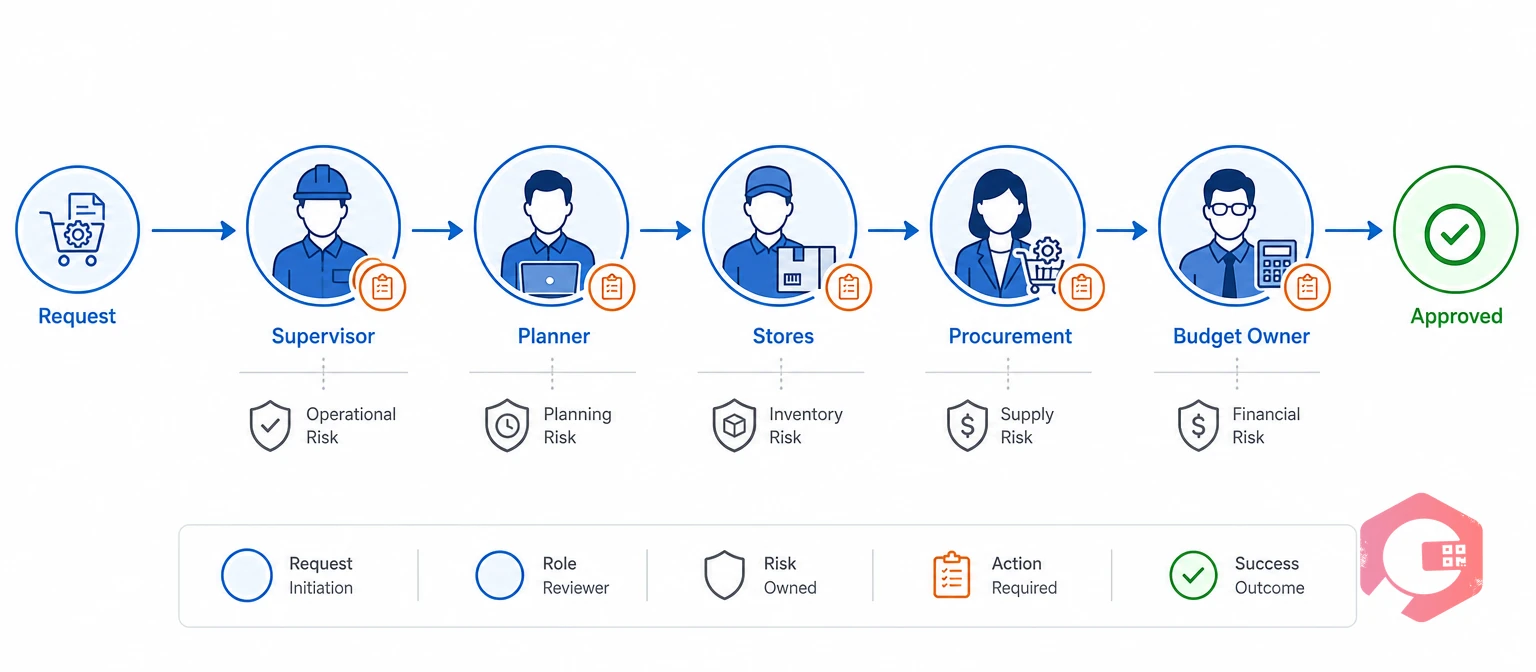
Multi-level approval is a purchasing control that sends one request through several reviewers instead of one generic sign-off. Each reviewer owns a different risk. For parts, that usually looks like this:
Safety, quality, or plant leadership join the route only when a threshold or risk condition calls for it. That is the point of multi-level approval for parts — it is risk-based, not a rubber stamp added at every level by default.
Context should travel with the request. Approvers should see the asset, the failure mode, and the required-by date instead of a bare line item. A well-run Computerized Maintenance Management System carries that context automatically. Most maintenance teams find approvers can act in minutes once asset and work-order data travel with the request.
Simple purchasing workflows check quantity, supplier, price, and budget. That works for predictable consumables, where a mistake has little consequence. Parts add variables a flat spend check was never built to catch.
The control question shifts. It is no longer just "is this spend approved?" The real question is bigger. Is this the right part, for the right asset, from the right source, at the right speed? That needs more than one reviewer. This is why multi-level approval and structured inventory management matter as much as the approval chain itself. Reliability groups such as SMRP treat this kind of review as standard practice for critical spares. It is not an optional extra step.
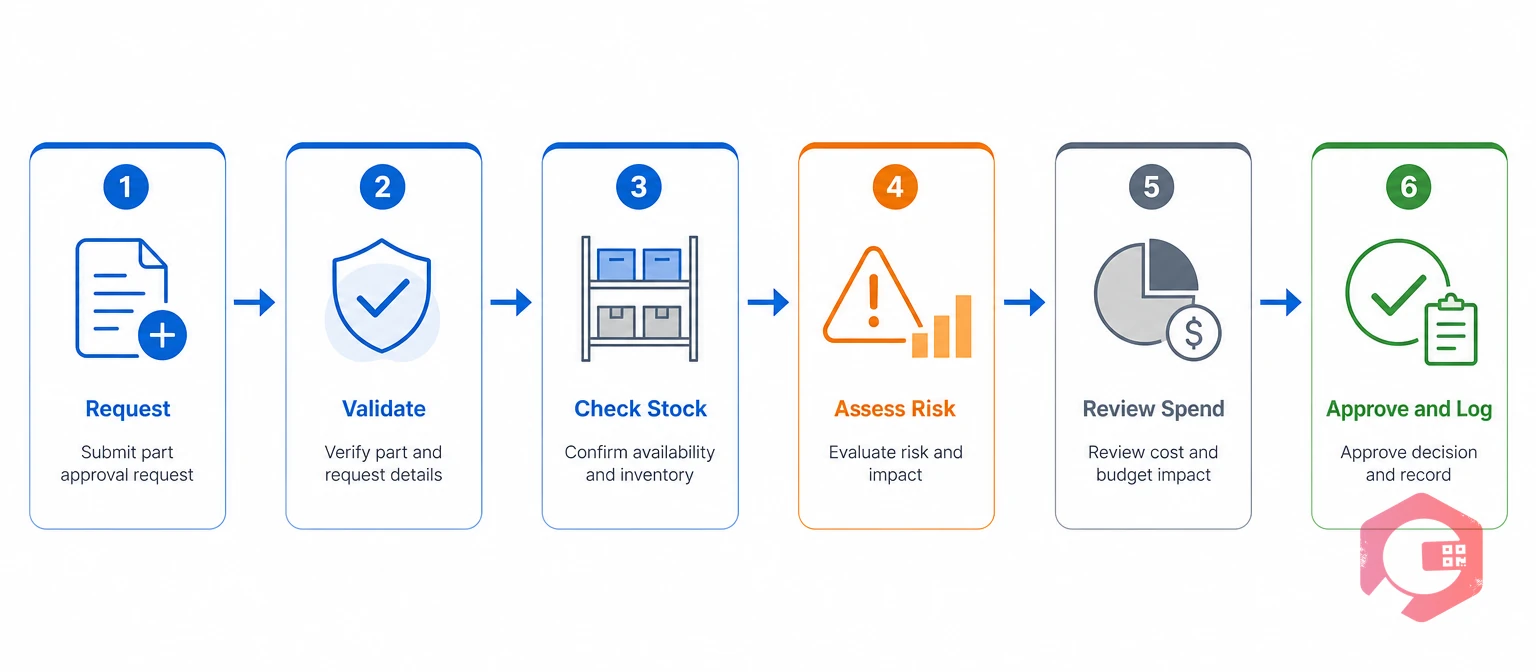
The Six-Gate Parts Approval Framework:
In practice, this moves fast. A gearbox fails. Stores finds one unit reserved for a more critical line. The planner approves a validated alternate instead of waiting on a new order. See how workflow automation software turns these six gates into automatic routing instead of a manual checklist your team repeats by hand.
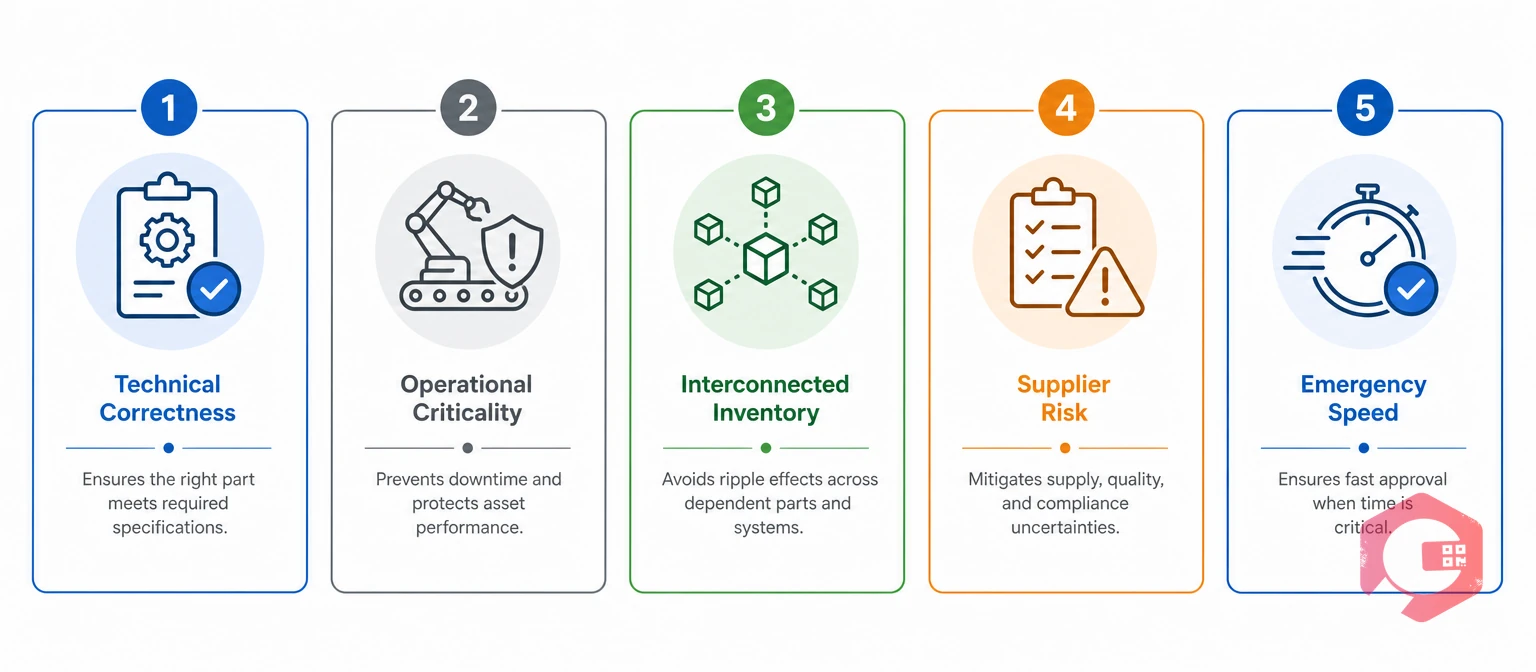
Five factors push parts approval past a simple spend check. Most maintenance teams run into all five in a normal month.
A critical spare is a part whose loss would stop production or break a safety rule. That single idea, not price, should decide how many approval gates a request passes through. Maintenance teams using Cryotos have reported up to 30% reduction in unplanned downtime and 25% faster repair turnaround. That gain shows up after teams replace flat spend thresholds with criticality-based, multi-level approval routing. Government guidance on supply chain risk makes a similar point. The supplier matters as much as the part.
Parts approvals connect procurement governance directly to maintenance strategy. A request should carry enough context for approvers to see the asset, failure mode, work order, and stock position without asking twice.
Stores and maintenance teams also need consistent material data. That means approved alternates, equipment bills of material, and clear ownership of critical spares. Most facilities that skip this groundwork find multi-level approval turns into slow manual checking instead of fast, confident routing.
When the underlying data is reliable, a spare parts inventory system can route only the requests that truly need technical, financial, or executive attention. Everything else moves on its own.
These six controls show up in almost every well-run parts program, regardless of industry.
Segregation of duties is the rule that no single person should request, approve, and receive the same purchase. This internal-control principle comes from finance. It applies just as directly to a multi-level approval process for parts.
These mistakes come up again and again once teams build a parts-specific approval process.
Unclear segregation of duties is common in small teams that combine requester, approver, and receiver roles. A compensating review on higher-risk purchases, paired with a full audit record, closes that gap without adding headcount. Standards bodies such as ISO treat this kind of audit trail as a baseline expectation, not an extra.
Rolling out multi-level approval does not need a big-bang launch. Most maintenance teams succeed by working through these steps in order.
A working parts approval workflow should track both control quality and speed. Approval cycle time by criticality, auto-approved low-risk requests, and audit-log completeness make a practical starting scorecard. Success means less avoidable risk without slower routine maintenance.
Parts are often asset-specific and safety-relevant, so a wrong choice can stop production or create a compliance gap. Office supplies are standardized and cheap to replace, so the risk is much smaller.
The number should follow risk, not a fixed rule. Routine, low-value items can auto-approve, while critical or high-value requests pass through technical, inventory, commercial, and budget review.
It does not have to. A conditional emergency path with named authority and reason codes lets urgent requests move fast while keeping a full audit trail.
It needs reliable material records, approved substitutes, and criticality ratings. That way, approvers can see stock and risk at the point of decision instead of guessing.
Maintenance and procurement should own it together, with finance signing off on cost thresholds. Maintenance knows asset criticality, procurement knows supplier risk, and finance knows budget limits. No single department has the full picture alone.
Office supplies need straightforward spend and policy controls because they are standardized and easy to replace. Parts need a richer model, because one decision can affect compatibility, safety, inventory, and production. Schedule a free demo to see how Cryotos routes parts requests by real risk instead of a flat spend limit.


Cryotos AI predicts failures, automates work orders, and simplifies maintenance—before problems slow you down.



