

Near miss reporting is the practice of recording every unplanned event that could have caused harm but did not, then fixing its cause before it repeats. In the TPM safety pillar, also called the SHE (Safety, Health and Environment) pillar, these reports give a plant its earliest warning on the way to zero accidents, zero health damage and zero fires.
This guide shows how to build near miss reporting into your SHE pillar. It covers a six-step closure method, a 5 Whys worked example, a register template and the KPIs that prove the system works. It suits plant managers, safety officers and TPM pillar leaders.
Key Takeaways

The SHE pillar is the TPM pillar that targets zero accidents, zero health damage and zero fires. It is one of the eight pillars of total productive maintenance, alongside autonomous maintenance, planned maintenance and quality maintenance.
The pillar rests on one idea: serious injuries rarely arrive without warning. Before a lost-time injury, most plants see several near misses, such as a dropped tool, a guard left open or a forklift that stopped a meter short. Herbert Heinrich's well-known safety pyramid suggests minor events far outnumber major injuries, although the exact ratios are debated.
Near miss reporting is the process of recording unplanned events that could have caused harm but did not. Recognized standards support this approach. ISO 45001 defines an incident broadly enough to include events with the potential to cause injury, and it expects organizations to investigate incidents and act on their causes. OSHA's safety management guidance also stresses worker participation and learning from close calls.
An unreported near miss is a hazard that stays on the floor, waiting for a worse outcome.
Near miss reporting fails when reporting feels risky, slow or pointless to the person on the shop floor. Most plants collect a burst of reports after a safety campaign, then watch the numbers fade within a few months.
Maintenance teams that fix these five points first see reporting recover quickly. A no-blame rule, a short form and a named owner cost almost nothing to put in place.
Trust in the reporting system is the foundation of the SHE pillar.

A near miss is closed only when its cause is fixed and the fix is checked. The method below gives the SHE pillar team one path for every report, from first alert to shared lesson.
The Six-Step Near Miss Closure Method:
Good near miss reporting starts where the event happened. Use a short form on a phone, a QR code on the machine or a WhatsApp message, and log it in a Computerized Maintenance Management System so every report carries a date, a location and an asset. Ask only what the reporter knows: what happened, where, when and what they did next.
The SHE pillar owner reviews each report within one working day. They score severity and likelihood, assign an investigator and flag high-risk reports for a full team investigation.
The investigator visits the spot, speaks to witnesses and builds a short timeline. Low-risk reports may need a quick 5 Whys, while high-risk reports deserve a cross-functional review.
Every root cause gets at least one corrective action. Where the same cause exists on other lines, add a preventive action too. Each action needs an owner and a due date.
After the due date, someone other than the action owner checks the fix on site. A second check 30 to 90 days later confirms the near miss has not come back.
Post the result on the pillar board and in shift briefings. Many TPM teams turn the lesson into a One Point Lesson (OPL). Tell the reporter in person, because that single conversation does more for reporting rates than any poster.
Want operators to report from the machine itself? See how asset QR code scanning links each report to the right equipment.
A near miss register is the log that holds every report, its cause and its follow-up action. Keep the form short for the reporter and let the triage owner add the detail. The table below shows the fields most plants need.
| Field | What to Record | Example | Who Fills It |
|---|---|---|---|
| Date, time and shift | When the event happened | 14 Oct, 02:40, night shift | Reporter |
| Location and asset | Area, line or machine involved | Packing line 3, conveyor C-12 | Reporter (QR scan) |
| Description | What happened, in plain words | Pallet slid off the forks near the walkway | Reporter |
| Immediate action | What was done to make the area safe | Stopped the line and cordoned the area | Reporter |
| Category | Unsafe condition, unsafe act, equipment, material or procedure | Unsafe condition | Triage owner |
| Severity and likelihood | Worst credible outcome and chance of repeat | Severity 4, likelihood 3 | Triage owner |
| Root cause | The validated cause, with evidence | No staging space after a layout change | Investigator |
| Actions and owners | Corrective and preventive actions with due dates | Add a staging bay by 30 Nov | Investigator |
| Verification | Who checked the fix and when | Checked by supervisor on 5 Dec | Verifier |
Ask reporters for the first four fields only. A short form gets used, and triage can complete the rest within a day.
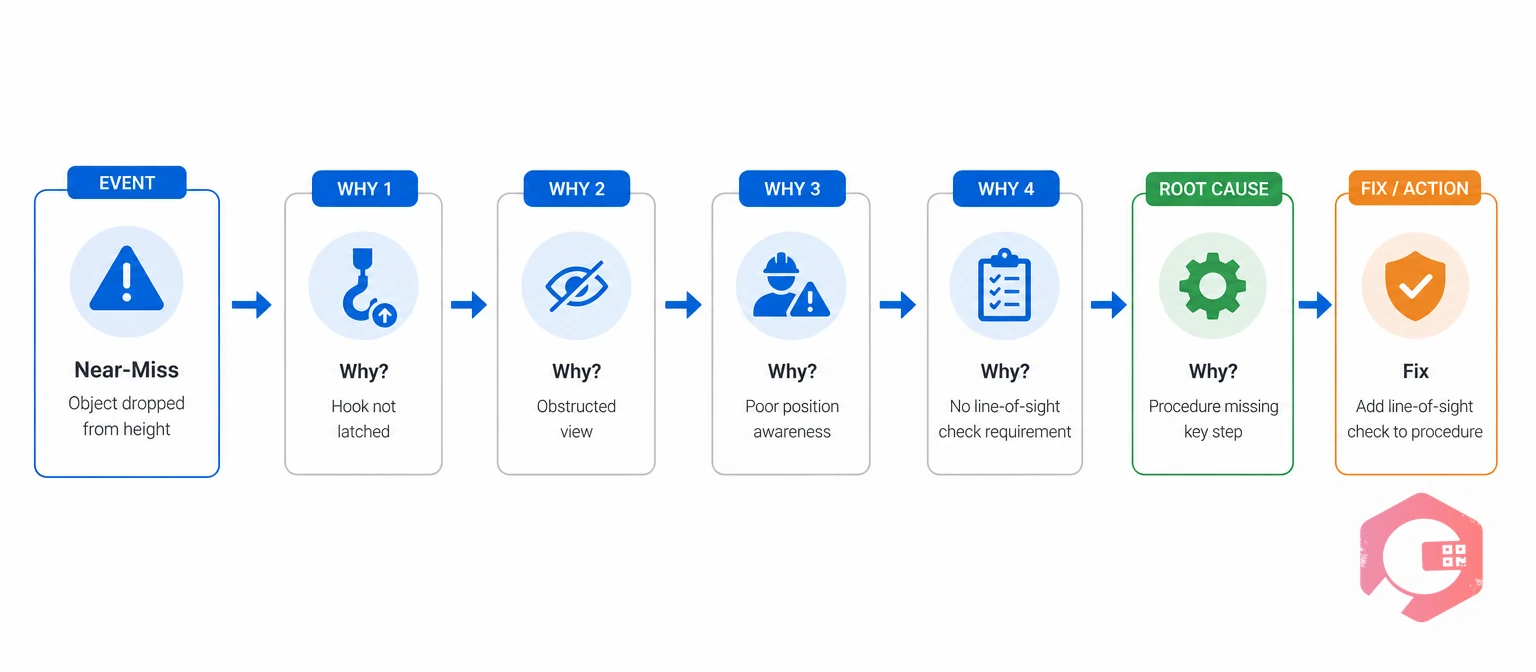
A 5 Whys analysis asks "why" repeatedly until you reach a cause you can fix, usually within three to five rounds. The aim is a system cause, not a person to blame. Stop at "the operator made an error" and the same near miss will return.
The example below is illustrative, not taken from a named customer.
Test every root cause with one question: if we fix this, would the near miss stop? If the answer is no, keep asking. A fishbone diagram helps when several causes compete, but the 5 Whys chain should still end in one fixable system cause.

Corrective actions from near miss reporting stick when they are tracked as work, with an owner, a due date and proof of completion. Actions that live in meeting minutes tend to fade within weeks. Raise each physical fix as a job in your work order management system, so it sits on the same schedule as other maintenance work.
Choose the strongest control you can. The hierarchy of controls ranks options from most to least reliable:
If every action on a register ends in "retrain the operator", the team is picking the weakest control. Push at least one action up the list.
Near misses around isolation and hot work deserve a faster path. A missed lock, an expired permit or an unverified isolation points to a gap in the permit process. Teams that use permit to work software can link the report to the permit, and review the lockout/tagout steps against what happened.
A clear schedule keeps near miss reporting and the rest of the SHE pillar running between audits. Give each activity an owner, a frequency and a record, so nothing depends on memory. Adjust the frequencies below to your site risk.
| Activity | Owner | Frequency | Evidence Kept |
|---|---|---|---|
| Raise a near miss report | Any employee or contractor | As it happens | Register entry with photo |
| Triage new reports | SHE pillar owner | Within 24 hours | Severity score and investigator |
| Daily SHE walk | Area supervisor | Daily | Checklist and hazards raised |
| Near miss review meeting | SHE pillar team | Weekly | Minutes and action list |
| Action aging and trend review | Plant head | Monthly | KPI scorecard |
| Pillar audit | TPM steering committee | Quarterly | Audit score and gaps |
Keep the weekly meeting short. Fifteen minutes on open actions and new reports beats an hour of general discussion.
A leading indicator is a measure that warns of risk before harm occurs. Near miss reporting KPIs are leading indicators, so read them differently from injury rates. A rising report count is usually good news in the first year, because it shows workers trust the system.
| KPI | How to Calculate | Healthy Direction | Data Source |
|---|---|---|---|
| Reports per 100 employees per month | Reports divided by headcount, times 100 | Up in the first year | Register |
| Near miss to injury ratio | Near misses divided by recordable injuries | Up | Register and injury log |
| Average days to close | Closure date minus report date, averaged | Down | Register |
| Overdue actions | Overdue actions divided by open actions, times 100 | Down | Action tracker |
| Repeat near misses | Reports on the same asset or cause in 12 months | Down | Register |
| Feedback given on time | Reports answered within 7 days divided by all reports | Up | Register |
Pair these with lagging measures such as lost-time injuries, and review both monthly. Compare against your own baseline instead of an outside benchmark, because definitions of a near miss differ between plants.
Cryotos supports near miss reporting in the SHE pillar by tying each report to an asset, an owner and a closed-loop action. Operators can raise reports from QR codes or the mobile app, which works offline and syncs when the network returns.
Maintenance teams using Cryotos have reported up to 30% reduction in unplanned downtime and 25% faster repair turnaround. Results depend on how consistently teams record data and close actions, and your team still sets the severity scale and review rhythm.
Most near miss reporting programs stall for the same few reasons, and all of them are habits, not software problems.
Fixing these habits costs little and makes the register trustworthy from the first month.
A near miss report covers an event that caused no injury or damage, while an incident report covers one that did. Keep both in the same register so you can see the full picture of risk.
There is no fixed number. A healthy plant sees steady reports and a rising count during the first year. Compare reports per 100 employees against your own baseline instead of an outside figure.
A senior production or maintenance manager usually leads the pillar, supported by a safety officer. Operators from each area join the pillar team, so the reports reflect real work.
Triage within one working day and start high-risk investigations at once. Physical evidence and memories fade quickly, so an early site visit gives better causes.
Offer both options. Named reports allow follow-up questions, while an anonymous option helps in plants where trust is still low. Share the outcome on the pillar board when the reporter is unknown.
A spreadsheet can work for one small site. It struggles with photos, alerts, action tracking and repeat detection, so most plants move to a CMMS once report volume grows.
Pilot it in one area for 30 days. Use a two-minute form, a named triage owner and a weekly review meeting, and share every closed case on the pillar board so people see results.
Small reports, fixed quickly, build the safest plants. Schedule a free demo to see how Cryotos helps your SHE pillar capture near misses, run 5 Whys and close every action.


Cryotos AI predicts failures, automates work orders, and simplifies maintenance—before problems slow you down.



