

A construction site HSE audit is a structured review of how well a project controls health, safety, and environmental risks. It measures the site against the law, client rules, and standards such as ISO 45001. The best audits go further than PPE and signage. They also confirm that cranes, scaffolds, excavators, and generators are inspected, maintained, and documented on schedule.
That last part is where many sites fall short. Equipment failure sits behind a large share of serious site incidents, yet maintenance records often live apart from safety findings. This guide shows you how to run construction site HSE audits that join safety checks, asset inspections, and maintenance compliance into one process. You'll get a 7-step method, a scorecard template, and the SAFER Site Audit Framework.
Key Takeaways
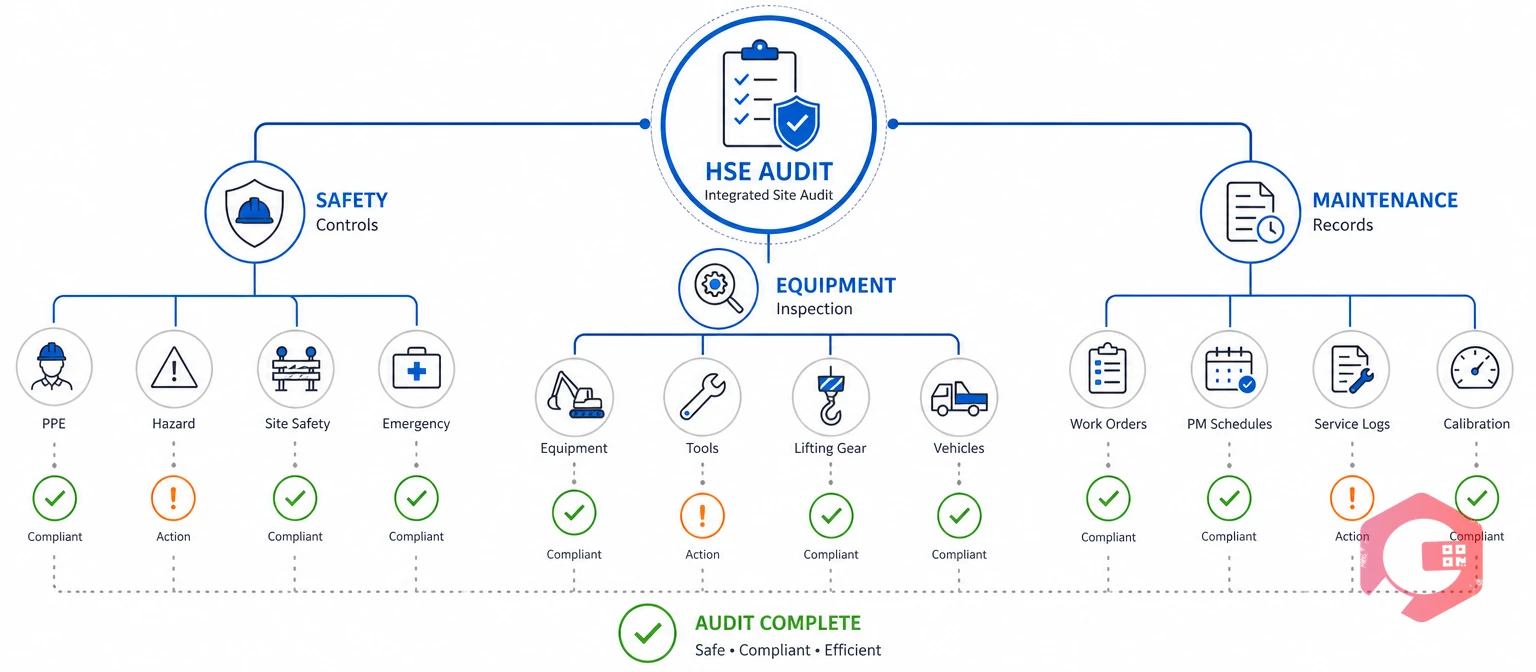
A construction site HSE audit is a documented review of how a project manages HSE risk against set criteria. Those criteria usually include national law, the client's contract terms, the contractor's own HSE management system, and international standards.
In the US, the legal anchor is the federal construction standard, 29 CFR 1926, which OSHA enforces on construction sites. Globally, most contractors align their management systems with ISO 45001 for occupational health and safety and ISO 14001 for environmental management.
An asset inspection is a recorded check of one piece of equipment against a defined checklist, signed by a competent person. On a construction site, these records are the evidence auditors need to confirm that plant and tools are fit for use. A sound audit treats them as core HSE evidence, not as a separate maintenance matter.
Safety and maintenance compliance belong in one audit for a simple reason. Many serious site incidents start with equipment that was overdue for inspection or repair. OSHA's "Focus Four" hazards on construction sites are falls, struck-by, caught-in or between, and electrocution. Fall protection has topped OSHA's list of most-cited standards for more than a decade.
Look closely and most of these hazards have a maintenance link. Here are common ways a missed inspection becomes a safety incident:
Most sites keep safety findings in an HSE spreadsheet. Equipment records sit in a plant manager's binder or a rental company's portal. When an auditor asks, "Show me that every crane on site has a current inspection," the team spends hours chasing paper. Gaps hide in the space between those two systems.
A Computerized Maintenance Management System (CMMS) closes that gap by holding asset registers, inspection checklists, and work orders in one place. When the data sits together, one construction site HSE audit can answer two questions in the same walk. Is the work safe? Is the equipment fit for use?
Construction sites use five main types of HSE audits, and each answers a different question. Most projects run several types at once, on different schedules.
Your HSE team or a senior site manager checks the project against company procedures, usually monthly or quarterly. Internal audits catch drift early, before a client or regulator finds it.
Clients audit contractors to confirm contract HSE terms are met. Certification bodies audit against ISO 45001 or ISO 14001 to grant or renew certification, often once a year with surveillance visits in between.
These reviews confirm that the site meets local law. Examples include OSHA 29 CFR 1926 in the US and the CDM Regulations in the UK. Many contractors run a mock regulatory audit before major milestones so there are no surprises.
This audit focuses on plant and tools: inspection dates, statutory examinations, operator certificates, and open defects. It is often the weakest link on busy sites, which is why the SAFER framework below folds it into every audit cycle.
Observers watch how people work, not just what the paperwork says. These audits spot shortcuts, such as skipped lockout steps or missing spotters, that never show up in a document review. The audit type sets the scope, but the evidence standard stays the same: every finding needs proof, an owner, and a deadline.
Want a ready-made starting point? Use our free safety compliance checklist to structure your next site audit.
A complete construction site HSE audit covers six areas. They are work at height, plant, electrical safety, health, the environment, and documents. Use the lists below as the backbone of your audit checklist.
Cover all six areas in every audit cycle, even if you rotate how deep you go in each one.
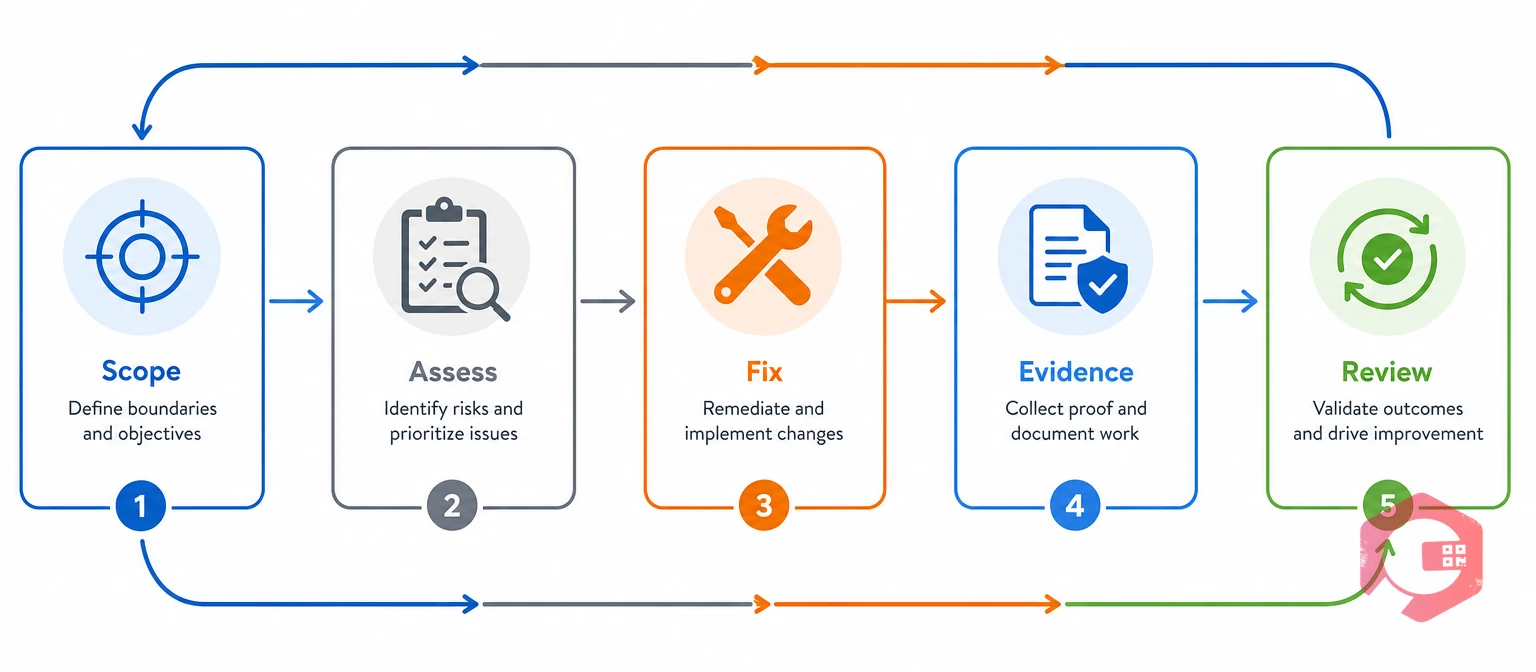
The SAFER Site Audit Framework is a five-stage loop. It joins safety checks, asset inspections, and maintenance actions into one audit process. It gives your team a shared method, so HSE managers and plant managers stop working from separate lists.
The SAFER Site Audit Framework:
Picture a mid-sized building project with two tower cranes, six excavators, and a fleet of rented generators. Under SAFER, the auditor scans each crane's QR code, sees its last inspection, and flags a sling that is two days overdue. The finding becomes a work order for the lifting supervisor, due before the next lift.
Real-time asset tracking makes the Scope and Assess stages much faster, because you always know which equipment is on site and where. Maintenance teams using Cryotos have reported up to 30% reduction in unplanned downtime and 25% faster repair turnaround. The same habits shorten the time between an audit finding and a safe fix.
SAFER works because it treats a missed inspection as a safety finding, not a paperwork issue.
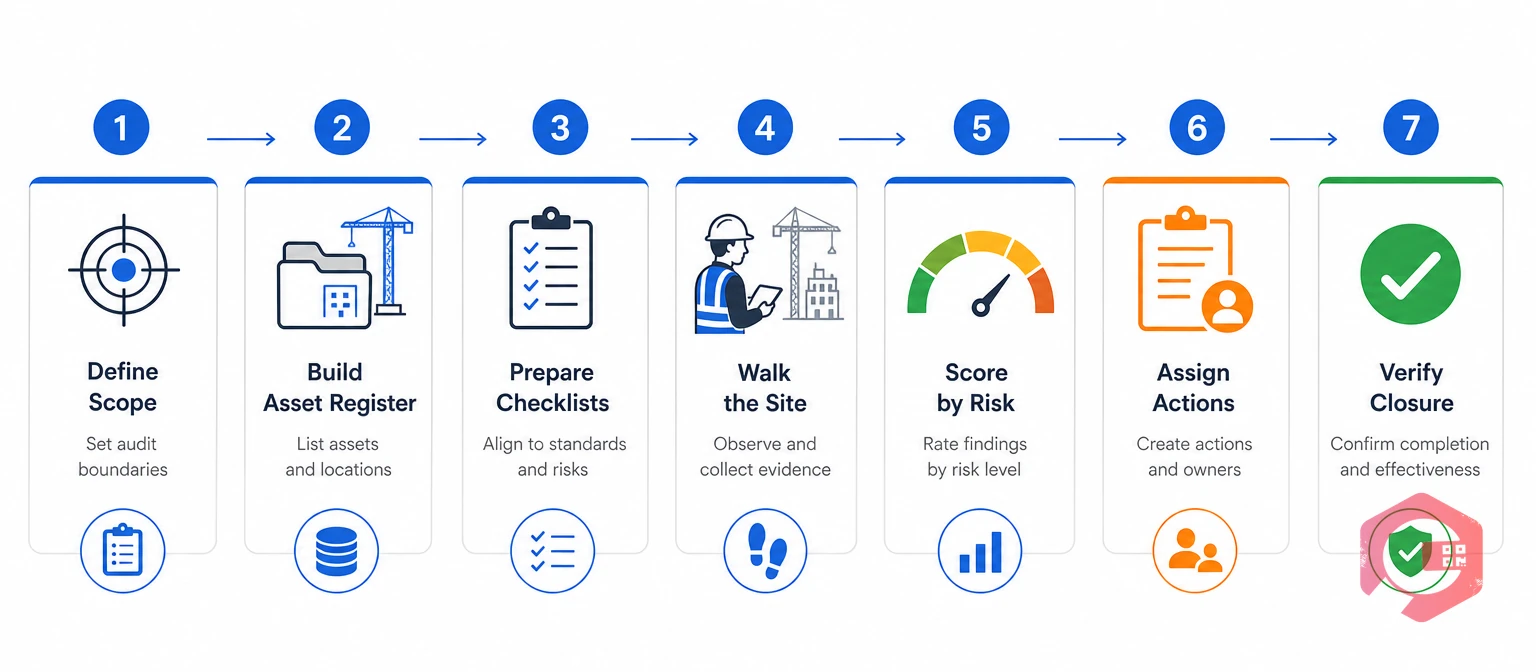
You can conduct a construction site HSE audit in seven steps. Define the scope, build the asset register, and prepare linked checklists. Then walk the site, score by risk, assign actions, and verify closure. Each step below includes what to do and what to avoid.
Decide which areas, contractors, and work phases the audit will cover. List the criteria you'll audit against, such as OSHA 29 CFR 1926, the client's HSE plan, and ISO 45001 clauses.
Pull a current list of all plant, lifting gear, and power equipment on site. Include rented and subcontractor equipment. Note the last inspection date, next due date, and any open defects for each asset.
This step alone often reveals the biggest gaps, such as rented equipment that arrived without inspection certificates.
Build checklists where each hazard question points to the asset it depends on. For example, "Is the excavation protected?" should link to the shoring equipment and its last inspection.
Observe work in progress, interview workers, and check records at the point of use. An operator's daily check sheet in the cab tells you more than a clean folder in the site office.
Rate each finding on severity and likelihood, using a simple 1-to-5 scale for each. A single overdue crane inspection outweighs ten untidy walkways, so your report should say so.
Every finding needs an owner, a due date, and a closure standard. Findings left in a PDF report rarely get fixed on time.
Raising digital work orders for equipment findings sends the task straight to the mechanic or rental firm. Photos stay attached, and everyone can see the deadline.
Check that each action was completed and that the fix actually worked. Close findings only with evidence, such as a photo, a new inspection record, or a signed sign-off.
A construction site HSE audit only creates value when its findings are closed, verified, and used to improve the next cycle.
A construction site HSE audit scorecard records each check, the evidence needed, its risk rating, and who owns the fix. Use the sample below as a starting template and adapt the rows to your project.
| Audit Area | Check Item | Evidence Required | Risk Rating | Owner | Close-Out Target |
|---|---|---|---|---|---|
| Work at height | Scaffold tags dated within 7 days | Tag photo + inspection record | High | Scaffold supervisor | 24 hours |
| Lifting | Crane annual inspection current | Inspection certificate | Critical | Lifting coordinator | Before next lift |
| Lifting | Slings and shackles tagged | Color-code tag + register entry | High | Rigging lead | Same shift |
| Plant | Excavator daily checks signed | Signed pre-use checklist | Medium | Plant operator | Daily |
| Plant | Brake and alarm service on schedule | Closed PM work order | High | Plant manager | 48 hours |
| Electrical | Ground-fault breakers tested | Test record with date | High | Site electrician | 24 hours |
| Environmental | Spill kits stocked near fuel | Photo + stock check | Medium | Environmental officer | 7 days |
| Documentation | Hot work permits closed | Signed permit with fire watch | High | Permit issuer | End of shift |
Score each row on a simple scale: 2 for compliant, 1 for partly compliant, and 0 for non-compliant. Then work out a percentage for each audit area. Track that percentage over time so you can see whether each area is improving or slipping.
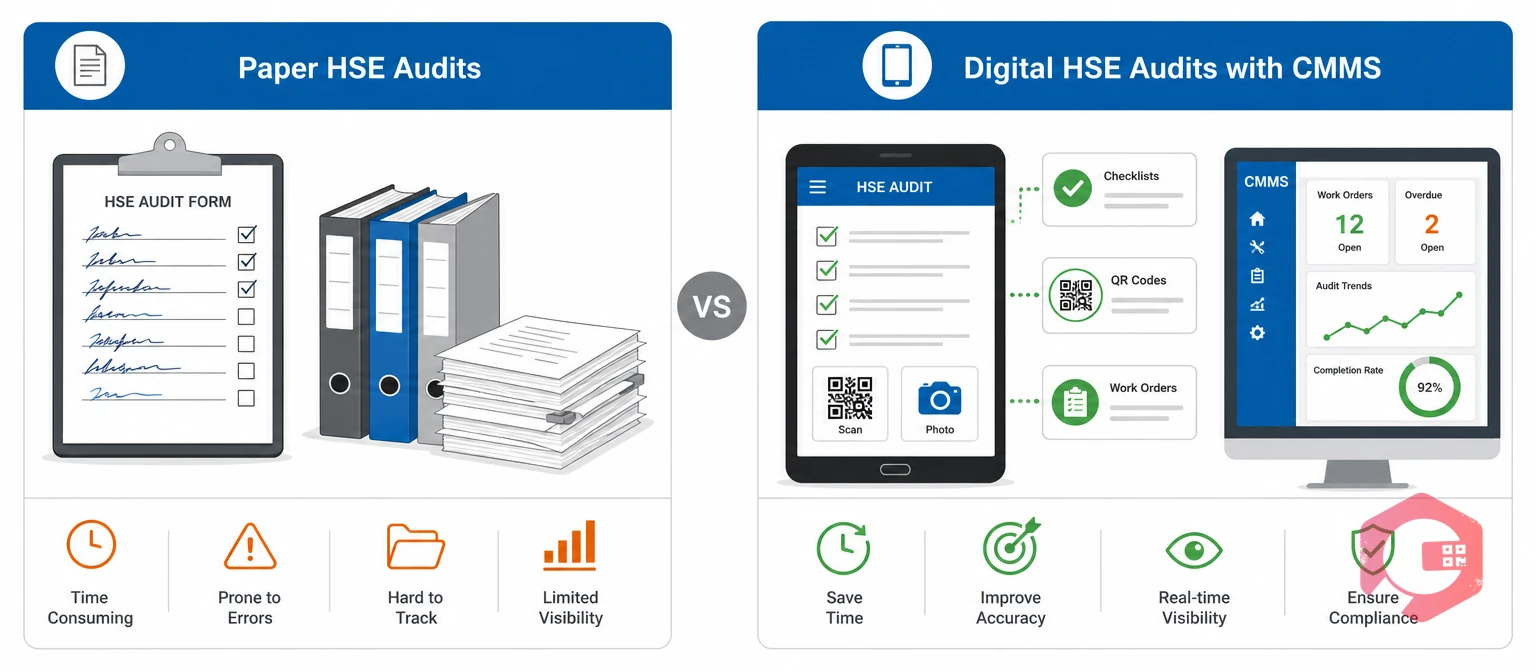
Digital HSE audits beat paper audits on speed, evidence, and follow-up. The main reason is that findings turn straight into tracked actions. Here is how the two approaches compare on a construction site.
| Factor | Paper and Spreadsheet Audits | Digital Audits with a CMMS |
|---|---|---|
| Data capture | Handwritten notes, typed up later | Mobile checklists with photos and signatures on the spot |
| Asset link | Equipment records kept in a separate file | QR code scan shows inspection history for each asset |
| Follow-up | Actions listed in a report, chased by email | Findings become work orders with owners and deadlines |
| Evidence trail | Easy to lose, hard to search | Timestamped audit trail for every change |
| Reporting | Manual summaries that take days | Live dashboards for overdue actions and repeat findings |
| Remote sites | Forms travel by hand or photo | Offline mobile mode that syncs once a signal returns |
Paper still works for very small jobs with a handful of assets. Once a project runs multiple contractors and a rented plant fleet, digital audits save hours per cycle and close the gaps that paper leaves open.
Three mistakes weaken construction site HSE audits most often. Teams leave equipment out of scope, audit paperwork instead of the work, and leave findings without owners. Teams that successfully avoid these mistakes usually share one habit: they audit what actually happens on site.
Fix these seven habits and your audits will catch real risk, not just missing paperwork.
Three KPIs matter most after a construction site HSE audit: action close-out rate, overdue inspections, and repeat findings. They show whether risk is going down. Pair them with lagging injury rates for a complete picture.
A leading safety indicator is a measure that predicts future incidents, such as overdue inspections or open corrective actions. Lagging indicators, like injury rates, only tell you about harm that already happened. To keep legal requirements in view while you track these KPIs, work through our regulatory compliance checklist each quarter.
Watch these KPIs between audits, not just on audit day, so problems surface while they are still small.
Most contractors run a full internal HSE audit monthly on active sites and a deeper system audit every quarter. High-risk phases, such as heavy lifting or deep excavation, may need audits every week. Daily and weekly inspections continue in between, and certification bodies audit once a year.
A qualified HSE auditor should know the relevant law, the company's HSE management system, and construction methods. Many hold certifications such as NEBOSH, OSHA 500, or ISO 45001 lead auditor training. For equipment-heavy sites, pair the auditor with a plant or maintenance specialist.
An HSE inspection checks current site conditions, such as a missing guardrail, at a point in time. An HSE audit reviews whether the whole safety system works over time, including training, permits, equipment records, and how findings get closed. Inspections feed evidence into audits.
Many serious construction incidents, including struck-by, caught-in, and electrocution events, trace back to equipment that was overdue for inspection or repair. Checking maintenance records during the audit confirms that plant is fit for use. It also gives auditors hard evidence instead of verbal assurances.
Prepare the HSE plan, risk assessments, method statements, permits, training and competence records, and incident reports. Also prepare the asset register with inspection certificates, pre-use checklists, and open maintenance work orders. Having these ready can cut audit time in half.
Yes, a CMMS helps by keeping asset registers, inspection checklists, preventive maintenance schedules, and work orders in one system. Auditors can scan an asset's QR code and see its full inspection history on the spot. Findings become tracked work orders, which creates a clear audit trail.
Integrated construction site HSE audits only work when every inspection, defect, and fix is recorded and easy to prove. Schedule a free demo to see how Cryotos links your safety checks, asset inspections, and maintenance work orders into one audit-ready record.



Cryotos AI predicts failures, automates work orders, and simplifies maintenance—before problems slow you down.



