

Oil and gas asset management is the discipline of tracking, maintaining, and optimizing every physical asset across upstream, midstream, and downstream operations. A well-run CMMS is the backbone of this discipline — centralizing asset data, maintenance schedules, and compliance records into a single system your entire operation can rely on. According to IEA data, unplanned outages in oil and gas cost the industry an estimated $38 billion annually in lost production — and the vast majority trace back to poor visibility into asset condition and maintenance history.
This guide covers the core pillars of oil and gas asset management, the safety requirements that make this industry uniquely demanding, and the practical steps operators take to shift from reactive firefighting to proactive, data-driven asset control.
Key Takeaways

No other industry combines this level of asset complexity with this level of consequence for failure. Three structural pressures set oil and gas apart from every other maintenance-intensive sector.
Extreme assets. Pipelines, offshore platforms, compressors, and refineries operate under intense pressure in corrosive, high-temperature environments. A bearing failure that might cause a few hours of downtime in a food plant can trigger a multi-week shutdown, an environmental incident, or a fatality in an oil and gas facility.
Stringent regulation. Asset managers must navigate OSHA Process Safety Management (PSM) standards, API RP 580 risk-based inspection requirements, and PHMSA pipeline integrity management rules — all simultaneously. Missed inspections don't just create operational risk; they create legal liability.
Geographic scale. A single operator may manage 10,000+ assets spread across multiple states or countries, maintained by rotating shift teams with inconsistent handover documentation. Without a centralized system, asset history lives in spreadsheets, paper logbooks, and the heads of technicians who may leave tomorrow.

Five interconnected pillars underpin effective oil and gas asset management. Gaps in any one of them undermine the others — which is why the most resilient operators treat these as a system, not a checklist.
Explore how the Cryotos Oil and Gas CMMS brings all five pillars into a single, connected platform built for the demands of upstream, midstream, and downstream operations.
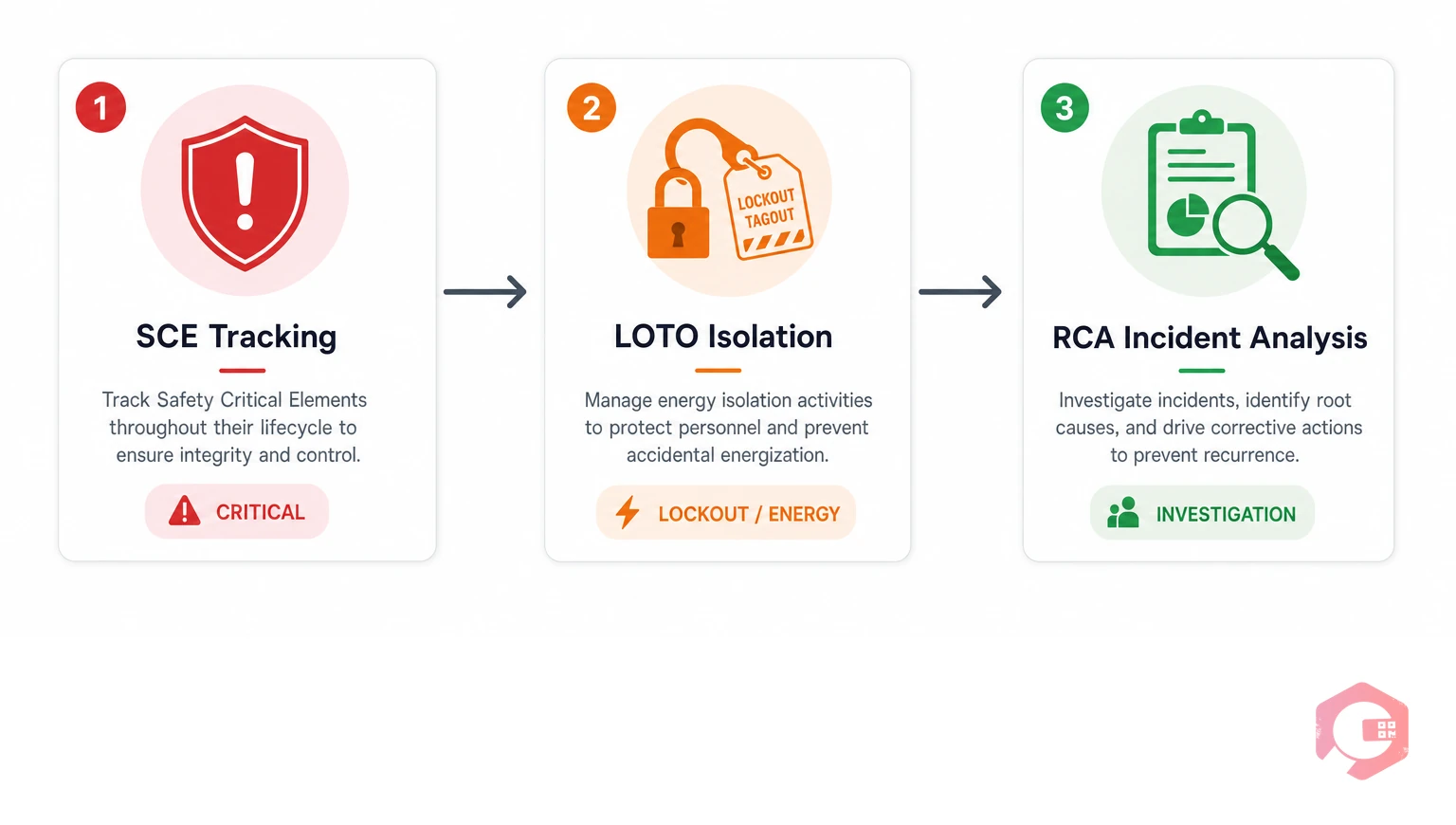
Safety and asset management are inseparable in oil and gas. A maintenance failure here doesn't just mean lost production — it can mean a loss of containment event, a fatality, or an environmental disaster that takes decades and billions to remediate. Three safety capabilities must be built into your asset management system from day one.
Safety-Critical Element (SCE) tracking. Blowout preventers, emergency shutdown valves, and fire and gas detection systems are designated safety-critical elements. They require enhanced maintenance rigor — shorter inspection intervals, mandatory sign-off requirements, and escalation workflows when overdue. SCE status must be visible to every planner and technician who touches these assets, not buried in a spreadsheet tab nobody checks.
Digital isolation management and LOTO. Before any technician opens a valve or removes a component, the energy sources feeding that equipment must be isolated and verified. Digital lockout/tagout workflows in the work order system enforce the isolation checklist, capture photo evidence, and prevent work-order closure until de-isolation is confirmed. This eliminates the verbal "I think it's isolated" handover that has caused preventable fatalities across the industry.
Incident reporting with built-in root cause analysis. Every near-miss and failure event should close the loop with a structured investigation. Cryotos's built-in 5 Whys analysis within the work order system connects the incident to the asset, the maintenance history, and the corrective action — creating an institutional memory that improves future PM intervals and inspection criteria.
The financial case for digital asset management in oil and gas is compelling — and well-documented. Operators who make the transition from paper-and-spreadsheet systems to an integrated CMMS consistently report measurable improvements across four key areas.
Most operators who integrate their CMMS with ERP and IoT systems see a 15–25% reduction in total maintenance spend over five years — with the largest gains coming in the second and third years as data quality improves and PM programs mature.
Successful CMMS implementations in oil and gas follow a proven sequence. Rushing any step — especially the asset register — undermines everything that comes after it.
Maintenance management focuses on the day-to-day work of keeping assets operational — scheduling PMs, managing work orders, tracking downtime. Asset management covers the full lifecycle: capital planning, risk-based inspection, regulatory compliance, financial performance, and end-of-life decisions. Most oil and gas operators need both capabilities in an integrated CMMS/EAM platform, rather than separate tools that don't share data.
Sensors on rotating equipment — compressors, pumps, turbines — transmit vibration, temperature, and pressure readings to the CMMS via IoT connectivity. The system compares live readings against baseline and alarm thresholds. When values drift outside normal operating ranges, the CMMS automatically generates a work order for inspection or corrective action — catching failures days or weeks before breakdown. This transforms maintenance from a reactive response into a scheduled activity with lead time to plan resources and parts.
The six most important KPIs are: MTBF by asset class (to benchmark reliability improvement), OEE for production assets (to quantify the combined impact of availability, performance, and quality), PM completion rate (target above 90%), corrective-to-preventive maintenance ratio (lower is better — target below 30% corrective), cost per operating hour by asset, and safety-critical element inspection compliance rate (target 100% — anything below 100% is a reportable gap).
Key regulatory frameworks include OSHA's Process Safety Management standard (29 CFR 1910.119) for facilities handling highly hazardous chemicals, API RP 580 and RP 581 for risk-based inspection of pressure-containing equipment, and PHMSA's pipeline integrity management regulations (49 CFR Part 195). International operators also navigate ISO 55000 (asset management systems) and regional frameworks like the UK's Safety Case regime for offshore installations.
Implementation timelines vary by scope. A single-site deployment with a clean asset register and focused scope typically runs 8–16 weeks from kickoff to go-live. Multi-site enterprise rollouts with ERP integration and IoT connectivity typically run 6–18 months. The most common delay factor is asset data quality — organizations with poor existing records spend 30–50% of their implementation timeline cleaning and migrating data before configuration can begin.
Ready to bring efficiency and safety together in your oil and gas asset management program? Schedule a free demo to see how Cryotos helps operators move from reactive to resilient — with fewer unplanned shutdowns, stronger regulatory compliance, and full asset visibility across every site.



Cryotos AI predicts failures, automates work orders, and simplifies maintenance—before problems slow you down.



