Pencil whipping in facilities is the act of signing off on inspections, work orders, or maintenance checklists without performing the required tasks — creating false records that mask real equipment risks and compliance gaps. It is one of the most underreported problems in facility maintenance, and one of the most dangerous: falsified inspection records are a known contributing factor in equipment failures, OSHA citations, and workplace injuries across manufacturing, healthcare, and commercial facilities.
This guide gives facility managers and maintenance supervisors a complete framework — how to spot pencil whipping in your program today, the root causes that drive it, a step-by-step detection audit, and the prevention system that makes falsification structurally impossible to sustain.
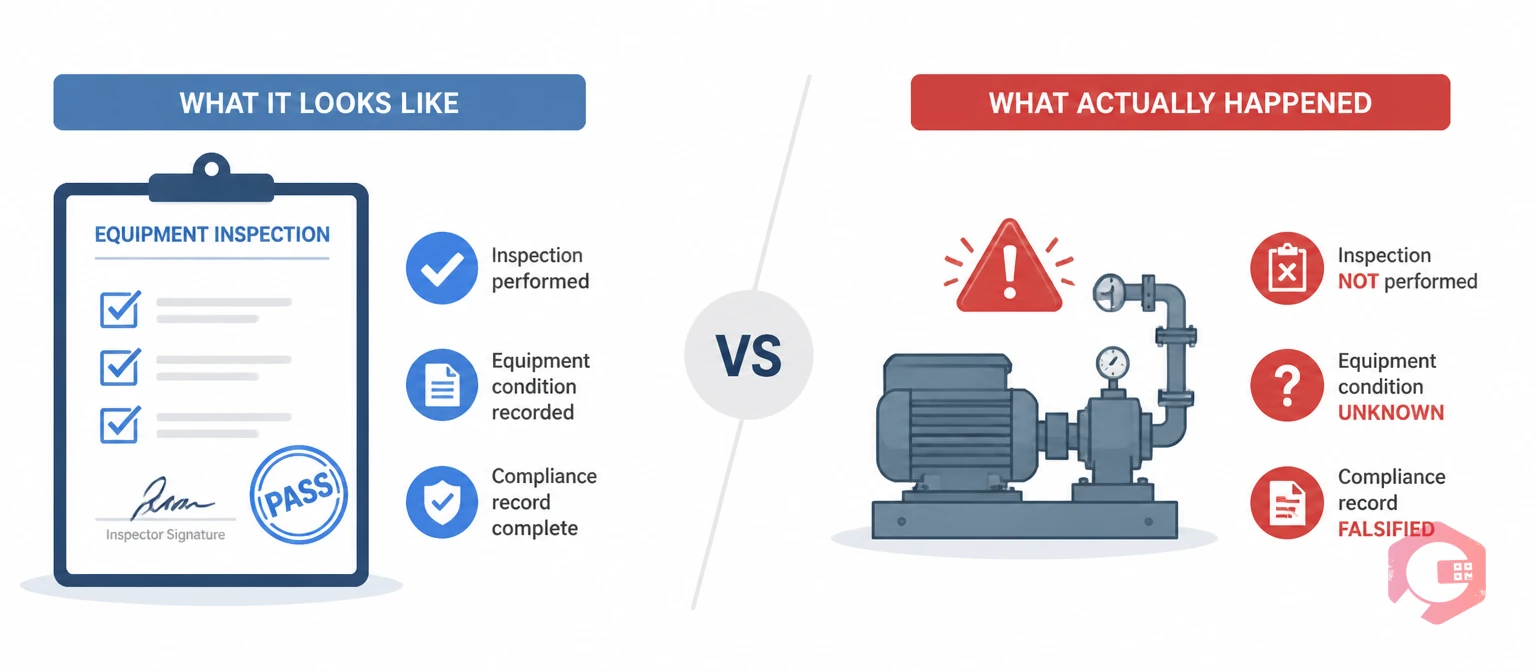
Pencil whipping is the practice of completing paperwork — inspections, preventive maintenance checklists, safety sign-offs, work orders — without actually performing the underlying work. The technician or inspector fills in the form, checks the boxes, and signs the record. The equipment never gets touched.
The term itself describes the physical act: quickly moving a pencil across a form, checking items off without engaging with them. In practice, pencil whipping takes several forms across a typical facility. A technician closes a work order as complete while still in the break room. A supervisor signs off on a monthly safety inspection without leaving the office. A PM record gets backdated because the schedule slipped and nobody wants the overdue flag showing in the system. In every case, the record says one thing and reality says another.
What makes pencil whipping particularly damaging is that it is invisible by design. The paper trail — or digital trail — looks exactly like legitimate maintenance. The only way to detect it is to know what patterns a falsified record introduces versus what genuine maintenance completion looks like.
According to OSHA's maintenance safety research, a significant share of equipment-related industrial incidents involve maintenance that was documented as complete but was not performed. For facility managers, that statistic has a direct operational meaning: somewhere in your current records, there may be maintenance gaps your documentation doesn't show.

Pencil whipping almost never starts as deliberate deception. It starts as a rational response to an impossible situation. Understanding the five root causes is the prerequisite to building a prevention system that works.
Each of these signals, alone, could have an innocent explanation. Multiple signals together form a pattern that warrants direct investigation.
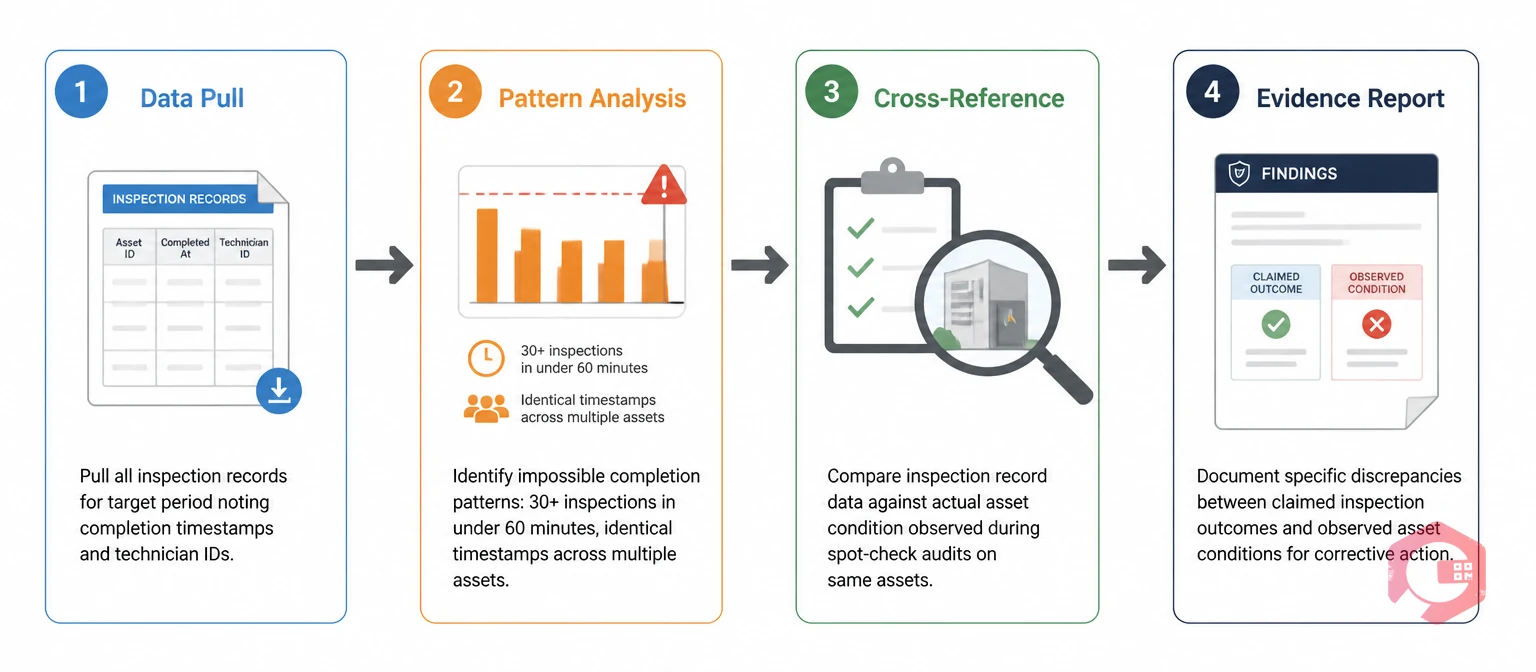
Run this detection audit on a sample of recent work orders — ideally 30–60 days of data across your highest-criticality assets.
Step 1 — Pull completion time analysis. Export all closed PMs and corrective work orders for the audit period. Calculate time-to-completion for each. Flag any work order where duration falls below 50% of the task's expected time. For facilities without time tracking in the CMMS, look at the time between "work order opened" and "work order closed" as a proxy.
Step 2 — Check timestamp clustering. Identify any technician who closed multiple work orders within a 5-minute window on the same day, particularly if those work orders cover different assets or different buildings. Cross-reference against shift schedules to confirm the technician was actually on site.
Step 3 — Audit checklist responses for uniformity. Pull completed checklists for any technician who has logged zero defect findings across 20 or more consecutive inspections. Request the physical equipment or review the asset's condition directly. Genuine inspections surface findings; pencil whipping produces perfect scores.
Step 4 — Cross-reference PM closures with failure data. For each asset that has experienced an unplanned failure in the audit period, check whether a PM was closed within the 30 days prior. A pattern of "PM completed" followed by rapid failure is the clearest evidence trail that the PM was falsified.
Step 5 — Conduct unannounced field verification. Pick 5–10 work orders that were closed in the past week and physically verify the completed work. Check lubrication points for fresh grease. Verify filters were changed. Confirm readings match what was logged. Discrepancies between the record and the field condition are direct evidence of pencil whipping.
Step 6 — Review the maintenance reports for PM compliance trends. In facilities where pencil whipping is occurring at scale, you typically see unusually high PM completion rates (above 95%) combined with flat or worsening equipment reliability metrics — a statistical impossibility if the PMs were genuinely performed.
| Signal | Pencil Whipping | Legitimate Completion |
|---|---|---|
| Completion duration | Consistently far below the task's expected time | Duration varies realistically; reflects actual work performed |
| Timestamp patterns | Multiple tasks closed simultaneously or within minutes | Task closures spread across the shift; sequential by location |
| Location at sign-off | Office, break room, or remote from the asset | GPS confirms technician was at the asset location |
| Photo/evidence quality | Absent, reused from previous inspections, or taken out of sequence | Current photos showing actual equipment condition and completed work |
| Defect findings rate | Zero findings across consecutive inspections; everything passes | Occasional defects logged; findings lead to follow-up work orders |
| Post-PM failure rate | Equipment failures occur shortly after PM was logged complete | MTBF improves or holds steady following PM completion |
| Checklist engagement | All items marked "pass" with no notes or measurements | Readings recorded, notes on observed conditions, some items flagged |
Effective prevention addresses both the conditions that make pencil whipping rational and the technical gaps that make it easy. Most programs fail because they focus on detection and punishment while leaving the root conditions unchanged. Here is what actually works.
Fix the workload before anything else. Audit your preventive maintenance schedule against real labor capacity. If your technicians have more PM hours scheduled than they can physically complete, pencil whipping is a structural outcome, not a behavioral failing. Where coverage does not match capacity, you have three legitimate choices: reduce the task list, increase headcount, or extend PM intervals where equipment failure data supports it. Any other response simply perpetuates the pressure that makes falsification rational.
Redesign checklists for field execution. A good maintenance checklist requires a technician to engage with the equipment to complete it. Replace vague line items like "check condition" with specific, verifiable tasks: "Record motor temperature reading," "Measure belt tension — log mm deflection," "Photo of filter condition before and after replacement." Tasks that require actual measurements or photos cannot be completed without touching the equipment.
Implement digital work orders with mandatory evidence capture. Mobile work orders that require photo attachments, GPS sign-off, and sequential task completion eliminate the structural gap between a completed and a falsified record. When a technician must photograph the work, record their location at the asset, and complete a digital checklist step-by-step — in real time — the opportunity for desk sign-off disappears. Cryotos CMMS's mobile maintenance checklists support all of these requirements, including mandatory fields that cannot be bypassed.
Create a culture where findings are welcomed, not penalized. If logging a defect means getting blamed, every technician's rational choice is to log "pass" and move on. Change the metric: reward defect detection, not zero-defect scores. When technicians see that reporting a finding leads to a repair order and a fixed machine rather than a performance review conversation, the incentive to falsify disappears.
Establish a regular cross-verification routine. Supervisors should conduct unannounced spot-checks on a rotating sample of recently closed work orders — physically verifying that the work documented was actually done. This does not need to be adversarial. Framing it as "quality assurance for our records" rather than "catching people out" changes the dynamic. What matters is that technicians know records are checked, which creates a credible deterrent against falsification even when supervision is not present.
Use wrench time and MTBF data to identify patterns. Track the relationship between PM completion rates and asset reliability. In a program free of pencil whipping, PM completion and MTBF trend together — more completed maintenance means fewer failures. When PM completion is high but MTBF is stagnant or worsening, that divergence is a signal that your completion rate is inflated by falsification.
Pencil whipping is not just an operational problem. In regulated industries, falsified maintenance records carry direct legal exposure that extends from the facility to individual managers.
Under OSHA 29 CFR 1910 standards for general industry, employers are required to maintain equipment in safe operating condition and retain documented evidence of maintenance activities. When an OSHA inspection follows an equipment-related incident and investigators discover that maintenance records were falsified — that PMs were closed without being performed — the citation is not just for the equipment failure. It is for the false record. Willful violations carry penalties up to $156,259 per instance as of 2024. If multiple falsified records are found, each becomes a separate citation.
The liability exposure compounds in litigation. When equipment failure causes worker injury and discovery reveals that maintenance records were falsified, those records become exhibits that demonstrate not just negligence but deliberate concealment. Courts and juries treat falsified safety records differently from genuine maintenance gaps. The message a falsified record sends — that someone knew the equipment wasn't being inspected and chose to document it as inspected anyway — is substantially more damaging than a genuine failure to complete maintenance.
Beyond regulatory and legal exposure, there is the operational reality: uninspected equipment fails. Pressure vessels, lifting equipment, electrical panels, fire suppression systems, and HVAC units that are documented as inspected but not actually inspected accumulate risk over time. The failure is not a question of if but when. According to the National Safety Council, equipment failure from deferred or falsified maintenance is a leading cause of serious workplace injuries in maintenance-intensive industries. The safety compliance checklist for any facility should explicitly include verification that inspection records are backed by evidence — not just that records exist.
A paper-based maintenance program makes pencil whipping easy because falsification and genuine completion are structurally identical — both produce a piece of paper with boxes checked. A CMMS with mobile execution, mandatory evidence capture, and real-time reporting makes falsification structurally difficult because genuine completion and falsification no longer produce the same record.
Cryotos CMMS builds the accountability infrastructure that pencil whipping cannot survive. Mobile work orders require technicians to complete tasks sequentially on their device — no jumping to "complete" without going through each step. Mandatory photo fields mean certain tasks cannot be closed without a time-stamped image of the completed work. GPS location logging at sign-off creates an automatic record of where the technician was when they closed the task. Offline mode ensures this works even in areas with no connectivity, with all data syncing automatically when the device returns to range.
On the detection side, Cryotos's BI Dashboard surfaces the statistical patterns that indicate falsification in aggregate. Assets with high PM completion rates but poor reliability trends. Technicians with consistently below-average completion durations. Inspection records with perfect defect-free scores across extended periods. These signals appear automatically in maintenance reporting — no manual analysis required. When a pattern emerges, it is visible before it becomes an incident.
The downtime tracking module creates a direct link between PM records and equipment reliability. When a PM is closed and the asset subsequently fails, that sequence is visible in the asset history. Over time, this data identifies which assets are generating post-PM failures — the clearest operational signal that pencil whipping is occurring for those specific tasks.
Facilities using Cryotos report a 30% reduction in downtime and 25% faster repair times. A significant portion of that improvement comes not from adding new maintenance tasks but from ensuring the maintenance already scheduled is actually completed. When pencil whipping stops, PM effectiveness becomes real — and the reliability gains that PMs are designed to deliver start showing up in the data. Book a free demo to see how Cryotos builds the accountability structure your maintenance program needs.
Pencil whipping means signing off on an inspection, maintenance checklist, or work order without actually performing the required tasks. It creates false maintenance records that show compliance while leaving equipment uninspected and safety risks unaddressed. The term comes from the act of quickly moving a pencil across a form without engaging with the work it documents.
In regulated industries, falsifying safety inspection records violates OSHA requirements and can result in willful violation citations, substantial fines, and personal liability for managers who knowingly allow it. In some jurisdictions and industries — particularly those involving life safety equipment — deliberate falsification of maintenance records constitutes a criminal offense. Beyond regulatory exposure, falsified records create serious legal liability in any subsequent equipment failure or injury claim.
The clearest signals are: work orders closed in implausibly short timeframes, multiple tasks completed simultaneously across different locations, 100% defect-free inspection records with no findings over extended periods, and equipment failures occurring shortly after PMs were logged as complete. A structured audit comparing documented completion times against task requirements — and cross-referencing PM closures with subsequent failure events — will identify the pattern quickly in most facilities.
Fix the workload first — if technicians have more scheduled work than they can complete, pencil whipping is a predictable outcome regardless of enforcement. Then implement mobile digital work orders with mandatory photo evidence and GPS timestamping, which makes the act of falsification structurally difficult rather than just against policy. Build a culture where defect findings are welcomed as the goal of inspections rather than treated as performance failures.
CMMS software prevents pencil whipping by making genuine completion and falsification structurally different records. Mobile work orders with sequential step completion, mandatory photo attachments, real-time GPS location logging, and automatic timestamp recording produce a record that a desk sign-off cannot replicate. Combined with BI reporting that flags statistical patterns — unusually fast completions, zero-defect streaks, post-PM failure correlations — a CMMS makes falsification both harder to commit and faster to detect.
Willful violations under OSHA standards carry penalties up to $156,259 per violation as of 2024. If multiple falsified records are found during an inspection — which is common, since pencil whipping tends to be systematic rather than isolated — each falsified record or pattern can constitute a separate citation. In the event of an injury or fatality involving equipment with falsified maintenance records, regulatory and civil liability compounds significantly.
Pencil whipping is a symptom of a maintenance program under pressure — unrealistic schedules, poor checklists, honor-system records, and cultures that punish genuine findings. The fix is not stricter enforcement of the same broken system. It is redesigning the system so that legitimate completion is faster and easier than falsification, and so that falsification is detectable before it causes an incident. Cryotos facility management software gives your team the digital work order infrastructure, mandatory evidence capture, and real-time reporting that makes pencil whipping structurally unsustainable — and gives facility managers the audit trail to prove it isn't happening.


Cryotos AI predicts failures, automates work orders, and simplifies maintenance—before problems slow you down.