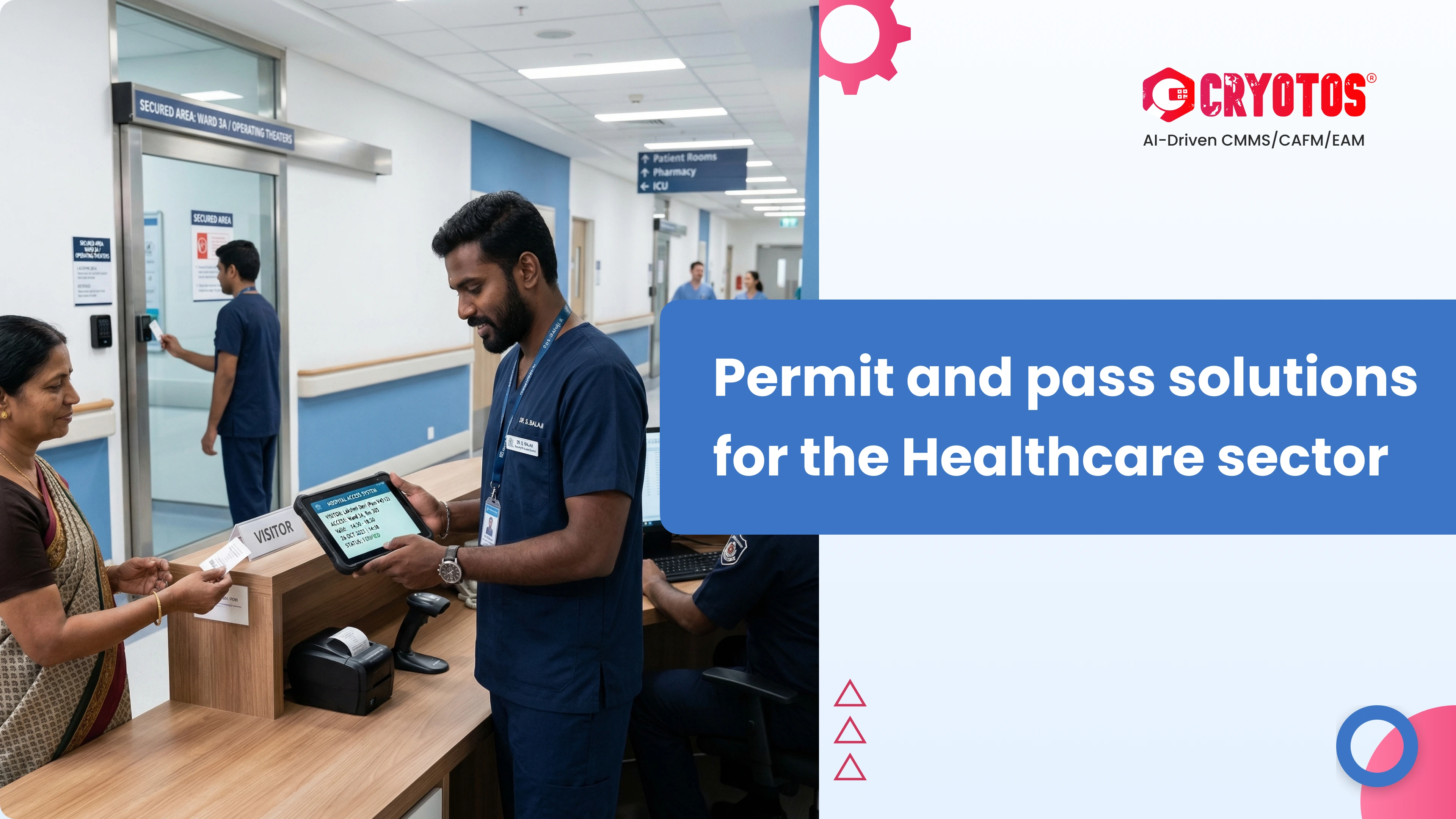
Permit and pass solutions for the Healthcare sector

Article Written by:

Ganesh Veerappan

Created On:

March 30, 2026

Permit and pass solutions for the Healthcare sector

Table of Contents:

There is no doubt that hospitals are under a lot of pressure and hence secure control access to the critical infrastructure is a matter of life and death. Using manual procedures from previous times causes compliance with blind spots and exposes exposed vulnerable patients to avoidable risks.

To counter these weaknesses, active healthcare institutions are quickly moving out of the siloed paper records to centralized digital-identity ecosystems. These high-stakes systems have been improved with modern permit and pass solutions that use mobile credentials and real-time tracking to achieve absolute accuracy in these environments.

With the help of the smart platform (Cryotos CMMS), the maintenance leaders will be able to automate complex Permit-to-Work processes and check compliance on all wards in real-time. This guide will discuss the central aspects of sound access management and how the full optimization of these protocols through digitalization reshapes hospital security.

Why Hospitals Require Specialized Control

The healthcare facilities are complex to operate and highly regulated to maintain physical and digital specifications. The interests are too great where generic access solutions are concerned.

Protecting Vulnerable Populations

Specialized security systems like a secure infant system and wander control of at-risk patients are needed. They should also compare visitors to registries to identify the unaccompanied minors and install real-time location systems (RTLS) to give instant duress alerts to frontline staff.

Securing High-Risk Infrastructure

Hospitals contain extremely sensitive infrastructure pipes of medical gases, high electrical systems, radioactive drains, and operating theatre specific ventilation plants. To ensure that disruptions are catastrophic, it is important to ensure that the systems are maintained with high levels of care and that such controls are exclusive to the system.

Balancing Complex Access Needs

The access system of the hospital should consider doctors, phlebotomists, food service employees, and environmental services. Each position demands extremely specific access to specific areas.

Strict Cybersecurity and Data Privacy

Data breaches are very expensive, and the healthcare sector is of prime interest to cybercriminals. Facilities have been subjected to stringent regulations such as the HIPAA to safeguard electronic Personal Health Information (e-PHI) using stringent administrative, physical, and technical measures.

Understanding Permits and Passes in the Healthcare Sector

Within the hospital setting, the concept of permits and passes transcends to a plastic ID badge. They constitute a multi-layered system, which is holistic, and whose purpose is to regulate movement of people, as well as operational risk management and compliance verification over the whole facility.

The ecosystem breaks down into three distinct categories:

1. Staff Credentials and Visitor Passes

The initial safeguard against patient privacy and security is controlling the people who walk around the halls.

  • Staff Access: Employees can navigate authorized areas using a dynamic combination of mobile smartphone authentication, key fobs, and RFID parking tags without any problem.
  • Visitor Management: The new visitor passes are connected to Electronic Health Records (EHR) systems. This automatically tracks a visitor to a particular patient and an area; keeping unauthorized people out of sensitive clinical areas.

2. Permits to Work (PTW) for Facility Maintenance

Maintenance of hospitals is often overlapped with hazardous materials and life-support equipment. A PTW is a strict Safe System of Work (SSOW) that is necessary for high-risk, non-routine work.

  • The Triggers: PTWs are obligatory to such activities as hot work (welding), entering confined spaces, servicing high-voltage systems and piped medical gases.
  • The Process: The hazard is evaluated by an Authorized Person (such as an Estates Manager), the utilities that must be isolated are issued, and the permit is issued. The Competent Person (the technician) performs the task with close safety measures where the live permit is retained until the job is completed in a safe manner and a signature is given.

3. Digital Health Passes

Digital health passes are originally hastened by the pandemic, which offers verifiable proof of the health status of a person that is secure.

  • Secure Verification: These passes adopt tamper-evident technology in checking vaccination records or lab tests instantly.
  • Privacy Protection: They enable employees and others to demonstrate their medical conditions without sharing their wider, personal medical history with the company.

The Hidden Risks of Traditional, Paper-Based Systems

The use of a clipboard, physical keys, and printed spreadsheets in a contemporary hospital is not merely an issue that needs to be addressed by an administrative headache, but a grave security issue. Paper tracking generates real time blind spots throughout your facility.

It is at this point that analog systems collapse:

  • Susceptibility to Forgery: There is no cryptographic verification of physical documents. Any person holding a scanner or a printer can copy a paper pass and therefore, one can never be sure of the authenticity of the credentials or health status of a contractor.
  • Severe Administrative Bottlenecks: With manual logbooks, manual gatekeepers are compelled to be staff members and lead to frustrating delays when trying to change shifts or emergency maintenance. Allocation and monitoring of physical keys or ID cards is a tedious error-prone task.
  • Inadequate Security Coverage: Analog solutions will not be able to cover a hospital campus of multiple buildings. Legacy systems, such as physical locks, barcodes, and magnetic stripes, cannot provide zero real-time visibility, and it is impossible to recall them immediately in the case of a threat.

Core Elements of a Robust Permit-to-Work (PTW) System

A successful PTW system leaves absolutely nothing to chance. It transforms a high-risk maintenance task from a potential disaster into a tightly controlled, predictable workflow.

To be truly effective and audit-ready, your system must be built on four non-negotiable pillars:

1. Clearly Defined Roles and Accountability

Ambiguity is dangerous, especially in hospitals. A robust system relies on a strict, documented chain of command:

  • The Authorized Person: Typically, an Estates Officer or Facility Manager. They assess the risk, isolate necessary utilities (like power or medical gases), and officially issue the permit.
  • The Competent Person: The technician is executing the job. They hold the active permit, enforce safety controls on-site, and sign off once the work is securely completed.
  • The Department Manager: The clinical lead of the affected area. They must be consulted and sign off on the permit so they can prepare for any service disruptions.

2. Strict Documentation Protocols

Before a wrench is ever turned, the safety parameters must be locked in. This requires two critical documents:

  • Risk Assessment: A clear identification of potential hazards and exactly who might be harmed.
  • Method Statement: A step-by-step guide detailing how the task will be executed safely and the specific control measures deployed.

3. A Systematic, Unbreakable Workflow  

A PTW must follow a rigid lifecycle to ensure no safety checks are skipped along the way:

  • Application: The Competent Person submits the request well in advance (often 72 hours) alongside their safety documents.
  • Assessment & Issue: The Authorized Person reviews the plan, confirms safety measures are viable, and activates the permit.
  • Execution: Work occurs strictly within the agreed parameters—no scope of creep allowed.
  • Hand back & Cancellation: The job is finished, the site is secured, services are safely reinstated, and the permit is officially closed out.

4. Unambiguous Triggers

Your maintenance team needs crystal-clear guidelines on exactly which activities require a PTW. In a healthcare setting, this typically includes "hot works" (like welding), confined space entry, working on high-voltage electrical systems, or breaking into piped medical gas lines.

Modernizing Access Passes and Visitor Management

The modernization of healthcare access is moving rapidly toward centralized, cloud-based identity ecosystems.

  • Mobile Credentials: Organizations are pushing access rights directly to users' smartphones. This mobile-first approach allows administrators to instantaneously grant or revoke access rights.
  • EHR Integration: Modern platforms link physical security directly with clinical data. Automating this process ties a visitor to a specific patient room, slashing administrative burdens while tightening security.
  • Enhanced Vetting: Modern platforms feature photo capture, ID scanning, and the generation of audit-ready logs to track facility interactions, helping hospitals meet strict OSHA and CMS standards.

Ensuring Regulatory Compliance and Data Security

Protecting e-PHI and ensuring patient safety requires a combination of stringent digital architectures and integrated physical security.

  • HIPAA Adherence: Healthcare organizations must follow the Minimum Necessary Rule, ensuring e-PHI is only disclosed for authorized purposes. This involves strict access controls, audit logs, and transmission security.
  • Zero Trust Architectures: Adopting a Zero Trust Architecture (ZTA) ensures that modern security solutions connect specific users only to specific applications. This eliminates the inbound attack surface and prevents lateral threat movement.
  • Integrated Physical Security: Security directors frequently audit access lists for sensitive areas like the NICU or emergency departments to ensure compliance with Joint Commission requirements.

How Cryotos CMMS Transforms Permit and Pass Management

Managing high-risk maintenance in a hospital shouldn't rely on chasing physical signatures. Cryotos CMMS completely digitizes the permit and pass lifecycle, turning rigid compliance requirements into seamless, intelligent workflows.

Here is how Cryotos shifts your facility from reactive paperwork to proactive control:

Automated, Custom PTW Workflows

Say goodbye to manually rout paper folders. Cryotos lets you build conditional workflows that automatically route Permit-to-Work applications to the correct Authorized Person. The system natively integrates Lockout-Tagout (LOTO) procedures and enforces strict safety timelines.

Mobile Execution with Offline Sync

Cell service is not always available in hospital basements and radiology wards that are shielded. Technicians can view active permits, fill in required safety checklists, and manage to get digital signatures on the Cryotos mobile app. All the data is also securely synchronized in the system when they rejoin the network.

Instant Verification via QR Codes

Clinical staff and facility managers can easily authenticate the qualifications and the scope at which a technician is working by merely scanning a QR code. This will ensure that only qualified and skilled individuals are dealing with vital medical infrastructure.

Audit-Ready Compliance Dashboards

In the days of the arrival of Joint Commission or safety auditors, it is a thing of the past: scrambling physical records. The Cryotos Business Intelligence (BI) dashboard gives real-time access to all the active and closed permits, and you can create full time stamped compliance reports in just a single click.

AI and IoT-Driven Initiation

An integrated IoT sensor that notices an issue with a piped medical gas system does not only sound like an alarm when Cryotos is involved. It automatically creates a work order and initiates the precise PTW protocols needed to repair and saves a significant response time with locking in safety standards.

Fostering Innovation in Healthcare Facilities

  • Predictive Reliability: Shifting to predictive maintenance is the best way to optimize the availability of life-saving devices.
  • Data-Driven Choices: The use of real-time asset data enables plant heads to decide on the repair and replacement of assets with confidence.
  • Centralized Intelligence: By digitalizing historical records of maintenance, a centralized hub of ongoing and proactive operational enhancement is developed.
  • Resource Optimization: With compliance automation, your highly skilled technicians are free to work on highly challenging and higher-value facility innovations.

Conclusion

We discussed the radical transformation of weak paper-based access logs into strong electronic permits and pass systems tailored to multifaceted clinical settings. Adopting these new structures will provide maintenance leaders with the complete command over the high-risk work processes and the complete visibility of the facility.

The digitalization of these stringent safety measures shields the patients at risk directly and life-saving infrastructure against disastrous maintenance failures. The use of smart systems such as Cryotos CMMS in healthcare facilities ensures high levels of regulatory compliance and that the technicians in the facility are empowered to make important repairs without mistakes.

Schedule a personalized Cryotos CMMS demo today to automate your permit workflows and bulletproof your hospital's maintenance operations.

Want to Try Cryotos CMMS Today? Lets Connect!
Thank you! Your submission has been received!
Oops! Something went wrong while submitting the form.
Related Post