PM Optimization (PMO) is a structured process for reviewing a preventive maintenance program task by task, evaluating whether each task is actually preventing the failure it was designed to prevent, and eliminating, modifying, or replacing tasks that don’t deliver measurable value. The goal isn’t to do less maintenance — it’s to stop doing maintenance that wastes labor on tasks that don’t improve reliability, while ensuring that the maintenance tasks with real failure-prevention value are executed consistently, at the right frequency, and by the right method.
According to Reliable Plant, most industrial PM programs contain 20–40% of tasks that are either redundant, ineffective, or performed more frequently than the failure mode they target actually warrants. In a maintenance team executing 500 PM work orders per month, that means 100–200 work orders are consuming labor hours, parts, and shutdown time without producing a measurable reliability benefit.
Why Most PM Programs Drift Into Waste
PM programs don’t start out wasteful. They degrade gradually through three predictable patterns:
The Copy-Paste Problem: Most PM programs are built by copying task lists from manufacturer manuals and never revisiting whether those tasks apply to the actual operating context.
Age-Based Intervals That Were Never Validated: Research shows that for most failure modes in industrial equipment, failure probability is not time-dependent — the equipment is equally likely to fail at month 3 as at month 12. For these failure modes, time-based PM does nothing to prevent the failure.
PM Tasks That Survive Because No One Questions Them: Every PM program accumulates tasks that exist not because they prevent failures, but because they were added at some point in the past and never removed when the conditions that justified them changed.
What PM Optimization Actually Means
The Four PMO Outcomes
A PMO review of any individual PM task will produce one of four outcomes:
Retain as-is: The task is correctly specified, at the right frequency, using the right method. No change required.
Modify: The task is worth keeping, but the frequency, scope, or method should change.
Eliminate: The task provides no measurable failure-prevention value, duplicates monitoring already in place, or applies to a failure mode that doesn’t affect this asset in this operating context.
Replace: The task is the wrong method for the failure mode it targets. A scheduled replacement task might be better replaced by condition monitoring that only triggers action when condition actually degrades.
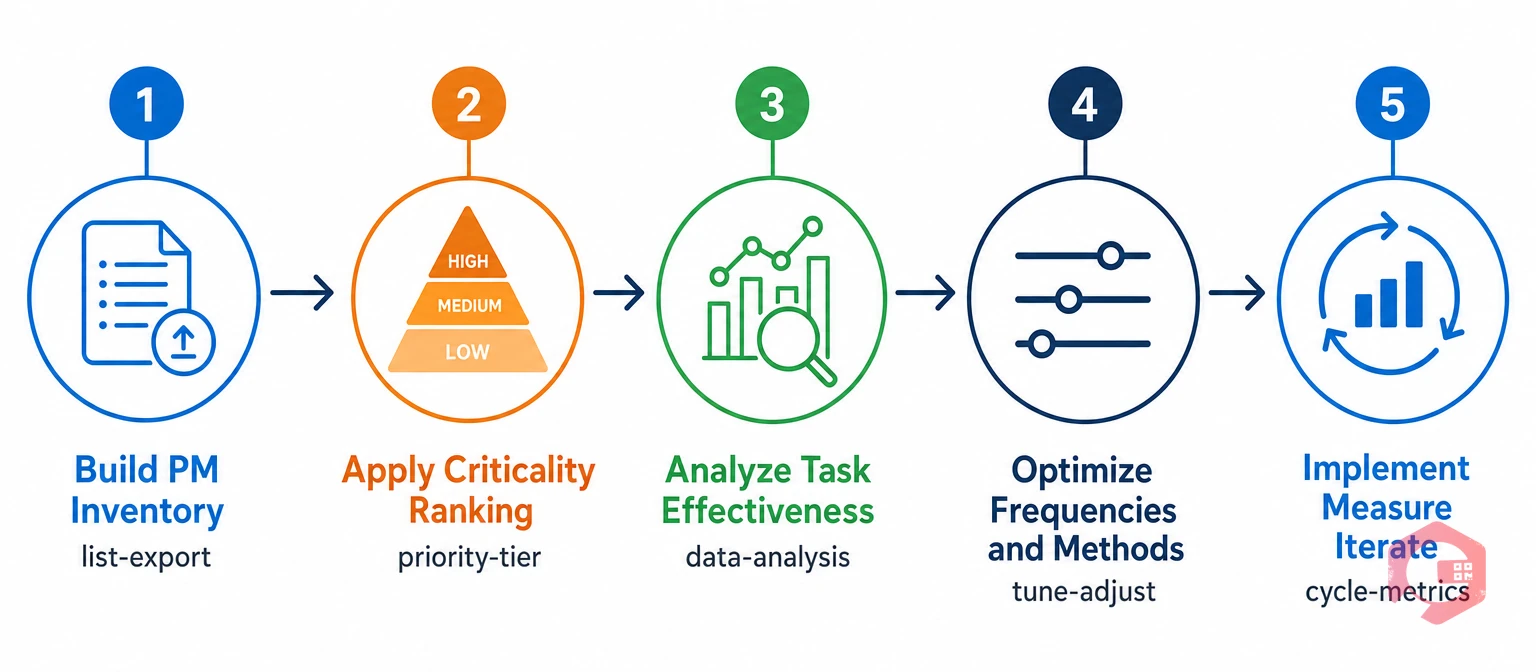
The 5-Step PM Optimization Process
Build Your PM Inventory: A complete, structured list of every PM task in the current program: the asset it applies to, the task description, the current frequency, the estimated labor hours, the skill level required, and any parts or materials consumed. Cryotos’s preventive maintenance module maintains a complete, queryable PM library — a PM inventory export takes minutes.
Apply Criticality Ranking to Every Asset: Prioritize the review effort by identifying which assets have the greatest consequence of failure: production impact, safety exposure, regulatory compliance risk, and repair cost.
Analyze Task-Level Effectiveness: For each PM task, ask three questions: Is this task preventing a real failure mode? Is the current method the most effective way? Is the current frequency matched to how quickly the failure mode actually develops?
Optimize Frequencies and Methods: Based on the task-level analysis, each task gets a recommendation: retain, modify, eliminate, or replace. Modifications to frequency should be traceable to the evidence base that justified the change.
Implement, Measure, and Iterate: Implement the approved changes in the CMMS, then measure outcomes: total PM hours per month, unplanned failure rate on reviewed assets, corrective work orders per PM work order, and maintenance cost per unit of production.
How Cryotos Supports PM Optimization
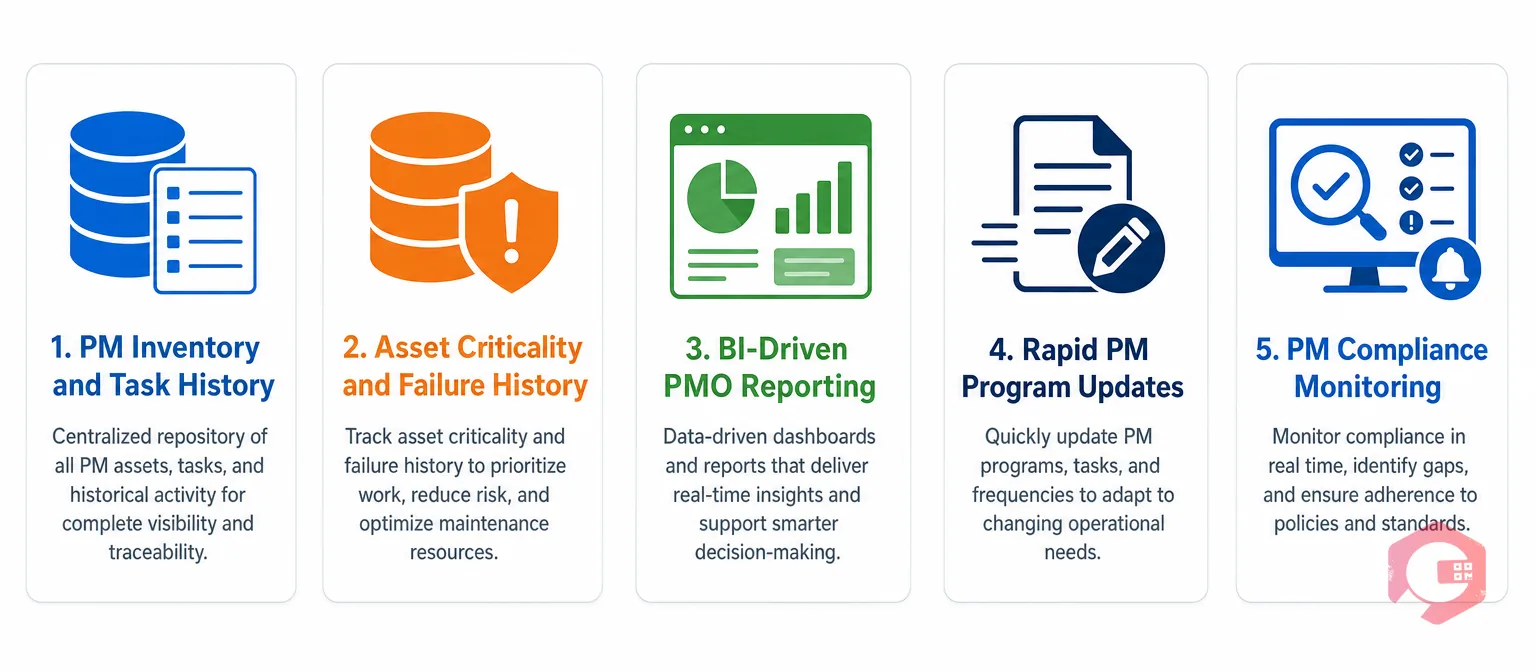
PMO is a data-intensive process that stalls without a CMMS that makes the right data easy to access. Cryotos supports every phase of the PMO cycle:
PM inventory and task-level history: The full PM library with linked completion history, defect finding rates, and parts consumption per task.
Asset criticality and failure history: Criticality classification, failure code capture at work order closure, and MTBF tracking by asset and failure type via the downtime tracking module.
BI-driven PMO reporting: Cryotos’s BI Dashboard generates PM completion rates, corrective work orders per PM work order, MTBF trends before and after PMO changes, and labor hours by PM task category.
Rapid PM program updates: Once PMO decisions are made, task frequencies are updated directly in the PM schedule, eliminated tasks are archived with PMO justification notes, and new condition-based triggers are configured to replace time-based tasks.
Ongoing PM compliance monitoring: Cryotos’s work order management module tracks PM compliance rate and escalates overdue items to supervisors automatically.
If your PM program hasn’t been reviewed in the last 18 months, there are almost certainly tasks in it that are consuming labor without preventing failures. Request a Cryotos demo to see how the platform’s PM data and reporting capabilities support a structured PMO review at your facility.
Frequently Asked Questions
How often should a PM program be optimized?
Most maintenance best-practice frameworks recommend a formal PMO review every 12–24 months for the overall program, with continuous rolling review for high-criticality assets whenever significant failure events, equipment modifications, or major changes in operating conditions occur.
What data do you need to conduct a PMO review?
The minimum data set is: a complete PM task inventory, PM completion history showing what was found, unplanned failure events by asset with root cause codes, and asset criticality classification. All of this data should live in a well-configured CMMS.
Is PM Optimization the same as reducing maintenance?
PMO is not a maintenance cost reduction program, though it often produces labor savings as a side effect. Some PMO reviews actually increase PM effort on critical assets where the analysis reveals under-maintained failure modes. The saving comes from reallocating hours freed by eliminating ineffective tasks toward high-value maintenance work that actually improves reliability.