How to Prep Parts and Tools Before the Wrench Ever Turns

Calendar
Duration:
5 min
calendar today
Published on
July 20, 2026
Featured Image

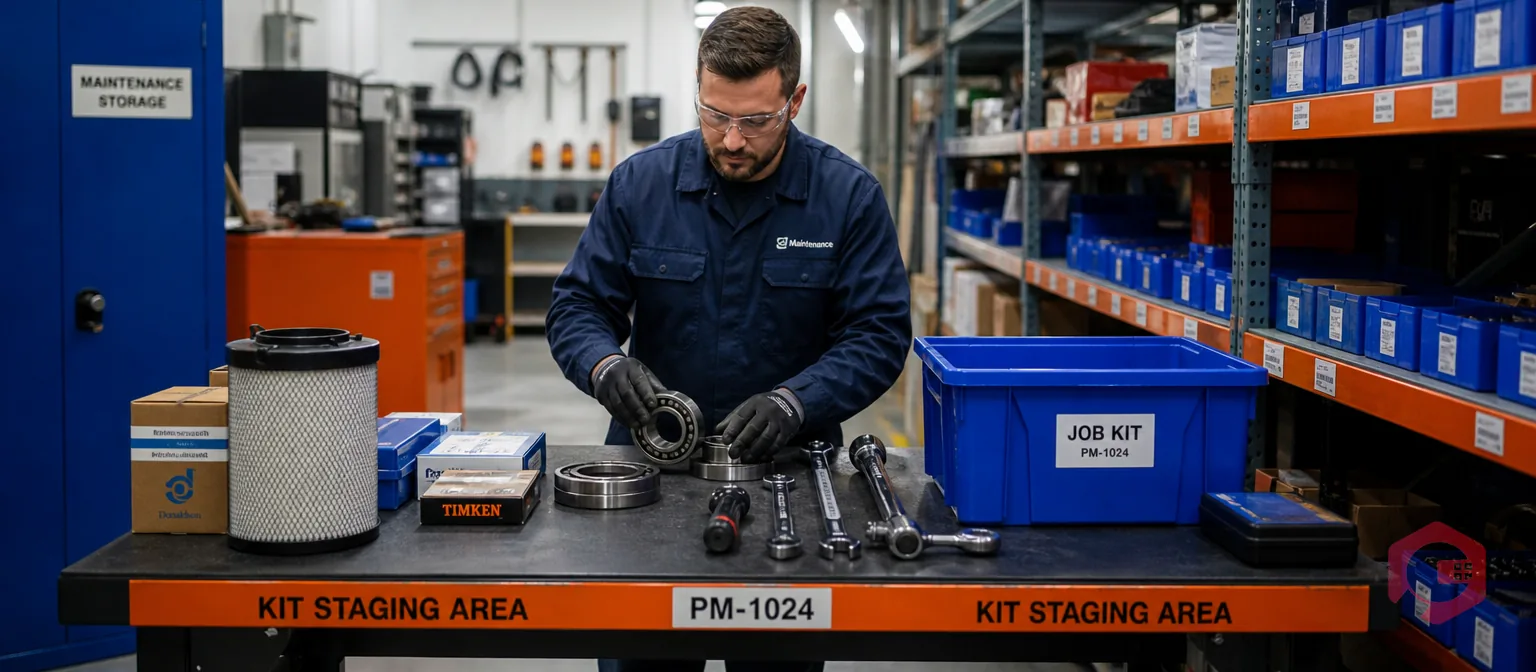
Maintenance pre-staging means pulling and organizing the parts, tools, and documents a technician needs before a scheduled job begins — not scrambling for them once the work order opens. A stalled PM because a filter is missing from the shelf isn't a parts problem. It's a planning problem.

Key Takeaways
  • Pre-staging, defined: gathering parts, tools, and documents before a job starts, not sourcing them during it.
  • The payoff: plants that pre-stage consistently see wrench time and PM compliance rise together while emergency work orders fall.
  • The root cause of failure: a coordination problem hiding inside what looks like an inventory problem.
  • The fix: a CMMS ties the job plan, parts list, and stockroom together so pre-staging happens automatically.

What Pre-Staging Covers

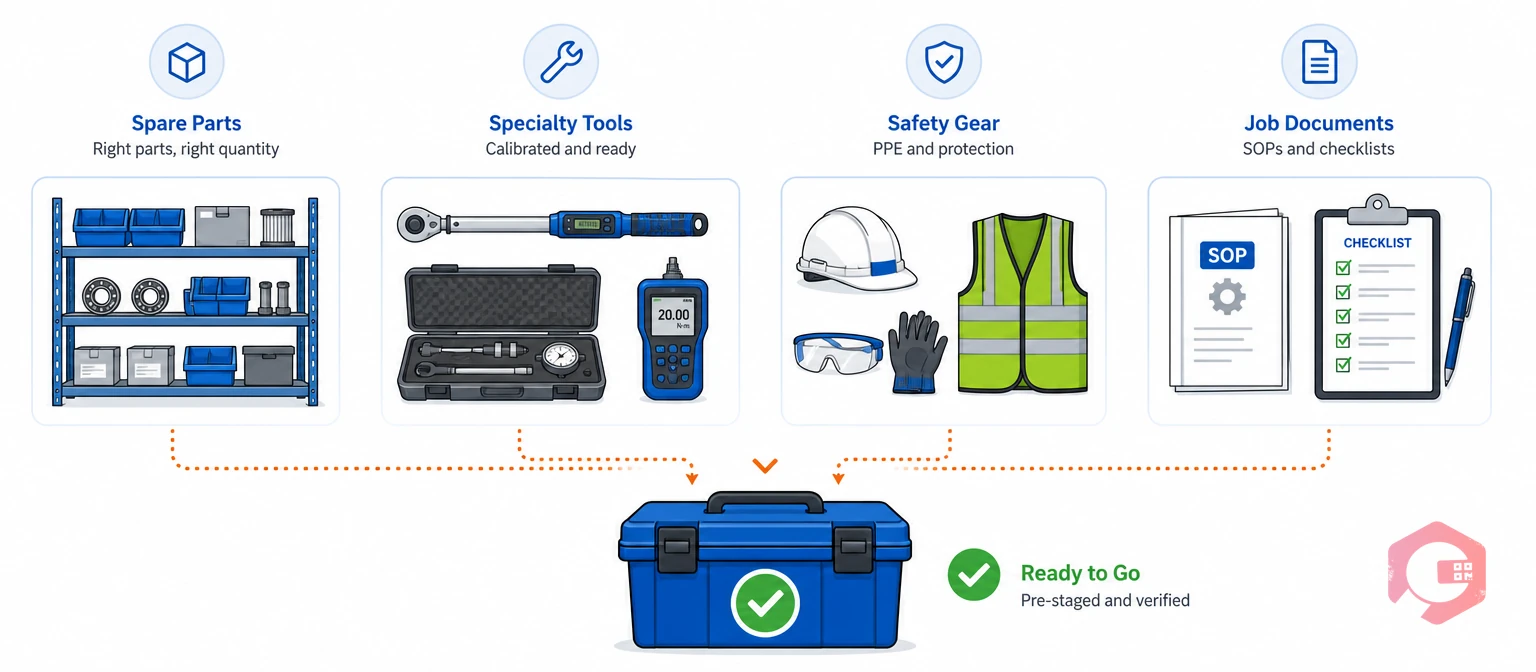
What maintenance pre-staging covers: parts, tools, safety gear, and documents | Cryotos

Pre-staging typically covers the exact spare parts listed on the job plan, specialty tools such as torque wrenches, calibration kits, and lockout devices, safety gear tied to the task, and any drawings, SOPs, or checklists the technician needs on-site.

Why Pre-Staging Matters

A technician who has to leave the job site to hunt for a bearing or a gasket isn't just losing that trip's time — the momentum of the job goes with it, and the asset stays down longer than the plan called for. Pre-staging closes that gap by making sure every job starts with everything already in hand.

Reliability-centered maintenance programs treat this kind of resource readiness as part of the maintenance strategy itself, not a separate storeroom task. Plants that pre-stage consistently tend to see three things improve together: wrench time goes up, PM compliance goes up, and emergency work orders caused by a missed or delayed PM go down.

The Manual Pre-Staging Problem

Without a system behind it, pre-staging depends entirely on someone remembering to walk the stockroom the day before. That breaks down fast.

  • Missed checks: planners forget to check part numbers against the job plan.
  • No advance notice: storeroom staff don't know a PM is coming up next week.
  • Parts get diverted: they're pulled for one job and used on another.
  • Tools go unconfirmed: no one checks the crib actually has the right calibration kit that day.

The result is a coordination problem hiding inside what looks like an inventory problem.

How CMMS Automates Pre-Staging

Six-step CMMS workflow that automates maintenance pre-staging | Cryotos

A Computerized Maintenance Management System ties the job plan, the parts list, and the stockroom together so pre-staging happens automatically instead of by memory.

The Step-by-Step Workflow

  • Trigger the job plan: the PM schedule flags an upcoming job and pulls its linked bill of materials.
  • Check stock levels: inventory management confirms whether every required part is on the shelf.
  • Fire low-stock alerts early: if a part is short, the planner gets notice days before the PM, not the morning of.
  • Reserve tools: tool management tracks which tools are checked out and to whom.
  • Deliver a ready kit: the mobile work order shows the exact parts, tools, and checklist tied to the job.
  • Pick and stage: put-away and picking workflows get parts physically ready at a marked location.

Maintenance teams using Cryotos have reported up to 30% reduction in unplanned downtime and 25% faster repair turnaround, much of it tied to technicians no longer walking off-site mid-job to chase a missing part.

See how Cryotos warehouse management maps storage locations so picking a pre-staged part takes seconds, not a walk through every aisle.

Cryotos Features That Support Pre-Staging

Four Cryotos features that support maintenance pre-staging | Cryotos
  • Inventory Management: real-time stock visibility with min-threshold alerts.
  • Tool Management: lending history and availability tracking.
  • Maintenance Checklists: attach the exact parts and tools list to every PM template.
  • Warehouse Management: map storage locations so picking is fast, not a scavenger hunt.

Industry Use Cases

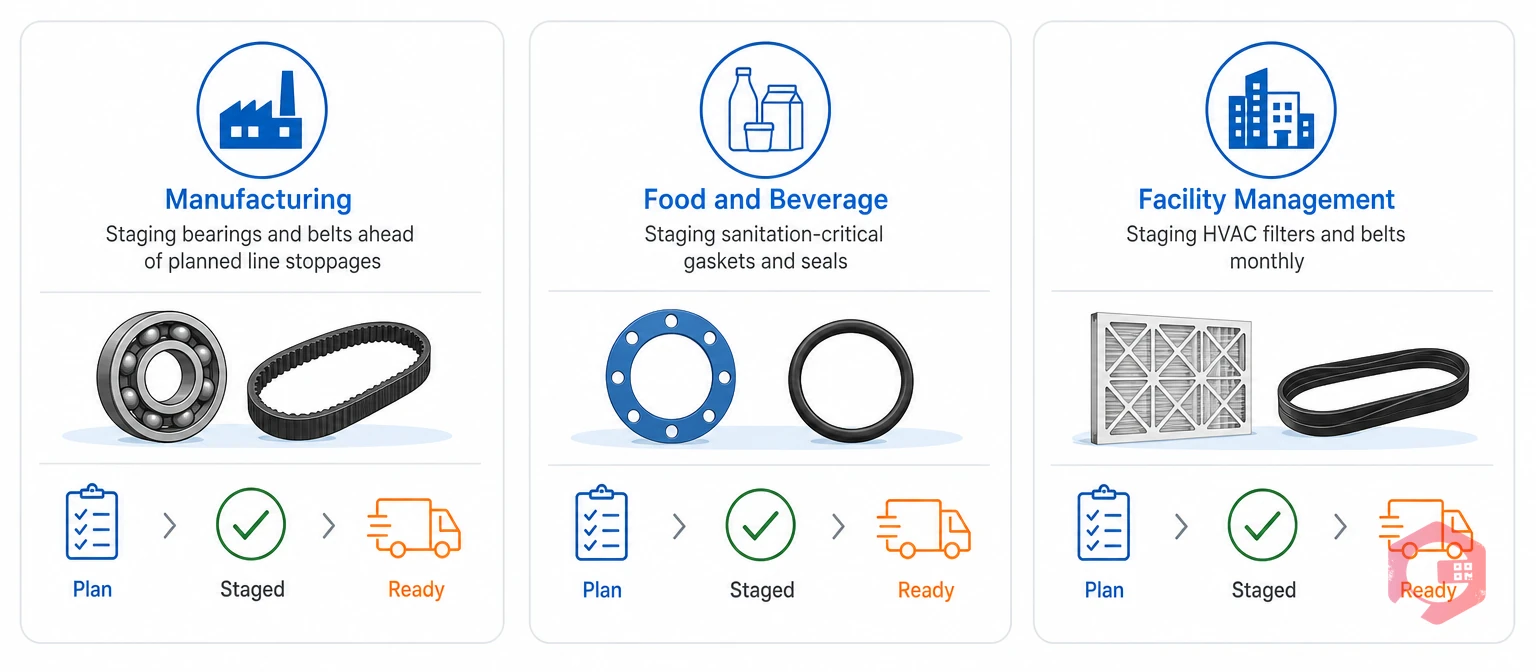
Pre-staging use cases across manufacturing, food and beverage, and facility management | Cryotos
  • Manufacturing: pre-staging bearings and belts ahead of planned line stoppages keeps changeovers on schedule.
  • Food & Beverage: sanitation-critical parts get staged with the right gaskets and seals to avoid contamination risk from substitute parts.
  • Facility Management: HVAC filters and belts staged monthly cut emergency call-outs during peak season.

KPI Improvements

Teams that build pre-staging into their preventive maintenance software workflow typically track improvement in PM compliance rate, average wrench time per work order, and a drop in unplanned maintenance events tied to missing parts.

Best Practices

  • Build the list into the template: parts and tools belong in the job plan, not as a separate note.
  • Set stock alerts a cycle ahead: at least one PM cycle, not at zero.
  • Assign one owner: someone confirms staging complete before the shift starts.
  • Review misses monthly: fix the root cause, not just the symptom.

Frequently Asked Questions

What is maintenance pre-staging?

Maintenance pre-staging is the practice of gathering and organizing the parts, tools, and documents a technician needs before a scheduled maintenance job starts, instead of sourcing them during the job.

How is pre-staging different from a regular parts pick list?

A pick list tells the storeroom what to pull. Pre-staging goes further — it confirms stock availability, reserves tools, and stages everything at a known location before the technician arrives.

Does pre-staging only apply to preventive maintenance?

No. It applies to any planned work, including work order management for planned corrective jobs, though PM work sees the biggest compliance gains since it's scheduled in advance.

What's the biggest reason pre-staging fails without a system?

Lack of visibility. Planners often don't know a part is out of stock until the technician is standing at the shelf with an empty hand.

Want your PM schedule and spare parts working from the same plan? Schedule a free demo to see how Cryotos pairs the two automatically.


Want to Try Cryotos CMMS Today?

Get Free Demo

Let AI Take Control of Your Maintenance

Cryotos AI predicts failures, automates work orders, and simplifies maintenance—before problems slow you down.

Try AI-Powered CMMS
🡢