

RO membrane cleaning and replacement is the condition-based work of restoring fouled membranes and retiring damaged ones. Clean when normalized performance drops about 10-15% from a stable baseline. Replace only when diagnosis, cleaning recovery, and lifecycle cost show the membrane cannot recover.
Membranes rarely fail without warning, so age alone is a poor trigger. A Computerized Maintenance Management System (CMMS) connects trends, cleanings, and replacements in one asset history. This guide covers the triggers, a clean-or-replace matrix, and how Cryotos supports each step.
Key Takeaways
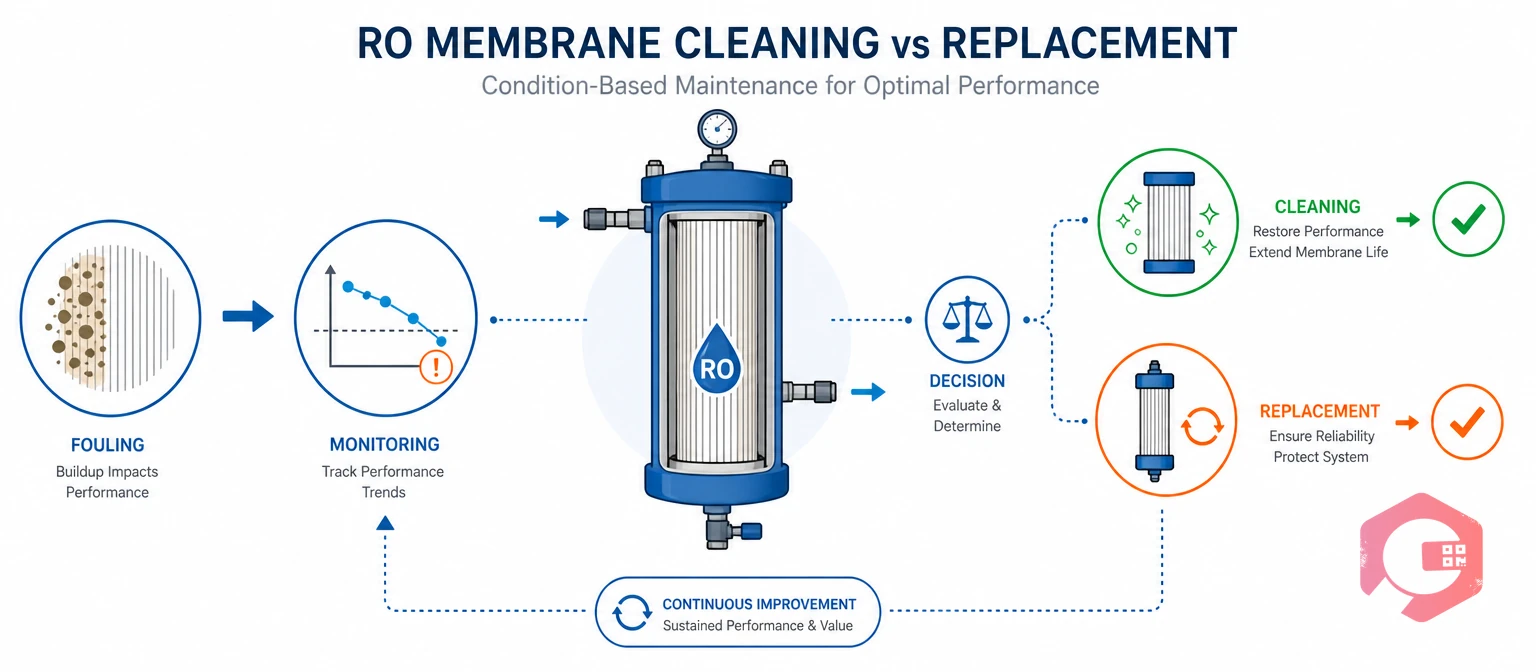
In a reverse osmosis train, this work covers two decisions: when to restore a fouled element and when to retire it. Membrane fouling is the buildup of scale, solids, organics, or biological growth that cuts flow or raises pressure drop.
Common causes of membrane fouling include mineral scale, silica, iron, and incompatible pretreatment chemicals. Damage is different, because cleaning cannot repair it:
Treat every membrane as a managed asset. ISO 55000 frames asset management around lifecycle value, so weigh cleaning cost, energy, downtime, and replacement cost together. Many plants catch fouling late because they watch raw readings instead of normalized trends.
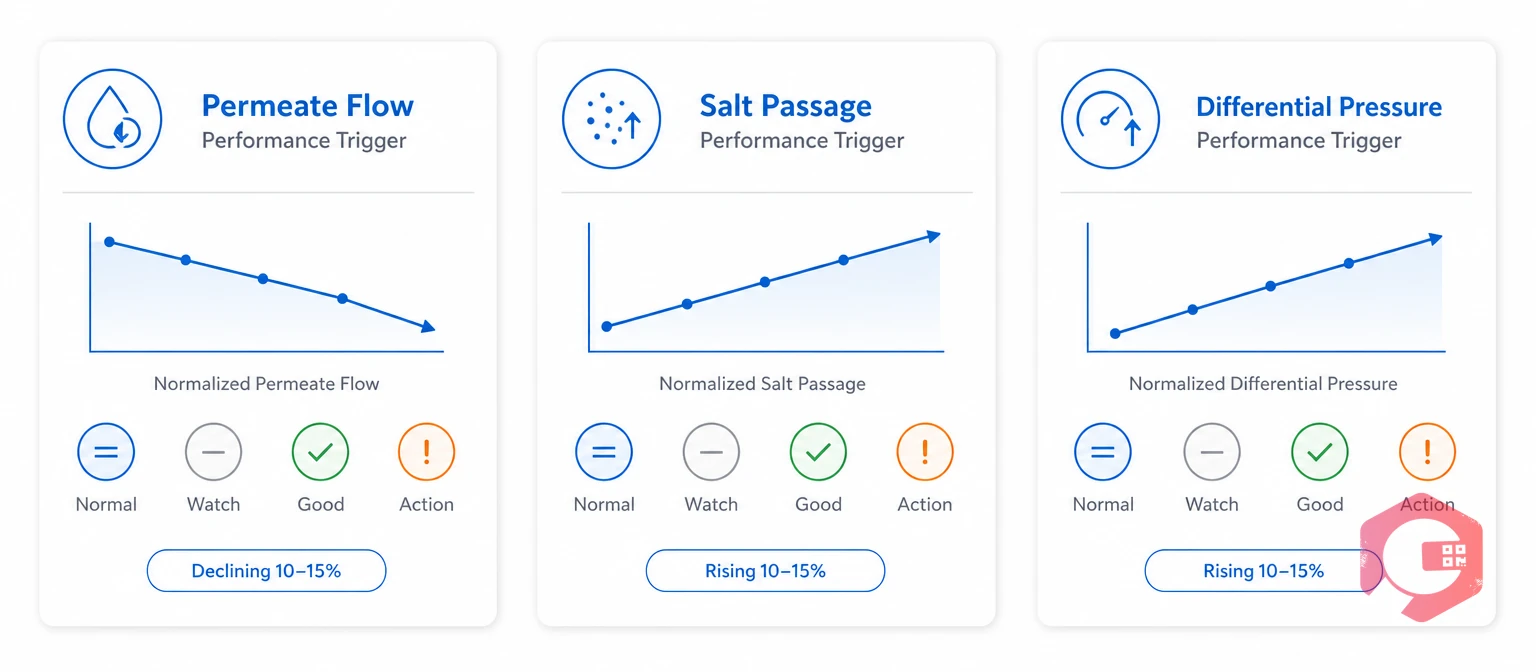
Start cleaning when normalized performance moves 10-15% from a clean baseline and troubleshooting points to recoverable fouling. These bands are typical industry guidance, so your membrane supplier's limits always take priority.
Normalized permeate flow is the permeate flow corrected for temperature, pressure, feed salinity, and recovery. Raw flow falls on a cold day even when membranes are healthy, so raw readings cause false alarms.
Waiting too long hardens deposits, raises energy use, and adds pressure stress. Cleaning too often adds chemical and hydraulic cycles that age elements early. Maintenance teams that clean on condition, not habit, avoid both problems.
Set these triggers once, and Cryotos preventive maintenance software can raise the inspection for you.
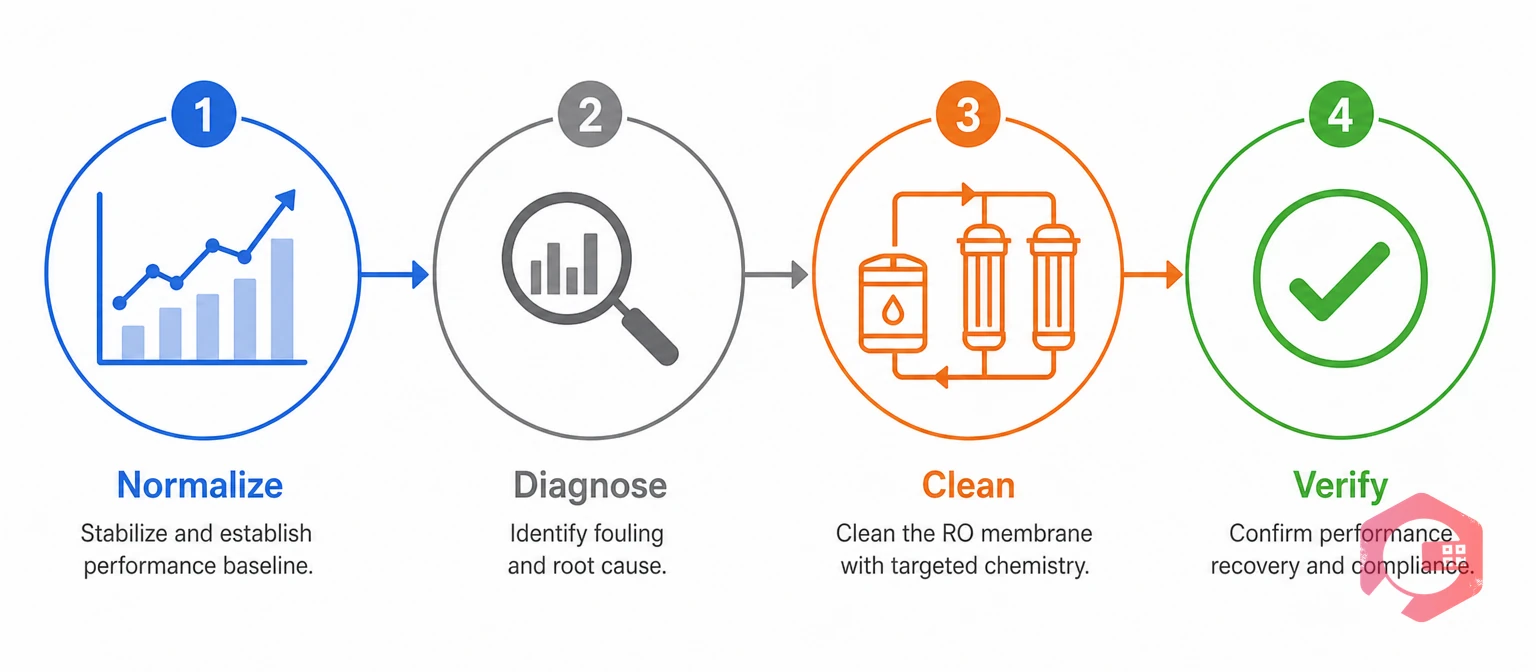
A four-step loop turns RO membrane cleaning and replacement into repeatable work that leaves a record at every step.
The Normalize-Diagnose-Clean-Verify Framework:
Clean-in-place (CIP) is a chemical recirculation that removes deposits while elements stay in their vessels. Log these items every time:
Measure recovery as (post-clean flow - pre-clean flow) ÷ (reference flow - pre-clean flow) × 100, using normalized flow. Treat CIP as chemical work, with PPE, isolation, spill control, and neutralization under the OSHA hazard communication standard.
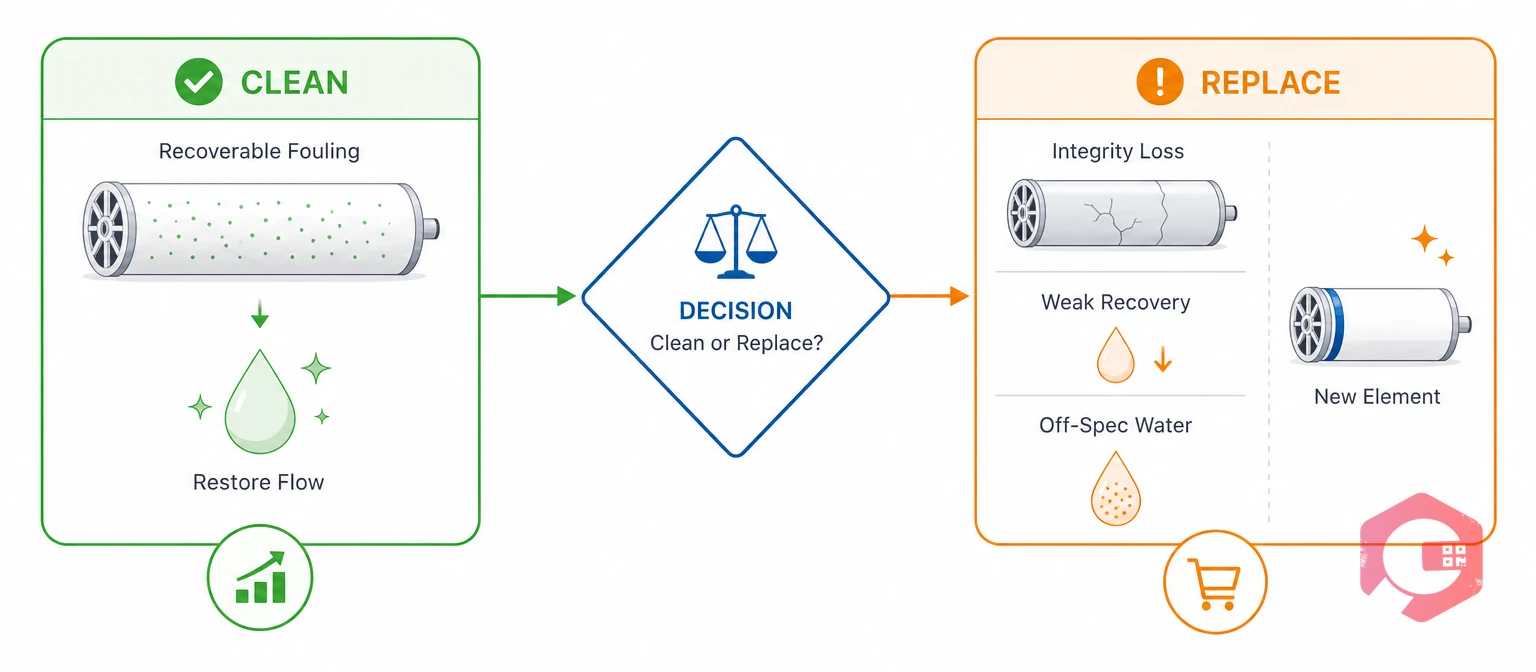
Clean when evidence points to recoverable fouling, and replace when integrity, recovery, or water quality fails. Use this matrix to match each symptom to an action.
| Observed condition | Likely cause | Maintenance action | Replacement tendency |
|---|---|---|---|
| Flow loss and higher pressure drop; salt passage steady. | Fouling or scaling. | Diagnose the foulant, run a validated CIP, fix the upstream cause. | Low if cleaning restores performance. |
| Salt passage rises sharply; hydraulics normal. | Oxidation, seal leak, or damage. | Probe vessels and check seals and integrity. | Moderate to high if damage is confirmed. |
| Each cleaning recovers less. | Irreversible fouling, aging, or a chronic upstream problem. | Review CIP method and pretreatment; compare lifecycle cost. | Rising. |
| Pressure drop stays high after cleaning. | Hydraulic blockage or a deformed element. | Inspect the vessel and flow distribution. | High if structural damage is confirmed. |
| Water quality misses spec at acceptable pressure. | Membrane no longer meets the process need. | Verify instruments, then model replacement benefit. | High if the spec cannot be restored. |
| Old membrane, stable normalized performance. | Age is not a failure mode. | Keep condition-based monitoring and spares. | Low. |
Check the numbers before approving new elements. Net replacement benefit = avoided energy + avoided cleaning cost + avoided downtime + avoided off-spec water - replacement cost. Simple payback = project cost ÷ monthly verified net benefit.
Fix the cause before the new membrane goes in, or the same fouling returns.
Most mistakes come from acting on raw data, using the wrong chemistry, or missing the right timing. Each one shortens membrane life or hides the real cause.
Chemical handling adds safety risk, so follow supplier limits and site chemical-safety rules.
Smart RO membrane cleaning and replacement starts upstream, because longer membrane life comes from pretreatment control, not more cleaning. CIP treats the symptom, so recurring fouling must be fixed at its source.
A recurring biofouling event, for example, calls for pretreatment and shutdown fixes, not a shorter cleaning interval.
Cryotos turns each membrane decision into scheduled, signed, and searchable work. Normalization stays in your SCADA, historian, or OEM tool, and Cryotos manages the maintenance work around those results.
Train 2 normalized flow falls 12% below baseline, first-stage pressure drop rises 14%, and salt passage barely moves. The threshold opens a diagnostic inspection with the 30-day trend, feedwater data, filter history, and last cleaning recipe attached.
The technician confirms lead-vessel fouling and high SDI, runs an alkaline clean, and logs 97% flow recovery on the mobile checklist. The reliability engineer tags it as pretreatment-related colloidal fouling and corrects the upstream cause.
Maintenance teams using Cryotos have reported up to 30% reduction in unplanned downtime and 25% faster repair turnaround. Most plants start with one RO train, then expand.
Six numbers, reviewed monthly, show whether your RO membrane cleaning and replacement program is improving or drifting.
Rising CIP frequency usually points upstream, not at the membrane.
There is no fixed calendar interval. Clean when normalized flow, salt passage, or pressure drop moves about 10-15% from baseline, within your supplier's limits. A rising CIP frequency signals an upstream problem.
Replace when integrity is lost, recovery keeps weakening, or pressure drop stays high after cleaning. Also replace when water quality misses spec or lifecycle cost favors new elements. Age alone is not a reason.
Fouling shows up as flow loss and higher pressure drop, and cleaning often reverses it. Damage, such as oxidation or leaking seals, shows up as high salt passage with normal hydraulics.
Yes. A CMMS records membrane assets, schedules or triggers CIP work, captures cleaning data, and links each event to cost and root cause. Normalization still comes from your SCADA or OEM tools.
Cleaning treats the symptom. Check pretreatment, antiscalant dosing, dechlorination, shutdown practice, and cleaning chemistry, then fix the source before cleaning again.
Longer membrane life starts with evidence, not a calendar. Schedule a free demo to see how Cryotos turns RO membrane cleaning and replacement into tracked, auditable work.


Cryotos AI predicts failures, automates work orders, and simplifies maintenance—before problems slow you down.



