

A multi-phase maintenance project is a planned initiative — an equipment overhaul, capital installation, plant turnaround, or multi-site rollout — that spans distinct stages. Each stage has its own milestones, budget, and resource needs, and it runs inside the same Computerized Maintenance Management System that handles daily operations. Unlike a single work order, it can't be tracked with one task and one due date. It needs scope, schedule, cost, and resource data held together across weeks or months, without pulling technicians off routine work in ways nobody planned for. This guide covers why these projects go off track, a four-layer framework for keeping them on track, and how a CMMS handles the job without a separate project tool.
Key Takeaways

A multi-phase maintenance project is a maintenance initiative broken into sequential or overlapping stages. Each stage has its own deliverables, budget allocation, and resource plan, rather than the whole thing running as one work order with one start and end date. Equipment overhauls, capital installations, plant turnarounds, and standardized multi-site technology rollouts all fit this pattern.
A work breakdown structure is a hierarchical decomposition of a project's total scope into smaller, manageable components. The Project Management Body of Knowledge formalized this concept, and it applies well beyond construction and engineering work. Most maintenance teams manage single work orders competently. A project spanning multiple phases needs that same scope broken into work packages, or it ends up as one oversized work order with no internal structure.
Most facilities treat a turnaround the same way they treat routine repairs: one big work order. That works until scope creep or a missed contractor handoff shows the project needed its own structure from day one. Without a documented phase structure, nobody owns the sequence between stages. That gap is exactly where cost and schedule control disappears.
Multi-phase maintenance projects rarely fail from one dramatic mistake. They fail from small, untracked gaps that compound across phases.
Industry analysis of plant turnarounds consistently finds that cost and schedule overruns grow as more capital project work gets folded into the shutdown scope. The more phases a project touches, the more places a gap can open. Build the control structure before the project starts, not after the first missed milestone.
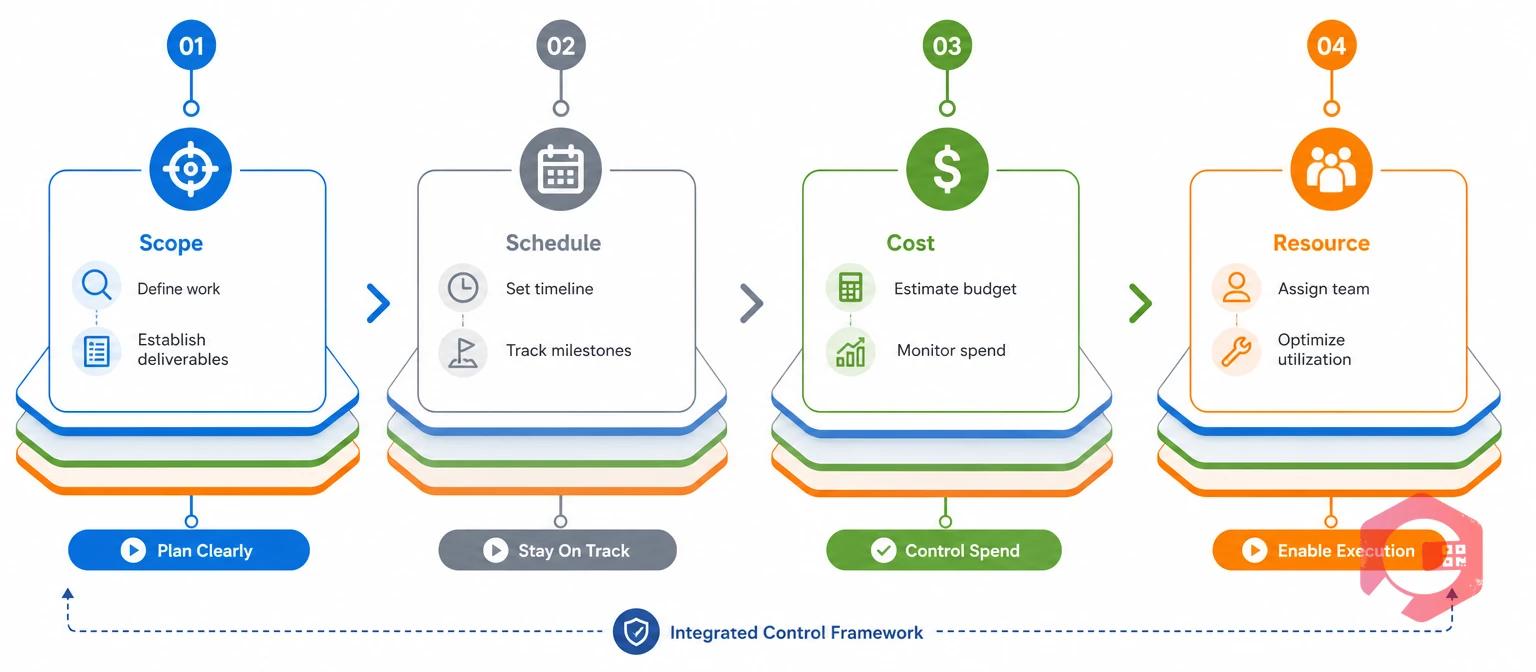
The Four-Layer Control Framework:
Cryotos's project and budget module holds all four layers in one place. Parent project, child work packages, and individual work orders roll up into the same budget and schedule view technicians already use for daily work.
Want to see how a project's cost per category compares to industry maintenance cost benchmarks? Try the mean maintenance cost calculator to check your own numbers before the next project kicks off.
A milestone is a scheduling point that marks the completion of a significant deliverable or phase gate. It has no duration of its own, only a date and a set of exit criteria. Managing milestones across a multi-phase project means defining those exit criteria before the phase starts, not deciding after the fact whether the work "counts" as done.
Phase-gate reviews close out each phase with a documented check: is the deliverable complete, is the budget within variance, and is the next phase's prerequisite work actually finished? Skipping this step is how a delayed phase quietly becomes a delayed project.
Dependency tracking keeps phases in the right order. A shutdown phase can't begin until parts arrive. A commissioning phase needs the installation phase signed off first. These dependencies need to be visible in the same schedule view the rest of the project uses, not tracked separately in someone's inbox.
Cryotos's report builder generates milestone and variance reports directly from the same work order data driving the project, so a phase-gate review pulls real numbers instead of a manually assembled status update.

Earned value management is a project management technique that compares planned cost, actual cost, and completed work. It shows whether a project is truly on budget, not just on schedule. The Project Management Institute has formalized this approach since the 1980s. Spending 50% of a project's budget means nothing on its own. Spending 50% of the budget while only 25% of the work is done is a project in trouble. Spending 50% of the budget while 75% of the work is done is a project ahead of plan.
Applied to a maintenance project, this means tracking maintenance costs by category and phase, not as one running total:
| Cost Category | Planned | Actual | Variance |
|---|---|---|---|
| Labor Hours | Budgeted crew hours per phase | Logged hours from work orders | Over/under against budgeted hours |
| Parts and Materials | Estimated parts spend | Actual parts issued and invoiced | Over/under against estimate |
| Contractor Spend | Contracted fixed or estimated cost | Invoiced contractor cost to date | Over/under against contract |
| Rental Equipment | Planned rental duration and rate | Actual rental days billed | Over/under against planned duration |
Reviewing this table phase by phase, instead of only at project close, is what turns a budget overrun into a mid-project correction instead of a year-end surprise.
Resource leveling is the practice of adjusting task start and finish dates so the demand for technicians never exceeds the supply available in a given week. The Project Management Body of Knowledge defines the technique this way, and it applies directly to maintenance scheduling. A project and the routine maintenance backlog draw from the same pool of electricians, mechanics, and specialists. Without leveling, that competition gets resolved subjectively instead of planned in advance.
Most maintenance teams already run a version of this for the weekly backlog, matching planned work-order estimates against available crew hours before the week starts. A multi-phase project needs that same discipline applied across both the project schedule and the operational schedule at once. Without it, the project quietly wins every resource conflict at the expense of routine work, or loses every one of them at the expense of the project deadline.
Major maintenance projects rarely run on in-house labor alone. Turnarounds and capital installations typically involve multiple contractors working overlapping phases, each with their own scope, schedule, and invoicing terms.
Routing contractor tasks through the same work order management system used for in-house technicians keeps SLA tracking, completion verification, and cost capture consistent across both groups. That beats running two parallel systems that never reconcile.
Change control matters just as much. Scope changes, schedule slips, and budget revisions all need a documented decision trail: what changed, when, and who authorized it. A project without a change log isn't necessarily a project with no changes. It's a project where nobody can explain, six months later, why the final cost or timeline doesn't match the original plan.
Not every maintenance project belongs in a CMMS. The right choice depends on how much the project overlaps with ongoing asset and maintenance data versus how much it resembles a standalone construction or enterprise initiative.
| Project Type | Recommended System |
|---|---|
| Equipment overhauls and capital maintenance | CMMS |
| Turnarounds and planned shutdowns | CMMS |
| Standardized multi-site rollouts | CMMS |
| Large capital construction with architects and contractors | Dedicated project management tool |
| Enterprise cross-departmental initiatives | Dedicated project management tool |
| Projects requiring formal earned-value management | Dedicated project management tool |
The pattern is straightforward. When the project's reliability context already lives in the CMMS — the assets, the technicians, the parts — keeping the project there too eliminates a handoff. When the project is closer to construction or enterprise program management, a dedicated tool usually fits better. Some organizations reasonably use both.
Cryotos structures multi-phase projects as a hierarchy: a parent project holds child work packages, and each work package holds the individual work orders technicians actually complete. Milestones are defined with start and end dates at each level, so a phase-gate review pulls real progress data instead of a status update assembled by hand.
Budget tracking follows the same hierarchy. Labor, parts, contractor, and rental spend roll up from individual work orders into the project-level budget view. Planned-vs-actual variance is visible by category and by phase, not just as a single number at project close.
Maintenance teams using Cryotos have reported up to a 30% reduction in unplanned downtime and 25% faster repair turnaround. Part of that gain comes from project work and daily operations sharing the same asset, cost, and technician data instead of living in two disconnected systems that need manual reconciliation.
A multi-phase maintenance project is a maintenance initiative broken into distinct stages, such as an equipment overhaul, capital installation, or plant turnaround. Each stage has its own milestones, budget, and resource requirements. It isn't tracked as a single work order.
A single work order has one task, one due date, and one technician assignment. A multi-phase project decomposes into a work breakdown structure of phases and work packages, each containing multiple work orders, with dependencies, milestones, and a budget that spans the entire initiative.
Maintenance-heavy projects like overhauls, turnarounds, and multi-site rollouts generally fit best inside a CMMS, since the reliability context already lives there. Large capital construction, enterprise-wide initiatives, and projects requiring formal earned-value management usually fit better in a dedicated project management tool.
Resource leveling is the process of adjusting task start and finish dates so that demand for technicians never exceeds the available supply in a given period. It resolves conflicts between project work and routine maintenance, without relying on ad hoc, subjective decisions.
Multi-phase maintenance projects succeed when scope, schedule, cost, and resources live in one system instead of four disconnected ones. Schedule a free demo to see how Cryotos keeps your next capital project, overhaul, or turnaround on budget and on schedule.




Cryotos AI predicts failures, automates work orders, and simplifies maintenance—before problems slow you down.



