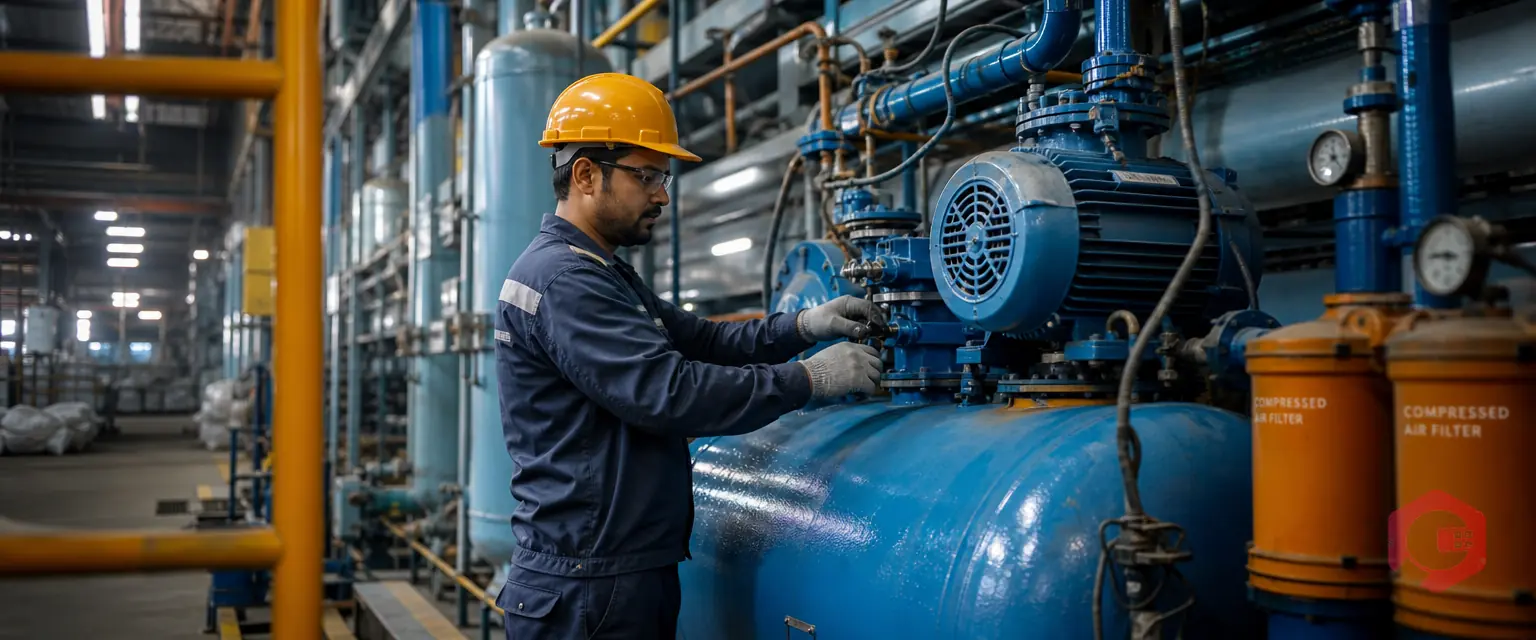
Textile mills should maintain compressed air and water utilities on a fixed schedule. That means daily checks, weekly cleaning, monthly leak and water tests, and yearly overhauls. Track each task against the machines that depend on it. Looms, spinning frames, and dye houses stop or make defects within minutes when air pressure drops or water goes bad. So utilities are as critical as the machines they feed.
The good news is that most utility failures warn you first. A clogged filter, a rising dew point, or a tired softener can all be caught on a routine round. This guide gives you a step-by-step plan, two ready-to-use schedules, and a simple framework to keep both utilities reliable.
Key Takeaways
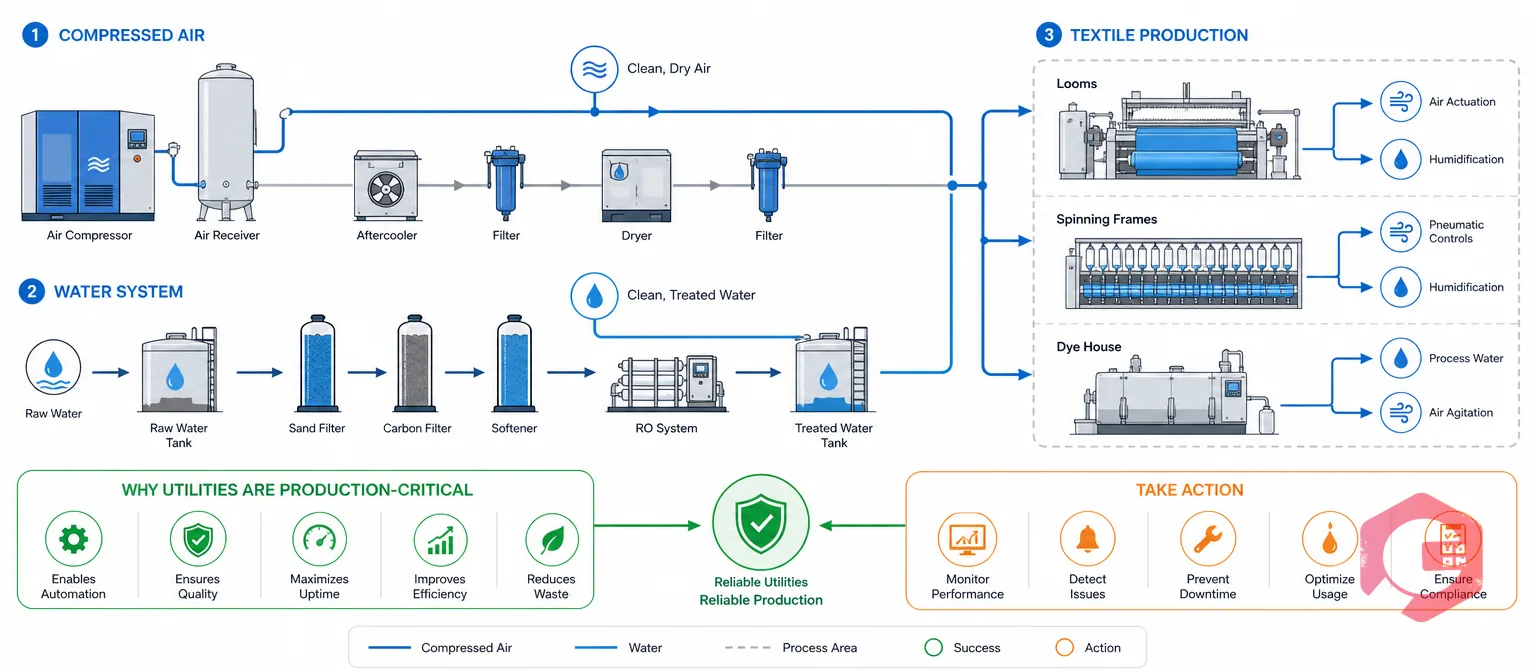
Almost every step in a textile mill depends on compressed air and water. Compressed air carries the weft yarn on air-jet looms. It also runs splicers and drives valves on dye machines. Water feeds the boilers, dye baths, washers, and humidifiers.
A utility asset is any shared system, such as a compressor, dryer, softener, or pump, that serves many production machines at once. When one fails, the loss spreads across a whole shed rather than a single machine.
Good utility care also fits the standards most mills follow. TPM asks operators to own basic cleaning and checks. ISO 55000 asks you to manage assets by risk and cost. Air quality is often set using the ISO 8573-1 classes for dirt, water, and oil.
Treat your compressors, dryers, softeners, and pumps as production-critical assets, because the mill cannot run without them.
Start by listing every utility asset and the machines it serves. Without this map, a dryer fault looks like a loom problem. The real cause then stays hidden.
Put a QR tag on each asset, so technicians log readings and faults against the right record. Most mills that do this find two or three single points of failure, such as one dryer serving the whole weaving shed.
A Computerized Maintenance Management System stores this map in one place and links every reading and work order to the asset. A clear asset map turns scattered utility faults into patterns you can act on.
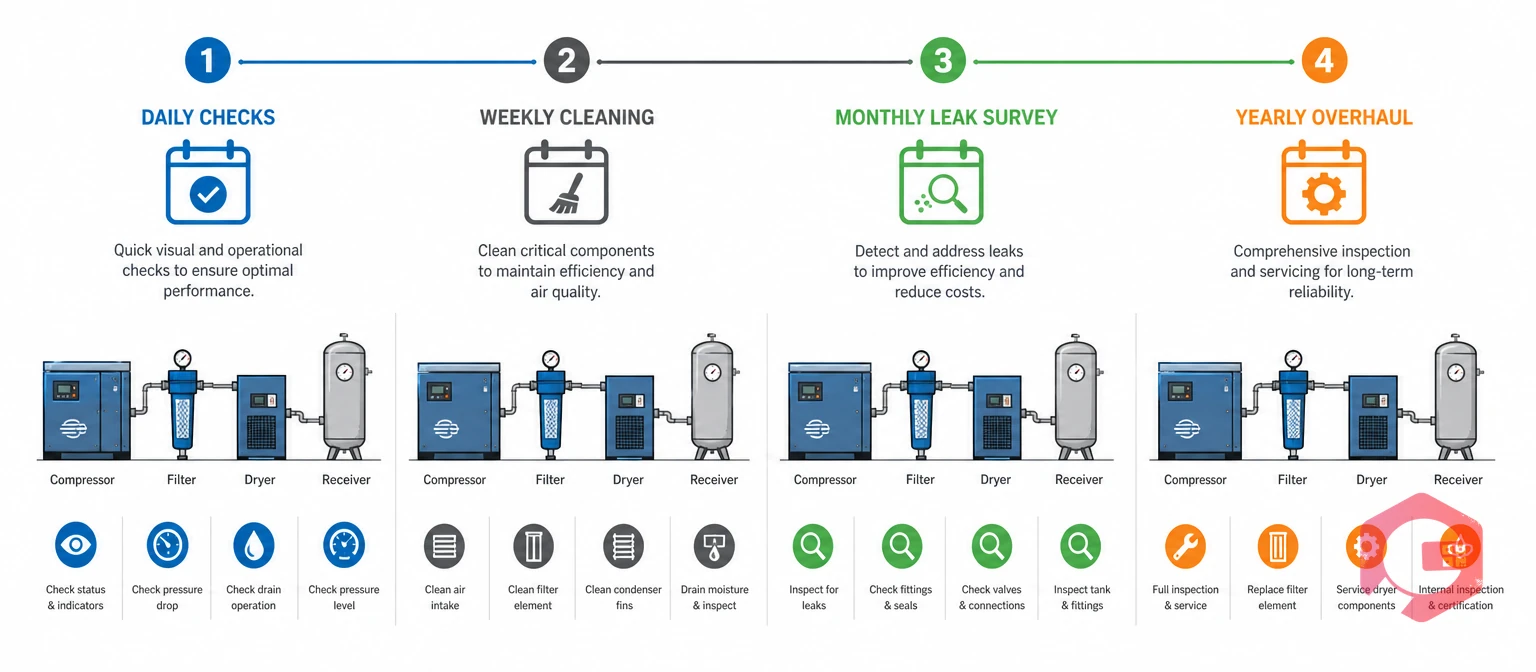
A compressed air system maintenance schedule lists each part, the task, how often to do it, and the limit that calls for action. In textile mills, clean filters and coolers more often than the maker says. Lint and cotton fly clog them fast.
| Component | Task | Frequency | Action Trigger | Textile Risk If Missed |
|---|---|---|---|---|
| Air intake filter | Inspect and blow clean | Weekly | Visible lint or high pressure drop | Lower output, higher power use |
| Oil and air coolers | Clean fins of fly and dust | Weekly to monthly | Discharge temperature rising | High-temperature trips during peak loom load |
| Compressor oil | Check level, sample and change | Daily check, change per OEM hours | Low level or due run hours | Worn compressor element and oil in the air |
| Oil separator | Read pressure drop, replace element | Monthly reading | Pressure drop near OEM limit | Oil reaching yarn and fabric |
| Air dryer | Log pressure dew point | Every shift | Dew point above set value | Wet air, rusty valves, loom stops |
| Condensate drains | Test that each drain discharges | Daily | Drain stuck or blowing air | Water slugs in loom headers |
| Line filters | Read pressure drop, change element | Weekly reading | Pressure drop above OEM limit | Pressure loss at the farthest looms |
| Receiver tank | Drain, check safety valve, inspect shell | Daily drain, yearly inspection | Corrosion or valve not lifting | Safety risk and statutory non-compliance |
| Distribution network | Ultrasonic leak survey | Monthly | Any tagged leak | Wasted power and low header pressure |
Load these tasks into preventive maintenance software as time-based and run-hour-based jobs. Most mill compressors run all day and night. Run-hour triggers keep oil and separator changes on time.
A written compressed air schedule, with clear limits for each task, is the base for every other step in this guide.
Want to know what a single utility breakdown costs your mill? Try the free unplanned downtime calculator with your loom count and hourly output.
Mills should check for compressed air leaks every month and fix them within a week. Leaks are the biggest waste in most air systems. Energy studies often find that a poorly kept plant loses 20 to 30 percent of its compressor output to leaks.
A compressed air leak survey is a planned walk of the whole network with an ultrasonic detector to find, tag, and size every leak. The detector picks up the high-pitched hiss that you cannot hear over running looms.
Monthly surveys turn leak repair from a one-time project into a habit, and that habit keeps your compressor power bill under control.
Compressed air for textile machines must be clean, dry, and free of oil. Dirt, water, or oil can stain yarn or stop a machine. Loom nozzles and splicers have tiny holes that block or rust when air quality slips.
Pressure dew point is the temperature at which water vapor in compressed air turns into liquid at line pressure. Keeping it below the coldest point in your piping stops water from forming in the headers.
Short, simple checks like these suit operator rounds under autonomous maintenance. Operators see the dryer and drains every shift, so they spot trouble before the maintenance team does.
Dry, oil-free air protects both your machines and your fabric quality, so check it every shift.
Water utility maintenance keeps water soft, clean, and flowing to boilers, dye houses, humidifiers, and cooling towers. Hard or iron-rich water causes uneven dyeing. Dirty humidifier water spreads odor and germs through the shed.
Water hardness is the amount of dissolved calcium and magnesium in water, and it is the main cause of scale and dyeing defects. Most dye houses test it every shift at the softener outlet.
| System | Task | Frequency | Action Trigger | Textile Risk If Missed |
|---|---|---|---|---|
| Water softener | Test outlet hardness, check salt and regeneration | Every shift | Hardness above dye house limit | Dye spots, shade variation, boiler scale |
| RO plant | Log pressures, flow, and permeate quality | Daily | Permeate flow down or pressure drop up | Membrane fouling and short supply |
| Humidification plant | Clean nozzles, eliminators, and sump | Weekly to monthly | Blocked nozzles or RH off target | Yarn breaks, static, poor spinning |
| Cooling tower | Check conductivity, dosing, and blowdown | Daily, with quarterly bacteria test | Conductivity high or biofilm seen | Scale, poor cooling, health risk |
| Pumps and motors | Check vibration, seals, and bearings | Monthly | Vibration rising or seal leaking | Loss of water to dye machines |
| Storage tanks | Inspect, clean, and check level sensors | Half-yearly | Sludge build-up or sensor drift | Iron and dirt in process water |
Use digital maintenance checklists for each water round, so readings are logged with a time stamp instead of written on a wall sheet. Steady water quality is the cheapest way to cut re-dyeing and boiler fuel costs.
Meters and sensors let you act on real trends, not just fixed dates. A compressor that runs hotter each week gives warning days before it fails. So does a softener that lets hardness through earlier each cycle.
Many new compressors and RO plants already send data to a PLC or SCADA system. Condition monitoring software can pull those readings and raise a work order when a value crosses its limit.
Maintenance teams using Cryotos have reported up to 30% reduction in unplanned downtime and 25% faster repair turnaround. Much of that gain comes from catching utility drift early, before a whole weaving shed stops.
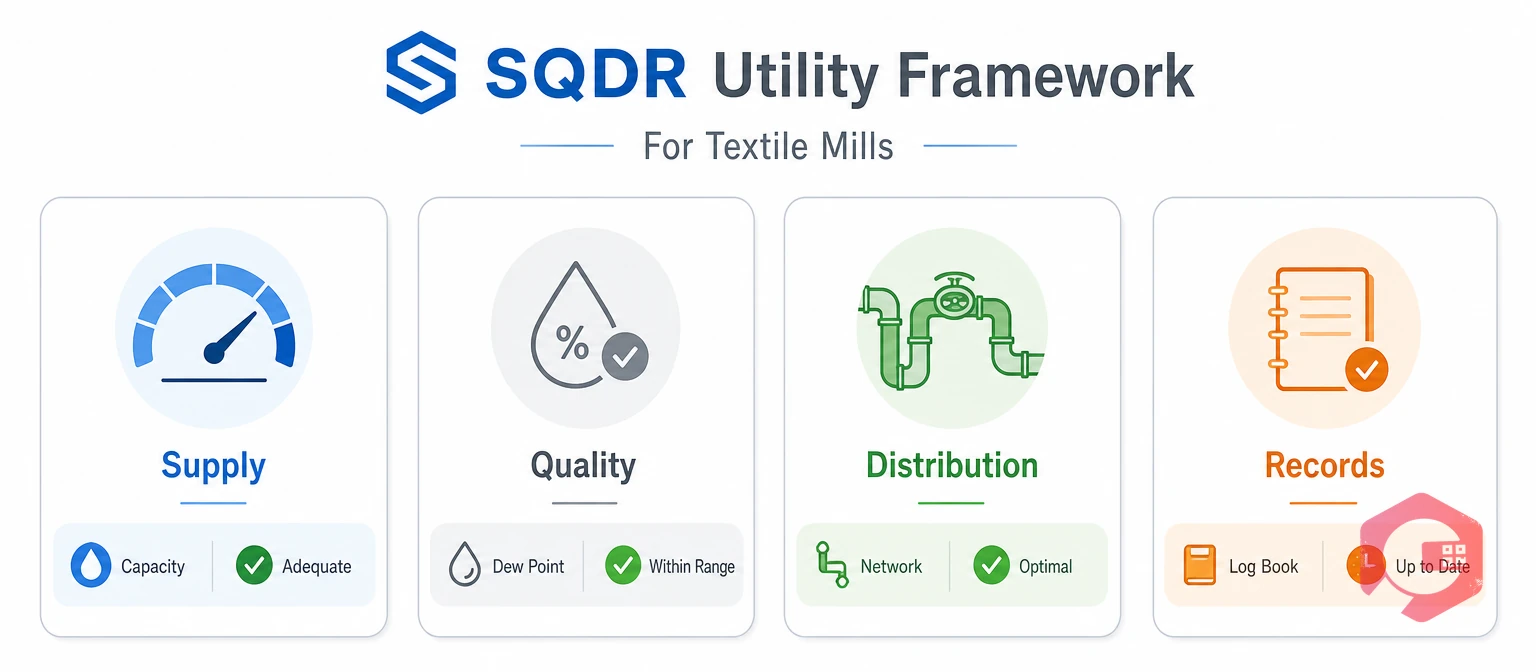
The SQDR Utility Framework is a simple way to check that each compressed air and water utility is fully covered. It works for one compressor or a full utility block.
The SQDR Utility Framework:
Score each utility from one to three on all four points. A low Supply score means you need a standby. A low Quality score means checks are missing. A low Records score means you cannot prove what happened.
Review scores with production heads each month. That way, gaps get budget before they cause a breakdown. Linking this review to your manufacturing maintenance software keeps the scores tied to real work orders.
When all four points are covered, utility failures become rare and predictable.
Most mistakes in textile utility care come from treating utilities as background kit. Most facilities only notice them when a loom shed stops.
Fixing these habits costs little, and it often gives the fastest savings any mill maintenance team can find.
Most mills check oil level, drains, and dryer dew point every day and clean intake filters and coolers every week. Oil, separator, and filter changes follow the maker's run-hour limits, often between 4,000 and 8,000 hours for rotary screw units. Lint-heavy areas may need even shorter cleaning cycles.
Air-jet looms use fine nozzles and fast valves to insert the weft yarn. Water corrodes valves and causes stops, while oil can stain yarn and finished fabric. Clean, dry air keeps pick timing steady and protects fabric quality.
Start with monthly leak surveys and fast repairs, then lower the header pressure once leaks are fixed. Stop open blowing with air guns and close supply valves on idle machines. Track energy per unit of air so you can see each saving.
Hard water and dissolved iron are the most common causes of dyeing defects. They react with dyes and chemicals and cause spots, dull shades, and uneven color. Testing softener outlet water every shift and keeping tanks clean prevents most of these problems.
Yes, a CMMS can hold every utility asset, its schedule, and its readings in one system. It creates work orders when limits are crossed and links each fault to the production machines it affects. This gives mill managers one view of utility health across the plant.
Reliable compressed air and water keep every loom, frame, and dye machine in your mill running. Schedule a free demo to see how Cryotos schedules utility maintenance, tracks readings, and links every utility fault to the machines it affects.



Cryotos AI predicts failures, automates work orders, and simplifies maintenance—before problems slow you down.