

Why fixing things only after they break is costing food manufacturers far more than they realize - and what to do about it.
You share your experiences with others who have faced similar problems. This situation happens frequently in food processing plants and beverage facilities and cold chain operations. When the equipment fails, the team comes to fix it, but expenses keep increasing until the equipment needs to be repaired again.
That cycle has a name: reactive maintenance. And specifically, it carries a price tag that most people never fully see.
This blog breaks down exactly what reactive maintenance is costing your operation - not just in repair bills, but in the hidden layers of damage that rarely show up on a single invoice.
Every maintenance manager wants to operate a proactive system. The situation begins to expand when a quarter becomes busy, and a budget restriction takes effect, and the team already faces resource limitations. The team delays preventive maintenance activities until later. They will postpone the task until the following month. The conveyor system suddenly halts operations during the middle of the workday.
More than half of maintenance teams spend most of their working hours responding to equipment failures instead of handling preventive maintenance tasks. Production line operation demands force workers to continue their tasks which interrupts their scheduled maintenance activities.
In most industries, that's a costly habit. In the food industry, it's a dangerous one.
The obvious initial costs begin to emerge when equipment suffers from operational failure. The technician comes to your location which incurs extra costs for emergency services. You need to acquire a replacement component which results in urgent delivery charges. You will incur expenses for urgent component delivery. The repair gets completed and the machine functions again while all data gets recorded.
That's the visible tip of the iceberg. And most facilities only ever track this part.
But the direct repair cost is rarely the most damaging number on the page.
Food manufacturing facilities experience their most challenging times during reactive maintenance operations. The food industry requires a different operational model than standard factories. Your production process faces challenges from perishable raw materials and strict hygiene rules and limited time for production and inspectors who disregard your equipment failure that occurred at 2 AM.
The sudden failure of essential assets leads to these events.
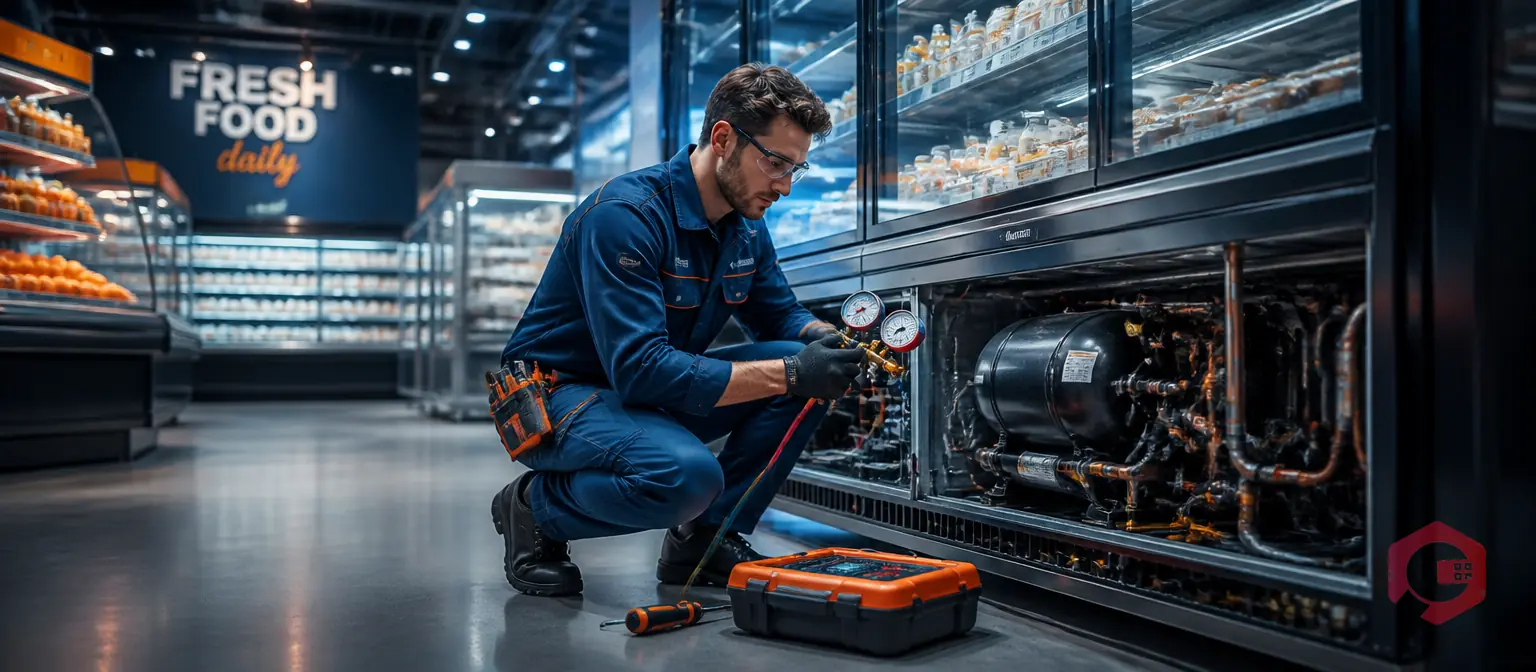
A refrigeration unit fails. A batch of dairy, meat, or fresh produce crosses the safety temperature threshold. Depending on the volume, you're not looking at a minor write-off -you're looking at a significant hit to your margins, and possibly a food safety incident.
In food manufacturing, lines are tightly sequenced. When one machine goes down, it doesn't just pause that machine - it backs up the entire flow. Every idle minute on a high-volume line is lost output you cannot recover.
When equipment stops working during production, cleaning and sanitation measures must begin anew because production cannot start again until those tasks are complete. The lost time amounts to several hours instead of just a few minutes.
Sourcing a part reactively almost always costs more. Rush orders, premium shipping, and accepting whatever's available rather than the ideal component - these inflate your maintenance spend in ways that don't show up neatly in your breakdown cost report.
Running equipment until it fails is one of the fastest ways to wear it out permanently. Repeated run-to-failure cycles cause secondary damage to surrounding components and eventually force premature capital expenditure on asset replacement.
In food manufacturing, maintenance records aren't just administrative paperwork - they're part of your HACCP compliance. Reactive environments tend to have messy documentation, gaps in service history, and incomplete work order records. When an auditor walks in, those gaps become violations.
Any one of these alone is expensive. When they stack together after a single unexpected failure, the true cost of that breakdown can be many times higher than the repair bill that gets filed.
HACCP - Hazard Analysis and Critical Control Points - is the backbone of food safety management. It exists to identify where contamination or safety failures can occur in the production process, and to make sure controls are always in place at those Critical Control Points.
Reactive maintenance and HACCP don't mix well.
When a piece of equipment fails unexpectedly - a filling machine, a pasteurizer, a cooling tunnel - there's an immediate question: was the Critical Control Point compromised? Were temperature thresholds breached? Is there a contamination risk? In a reactive environment, the honest answer is often 'we're not sure.
That uncertainty is dangerous. It can mean a precautionary product to hold while investigations happen. It can mean a recall if the worst-case scenario plays out. And it can mean losing a customer who simply can't afford to have their supply chain disrupted by your equipment failures.
There's a human side to this that rarely makes it into cost calculations.
Your maintenance team spends their time on emergency repairs because they need to respond to urgent situations all the time. The staff operates under intense circumstances which drives them to make decisions quickly while omitting essential maintenance procedures. Technicians experience higher safety hazards, which they face in their work environment.
There's also a morale issue. Maintenance teams that spend all their time reacting to failures - never feeling like they're ahead of the problem - burn out. Skilled technicians leave. Institutional knowledge walks out the door with them. And then you find yourself in the next crisis with a team that doesn't have the history to diagnose the problem quickly.
Recruitment and training costs for maintenance staff are significant. Retaining experienced technicians by giving them a structured, manageable workload is one of the less obvious benefits of moving to preventive maintenance - but it's a very real one.
This is the most common reason food manufacturers stay stuck in reactive cycles. Preventive maintenance programs need initial funding, which makes it challenging to talk about them during times when profit margins are low.
But consider the actual financial comparison.
A planned maintenance visit - scheduled in advance, with the right parts ready, at a normal labor rate, with zero production impact - costs a fraction of the equivalent emergency repair. You're paying for the same work, but without the premium pricing on parts, the overtime rates, the lost production, the spoiled product, and the compliance documentation scramble.
The facilities and food manufacturers who have made the shift consistently report that planned maintenance pays for itself, often within the first year. The investment isn't in the maintenance itself - it's in the system that makes planned maintenance possible.
The transition from reactive maintenance to preventive maintenance requires time to implement, and you need to maintain ongoing operations without making all changes at once. The most effective method requires you to create a preventive maintenance schedule which starts from your most important assets but handles equipment shut down situations for the most critical assets first. That means:
Cryotos CMMS is designed for operations which require perfect operations without any unexpected events. Your maintenance team needs Cryotos tools to identify potential equipment failures for food processing plants and cold storage facilities and beverage production lines and multi-site food manufacturing networks.
The process operates through these steps:
The goal isn't to eliminate all reactive maintenance - some amount of it is inevitable in any operation. The goal is to stop it from being your default mode. When you have the right system in place, reactive maintenance becomes the exception, not the standard.
Reactive maintenance in the food industry is never just about broken machines. It's about the product you lost, the production time you can't recover, the compliance record that just got messier, the technician who worked through the night, and the customer calls you're dreading in the morning.
Every one of those costs were preventable.
The food industry moves fast; margins are tight, and the standards you're holding leave very little room for error. Reactive maintenance is a luxury this industry simply can't afford - even when it feels like the cheaper option in the short term.
If you're ready to see what a proactive maintenance program could look like for your facility, Cryotos is ready to show you. Book a free product tour and let's start with your most critical assets.


Cryotos AI predicts failures, automates work orders, and simplifies maintenance—before problems slow you down.



