Food safety compliance with CMMS means using a Computerized Maintenance Management System to systematically document, schedule, and audit every piece of equipment maintenance required under FDA and FSMA regulations. For food manufacturers, processors, and packagers, this is not optional — the Food Safety Modernization Act mandates written preventive controls, sanitation schedules, and documented corrective actions that paper-based maintenance systems simply cannot sustain under audit conditions.
The FDA conducts approximately 12,000 domestic food facility inspections per year, and maintenance record gaps are among the most common 483 observations cited. A modern CMMS eliminates those gaps by creating a time-stamped, searchable audit trail for every maintenance task — from CIP cleaning cycles to allergen line changeovers to refrigeration calibration.
This guide explains exactly how to use a CMMS to meet FDA and FSMA maintenance requirements, what records you must keep, and how to build a maintenance program that passes inspections without scrambling for paperwork

The FDA's Preventive Controls for Human Food rule (21 CFR Part 117) is the operational spine of FSMA compliance. For maintenance teams, four requirements carry the highest compliance burden.
First, the rule requires written preventive controls for every hazard reasonably likely to occur — and equipment malfunction is explicitly listed as a process hazard. This means your maintenance program must be documented in writing, not just practiced in the field. Second, you must perform monitoring activities to verify that preventive controls are being implemented as written. A CMMS generates the timestamped completion records that constitute this monitoring evidence.
Third, the rule requires corrective action records any time a preventive control is not properly implemented or when a hazard may have been introduced. In maintenance terms, this covers equipment breakdown during production, a missed sanitation task, or an out-of-specification refrigeration reading. Fourth, the verification records — annual reanalysis, validation of control effectiveness — must all be retained for a minimum of two years.
The Current Good Manufacturing Practice (CGMP) regulations at 21 CFR 117 Subpart B add equipment-specific requirements: all plant equipment and utensils must be designed, constructed, and maintained to facilitate adequate cleaning, be capable of withstanding the environment of intended use, and be maintained to prevent contamination of food, food-contact surfaces, or food-packaging materials.
What this means practically: every maintenance task performed on food-contact equipment must be documented. The date, the technician, the parts used, and the post-maintenance verification check must all exist as retrievable records. Paper logs cannot reliably meet this standard — too many links in the chain rely on individual compliance.
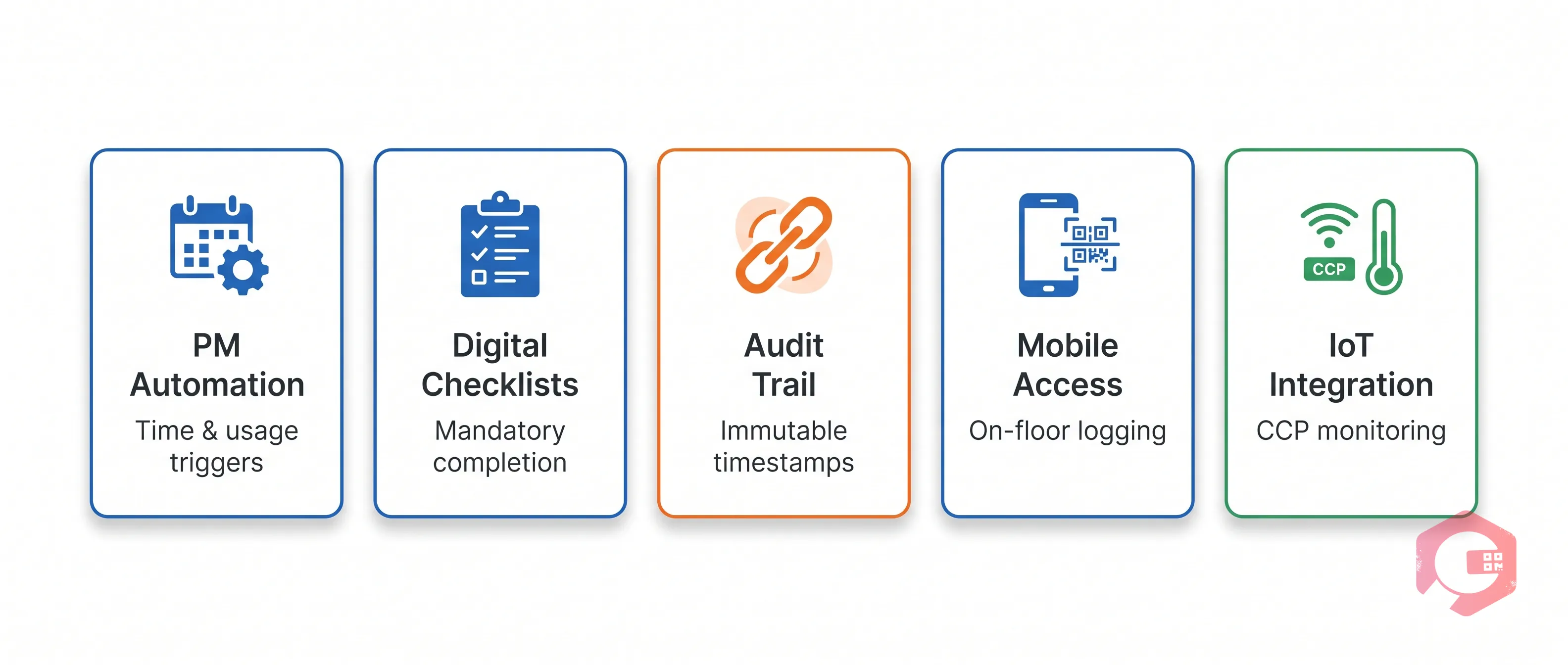
Not all CMMS platforms are built with food manufacturing in mind. These are the capabilities that directly support FDA and FSMA compliance — and what to look for when evaluating a system.
A food safety CMMS must be able to trigger work orders automatically — both on calendar intervals and on production-based triggers. A high-speed filler that runs 16 hours a day degrades far faster than one running 8 hours, and your PM schedule needs to reflect that. Look for both static (fixed-date) and dynamic (runtime-hour) PM triggers. Cryotos supports both, including complex "Either/Or" scheduling logic — so a conveyor bearing gets inspected every 90 days or every 2,000 operating hours, whichever comes first.
FSMA requires that preventive controls monitoring be documented. In CMMS terms, this means maintenance technicians cannot close a work order without completing the checklist. The system enforces the protocol, not the supervisor. Each checklist item — post-maintenance equipment verification, food-contact surface reinspection, allergen sign-off — becomes a timestamped record attached to the work order permanently.
Every action in the system — work order creation, assignment, step completion, override, closure — must be logged with a timestamp and user identity that cannot be edited after the fact. This is the record that FDA investigators review during inspections. The CMMS must generate this trail automatically, not require technicians to manually fill in log books.
In food environments, maintenance often happens in areas where a desktop is inaccessible. Technicians need to document work at the point of execution — while the task is fresh, before the line restarts. A mobile-first CMMS like Cryotos allows technicians to scan a QR code on the equipment, pull up the work order, complete the checklist with photos, and close the task — all from the plant floor without returning to the maintenance office.
Critical control points — cold chain temperature, pasteurizer pressure, filler seal integrity — need continuous monitoring. A CMMS integrated with IoT sensors can receive real-time data from these control points and automatically trigger a corrective work order the moment a reading drifts outside acceptable limits. This converts a reactive response into a documented preventive control.

FSMA's Preventive Controls rule asks a specific question about every process hazard: do you have a preventive control in place, are you monitoring it, and can you prove it? For equipment-related hazards, this framework maps directly onto your maintenance program.
Consider a metal detection system at the end of a production line. The equipment itself is a preventive control against physical contamination. Your CMMS must schedule daily functional tests of the metal detector, generate a work order for the test, require the technician to log the result (pass/fail, sensitivity setting), and retain that record for two years. If the detector fails a test during the day, the CMMS must generate an immediate corrective action work order — and that corrective action must be closed before the line can restart.
The same logic applies to every piece of equipment involved in a food safety critical control point: pasteurizers, retorts, X-ray systems, fill-level checkers, check-weighers, foreign object detection systems, and CIP systems. For each one, your maintenance program needs a scheduled inspection frequency, a documented completion record, and a corrective action pathway.
A plant that replaced paper-based PM checklists with a CMMS typically sees PM compliance rates improve from around 60-70% to over 95% within the first six months — simply because the system won't allow a work order to disappear or be forgotten. The outstanding task stays visible in the dashboard until it is completed or formally deferred with a documented reason.
According to GFSI benchmarking guidelines, maintenance documentation is one of the five highest-risk areas identified across food safety audit failures globally. A CMMS that enforces completion and creates automatic records closes this gap structurally, rather than relying on individual discipline.
Sanitation is where food safety maintenance and equipment maintenance converge most tightly. CIP (clean-in-place) systems — the spray balls, piping circuits, chemical dosing pumps, and heat exchangers that clean product-contact surfaces without disassembly — are themselves pieces of equipment that require maintenance. A CIP system with a corroded spray ball or an improperly calibrated dosing pump is not cleaning what you think it is cleaning.
Your CMMS should carry two layers of records for CIP systems: the sanitation records (what was cleaned, when, by whom, with what chemical concentration, at what temperature) and the equipment maintenance records (when was the spray ball inspected and replaced, when were the dosing pumps calibrated, when was the heat exchanger serviced). These are different records with different retention requirements and different inspection frequencies, but they should be linked in your system — because an FDA investigator looking at a CIP deviation will want to see both.
Allergen changeovers represent another critical maintenance-sanitation intersection. When a production line switches from a product containing peanuts to one labeled peanut-free, the changeover procedure is a preventive control. Every step — equipment disassembly, cleaning verification swab, allergen clearance sign-off, re-assembly — must be documented. In a CMMS, this becomes a multi-step work order template with mandatory completion fields at each stage. No step can be skipped; the system enforces sequential execution.
FSMA requires that sanitation preventive controls be monitored and that monitoring records be kept. In practice, this means your CMMS sanitation records need to capture: the date and time the sanitation was performed, the name of the person who performed it, the results of any verification testing (ATP swabs, allergen swabs), and any corrective actions taken when results were out of specification.
Temperature is the most common critical control point in food manufacturing — and thermometer calibration is therefore one of the most frequently cited maintenance gaps in FDA inspections. The rule is straightforward: instruments used to monitor critical control points must be calibrated at specified intervals, and calibration records must be retained. But in practice, calibration schedules frequently drift, calibration records disappear into binders, and investigators find instruments that were last calibrated eighteen months ago against a requirement of quarterly calibration.
A CMMS solves this by treating each calibrated instrument as an asset with its own PM schedule. When a thermocouple is registered in the system, you attach a calibration interval — say, quarterly for critical process controls and annually for monitoring instruments. The CMMS automatically generates a calibration work order 14 days before the due date, assigns it to the appropriate technician, and tracks completion. If the calibration is not completed by the due date, the system escalates an alert to the maintenance manager.
The calibration record captured in the CMMS should include: the instrument ID, the calibration standard used (with its own traceability to NIST), the before and after reading, the acceptance criteria, the pass/fail determination, and the technician's digital signature. This is the record that demonstrates compliance with 21 CFR 117.145 verification requirements.
Cold chain integrity is equally critical. Refrigeration and freezer units in food facilities must maintain specified temperature ranges continuously. When a refrigeration unit's compressor starts to fail — evidenced by rising average temperatures, longer pull-down times, or increasing energy draw — a CMMS integrated with IoT temperature sensors will detect the drift before the unit fails completely. This converts what would have been a food safety incident (product held above 41°F for an unknown period) into a scheduled compressor service during a planned maintenance window.
According to Food Safety Magazine, refrigeration system failures are a leading cause of regulatory action in food facilities — and most of those failures were preceded by warning signs that a monitoring system would have caught weeks earlier.
An FDA inspection under FSMA is fundamentally a records review. The investigator arrives, requests your food safety plan, and then validates that what is written in the plan matches what is actually being done and documented. The maintenance section of that review covers: are your preventive maintenance schedules being followed? Are calibrations current? Are corrective actions being documented and closed? Are the records complete and retrievable?
A CMMS creates audit-readiness as a byproduct of normal operations. Every scheduled task generates a work order. Every completed work order creates a timestamped record with a technician signature. Every corrective action triggers a new work order with its own documentation trail. On the day of an inspection, you can pull a report in minutes that shows every maintenance task completed over the past two years, filtered by equipment, by task type, or by date range.
The specific report most useful during FDA inspections is a "Preventive Maintenance Compliance Report" — showing all scheduled PM tasks, whether they were completed on time, and any that were deferred with a documented justification. This single report answers the investigator's core question: are you doing what your food safety plan says you will do?
Beyond the report, CMMS platforms like Cryotos offer drill-down capability — an investigator can see a summary of all refrigeration unit maintenance, then click through to the specific work order for a unit, see the technician who performed the inspection, the checklist items completed, the photos attached, and the digital signature. This level of detail is not achievable with paper records.
FSMA requires maintenance records to be retained for two years for most activities, and three years for records relating to process controls in some contexts. Your CMMS should have configurable retention policies so records are automatically archived but remain searchable within the retention window.
When something goes wrong in a food facility — equipment fails during production, a critical control point monitoring check comes back out-of-specification, a sanitation verification swab fails — FSMA requires a documented corrective action. The corrective action record must capture what happened, what was done immediately to address the hazard, what was done to identify the root cause, and what was done to prevent recurrence.
This is where a CMMS's built-in root cause analysis tools become a compliance asset. Cryotos includes a "5 Whys" root cause analysis template that attaches directly to corrective action work orders. The technician or maintenance manager works through the 5 Whys at the point of closure, and the analysis becomes a permanent part of the work order record. Six months later, if an FDA investigator asks why a particular piece of equipment failed and what was done to prevent recurrence, the answer is in the work order with the date it was written.
CAPA (Corrective and Preventive Action) management is the formal structure that most food facilities use to track significant quality and food safety deviations. A CMMS supports CAPA by linking the initial corrective work order to the longer-term preventive action — for example, a corrective work order for an emergency seal replacement links to a preventive action work order to inspect all seals of that type on a quarterly basis going forward. The preventive action work order then generates recurring PM tasks automatically.
The OSHA lockout/tagout standard (29 CFR 1910.147) intersects with food safety CAPA when corrective maintenance involves energy-isolated equipment. Your CMMS should support LOTO documentation within the work order — each isolation point, the lock placement and removal, and the post-work verification check — so that food safety corrective actions also satisfy occupational safety requirements simultaneously.

Moving from paper-based maintenance records to a CMMS in a food manufacturing environment requires careful planning — not because the technology is complex, but because the regulatory stakes of a botched transition are high. Here is a practical implementation roadmap.
Start by registering every piece of equipment in the CMMS, classified by food safety criticality. Use a three-tier system: CCP equipment (directly involved in a critical control point), food-contact equipment (touches product but not a CCP), and non-food-contact equipment. This classification drives your PM frequency, checklist depth, and escalation rules. Critical control point equipment gets the most rigorous schedule; a non-food-contact compressor gets a standard industrial maintenance schedule.
Your FSMA food safety plan already specifies what maintenance activities are required for each preventive control. Use these as the basis for your CMMS PM templates. Each template should specify the task description, the acceptance criteria, and the verification step required before the work order can be closed. Import existing paper checklists into the CMMS — Cryotos supports Excel import for bulk checklist creation, which accelerates this step significantly.
Set escalation rules for overdue tasks on CCP equipment. If a scheduled CCP maintenance task is not completed by its due date, the CMMS should automatically alert the food safety manager — not just the maintenance supervisor. This creates a second line of accountability for the tasks that carry the highest regulatory risk. Configure IoT alert thresholds for temperature sensors and other continuous monitoring points so that out-of-spec readings generate immediate corrective action work orders.
The quality of a CMMS's audit trail depends entirely on the quality of data entered by technicians. Train maintenance staff not just on how to use the mobile app, but why complete documentation matters in a regulated food environment. Show them what an FDA 483 observation looks like. When technicians understand that incomplete checklist items are a regulatory finding, compliance improves significantly.
Cryotos's mobile CMMS app supports photo attachment to work orders, voice-to-text task notes, and offline functionality in areas with poor connectivity — all of which reduce the friction of in-the-moment documentation. A technician servicing a refrigeration compressor in a freezer corridor can complete the entire work order on their phone without returning to the maintenance office.
The investment in a well-implemented CMMS pays off quickly in food manufacturing environments. One food processing plant that transitioned to digital maintenance management reported cutting FDA inspection preparation time from three days to three hours — because the records that investigators needed were already organized and searchable in the system.
If you are managing food safety compliance and want to see how Cryotos CMMS can replace your paper-based maintenance records with an audit-ready digital system, connect with our team for a walkthrough tailored to your facility's specific regulatory requirements. Our preventive maintenance software is already helping food manufacturers build inspection-ready programs across their facilities.
FSMA's Preventive Controls for Human Food rule (21 CFR Part 117) requires written records for all preventive control monitoring activities, corrective actions, verification activities, and supplier controls. For maintenance specifically, this includes preventive maintenance completion records, calibration records for instruments used to monitor critical control points, and corrective action records for any equipment failure that may have affected food safety. Most records must be retained for at least two years.
During an FDA inspection, investigators request records to verify that your food safety plan is being implemented as written. A CMMS generates searchable, time-stamped records for every maintenance task — PMs, calibrations, corrective actions — that can be pulled in minutes and filtered by date, equipment, or task type. This replaces the hours-long process of searching paper binders and reduces the risk of missing records creating an observation.
A CMMS manages the maintenance and reliability of physical equipment. A food safety management system (FSMS) like SQF, BRC, or FSSC 22000 manages the broader food safety program including hazard analysis, supplier controls, and traceability. In practice, the maintenance module of an FSMS relies on your CMMS data — particularly PM records and calibration logs — to demonstrate compliance. A well-configured CMMS produces the maintenance documentation that feeds into your FSMS audit evidence.
FSMA does not specify universal inspection frequencies — instead, it requires that frequencies be based on a written hazard analysis. In practice, most food manufacturers inspect CCP equipment (metal detectors, pasteurizers, temperature monitoring devices) daily to weekly, food-contact equipment monthly to quarterly, and non-food-contact equipment on standard industrial intervals. Your CMMS should automate these schedules based on your food safety plan and alert escalation when tasks are overdue.
Yes. GFSI-recognized schemes like SQF (Edition 9), BRC Global Standard Issue 9, and FSSC 22000 v5.1 all require documented equipment maintenance programs, calibration records, and corrective action documentation — requirements that are structurally identical to FSMA's maintenance documentation requirements. A CMMS that meets FDA documentation standards typically satisfies the maintenance evidence requirements of GFSI audits simultaneously.




Cryotos AI predicts failures, automates work orders, and simplifies maintenance—before problems slow you down.