

TPM One Point Lesson (OPL) is a single-page visual training document used in Total Productive Maintenance to transfer one focused piece of knowledge to frontline workers — quickly, clearly, and at the point of need. Unlike lengthy manuals, an OPL delivers one specific topic per page through visuals, diagrams, and concise text that any operator or technician can absorb in under five minutes. According to TPM research, organizations that standardize OPL programs reduce repeat failures by up to 30% and cut technician onboarding time by 25%.
Whether you manage a manufacturing plant, a food processing facility, or a logistics hub, OPLs are one of the fastest ways to build operational knowledge across your entire workforce — without expensive training programs or lengthy documentation.
In this guide, you will learn exactly what OPL means within the TPM framework, how the three types work, how to create one effectively, and why it delivers measurable impact across every sector that depends on equipment and people.
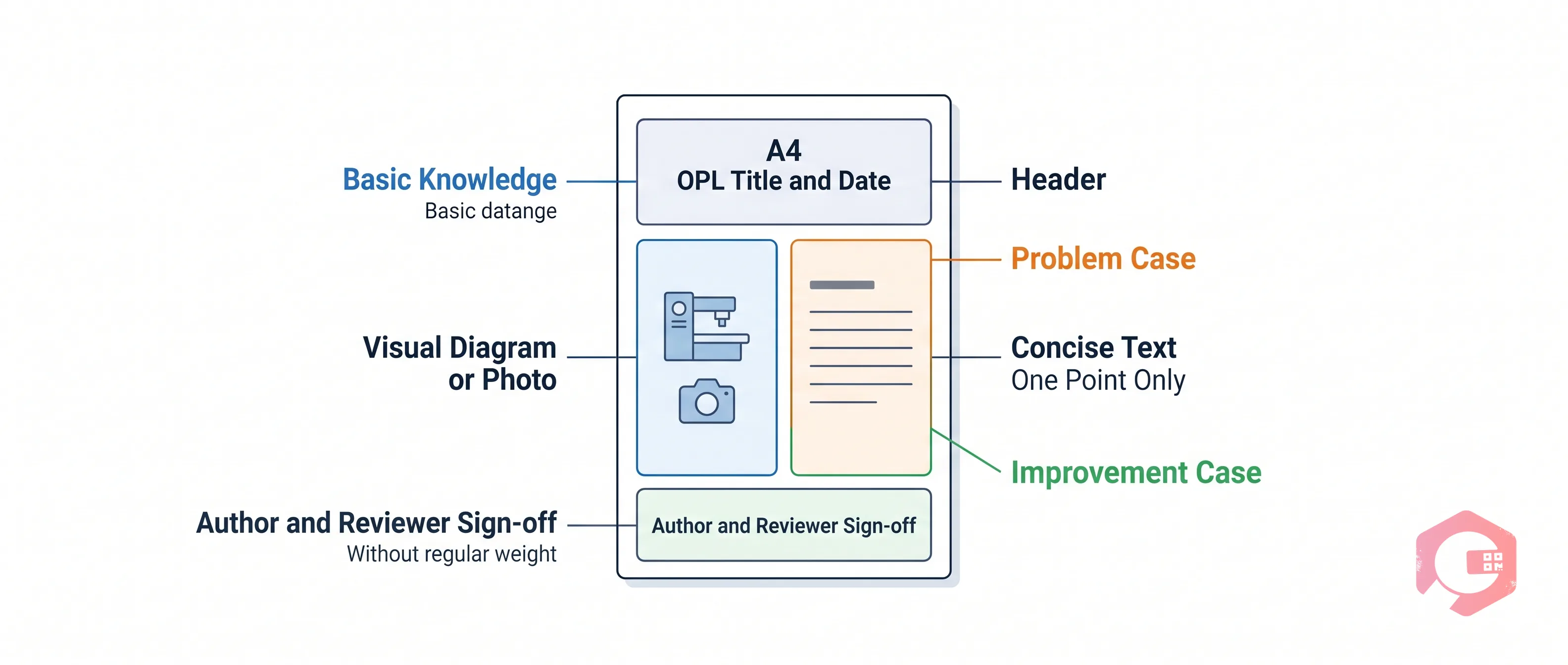
A One Point Lesson (OPL) is a simple, one-page visual training tool developed within the Total Productive Maintenance (TPM) philosophy. Originating from Japanese manufacturing practices, it is designed to communicate exactly one focused topic to frontline workers — in a format that is visual, concise, actionable, and understood immediately.
Unlike technical manuals or formal training modules that workers rarely read, an OPL is created to be used on the floor, at the machine, at the moment a knowledge gap exists. It typically uses diagrams, photos, comparison images, and short text to make the point without ambiguity.
OPLs are typically created by the people closest to the work — operators, technicians, and shift supervisors — who identify a gap or a lesson worth capturing. They are then reviewed, validated, and shared as a standard reference in the team's continuous improvement cycle.

Understanding the types of OPLs helps teams apply them strategically rather than generically. Each type serves a different purpose in the knowledge transfer chain.
Teaches fundamental operating or maintenance principles that every team member should know. Example: how to correctly lubricate a specific bearing, how to read a temperature gauge, or the correct sequence for resetting a machine after a stoppage. These are the building blocks of operator competency.
Documents a real problem that occurred, its root cause, and the corrective action taken. These turn failures into lasting lessons across the organization. Instead of the same breakdown repeating on a different shift or at a different site, the Problem Case OPL captures "what went wrong, why, and what we changed" in a format everyone can learn from.
Shares a successful improvement or best practice so others can replicate it. This accelerates horizontal knowledge sharing across departments and multi-site operations. When one team finds a better way to perform a maintenance task, the Improvement Case OPL makes that better way the standard everywhere.
Total Productive Maintenance is built on eliminating the Six Big Losses and empowering operators to take ownership of their equipment. OPLs directly support this goal by putting the right knowledge in the right hands at the right time. When operators understand their equipment deeply enough to spot abnormalities and maintain it correctly, the entire maintenance program shifts from reactive to proactive.
OPLs specifically support TPM by:
When OPLs are consistently used, organizations experience fewer breakdowns, improved product quality, faster onboarding, and higher employee engagement — all measurable outcomes tied directly to TPM maturity.
One of the most powerful aspects of the One Point Lesson is its universality. It is not limited to automotive manufacturing — OPL methodology adds measurable value in virtually every industry that relies on processes, equipment, and people working together.
In discrete and process manufacturing, OPLs are used to teach correct setup procedures, identify early signs of equipment wear, and document abnormality standards. An OPL on "how to identify abnormal noise in a conveyor motor" can prevent an unplanned shutdown costing thousands of dollars per hour. Operators become the first line of equipment defence, not passive bystanders waiting for maintenance.
In GMP-regulated environments, knowledge standardization is not just best practice — it is a regulatory requirement. OPLs help nursing staff, lab technicians, and equipment operators follow validated procedures consistently, reducing the risk of errors, non-conformances, and patient safety incidents. A single-page visual on equipment decontamination sequence is far more likely to be followed correctly than a 12-page SOP.
Field technicians in remote locations often work without immediate expert support. An OPL on valve inspection criteria or pump seal replacement steps gives them reliable, visual guidance exactly when they need it — reducing safety risks and costly rework. In high-hazard environments, procedural clarity is not optional.
In food processing plants, OPLs are critical for hygiene compliance, CIP (Clean-in-Place) procedures, and allergen changeover protocols. A well-placed OPL on the correct cleaning sequence for a filling line can prevent cross-contamination, product recalls, and the brand damage that follows. Food safety depends on consistent operator behavior — and OPLs make consistent behavior achievable.
From forklift battery maintenance to conveyor belt tension checks, OPLs help warehouse teams maintain equipment reliability without requiring full maintenance shutdowns. They also support safe material handling training for seasonal or temporary staff who need to reach competency quickly. A one-page visual on safe pallet stacking is faster and more effective than a training course.
Building and facilities teams use OPLs for HVAC filter replacement schedules, BMS alarm response procedures, and preventive maintenance checkpoints. This ensures consistent service delivery even as team compositions change — particularly important in contract FM environments where technician turnover is high.
On construction sites where worker turnover is high, OPLs offer a rapid way to train crews on equipment operation safety, inspection checklists, and quality standards. Reducing rework and preventing accidents on complex projects often comes down to whether the right knowledge reached the right person at the right time — exactly what OPLs are designed to do.

Creating a high-quality OPL does not require design expertise or a training department. The best OPLs are created by the people closest to the work, following a simple seven-step process:
Modern CMMS (Computerized Maintenance Management System) platforms are transforming how organizations manage OPLs. Instead of paper-based binders that get lost, damaged, or go out of date, digital OPLs can be managed systematically across the entire maintenance operation.
When OPLs are digitized within a CMMS, they can be:
This digital integration makes OPLs far more effective, measurable, and scalable — especially for multi-site organizations that need to ensure consistent knowledge standards across dozens of locations simultaneously.
With Cryotos CMMS, maintenance teams can attach OPLs to work orders, link them to the preventive maintenance schedule for each asset, and incorporate OPL acknowledgment into the asset management workflow — creating a closed loop between equipment knowledge and maintenance execution.
The ROI of OPLs is compelling and consistent across industries. Organizations that implement structured OPL programs report:
The mathematics are straightforward: one well-crafted OPL, shared across 50 operators, prevents the same mistake 50 times. At scale, across hundreds of assets and dozens of shifts, that multiplier effect becomes one of the highest-return investments in any operational improvement program.
A standard operating procedure (SOP) is a comprehensive, multi-step document covering an entire process — often running several pages and requiring formal sign-off before use. A One Point Lesson (OPL) teaches exactly one point in a single visual page, created and shared informally by the people doing the work. OPLs are designed for speed and impact at the floor level; SOPs are designed for procedural completeness and regulatory compliance. Both are needed — they serve different purposes in the knowledge management system.
There is no fixed frequency — OPLs should be created whenever a knowledge gap is identified, a problem occurs that others should learn from, or an improvement is found worth sharing. Active TPM sites typically generate between 5 and 20 OPLs per month per team. They should be reviewed and updated whenever the underlying process changes, equipment is modified, or better practice is established. A digital CMMS makes version control and update notification straightforward to manage.
Absolutely. Safety OPLs are among the most impactful applications of the format. A single-page visual showing correct PPE selection for a specific task, the lockout/tagout sequence for a particular machine, or the emergency response procedure for a chemical spill can reduce safety incidents more effectively than a lengthy safety induction. When safety knowledge is simple, visual, and immediately accessible, compliance improves.
A CMMS like Cryotos supports OPLs by providing a platform to store, link, and distribute them digitally. OPLs can be attached to specific assets, triggered alongside work orders, and tracked for acknowledgment — ensuring that the right knowledge reaches the right person at the right time. Digital OPL management also creates the audit trail that ISO, GMP, and safety regulators require as evidence of systematic workforce training.
If your team is ready to build a culture where knowledge never leaves the organization with a retiring technician or a departing operator, Cryotos CMMS gives your maintenance team the digital tools to create, manage, and deploy OPLs at scale. Book a free demo today and see how the world's best maintenance teams use knowledge management to drive operational excellence across every sector.

Cryotos AI predicts failures, automates work orders, and simplifies maintenance—before problems slow you down.



