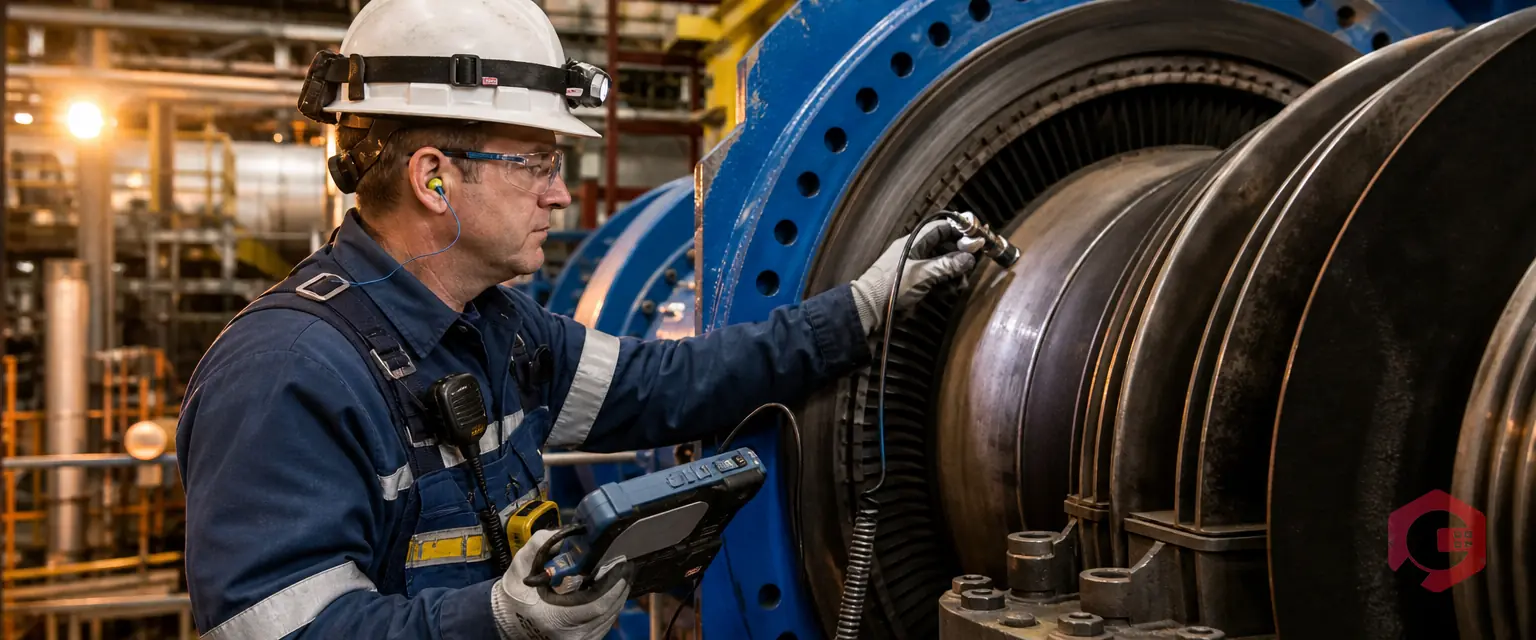
Ultrasound commissioning checks help during startup after a shutdown by catching the problems that shutdown work leaves behind: passing valves, leaking flanges, failed steam traps, dry or over-greased bearings, cavitating pumps, and electrical arcing. An ultrasound instrument hears the high-frequency friction and turbulence these faults make, often before heat or vibration shows anything. The checks are fast, non-invasive, and run while the plant comes back online.
This guide walks through 9 steps for using ultrasound before, during, and after a restart. It also includes a comparison with other startup checks, a sample commissioning register, and a simple way to turn every reading into a tracked baseline.
Key Takeaways

Good ultrasound commissioning starts with a plan that matches checks to the moment they matter. A shutdown has natural windows, and each one suits a different ultrasound test.
Ultrasound commissioning is the use of ultrasound checks to confirm equipment is sound during startup. The instrument detects sound above about 20 kHz and converts it into an audible signal and a decibel reading. It sits alongside vibration analysis and infrared as a core condition monitoring technique. ISO 29821 covers ultrasound for condition monitoring, and ISO 18436-8 sets inspector qualification levels.
The Four-Window Startup Ultrasound Method:
Ultrasound never replaces formal energy isolation. OSHA's lockout/tagout standard (29 CFR 1910.147) still governs every isolation and re-energization step. Ultrasound adds evidence; it does not sign off safety.
The most useful startup reading is one you can compare against something. Take baselines on critical assets in the days before the shutdown, while they run at normal load and temperature.
Most maintenance teams skip this step because the shutdown plan is already crowded. Yet without a baseline, a startup reading only tells you "loud" or "quiet," not "better" or "worse."
Ten minutes per critical asset before shutdown saves hours of guessing after startup.
Want to know what one failed restart costs your plant? Put a number on it with the unplanned downtime calculator.
Valve leak-by is the flow of fluid through a valve that should be fully closed. Isolation valves that pass fluid are a common shutdown hazard. Ultrasound in contact mode hears the turbulence of fluid squeezing past a closed seat, which helps teams find a passing valve before work starts behind it.
Some systems cannot be pressurized for a leak test. An ultrasonic tone generator placed inside a tank, cabinet, heat exchanger shell, or door seal fills the space with ultrasound. An inspector scans the outside, and any gap leaks sound to the instrument.
This lets you check hatches, gaskets, and seals before closing up, when fixing them still costs minutes rather than a second shutdown.
Every flange, union, and fitting opened during a shutdown is a possible leak on restart, which makes leak checks a core part of ultrasound commissioning. Scan them as pressure comes back, in stages if your procedure allows, so leaks are found at low pressure rather than full pressure.
Compressed air, nitrogen, and steam leaks are easy to hear with ultrasound even in a noisy plant, because most machinery noise sits in the audible range. Liquid leaks are harder to hear and often need visual checks as well.
Finding leaks at re-pressurization is far cheaper than finding them after insulation is back on.
Steam traps work hardest during warm-up, when cold pipes produce large amounts of condensate. That makes startup the right time to confirm every steam trap works as designed.
Pair each reading with a temperature check using an infrared thermometer or thermography. Ultrasound tells you how the trap is cycling, and temperature tells you whether condensate is backing up.
Re-test traps once the system reaches steady temperature, because warm-up loads can mask a trap that fails under normal running.

Bearings are often re-greased, replaced, or disturbed during a shutdown. Ultrasound hears friction inside a bearing directly, which makes it one of the best first-run checks on motors, pumps, fans, and gearboxes.
Ultrasound works well at low speeds where vibration data is weak, such as slow conveyors and mixers. For higher-speed machines, pair it with vibration readings for a fuller picture.
A bearing that passes its ultrasound commissioning check at first run is one less surprise in the first week of production.
Once flow returns, process problems start making noise. Many of them come from startup conditions, such as low suction levels, partly open valves, or wrong valve line-ups.
Cavitation is the rapid formation and collapse of vapor bubbles inside a pump. Record a reading at each critical valve and pump once the line reaches normal flow. These first readings under load become the most useful baseline you have.
Electrical faults such as corona discharge, tracking, and arcing produce ultrasound. Inspectors can often hear them through panel vents and door seals without opening energized equipment.
Shutdowns often include cleaning, terminal re-tightening, and breaker work in electrical rooms. A quick ultrasound commissioning scan on startup confirms that work did not leave a new fault behind.

Ultrasound commissioning is not the only startup check, and it works best alongside the others. The table shows where each method fits during commissioning after a shutdown.
| Method | Best Startup Uses | Strength | Limitation |
|---|---|---|---|
| Ultrasound | Leaks, steam traps, valve leak-by, lubrication, electrical arcing | Detects faults early, works in noisy plants, often without opening equipment | Needs a baseline and trained ears; limited on liquid leaks |
| Vibration analysis | Misalignment, imbalance, looseness, bearing defects on rotating machines | Detailed diagnosis of mechanical faults | Weaker at low speeds; needs more setup time per machine |
| Thermography | Electrical hot spots, insulation gaps, trap backup, overheating bearings | Fast visual scan of large areas | Needs load and time for heat to build; affected by emissivity |
Use ultrasound first for speed, then call in vibration and thermography to confirm and size the problems it finds.
A simple register keeps every ultrasound commissioning reading tied to an asset, a window, and an action. The example rows below are illustrative; build your own limits from site data.
| Asset | Window | Baseline (dB) | Startup (dB) | Finding | Action |
|---|---|---|---|---|---|
| Pump P-201 drive-end bearing | First run | 18 | 27 | 9 dB rise, dry tone | Grease by ear, re-test in 24 h |
| Isolation valve V-114 | During isolation | Upstream 22 | Downstream 34 | Likely passing | Prove isolation by procedure; raise repair |
| Steam trap ST-36 | Warm-up | Cycling | Constant rush | Blowing through | Corrective work order |
| Flange F-12 on nitrogen header | Re-pressurization | Quiet | Audible rush | Gasket leak | Re-torque, re-scan |
| MCC-3 incoming section | Re-energization | Quiet | Steady buzz | Possible corona | Thermography and electrical test |
Keep the same test points and settings for every entry, so later readings can be compared directly.
A startup reading is only valuable if someone acts on it and can find it later. Close every ultrasound commissioning finding with an owner, a deadline, and a stored result.
A Computerized Maintenance Management System makes this practical. Technicians scan a QR tag, enter readings on mobile, and raise a request on the spot. With condition monitoring software, readings can also flow in from connected sensors. Maintenance teams using Cryotos have reported up to 30% reduction in unplanned downtime and 25% faster repair turnaround.
The goal is simple: every startup should leave you with better data than the last one.
Ultrasound can detect gas and steam leaks, failed steam traps, passing valves, under- or over-lubricated bearings, pump cavitation, and electrical corona, tracking, or arcing. These faults create high-frequency sound that the instrument picks up before many of them show up as heat or vibration.
Take baselines in the days just before the shutdown, while assets run at normal speed, load, and temperature. Use the same test points and instrument settings you will use after startup, so the readings can be compared directly.
Ultrasound can show whether a valve sounds like it is passing, which is useful evidence. It does not replace your lockout/tagout procedure, so always prove isolation using the methods your site requires before work starts.
Many inspectors use around 38 to 40 kHz in airborne mode for leaks and electrical scans. For contact checks on bearings, valves, and steam traps, settings around 25 to 30 kHz are common. Follow your instrument maker's guidance and keep settings consistent.
No. Ultrasound is faster and better for leaks, traps, lubrication, and electrical checks, while vibration analysis gives deeper diagnosis of misalignment, imbalance, and looseness. Most plants use ultrasound to screen and vibration to confirm.
A CMMS stores baselines against each asset, puts startup checklists on technicians' phones, and turns findings into tracked work orders. That keeps every reading, photo, and repair in one record for the next shutdown.
A clean restart is one where every leak, trap, bearing, and panel has been heard and recorded. Schedule a free demo to see how Cryotos turns your ultrasound commissioning readings into baselines, work orders, and a startup record you can trust.



Cryotos AI predicts failures, automates work orders, and simplifies maintenance—before problems slow you down.