For decades, maintenance managers have relied on spreadsheets to track work orders, schedule preventive maintenance, and manage asset histories. They are familiar, flexible, and free. Yet despite their ubiquity, spreadsheets are quietly undermining maintenance operations across industries - driving up costs, creating compliance risks, and keeping teams perpetually reactive.
Research consistently shows that up to 94% of spreadsheets contain errors, and the consequences in a maintenance context are far more serious than a misaligned budget figure. A missed preventive maintenance task, an incorrect asset history, or a lost work order can mean unplanned downtime, equipment failure, or a failed audit - all of which carry significant financial and safety implications.
If your maintenance team is still running on spreadsheets, this article explains the fundamental reasons they fall short - and what a purpose-built solution looks like in practice.
Spreadsheets appear cost-effective on the surface. There is no licence fee, no onboarding, and no vendor to negotiate with. But the true cost is hidden in the hours your team loses every week to manual data entry, version reconciliation, and chasing down the latest copy of a file.
Industry research estimates that maintenance technicians waste between 18 and 25 hours per week on coordination tasks alone - manually assigning work orders, updating job statuses, and cross-referencing asset records across multiple files. At scale, this represents an enormous drain on labour productivity, with workers spending up to 60% of their time on repetitive tasks that could easily be automated with the right software.
Beyond wasted time, there is the cost of unplanned downtime. The average industrial facility experiences between 5% and 20% unplanned downtime annually, costing anywhere from $50,000 to $3 million per production line. When maintenance records are locked in disconnected spreadsheets, it is nearly impossible to identify failure patterns, predict breakdowns, or make data-driven decisions - leaving teams permanently in firefighting mode.
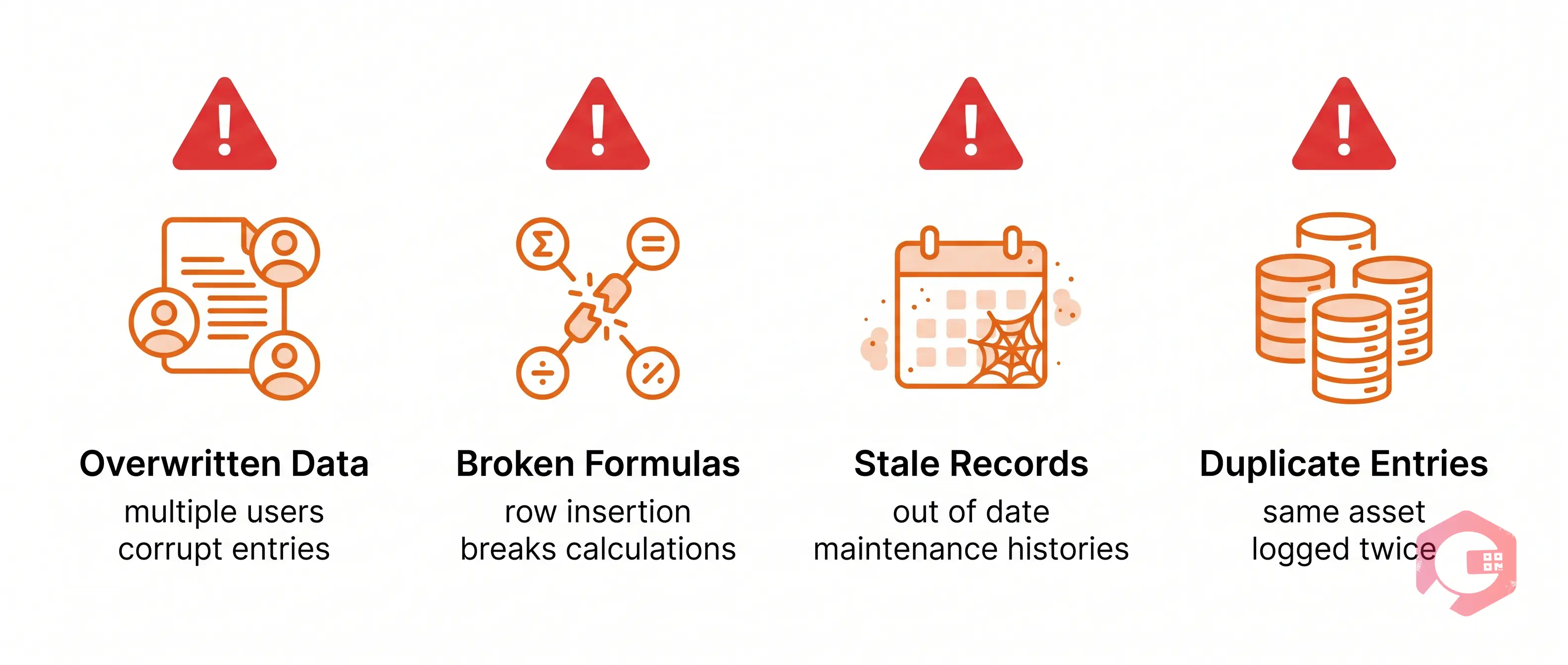
Spreadsheets were designed for financial modelling and data analysis - not for managing the real-time operational complexity of a maintenance department. The core issue is that they rely entirely on human accuracy: every entry, every formula, and every update depends on someone entering the right data in the right cell at the right time.
Studies have found that between 88% and 94% of all spreadsheets contain at least one error, with 1-5% of formula cells producing incorrect results. In a maintenance context, these errors manifest as incorrect part quantities, miscalculated PM intervals, duplicated work orders, and inaccurate asset records - all of which create compounding operational problems over time.
These are not edge cases - they are the everyday reality of teams trying to use a general-purpose tool for a highly specialised operational function.
One of the most critical requirements of modern maintenance management is real-time visibility - the ability to see, at any given moment, which assets are operational, which work orders are in progress, and where technicians are in the field. Spreadsheets provide none of this.
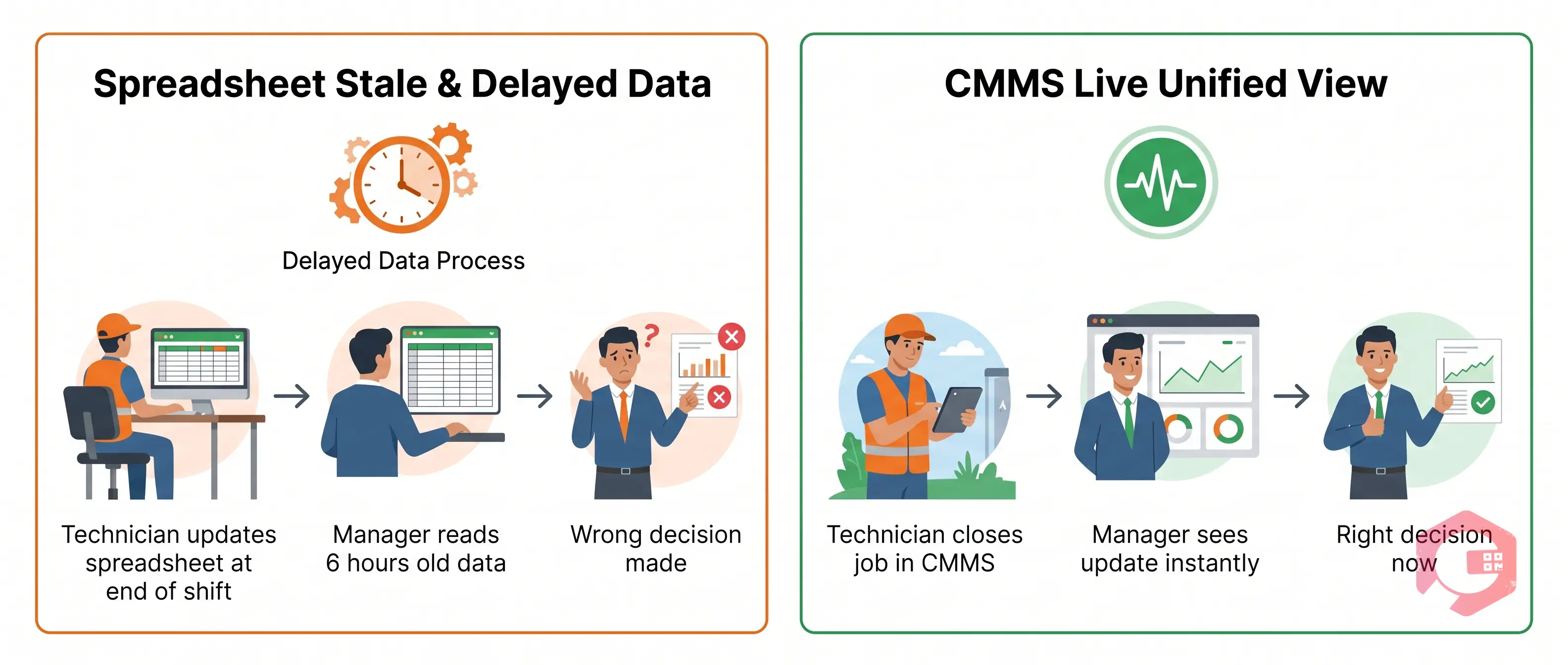
A spreadsheet reflects the state of your maintenance operation at the last moment someone updated it. If a technician completes a job at 2 PM but only updates the log at end of shift, your records are wrong for six hours. If the file is emailed rather than shared, you may be working from a version that is days out of date. This lag creates poor decision-making, duplicated effort, and missed preventive maintenance windows.
Collaboration is equally problematic. When multiple technicians, supervisors, and procurement staff need access to the same maintenance data, a single spreadsheet quickly becomes unmanageable. Teams resort to emailing updated versions, maintaining local copies, or creating separate files for different functions - all of which fracture your data and make consolidated reporting nearly impossible. A modern CMMS solves this by giving every stakeholder a live, unified view of operations from any device.
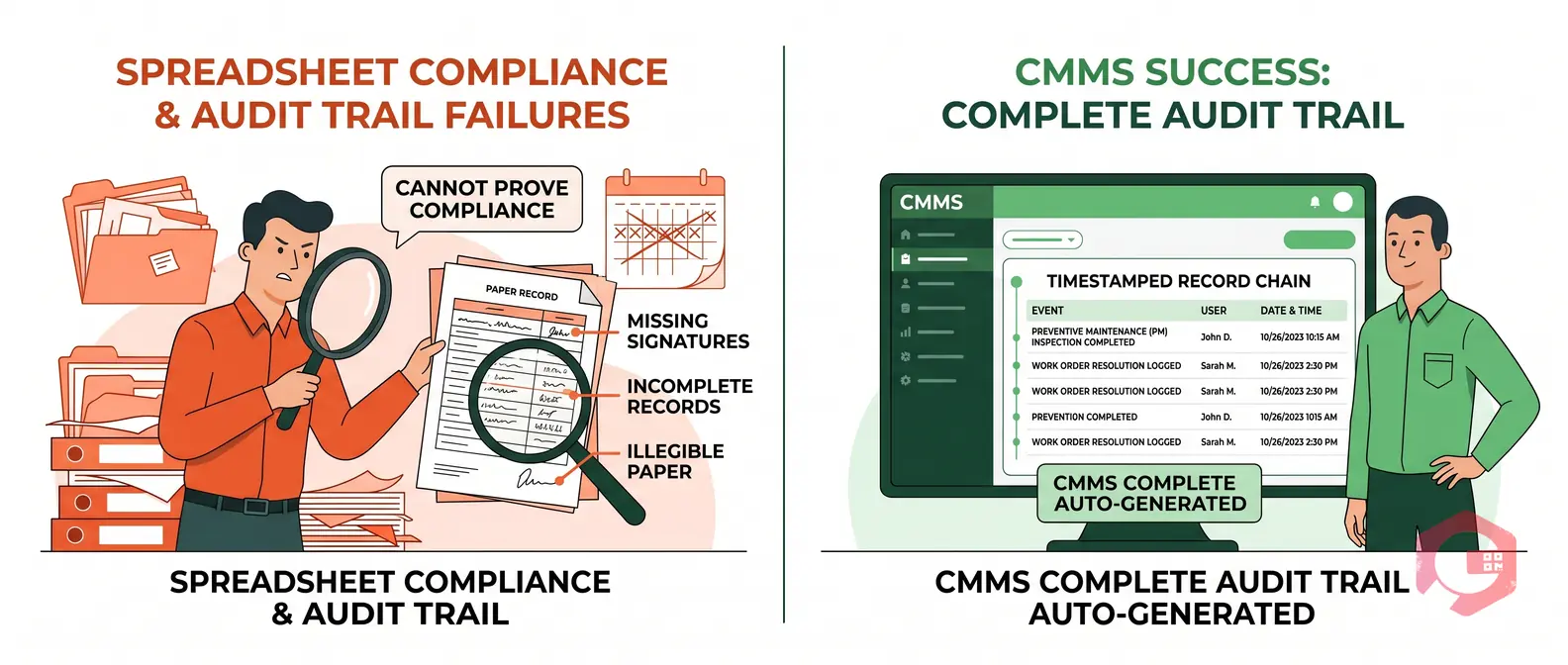
For organisations operating in regulated industries - food and beverage, pharmaceuticals, healthcare, oil and gas - maintenance documentation is not just an operational tool, it is a compliance requirement. Regulators require detailed, tamper-evident records of when maintenance was performed, by whom, and what was found. Spreadsheets fail this requirement fundamentally.
A spreadsheet shows the current state of data. It does not record who changed a value, when they changed it, or what it was before. There is no native audit trail, no version history that captures individual cell edits, and no access controls preventing unauthorised modifications. A single accidental keystroke can alter years of maintenance history - with no way to detect or reverse the change.
Using preventive maintenance software with built-in audit logging eliminates these risks by automatically recording every action, update, and sign-off against a tamper-proof timeline.
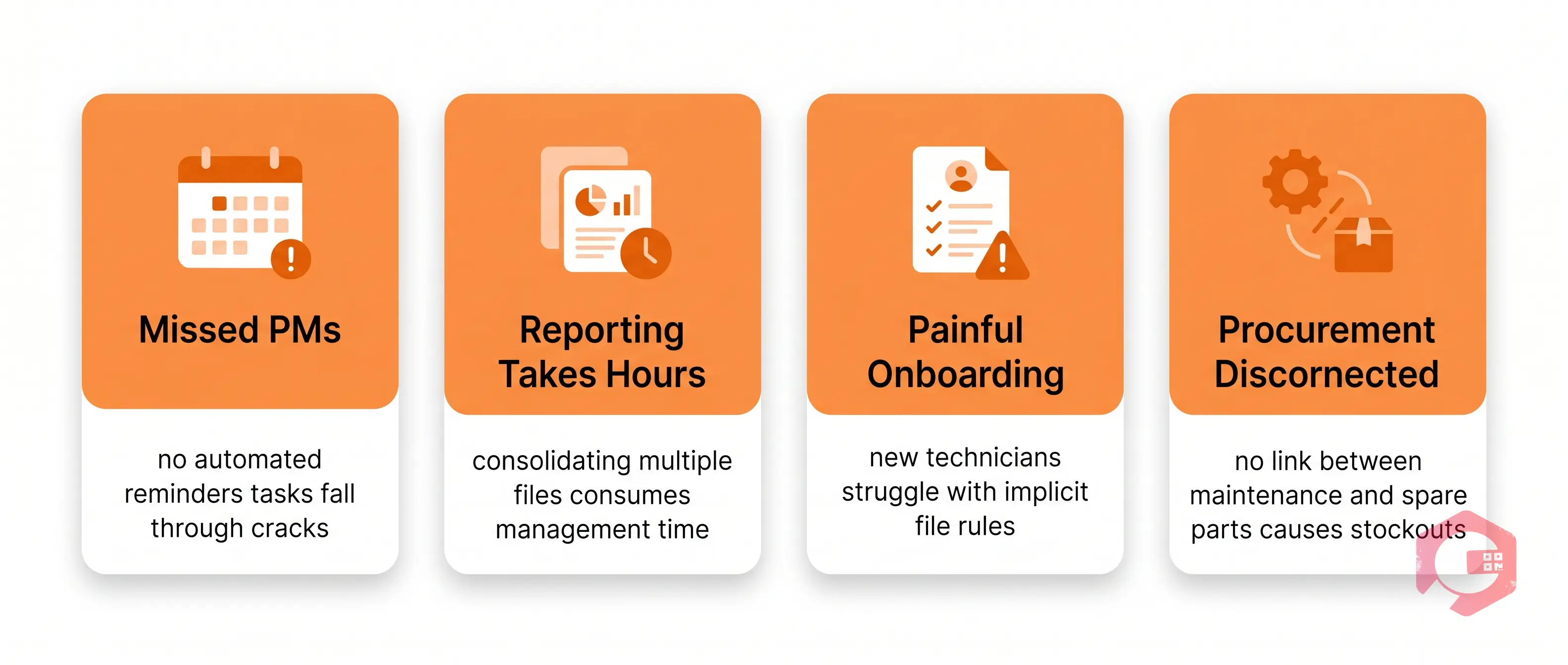
Spreadsheets can work - after a fashion - when a single coordinator is managing a small number of assets at one site. But as teams grow, sites multiply, and asset counts increase, the spreadsheet model collapses under its own weight.
A single-site operation with 50 assets might be manageable with a well-structured spreadsheet. A multi-site operation with 500 assets, 20 technicians, and dozens of active work orders at any given time becomes operationally unmanageable with the same approach. File sizes grow unwieldy, load times increase, and the risk of data corruption rises with every additional user and entry.
The CMMS market is growing at over 10% annually and is projected to exceed $5.9 billion by 2033 - a clear reflection of how many organisations have recognised that spreadsheets are not a scalable foundation for maintenance operations. Platforms like Cryotos asset management software are designed specifically to handle this complexity without the limitations of manual tools.

A Computerised Maintenance Management System (CMMS) replaces the fragmented, error-prone world of spreadsheets with a single, integrated platform where all maintenance data lives, updates in real time, and is accessible to everyone who needs it.
The difference in day-to-day operations is substantial. Preventive maintenance tasks are scheduled automatically based on runtime hours, calendar intervals, or sensor readings - not manual calendar entries. Work orders are generated, assigned, and tracked digitally, with technicians updating job status from mobile devices in the field. Spare parts inventory is linked directly to work orders, so stock levels adjust automatically when parts are consumed. And every action is logged with a timestamp and user attribution, creating an unbreakable audit trail.
These outcomes are not theoretical - they reflect the consistent experience of organisations that have made the transition from manual tools to purpose-built maintenance management platforms.
Spreadsheets served maintenance teams well in an era when the alternative was pen and paper. Today, they represent a significant operational liability - one that grows more costly as your asset base expands, your team scales, and regulatory scrutiny intensifies. The combination of high error rates, zero real-time visibility, absent audit trails, and poor scalability makes spreadsheets fundamentally unsuitable for modern maintenance management.
The good news is that the transition has never been easier. Purpose-built CMMS platforms are designed to be intuitive, mobile-friendly, and quick to implement - giving maintenance teams the structure, automation, and visibility they need without the complexity of enterprise software. If your team is ready to move beyond spreadsheets, explore what Cryotos can do for your maintenance operations and book a free demo today.




Cryotos AI predicts failures, automates work orders, and simplifies maintenance—before problems slow you down.