10 Proven Benefits of CMMS Software for Plant Managers and Reliability Engineers

Article Written by:

Ganesh Veerappan

Created On:

April 18, 2026

CMMS software benefits go far beyond simple work order tracking. A well-implemented Computerized Maintenance Management System gives plant managers and reliability engineers the tools to reduce unplanned downtime, extend asset lifespan, and make data-driven decisions that directly impact the bottom line. According to Plant Engineering, facilities using CMMS software report up to 30% reductions in downtime and significant improvements in key reliability KPIs like MTTR and MTBF. If you're still running maintenance on spreadsheets, whiteboards, or paper work orders, you're leaving measurable efficiency gains on the table. This guide covers 10 proven benefits of CMMS software with specific examples, industry data, and a practical checklist to help you get started.
10 Proven Benefits of CMMS Software for Plant Managers and Reliability Engineers

Table of Contents

What Is CMMS Software?

CMMS software is a digital platform that centralizes all maintenance data — work orders, asset histories, spare parts, schedules, and compliance records — in one system. It replaces the fragmented mix of spreadsheets, clipboards, and tribal knowledge that most maintenance teams still rely on today.

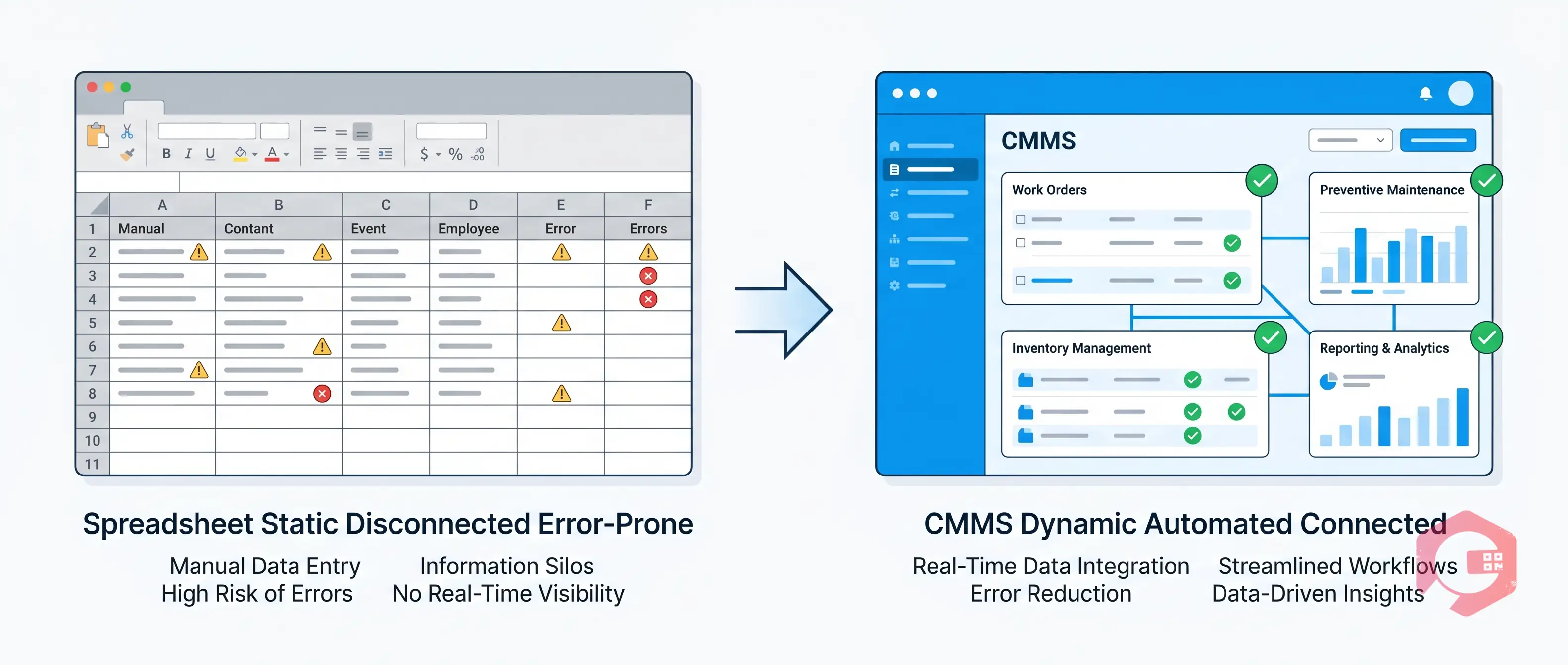
How CMMS Differs from Spreadsheets and Paper-Based Systems

Spreadsheets are static. A CMMS is dynamic — it tracks changes in real time, automates recurring tasks, flags overdue work, and generates reports without manual effort. Where a spreadsheet tells you what happened, a CMMS tells you what's happening and what needs to happen next.

Key differences at a glance:

Why Plant Managers and Reliability Engineers Need a CMMS

For plant managers, every hour of unplanned downtime is a direct hit to production output and revenue. For reliability engineers, the challenge is keeping critical assets running at peak performance across their entire lifecycle. Both roles share one core problem: too much reactive maintenance and too little predictive data.

According to a study by Reliable Plant, maintenance planning and scheduling improvements alone can increase wrench time by 20–25%, meaning technicians spend more hours doing productive work and fewer hours searching for parts or waiting for instructions. A CMMS is the engine that makes that improvement possible.

The Real Cost of Reactive Maintenance

Reactive maintenance costs 3 to 9 times more per task than planned preventive maintenance, according to data compiled by the U.S. Department of Energy. When a critical asset fails unexpectedly, you're not just paying for the repair — you're absorbing lost production, emergency labor premiums, rush-shipped parts, and potential safety incidents. A CMMS systematically shifts your maintenance program from reactive to proactive, and the financial impact is measurable from the first year of deployment.

Benefit 1 — Slash Unplanned Downtime with Preventive Maintenance Scheduling

10 Proven Benefits of CMMS Software for Plant Managers and Reliability Engineers — lifecycle

Unplanned downtime is the single biggest maintenance cost in most manufacturing plants. A CMMS attacks this problem directly by automating your preventive maintenance schedules so critical assets get serviced before they fail.

Instead of relying on fixed calendar-based intervals or OEM guidelines alone, modern CMMS platforms like Cryotos support dynamic PM triggers — based on actual machine runtime hours, production cycles, or live sensor readings from IoT devices. This means maintenance happens when assets actually need it, not on an arbitrary schedule.

Facilities that move from reactive to PM-driven maintenance typically see downtime reductions of 25–35%. Cryotos customers have reported a 30% reduction in downtime after full CMMS implementation, with maintenance teams shifting from firefighting to planned, scheduled work within the first three months.

Benefit 2 — Extend Asset Lifespan and Reduce Capital Expenditure

Replacing industrial equipment is expensive. A single CNC machine, compressor, or conveyor system can cost hundreds of thousands of dollars. The average age of industrial equipment in the US is the highest it has been since the 1940s — meaning most plants are running older assets that need smarter maintenance, not earlier replacement.

A CMMS extends asset lifespan by ensuring every piece of equipment receives the right maintenance at the right time. With complete asset history records — covering repairs, part replacements, inspections, and failure events — reliability engineers can identify deterioration patterns early, plan condition-based interventions, and make evidence-based decisions on repair vs. replace.

Over a 5-year horizon, extending the useful life of major assets by even 10–15% through better maintenance can defer millions in capital expenditure for a mid-sized plant.

Benefit 3 — Improve MTTR and MTBF for Better Reliability KPIs

MTTR (Mean Time to Repair) and MTBF (Mean Time Between Failures) are the two most important reliability KPIs for any plant. A CMMS directly improves both.

How CMMS Reduces MTTR

When a breakdown occurs, technicians waste time hunting for asset manuals, locating spare parts, and deciphering incomplete repair histories. A CMMS eliminates all of that. With instant access to asset documentation, parts location, previous repair notes, and step-by-step SOPs on a mobile device, technicians can diagnose and fix problems significantly faster. Cryotos customers report 25% faster repair times after deploying the platform's mobile work order and asset history features.

How CMMS Increases MTBF

MTBF improves when assets fail less frequently. A CMMS increases MTBF by ensuring PMs are completed on time, failure patterns are caught through data analysis, and root cause analysis (RCA) is documented after every breakdown. Cryotos includes a built-in "5 Whys" RCA tool directly in the work order flow, making it easy for reliability engineers to identify and eliminate recurring failure modes rather than just treating symptoms.

Benefit 4 — Cut Maintenance Costs and Prove ROI

Maintenance budgets are under pressure at most plants. A CMMS gives managers the data they need to cut costs intelligently — and prove the value of the maintenance department to finance and operations leadership.

Specific cost-reduction levers a CMMS provides:

Benefit 5 — Streamline Work Order Management and Eliminate Backlog

10 Proven Benefits of CMMS Software for Plant Managers and Reliability Engineers — workflow

Work order backlog is one of the clearest signs of a maintenance program under strain. When jobs pile up faster than they can be completed, critical maintenance gets delayed, assets deteriorate faster, and safety risks increase.

A CMMS transforms work order management from a manual, paper-based process into an automated, prioritized workflow. Work requests can be submitted by anyone — including operators via QR code scanning — and are automatically routed, assigned, and tracked. Cryotos even supports AI-powered work order creation via voice commands or photo analysis, which cuts the administrative burden on maintenance planners significantly.

With real-time visibility into all open, in-progress, and overdue work orders, managers can reallocate resources, prioritize critical jobs, and prevent backlog from building before it becomes unmanageable.

Benefit 6 — Gain Full Inventory Visibility and Reduce Parts Spend

10 Proven Benefits of CMMS Software for Plant Managers and Reliability Engineers — problems grid

Spare parts management is a hidden cost driver at most plants. Overstocking ties up working capital. Understocking causes downtime when critical parts aren't available during a breakdown. Without a CMMS, most maintenance teams operate on guesswork — ordering parts based on habit or memory rather than actual usage data.

Cryotos's inventory management module gives teams real-time stock visibility with QR codes and barcodes, automated reorder alerts when stock drops below minimum thresholds, and full parts usage history tied to work orders. The result is a leaner, more accurate parts store — less capital tied up in excess inventory and fewer stockouts causing downtime.

According to industry research, overspending on inventory can add 12–20% to the original purchase cost. A CMMS pays for itself quickly when you eliminate just a fraction of that waste.

Benefit 7 — Achieve Regulatory Compliance and Pass Audits with Confidence

10 Proven Benefits of CMMS Software for Plant Managers and Reliability Engineers — scenario

Regulatory compliance is non-negotiable in industries like food processing, pharmaceuticals, chemicals, and heavy manufacturing. OSHA requirements, ISO 55000 asset management standards, FDA regulations, and environmental permits all require documented evidence of maintenance activities — and auditors have little patience for missing records or inconsistent data.

A CMMS creates an automatic, time-stamped audit trail for every maintenance activity. Inspection records, calibration logs, safety checklists, PPE requirements, and corrective actions are all stored against the relevant asset or work order. When an auditor arrives, maintenance managers can pull complete compliance reports in minutes rather than hours.

Cryotos supports automated Permit to Work (PTW) and LOTO procedures within work order workflows, ensuring that safety protocols are followed every time — not just when someone remembers to check.

Benefit 8 — Empower Technicians with Mobile Access to Asset Data

Maintenance work happens on the shop floor, not at a desk. A CMMS with a strong mobile app puts the full power of the system in every technician's hands — anywhere in the plant, even in areas with limited connectivity.

Cryotos's mobile app supports full offline mode with automatic syncing, QR code scanning for instant asset identification, digital signatures, and the ability to attach photos, videos, and notes directly to work orders from the field. This eliminates the end-of-shift paperwork that wastes an hour of every technician's time and reduces data entry errors caused by transcribing handwritten notes.

For reliability engineers, mobile access means real-time updates on work order progress without needing to physically walk the floor or chase down information — freeing up time for analysis and planning work that drives long-term performance improvements.

Benefit 9 — Make Smarter Decisions with Real-Time Maintenance Analytics

Data is only valuable if you can act on it. A CMMS doesn't just collect maintenance data — it transforms it into actionable intelligence through dashboards, custom reports, and trend analysis.

Cryotos's BI Dashboard tracks OEE (Overall Equipment Effectiveness), availability, quality, and performance metrics at every level — from the entire organization down to an individual asset. With 50+ predefined reports and a custom report builder, maintenance managers and reliability engineers can monitor KPIs, spot chronic failure patterns, compare planned vs. actual PM completion rates, and track cost trends over time.

Scheduled reporting means key stakeholders receive accurate maintenance data automatically — no manual compilation required. According to McKinsey research, data-driven maintenance programs deliver 10–25% productivity improvements and reduce overall maintenance costs by 10–40%.

Benefit 10 — Align Maintenance Strategy with OEE Goals Across the Plant

OEE (Overall Equipment Effectiveness) is the gold standard metric for manufacturing performance, measuring the combined impact of availability, performance, and quality. World-class OEE is considered 85% or above — but most plants run at 60% or lower, meaning significant production capacity is being lost every shift.

Maintenance is the single biggest lever for improving OEE. Every point of availability improvement — driven by less downtime — flows directly into OEE. Every quality defect eliminated by keeping equipment in calibration adds to the quality score. And every performance loss caused by a degraded asset running below rated speed is a maintenance problem that a CMMS can help prevent.

With Cryotos's downtime tracking module, plant managers get real-time OEE visibility by department, production line, and individual asset. This allows maintenance and operations to work from the same data, prioritize resources on the assets that impact OEE most, and build a continuous improvement cycle that drives measurable gains quarter over quarter.

How to Get Started with CMMS Software: A Practical Checklist

If you're evaluating CMMS software for the first time — or replacing a legacy system — here's a practical checklist to guide your implementation planning:

Frequently Asked Questions

What is the main purpose of CMMS software?

The main purpose of CMMS software is to centralize all maintenance data and automate maintenance workflows — work orders, PM schedules, parts inventory, asset records, and compliance documentation — so maintenance teams can operate more efficiently, reduce downtime, and extend the lifespan of critical assets.

What is the ROI of implementing a CMMS?

ROI varies by facility size and starting point, but most organizations see payback within 6–18 months. Common financial gains include 20–30% reduction in maintenance costs, 25–35% less unplanned downtime, and significant labor savings from automation. According to McKinsey, data-driven maintenance programs reduce maintenance costs by 10–40% overall.

How does CMMS improve MTTR and MTBF?

CMMS reduces MTTR by giving technicians instant access to asset history, repair SOPs, parts locations, and diagrams on mobile — cutting the diagnostic and parts-hunting time that extends most breakdowns. MTBF improves because the CMMS ensures PMs are completed on schedule, failure patterns are tracked, and root cause analysis is documented to eliminate repeat failures at the source.

Is CMMS software suitable for small manufacturing plants?

Yes. Modern cloud-based CMMS platforms are designed to scale from single-site operations with a handful of technicians up to multi-plant enterprises. Small plants often see the fastest ROI because the improvement from ad-hoc paper-based systems to a structured CMMS is significant. Implementation timelines for smaller facilities can be as short as a few weeks.

The benefits of CMMS software are clear and measurable — from slashing unplanned downtime and extending asset lifespan to improving reliability KPIs and passing compliance audits. For plant managers and reliability engineers who need to do more with tighter budgets and older assets, a CMMS is one of the highest-ROI investments available.

Cryotos CMMS is built specifically for industrial maintenance teams — with AI-powered work orders, real-time downtime tracking, IoT sensor integration, and a mobile app that works even offline. If you're ready to see the difference a purpose-built CMMS can make for your plant, explore Cryotos today.

Want to Try Cryotos CMMS Today? Lets Connect!
Thank you! Your submission has been received!
Oops! Something went wrong while submitting the form.
Related Post

10 Proven Benefits of CMMS Software for Plant Managers and Reliability Engineers

Calendar
Duration:
14 min read
calendar today
Published on
April 18, 2026
Featured Image

Table of Contents

What Is CMMS Software?

CMMS software is a digital platform that centralizes all maintenance data — work orders, asset histories, spare parts, schedules, and compliance records — in one system. It replaces the fragmented mix of spreadsheets, clipboards, and tribal knowledge that most maintenance teams still rely on today.

How CMMS Differs from Spreadsheets and Paper-Based Systems

Spreadsheets are static. A CMMS is dynamic — it tracks changes in real time, automates recurring tasks, flags overdue work, and generates reports without manual effort. Where a spreadsheet tells you what happened, a CMMS tells you what's happening and what needs to happen next.

Key differences at a glance:

Why Plant Managers and Reliability Engineers Need a CMMS

For plant managers, every hour of unplanned downtime is a direct hit to production output and revenue. For reliability engineers, the challenge is keeping critical assets running at peak performance across their entire lifecycle. Both roles share one core problem: too much reactive maintenance and too little predictive data.

According to a study by Reliable Plant, maintenance planning and scheduling improvements alone can increase wrench time by 20–25%, meaning technicians spend more hours doing productive work and fewer hours searching for parts or waiting for instructions. A CMMS is the engine that makes that improvement possible.

The Real Cost of Reactive Maintenance

Reactive maintenance costs 3 to 9 times more per task than planned preventive maintenance, according to data compiled by the U.S. Department of Energy. When a critical asset fails unexpectedly, you're not just paying for the repair — you're absorbing lost production, emergency labor premiums, rush-shipped parts, and potential safety incidents. A CMMS systematically shifts your maintenance program from reactive to proactive, and the financial impact is measurable from the first year of deployment.

Benefit 1 — Slash Unplanned Downtime with Preventive Maintenance Scheduling

10 Proven Benefits of CMMS Software for Plant Managers and Reliability Engineers — lifecycle

Unplanned downtime is the single biggest maintenance cost in most manufacturing plants. A CMMS attacks this problem directly by automating your preventive maintenance schedules so critical assets get serviced before they fail.

Instead of relying on fixed calendar-based intervals or OEM guidelines alone, modern CMMS platforms like Cryotos support dynamic PM triggers — based on actual machine runtime hours, production cycles, or live sensor readings from IoT devices. This means maintenance happens when assets actually need it, not on an arbitrary schedule.

Facilities that move from reactive to PM-driven maintenance typically see downtime reductions of 25–35%. Cryotos customers have reported a 30% reduction in downtime after full CMMS implementation, with maintenance teams shifting from firefighting to planned, scheduled work within the first three months.

Benefit 2 — Extend Asset Lifespan and Reduce Capital Expenditure

Replacing industrial equipment is expensive. A single CNC machine, compressor, or conveyor system can cost hundreds of thousands of dollars. The average age of industrial equipment in the US is the highest it has been since the 1940s — meaning most plants are running older assets that need smarter maintenance, not earlier replacement.

A CMMS extends asset lifespan by ensuring every piece of equipment receives the right maintenance at the right time. With complete asset history records — covering repairs, part replacements, inspections, and failure events — reliability engineers can identify deterioration patterns early, plan condition-based interventions, and make evidence-based decisions on repair vs. replace.

Over a 5-year horizon, extending the useful life of major assets by even 10–15% through better maintenance can defer millions in capital expenditure for a mid-sized plant.

Benefit 3 — Improve MTTR and MTBF for Better Reliability KPIs

MTTR (Mean Time to Repair) and MTBF (Mean Time Between Failures) are the two most important reliability KPIs for any plant. A CMMS directly improves both.

How CMMS Reduces MTTR

When a breakdown occurs, technicians waste time hunting for asset manuals, locating spare parts, and deciphering incomplete repair histories. A CMMS eliminates all of that. With instant access to asset documentation, parts location, previous repair notes, and step-by-step SOPs on a mobile device, technicians can diagnose and fix problems significantly faster. Cryotos customers report 25% faster repair times after deploying the platform's mobile work order and asset history features.

How CMMS Increases MTBF

MTBF improves when assets fail less frequently. A CMMS increases MTBF by ensuring PMs are completed on time, failure patterns are caught through data analysis, and root cause analysis (RCA) is documented after every breakdown. Cryotos includes a built-in "5 Whys" RCA tool directly in the work order flow, making it easy for reliability engineers to identify and eliminate recurring failure modes rather than just treating symptoms.

Benefit 4 — Cut Maintenance Costs and Prove ROI

Maintenance budgets are under pressure at most plants. A CMMS gives managers the data they need to cut costs intelligently — and prove the value of the maintenance department to finance and operations leadership.

Specific cost-reduction levers a CMMS provides:

Benefit 5 — Streamline Work Order Management and Eliminate Backlog

10 Proven Benefits of CMMS Software for Plant Managers and Reliability Engineers — workflow

Work order backlog is one of the clearest signs of a maintenance program under strain. When jobs pile up faster than they can be completed, critical maintenance gets delayed, assets deteriorate faster, and safety risks increase.

A CMMS transforms work order management from a manual, paper-based process into an automated, prioritized workflow. Work requests can be submitted by anyone — including operators via QR code scanning — and are automatically routed, assigned, and tracked. Cryotos even supports AI-powered work order creation via voice commands or photo analysis, which cuts the administrative burden on maintenance planners significantly.

With real-time visibility into all open, in-progress, and overdue work orders, managers can reallocate resources, prioritize critical jobs, and prevent backlog from building before it becomes unmanageable.

Benefit 6 — Gain Full Inventory Visibility and Reduce Parts Spend

10 Proven Benefits of CMMS Software for Plant Managers and Reliability Engineers — problems grid

Spare parts management is a hidden cost driver at most plants. Overstocking ties up working capital. Understocking causes downtime when critical parts aren't available during a breakdown. Without a CMMS, most maintenance teams operate on guesswork — ordering parts based on habit or memory rather than actual usage data.

Cryotos's inventory management module gives teams real-time stock visibility with QR codes and barcodes, automated reorder alerts when stock drops below minimum thresholds, and full parts usage history tied to work orders. The result is a leaner, more accurate parts store — less capital tied up in excess inventory and fewer stockouts causing downtime.

According to industry research, overspending on inventory can add 12–20% to the original purchase cost. A CMMS pays for itself quickly when you eliminate just a fraction of that waste.

Benefit 7 — Achieve Regulatory Compliance and Pass Audits with Confidence

10 Proven Benefits of CMMS Software for Plant Managers and Reliability Engineers — scenario

Regulatory compliance is non-negotiable in industries like food processing, pharmaceuticals, chemicals, and heavy manufacturing. OSHA requirements, ISO 55000 asset management standards, FDA regulations, and environmental permits all require documented evidence of maintenance activities — and auditors have little patience for missing records or inconsistent data.

A CMMS creates an automatic, time-stamped audit trail for every maintenance activity. Inspection records, calibration logs, safety checklists, PPE requirements, and corrective actions are all stored against the relevant asset or work order. When an auditor arrives, maintenance managers can pull complete compliance reports in minutes rather than hours.

Cryotos supports automated Permit to Work (PTW) and LOTO procedures within work order workflows, ensuring that safety protocols are followed every time — not just when someone remembers to check.

Benefit 8 — Empower Technicians with Mobile Access to Asset Data

Maintenance work happens on the shop floor, not at a desk. A CMMS with a strong mobile app puts the full power of the system in every technician's hands — anywhere in the plant, even in areas with limited connectivity.

Cryotos's mobile app supports full offline mode with automatic syncing, QR code scanning for instant asset identification, digital signatures, and the ability to attach photos, videos, and notes directly to work orders from the field. This eliminates the end-of-shift paperwork that wastes an hour of every technician's time and reduces data entry errors caused by transcribing handwritten notes.

For reliability engineers, mobile access means real-time updates on work order progress without needing to physically walk the floor or chase down information — freeing up time for analysis and planning work that drives long-term performance improvements.

Benefit 9 — Make Smarter Decisions with Real-Time Maintenance Analytics

Data is only valuable if you can act on it. A CMMS doesn't just collect maintenance data — it transforms it into actionable intelligence through dashboards, custom reports, and trend analysis.

Cryotos's BI Dashboard tracks OEE (Overall Equipment Effectiveness), availability, quality, and performance metrics at every level — from the entire organization down to an individual asset. With 50+ predefined reports and a custom report builder, maintenance managers and reliability engineers can monitor KPIs, spot chronic failure patterns, compare planned vs. actual PM completion rates, and track cost trends over time.

Scheduled reporting means key stakeholders receive accurate maintenance data automatically — no manual compilation required. According to McKinsey research, data-driven maintenance programs deliver 10–25% productivity improvements and reduce overall maintenance costs by 10–40%.

Benefit 10 — Align Maintenance Strategy with OEE Goals Across the Plant

OEE (Overall Equipment Effectiveness) is the gold standard metric for manufacturing performance, measuring the combined impact of availability, performance, and quality. World-class OEE is considered 85% or above — but most plants run at 60% or lower, meaning significant production capacity is being lost every shift.

Maintenance is the single biggest lever for improving OEE. Every point of availability improvement — driven by less downtime — flows directly into OEE. Every quality defect eliminated by keeping equipment in calibration adds to the quality score. And every performance loss caused by a degraded asset running below rated speed is a maintenance problem that a CMMS can help prevent.

With Cryotos's downtime tracking module, plant managers get real-time OEE visibility by department, production line, and individual asset. This allows maintenance and operations to work from the same data, prioritize resources on the assets that impact OEE most, and build a continuous improvement cycle that drives measurable gains quarter over quarter.

How to Get Started with CMMS Software: A Practical Checklist

If you're evaluating CMMS software for the first time — or replacing a legacy system — here's a practical checklist to guide your implementation planning:

Frequently Asked Questions

What is the main purpose of CMMS software?

The main purpose of CMMS software is to centralize all maintenance data and automate maintenance workflows — work orders, PM schedules, parts inventory, asset records, and compliance documentation — so maintenance teams can operate more efficiently, reduce downtime, and extend the lifespan of critical assets.

What is the ROI of implementing a CMMS?

ROI varies by facility size and starting point, but most organizations see payback within 6–18 months. Common financial gains include 20–30% reduction in maintenance costs, 25–35% less unplanned downtime, and significant labor savings from automation. According to McKinsey, data-driven maintenance programs reduce maintenance costs by 10–40% overall.

How does CMMS improve MTTR and MTBF?

CMMS reduces MTTR by giving technicians instant access to asset history, repair SOPs, parts locations, and diagrams on mobile — cutting the diagnostic and parts-hunting time that extends most breakdowns. MTBF improves because the CMMS ensures PMs are completed on schedule, failure patterns are tracked, and root cause analysis is documented to eliminate repeat failures at the source.

Is CMMS software suitable for small manufacturing plants?

Yes. Modern cloud-based CMMS platforms are designed to scale from single-site operations with a handful of technicians up to multi-plant enterprises. Small plants often see the fastest ROI because the improvement from ad-hoc paper-based systems to a structured CMMS is significant. Implementation timelines for smaller facilities can be as short as a few weeks.

The benefits of CMMS software are clear and measurable — from slashing unplanned downtime and extending asset lifespan to improving reliability KPIs and passing compliance audits. For plant managers and reliability engineers who need to do more with tighter budgets and older assets, a CMMS is one of the highest-ROI investments available.

Cryotos CMMS is built specifically for industrial maintenance teams — with AI-powered work orders, real-time downtime tracking, IoT sensor integration, and a mobile app that works even offline. If you're ready to see the difference a purpose-built CMMS can make for your plant, explore Cryotos today.

Want to Try Cryotos CMMS Today?

Get Free Demo

Let AI Take Control of Your Maintenance

Cryotos AI predicts failures, automates work orders, and simplifies maintenance—before problems slow you down.

Try AI-Powered CMMS
🡢