

5S vs 6S is the most common framework decision in lean manufacturing, and the difference comes down to one structural gap: whether safety is an implicit assumption or an explicit, auditable discipline. 5S organises the workplace through five sequential disciplines — Sort, Set in Order, Shine, Standardize, Sustain — while 6S adds a dedicated Safety pillar with its own inspection routines, corrective workflows, and named owner. For high-hazard industries like heavy manufacturing, food processing, and healthcare, understanding the 5S vs 6S distinction is not academic. It is the difference between a lean programme that reduces risk and one that quietly creates new exposure by treating safety as someone else's responsibility.
Key Takeaways

5S is a lean workplace methodology that uses five sequential disciplines to create an organised, efficient, and visually manageable work environment. Developed in Japan as part of the Toyota Production System, 5S is now one of the most widely adopted continuous improvement frameworks in manufacturing, healthcare, logistics, and facilities management worldwide.
Each discipline begins with the letter "S" — originally in Japanese, then adapted to English equivalents that preserve the framework's logic. Facilities that apply all five consistently report measurable gains in productivity and reduction in errors within the first 90 days.
Most maintenance teams find that "Sustain" is the hardest S to maintain long-term — and that gap is precisely where the 5S vs 6S conversation begins. When organisations find that safety outcomes are still inconsistent despite a solid 5S foundation, adding the sixth S is the structural fix.

6S is an extension of 5S that adds Safety as a sixth, explicit, and auditable discipline of lean workplace management. Rather than treating safety as a background assumption embedded inside other steps, 6S elevates it to a dedicated focus area with its own standards, visual indicators, inspection routines, and corrective action workflows.
The sixth S is sometimes positioned after "Sustain" as a capstone discipline, and sometimes woven throughout each of the first five steps. Both approaches are valid. What matters is that safety becomes measurable and assigned, not assumed. In regulated industries like pharmaceuticals, food processing, and heavy manufacturing, this distinction separates compliance from liability exposure.
The Safety discipline in a 6S programme addresses three core areas that 5S leaves unassigned:
Maintenance teams using Cryotos have reported up to 30% reduction in unplanned downtime and 25% faster repair turnaround. Those results are difficult to achieve in workplaces where safety incidents and reactive shutdowns absorb maintenance hours that should be going toward planned work. Permit-to-work software is a practical tool for the Safety pillar, ensuring maintenance tasks in hazardous areas follow a structured authorisation process before any work begins.
When evaluating 5S vs 6S for your facility, the differences go beyond simply adding a sixth step. The table below compares both frameworks across six dimensions to help you make an informed choice:
| Dimension | 5S | 6S |
|---|---|---|
| Number of pillars | 5 (Sort, Set in Order, Shine, Standardize, Sustain) | 6 (adds Safety as a sixth, dedicated pillar) |
| Safety treatment | Implied within other steps — no separate owner | Explicit, auditable, and assigned to a named owner |
| Best fit | Office environments, light manufacturing, service operations | Heavy manufacturing, chemical plants, food processing, healthcare |
| Regulatory alignment | General lean compliance | Aligns with OSHA, ISO 45001, and industry-specific safety standards |
| Audit requirements | Organisation and cleanliness focus | Organisation plus dedicated safety inspection records with timestamps |
| Implementation complexity | Moderate — most teams achieve baseline in 30–90 days | Moderate to high — requires safety KPIs, named owners, and corrective workflows |
The 5S vs 6S decision is not about which framework is more advanced. It is about which one matches your risk profile. If your operation runs in a low-hazard environment and you're introducing lean for the first time, 5S is the right starting point. If you operate in a regulated industry with documented incident history or high-hazard equipment, 6S is the stronger choice from day one — it is far easier to add Safety while building a lean programme than to retrofit it after a recordable incident.
Want to see how digital safety workflows strengthen the 5S vs 6S decision? Permit-to-work software turns the Safety pillar from a walk-and-talk audit into a fully traceable corrective action system.
Organisations that upgrade from 5S to 6S typically do so after one of three triggers: a recordable safety incident, a regulatory audit finding, or leadership pressure to align lean programmes with OSHA's Safety and Health Management Systems guidelines. The shift isn't only about compliance — it's about closing a structural gap that 5S leaves open.
The core problem with implicit safety in 5S is accountability. When safety is embedded inside "Shine" or "Standardize," no single person owns the safety outcome. Hazards get cleaned around rather than corrected. Guards get noted during audits but not replaced. Near-misses go unlogged because there's no defined place to capture them and no workflow to generate a corrective action.
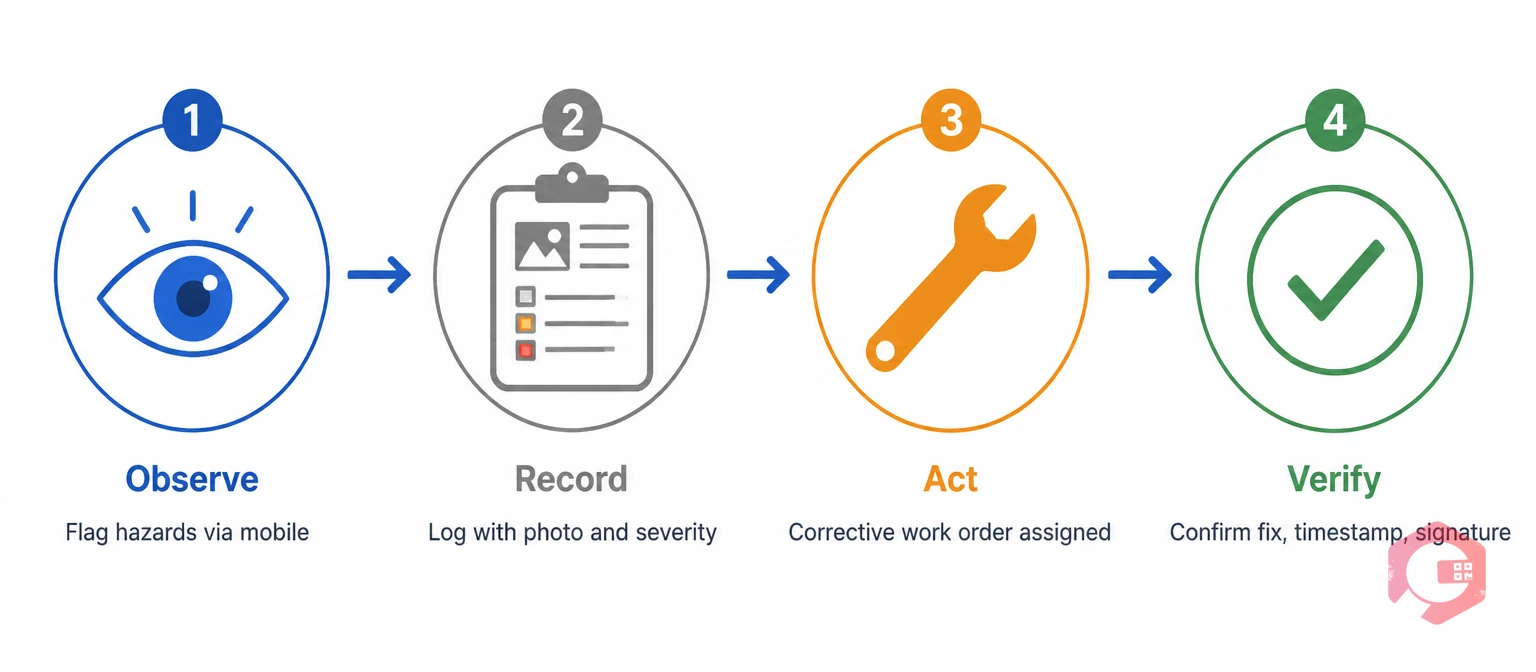
The 6S Safety Loop is a four-stage cycle that maintenance teams use to keep the Safety pillar active between formal audits. Each stage flows into the next, creating a closed-loop system where no observation can go unresolved:
Work order management software is the operational backbone of this loop. Without a digital system to receive, assign, track, and close safety observations, most facilities fall back on paper logs that accumulate on a desk and go unread until the next audit cycle.
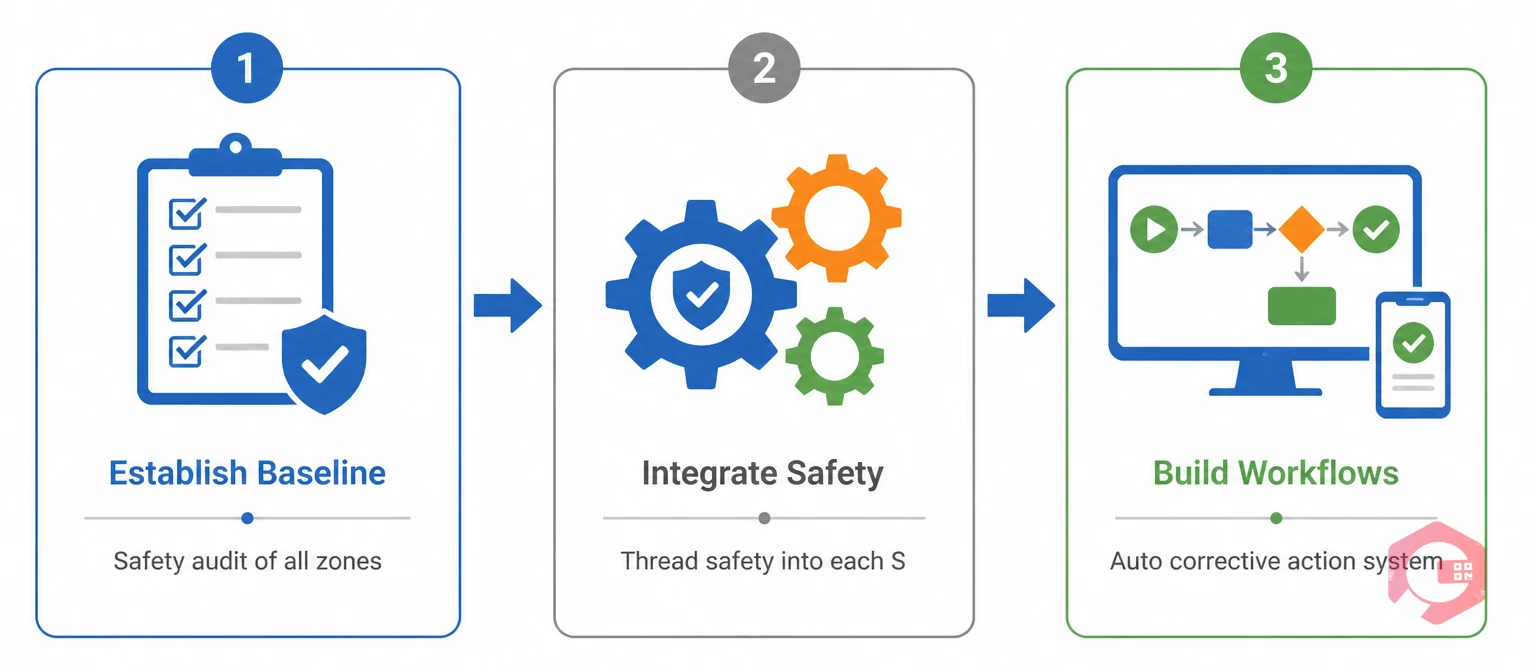
Adding the 6th S to an existing 5S programme doesn't require starting from scratch. Operations that already have Sort, Set in Order, Shine, Standardize, and Sustain in place have the strongest foundation for the Safety pillar. The 5S vs 6S transition typically happens in three structured phases.
Before you can improve safety, you need to know where you stand. Walk every zone covered by your current 5S programme and score it through a safety lens: Are hazards labeled? Are control measures in place and functional? Are near-misses being reported? A structured safety compliance checklist anchors this baseline assessment and creates a repeatable audit format for future safety walks.
Effective 6S doesn't treat Safety as a separate bolt-on programme — it threads a safety lens through the existing five steps. During Sort, remove items that create trip hazards or block emergency exits. During Shine, inspect electrical panels and hydraulic lines for signs of wear or leakage. During Standardize, publish safety criteria alongside organisation standards so both are checked in the same routine. Each step gains a safety component the team checks alongside the existing lean criteria, requiring no separate audit.
A safety observation that doesn't generate a corrective action is paperwork, not safety management. Set up a digital workflow where any safety finding automatically creates a work request with a due date and an assigned owner. Review open safety work requests in every maintenance team meeting until the backlog reaches zero and stays there.
According to the 5S methodology overview, organisations that sustain all five S's consistently report 10–30% productivity gains — and those that add Safety as a sixth pillar typically see a measurable reduction in recordable incidents within the first year of structured implementation.

A Computerized Maintenance Management System is the most effective tool for making 6S auditable and sustainable long-term. It replaces paper-based safety logs with a traceable digital system where every observation, work order, and closure carries a timestamp, an owner, and a status. That audit trail is what transforms 6S from a programme that looks good during the annual audit into a living discipline that holds across shift changes, staff turnover, and management rotations.
Here's how maintenance teams use a CMMS to support each S in a 6S programme — the 5S vs 6S difference becomes most visible in the final discipline:
The Lean Enterprise Institute describes lean as a system of continuous improvement that depends on standard work and visual management — both of which a CMMS provides directly in the context of 6S, turning audit cycles into repeatable, data-backed routines rather than periodic inspections that happen when someone remembers to schedule them.
Not for every workplace. The 5S vs 6S decision depends on your risk profile. 6S is the stronger choice in high-hazard environments — heavy manufacturing, chemical processing, food production, and healthcare settings where safety incidents carry significant regulatory and financial risk. For office environments, software teams, or light warehousing, 5S is typically sufficient, and adding a formal Safety pillar may create administrative overhead without proportional benefit. Choose 6S when safety outcomes in your facility are currently measured reactively — after incidents rather than before them.
The 6th S stands for Safety. In the 6S framework, Safety is treated as a dedicated, measurable pillar rather than an assumption embedded in other steps. This means safety gets its own audit criteria, its own assigned owner, its own inspection schedule, and its own corrective action workflow — entirely separate from the organisation and cleanliness standards covered by the original five S's. The 5S vs 6S distinction is not about adding a word to a poster — it's about creating accountability where none existed before.
Sustained 6S requires three things: digital systems that make compliance easy, visible accountability for each S, and leadership walk-throughs that signal the programme matters. Paper-based programmes degrade quickly — technicians skip logging observations, audit sheets get filed and forgotten, and the Safety pillar quietly disappears. Moving observations and corrective actions into a CMMS with mobile access dramatically improves follow-through. Pair that with a weekly metric review showing open safety findings versus closed findings, and you have the core of a durable programme.
Yes. Healthcare facilities apply 6S to organise supply rooms, reduce medication errors, and maintain clean environments with tracked safety standards. Hospitality operations use it for kitchen safety and food handling compliance. Even data centres have adopted 6S frameworks to manage cable organisation, airflow safety, and fire suppression system access. The 5S vs 6S choice is relevant in any environment where physical workspace organisation and safety are both measurable priorities with real consequences for failure.
Ready to make your 6S programme more than a checklist on a wall? Schedule a free demo to see how Cryotos turns safety observations, corrective work orders, and 6S audit routines into a system your team can actually sustain — shift after shift.




Cryotos AI predicts failures, automates work orders, and simplifies maintenance—before problems slow you down.



