

Setting up quality checkpoints in maintenance workflows means building specific pause-and-verify steps into your work order process. At each step, a technician's work gets checked against a clear standard before it can move forward or close. Done right, a checkpoint catches a bad repair, a missed safety step, or an incomplete inspection early.
Done wrong, a checkpoint is just a vague "double-check it" instruction with no owner and no criteria. That kind of checkpoint gets skipped the first time the schedule gets tight. This guide covers where quality checkpoints belong in a maintenance workflow, a five-step framework for setting them up, and how a Computerized Maintenance Management System turns each checkpoint into an enforced rule instead of a manual habit. By the end, you'll have a concrete plan for setting up quality checkpoints in maintenance workflows of any size, from a single-site plant to a multi-facility operation.
Key Takeaways
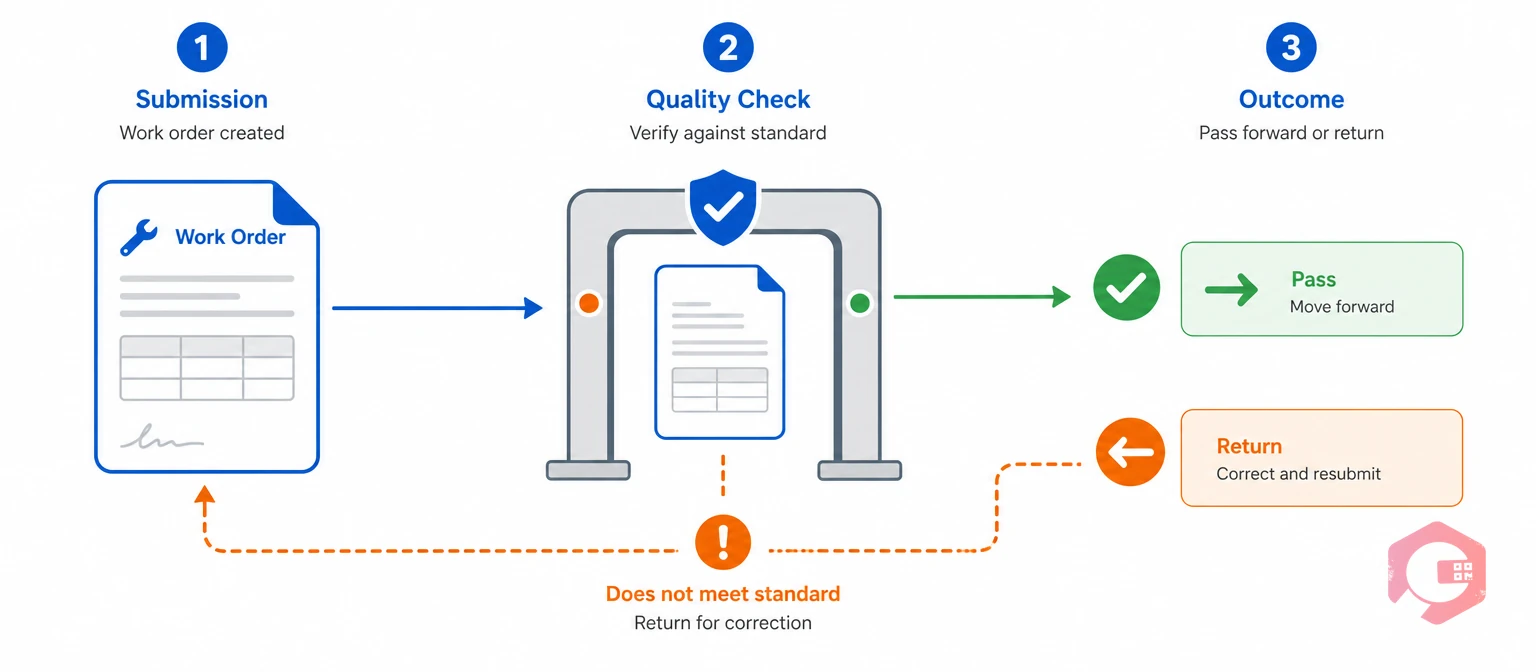
Quality checkpoints in maintenance workflows are set points where a work order pauses so someone can check the work against a standard. The work can only move forward or close once it passes. A checkpoint only counts as a real control if a failure changes what happens next. It might reroute the work order, block a sign-off, or open a corrective task. A checklist item marked "fail" that doesn't stop anything isn't a checkpoint. It's just a note.
Most maintenance teams already run informal checkpoints. A supervisor glances at a repair. A technician checks a gauge before closing a ticket. The problem is that informal checks depend on memory and spare time. Both disappear fast when a shift is short-staffed or the backlog is growing.
Formal quality checkpoints borrow their structure from standard asset management practice. ISO 55000 is the international standard for asset management, and it treats verification as a core part of a working maintenance system, not an optional extra. Building checkpoints into the workflow is how teams meet that bar without adding a separate audit process on top of daily work.
A missed checkpoint rarely costs you once. It compounds into rework, repeat failures, and eventually unplanned downtime. Every checkpoint a team skips is one more chance for a defect to travel further down the line. The farther it travels, the more it costs to fix.
The American Society for Quality tracks the cost of poor quality across industries. Their research puts that cost at 15% to 20% of sales revenue in some sectors. Internal failure costs, the kind a checkpoint catches early, are always cheaper than external failure costs. A good checkpoint is what keeps a failure internal instead of letting it reach a customer or the next shift.
Most maintenance teams that cut unplanned downtime didn't just work faster. They added a small number of well-placed quality checkpoints in their maintenance workflows, then tracked how often each one actually caught a problem. That data is what tells you which checkpoints earn their place and which ones just add delay without catching anything meaningful. Reviewing that data every quarter, rather than setting checkpoints once and forgetting them, is what keeps a checkpoint program useful as equipment ages and failure patterns shift.
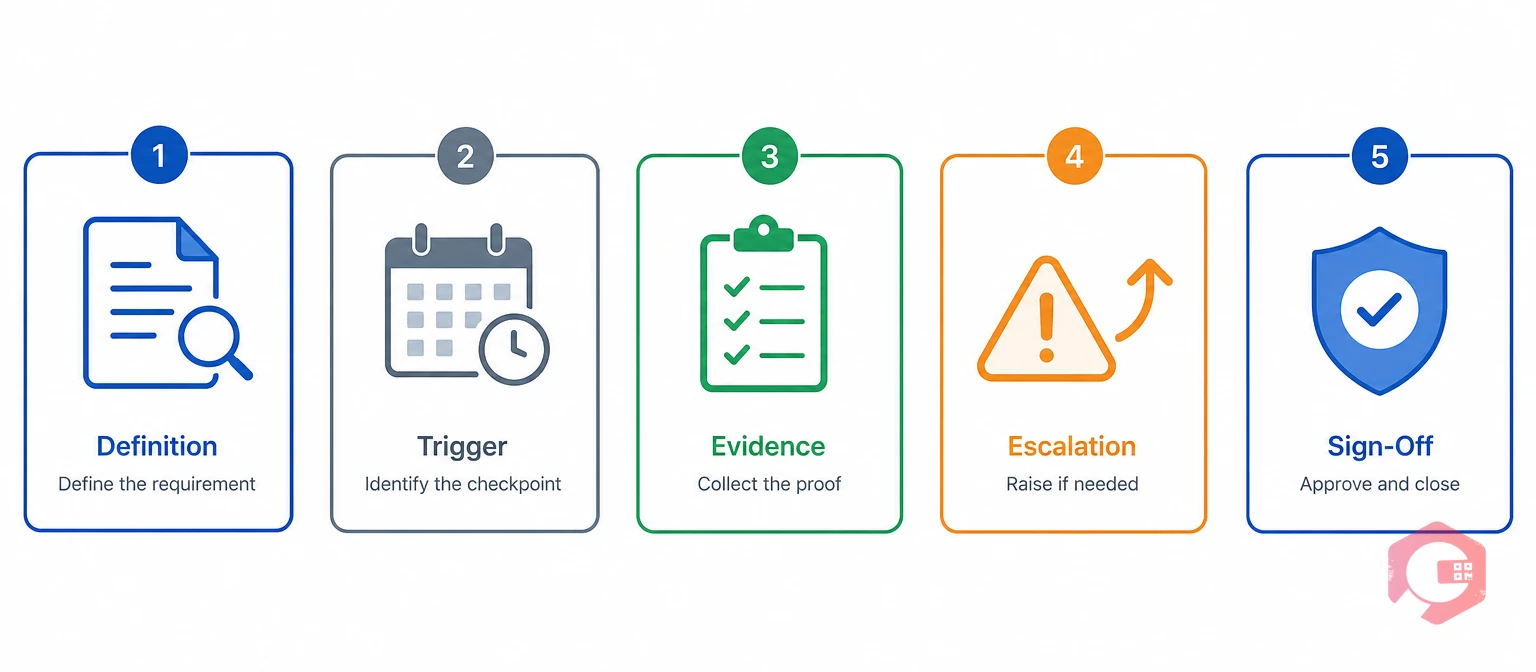
Most checkpoint programs fail for one reason. They define what to check but never say how the check enforces anything. The Five-Gate Framework:
Each gate answers one question: what standard, where, what proof, what happens on failure, and who signs off. Skip any one gate and the checkpoint quietly turns back into an informal habit that nobody actually enforces.
See how workflow automation software runs these five gates on its own, without a supervisor chasing approvals by hand.
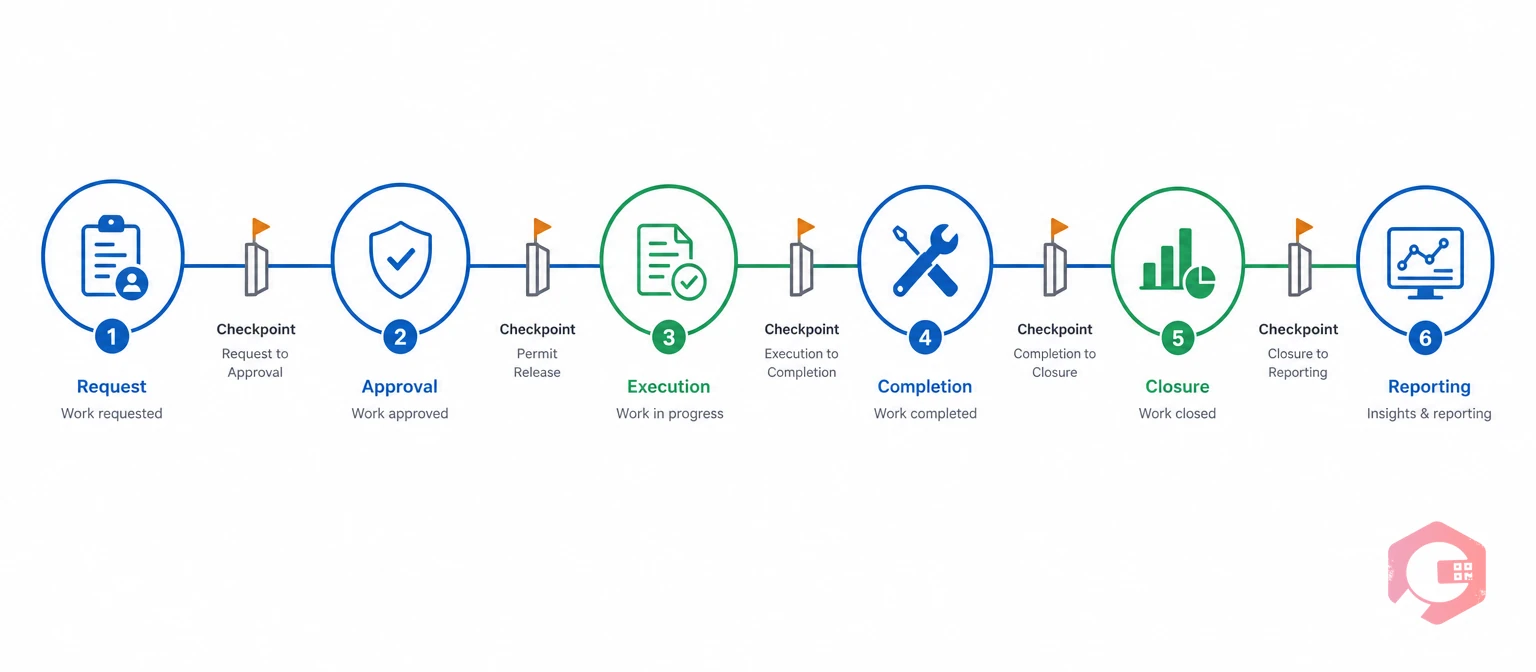
Checkpoints belong at the moments a work order changes hands, not at random points on a calendar. A checkpoint at a handoff catches problems before they move into the next stage. Placing one mid-task, when work isn't ready to be judged, just wastes a reviewer's time.
Running all five checkpoints on every routine, low-risk task is usually overkill. Save the full sequence for corrective, safety-critical, and regulatory work.
Here's what quality checkpoints in maintenance workflows look like on a single work order. A conveyor motor bearing is flagged for inspection on a preventive maintenance schedule.
The Definition Gate says the bearing must read below 80°C with no visible pitting. The Trigger Gate ties this check to the PM work order itself, not a separate task someone has to remember. The technician takes a temperature reading and a photo for the Evidence Gate, then logs both in the checklist.
The bearing reads 92°C. The Escalation Gate fires automatically: a corrective work order opens, and the technician can't close it without completing a 5 Whys root-cause entry. A supervisor reviews the finding and signs off at the Sign-Off Gate before the asset goes back into service. The whole exchange takes minutes, not days, because every gate already had a clear owner and a clear rule.
This is what setting up quality checkpoints in maintenance workflows looks like in practice. Five short steps, each with a clear owner and a clear consequence for failure.
Manual checkpoint enforcement depends on someone remembering to check, chase, and record it. That's exactly why checkpoints get skipped under pressure. A Computerized Maintenance Management System removes that dependency. It turns each gate into a system rule instead of a personal habit.
In practice, that means an inspection work order that won't close until every checklist item has an answer. It means a failed item that spins up a corrective work order on its own, with no one raising a ticket. It also means an approval chain that pings a supervisor the moment an SLA is breached.
Automated escalation is what separates a real checkpoint from a suggestion. When a technician can't submit "Completed" without a signature and a filled-in root-cause field, the checkpoint enforces itself. No follow-up email required.
This is the real practical difference between running quality checkpoints in maintenance workflows on paper and running them inside a CMMS. Paper depends on discipline. Software depends on a rule nobody can quietly skip.
Most checkpoint programs don't fail because the standard was wrong. They fail because the checkpoint had no teeth or no clear owner. These same mistakes show up in almost every attempt to run quality checkpoints in maintenance workflows, regardless of industry or CMMS platform. Watch for these patterns in your own operation:
A maintenance audit checklist is a fast way to spot which of these patterns is quietly undermining your current checkpoint program.
A quality checkpoint is a set point in a work order where the work must be checked against a standard before it can move forward or close. It only counts as a real checkpoint if a failure changes what happens next, such as blocking a sign-off or opening a corrective work order.
Most maintenance workflows need three to five checkpoints, placed at the natural handoffs: request to approval, permit release, execution to completion, and completion to closure. Adding more than that on routine, low-risk work usually slows teams down without catching extra defects.
A failed checkpoint should automatically create a corrective work order, rather than waiting for someone to notice and escalate it by hand. That corrective work order should require root-cause documentation, such as a 5 Whys analysis, before anyone can mark it complete.
Yes. A CMMS can require checklist completion before a work order closes, auto-create a corrective work order on a failed inspection item, and enforce multi-level approval with digital signatures before final closure. None of it needs a manual follow-up.
Each checkpoint needs one named, accountable person, not a team or department. Giving ownership to a group almost always means the checkpoint gets skipped the first time there's real deadline pressure, since no single person feels responsible for it.
A well-placed checkpoint adds minutes, not hours, because its criteria and evidence requirements are defined in advance. Quality checkpoints in maintenance workflows only slow work down when they lack clear pass/fail rules, forcing reviewers to guess what "good enough" means.
Getting quality checkpoints right isn't about adding more inspection steps. It's about making sure the steps you already have actually enforce a standard. Schedule a free demo to see how Cryotos turns the Five-Gate Framework into automatic work order rules instead of manual follow-up.




Cryotos AI predicts failures, automates work orders, and simplifies maintenance—before problems slow you down.



