

Muda, Mura, Muri are the three core wastes that Lean Manufacturing works to remove from every process. Muda means non-value-added activity, Mura means unevenness in workload or scheduling, and Muri means overburdening people, machines, or systems beyond their capacity. Toyota built its production system around cutting all three. The wastes feed each other: uneven demand creates overburden, and overburden creates the defects, downtime, and rework that show up as waste. Together, they drain productivity, raise costs, hurt quality, and put workers at risk. This guide breaks down each waste, how the three connect, and the steps manufacturing teams use to remove them for good.
Key Takeaways

Toyota engineer Taiichi Ohno built the Muda, Mura, Muri framework around a Japanese term for waste. It became part of the Toyota Production System, and Lean practitioners still use it as the starting point for waste reduction today. The three terms describe different sources of one problem: work that costs more time, money, or effort than it should.
Most manufacturers focus first on Muda because it is the most visible. Experienced maintenance teams know Mura and Muri are usually the root cause. Fixing only the symptom means the same waste keeps coming back.
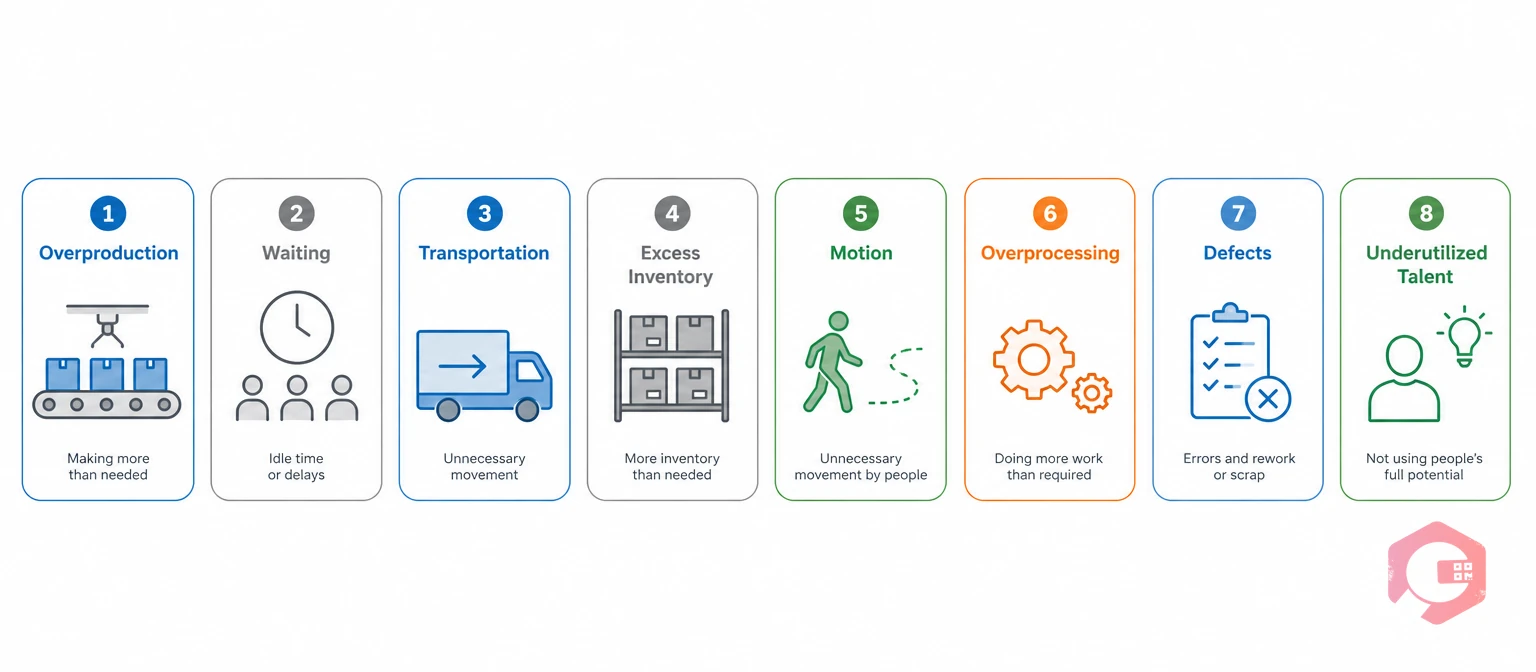
Muda, the first of the three wastes, is any activity that consumes resources without adding customer value. It shows up in almost every process, from the production line to the back office. It is the waste most Lean programs target first because it is easiest to see and measure.
Lean practice groups Muda into eight classic types.
Eliminating Muda improves efficiency and reduces operating costs, but a lasting fix means tracing each instance back to its Mura or Muri source.
Mura, the second waste in the framework, is any inconsistency in workload, scheduling, or process flow. It is often the hardest of the three to spot. It does not look like waste on its own - it looks like normal variation.
Common sources include fluctuating customer demand that production never catches up with, and irregular planning that alternates between rush jobs and idle stretches. Inconsistent work instructions add to the problem, leaving two shifts running the same job differently. A line that races through orders one week and sits half-idle the next is a textbook case of Mura. That happens before a single defect ever shows up.
Mura often creates both Muda and Muri at the same time. When demand spikes unevenly, a plant often overproduces to buffer against the next spike (Muda). Or it pushes the existing team and equipment past a safe pace to catch up (Muri).
Muri, the third waste Lean targets, is the overburdening of people, machines, or systems beyond a safe, sustainable capacity. It results from unrealistic targets, thin staffing, poor equipment upkeep, and process steps that demand more output than a resource can reliably deliver.
A technician covering three roles during a short-staffed shift is a form of Muri. So is a press run past its rated cycle time to hit a deadline, or a machine that skips maintenance to stay running. The strain rarely shows up right away. It builds until a breakdown or a wave of defects forces the issue into the open.
Muri increases equipment breakdowns, quality issues, and employee fatigue, and it is closely tied to safety performance. The Occupational Safety and Health Administration's ergonomics guidance shows how sustained physical strain raises injury risk. That is exactly the outcome Muri creates when left unmanaged.

The Three-M Waste Triangle: uneven demand or scheduling (Mura) forces people and equipment past a sustainable pace (Muri). That strain then produces the defects, downtime, and rework that show up on the floor as waste (Muda). Each corner of the triangle feeds the next, which is why sustainable Lean improvement addresses all three together rather than chasing Muda alone.
Consider a common shop-floor pattern. A spike in customer orders (Mura) pushes a team to run a machine past its rated capacity to keep pace (Muri). The machine overheats and starts producing out-of-spec parts. The team scraps the bad output and reworks what it can save (Muda). Without addressing the original demand spike or the workload it created, the same cycle repeats the next time volume jumps. According to Wikipedia's overview of lean manufacturing, this connection is precisely why Toyota's system treats the three wastes as one problem. It does not treat them as three separate ones.
Spotting Muda, Mura, Muri takes more than a walk through the plant. Manufacturing teams combine several methods to build a complete picture.
Most operations find that combining a data source, like OEE or downtime logs, with direct observation catches issues either method misses alone. The NIST Manufacturing Extension Partnership offers waste-assessment support for manufacturers getting started.
Once a team maps where Muda shows up, the fix usually comes from a standard set of Lean tools.
A common mistake is applying these tools to symptoms. Check first whether uneven scheduling or overburden is driving the waste.
Reducing Mura means smoothing the flow of work instead of reacting to every spike and lull.
Teams that level their scheduling typically see a direct drop in the Muri and Muda that used to follow every demand spike.
Preventing overburden means designing work around what people, machines, and systems can sustainably deliver.
A Computerized Maintenance Management System (CMMS) supports Lean goals by giving teams the data manual tracking misses. Cryotos schedules preventive maintenance before a worn part causes a defect. It also tracks asset history so recurring failures trace back to a root cause. It manages work orders so nobody guesses which job comes next.
Real-time downtime tracking flags exactly when and why a machine stopped, separating a Muri-driven breakdown from a one-off part failure. A BI dashboard rolls that data into one view for supervisors. A pattern of overburden or uneven scheduling shows up well before it turns into scrapped product. Manufacturers using Cryotos to run preventive maintenance report up to 30% less unplanned downtime and 25% faster repairs. That directly cuts the Muda that Muri-driven breakdowns create.
Reducing all three wastes together, the core of lean maintenance, delivers gains that reactive, single-focus efforts rarely reach.
Muda is non-value-added activity, Mura is unevenness in workload or scheduling, and Muri is overburden of people, machines, or systems. They connect: uneven work (Mura) creates overburden (Muri), which produces waste (Muda) as defects, downtime, and rework.
Most Lean practitioners start with Mura, since uneven scheduling is usually the root cause behind the Muri and Muda a team sees later. Fixing the schedule first stops the waste from reappearing after a Muda-only cleanup.
A CMMS schedules preventive maintenance, tracks downtime causes, and reports workload and equipment data on a dashboard. That evidence helps teams catch overburden and uneven scheduling before they turn into visible waste on the shop floor.
The eight classic types are overproduction, waiting, unnecessary transportation, excess inventory, unnecessary motion, overprocessing, defects, and underutilized talent. Lean teams use process mapping and gemba walks to find each one.
In practice, they rarely stay isolated for long. Uneven scheduling (Mura) and overburden (Muri) build strain on people and equipment. That strain eventually surfaces as defects, breakdowns, or rework, which is the definition of Muda.
Lean success is not achieved by eliminating one type of waste alone. Organizations that systematically reduce Muda, Mura, Muri build stable, efficient operations that sustain long-term improvement. Schedule a free demo to see how Cryotos helps your teams catch all three wastes before they hit your bottom line.



Cryotos AI predicts failures, automates work orders, and simplifies maintenance—before problems slow you down.



