

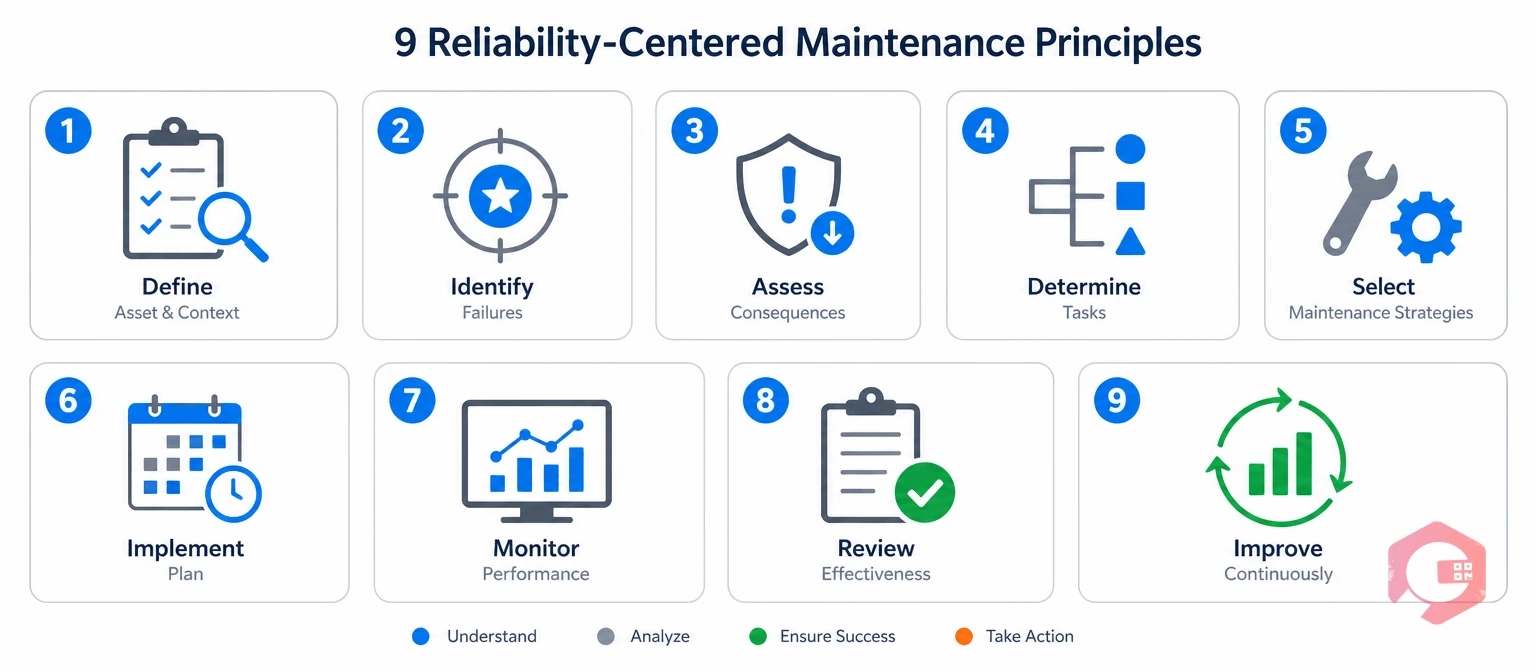
Reliability-Centered Maintenance (RCM) is a structured approach that ties every preventive maintenance (PM) task to an asset's actual criticality and real failure risk, instead of a fixed calendar that treats every machine the same way. A PM program built on RCM principles cuts unplanned downtime, extends equipment life, and keeps maintenance budgets under control because effort goes where it actually matters. This guide covers the 9 core Reliability-Centered Maintenance principles behind a strong PM program, along with how a Computerized Maintenance Management System puts each one to work on the shop floor.
Key Takeaways
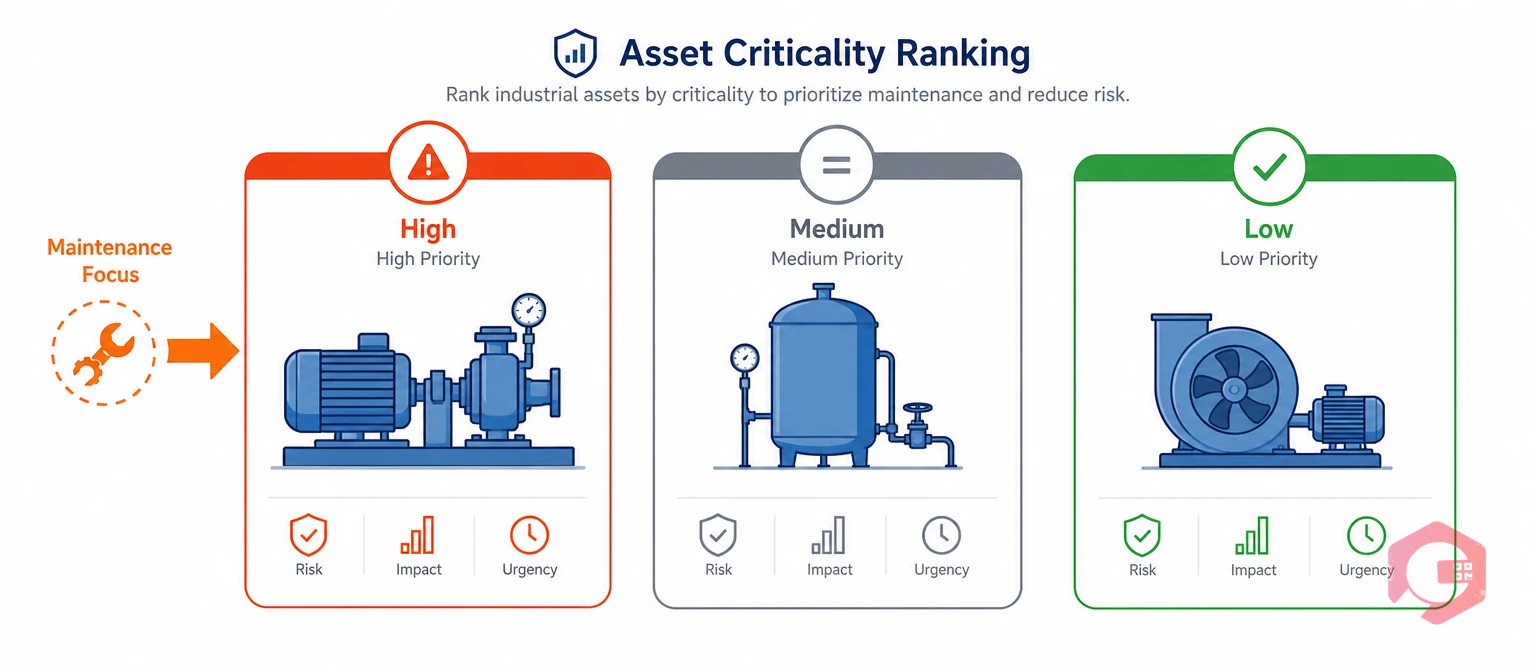
Not every asset deserves the same maintenance attention. A packaging line motor that stops production is not the same risk as a spare pump sitting in a low-priority area. RCM starts by ranking assets based on the operational, safety, and financial impact of a failure, then directs PM resources toward the equipment that matters most.
Think about a bottling plant running three filling lines. If Line 1 accounts for 60% of daily output, a failed capper on that line costs far more than the same failure on Line 3. Ranking assets by criticality means Line 1's capper gets tighter PM intervals and priority on the technician's schedule, while Line 3 gets a lighter touch.
Cryotos builds this ranking directly into its asset management software, where teams maintain a full asset hierarchy — parent equipment, sub-components, and location — and tag each item with a criticality level. Maintenance planners can then filter work orders and PM schedules by criticality, so the busiest technician still tackles the highest-risk asset first.
You can't prevent a failure you don't understand. RCM asks maintenance teams to examine how and why an asset actually fails — a worn bearing, a clogged filter, a corroded seal — rather than guessing at generic wear and tear. This failure mode data becomes the foundation for every PM task that follows.
Cryotos captures this history automatically. Every completed work order stores inspection notes, technician comments, and photos, building a searchable maintenance history for each asset. Over time, this record surfaces recurring failure patterns, so reliability engineers can spot a bearing that fails every 90 days on Line 3 and adjust the PM interval before it breaks again.
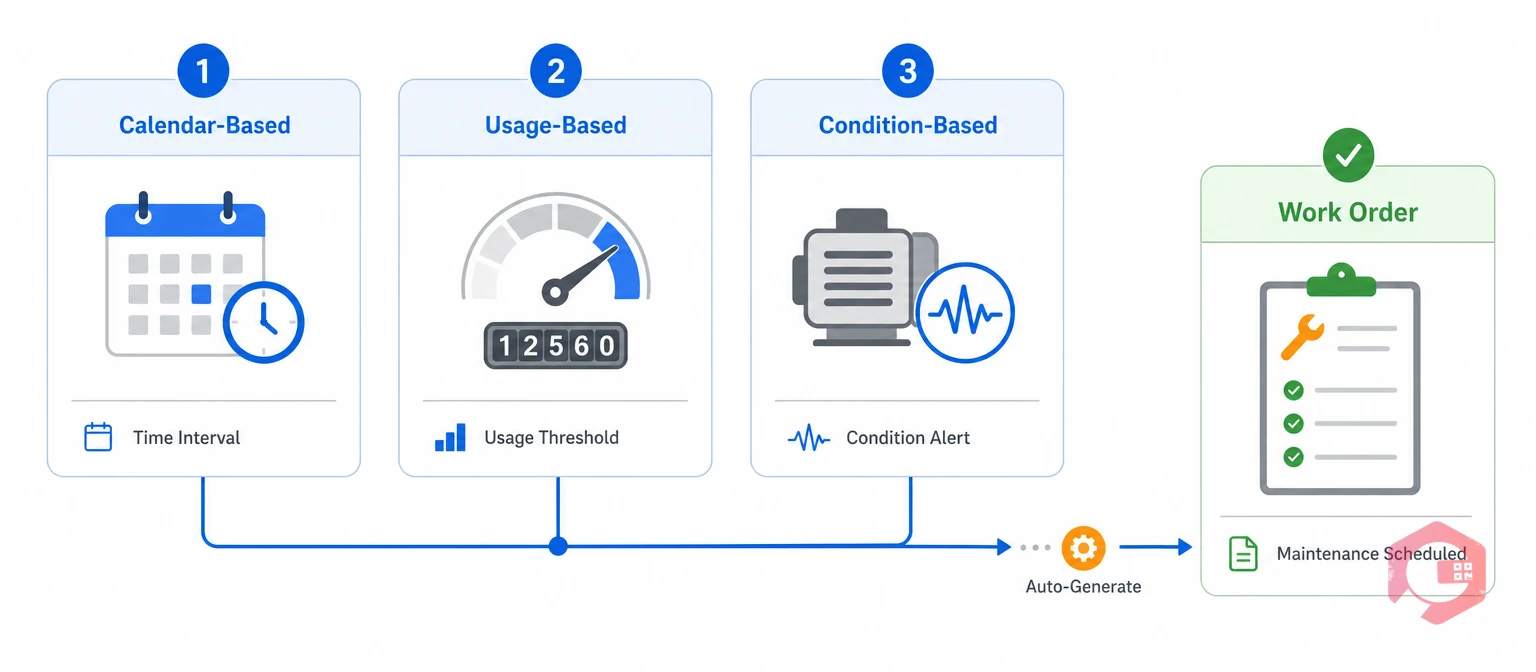
A one-size-fits-all PM calendar wastes labor on healthy assets and misses failures on the ones that need closer attention. RCM calls for PM frequency to match actual risk — some assets need monthly inspections, others need usage-based triggers, and some need condition-based checks driven by sensor data.
With preventive maintenance software, Cryotos supports calendar-based, usage-based (hours or mileage), and condition-based PM schedules side by side. Work orders generate automatically when a schedule triggers, and reminders reach the right technician before a due date slips, so PM tasks stay tied to risk instead of a static date on a calendar.
Inconsistent maintenance execution creates its own failure risk. If two technicians perform the same PM task differently, the asset ends up with unpredictable reliability no matter how good the schedule is. RCM programs standardize procedures so every technician follows the same verified steps, every time.
Standardization also protects institutional knowledge. When a senior technician retires, a well-documented checklist means the next person doesn't have to relearn which torque spec or lubrication interval actually works for that machine through trial and error.
Cryotos lets maintenance teams build digital SOPs, maintenance checklists, and inspection forms once, then attach them to every relevant work order. Technicians follow the same step-by-step instructions in the field, and completed checklists become part of the asset's permanent record — useful for audits and for training new hires.
A perfectly scheduled PM task still fails if the replacement filter or seal isn't on the shelf when the technician arrives. RCM treats spare parts planning as part of the maintenance strategy itself, not an afterthought, because stockouts turn planned work into unplanned downtime.
Cryotos connects inventory management directly to work orders, so technicians see live stock levels, reserve parts ahead of a scheduled job, and trigger automated reorder alerts when quantities drop below a set threshold. That link between parts and PM schedules keeps critical repairs from stalling on a missing component.
RCM only works if the plan actually reaches the technician doing the work — on the floor, not just on a planner's desktop. Mobile access turns a PM schedule into completed, documented work instead of a task that sits in a queue.
The Cryotos mobile CMMS pushes work orders straight to technicians' phones, lets them update job status in real time, attach photos, and capture digital signatures on completion. Full offline mode means a technician working in a basement mechanical room or a remote plant can still log a PM task and have it sync automatically once they're back in range.
A PM program that no one measures tends to drift — schedules get skipped, backlogs grow quietly, and nobody notices until a breakdown forces the issue. RCM treats performance monitoring as a continuous check on whether the program is actually reducing failures.
PM compliance is often the first metric to watch: it tells you what percentage of scheduled tasks are actually getting completed on time. A plant running at 60% PM compliance is, in practice, running a reactive maintenance program with extra paperwork. Pairing compliance with MTBF and MTTR trends shows whether the completed PM work is actually paying off in fewer and shorter failures.
Cryotos dashboards track PM compliance, Mean Time Between Failures (MTBF), Mean Time To Repair (MTTR), downtime, and technician productivity in real time. Teams can also run the numbers directly using the MTBF calculator or failure rate calculator to benchmark specific assets. Maintenance teams using Cryotos have reported up to 30% reduction in unplanned downtime and 25% faster repair turnaround once this level of visibility pairs with automated scheduling.
Manual follow-up doesn't scale. When an approval sits in someone's inbox for three days or an overdue PM task goes unnoticed, the RCM program breaks down at the process level, not the technical level. Automation closes that gap.
Cryotos's no-code workflow automation routes approvals to the right person, escalates overdue work orders automatically, and sends notifications by email or WhatsApp — so a stalled task gets flagged before it turns into a missed PM and, eventually, a failure.
RCM isn't a one-time setup — it's a strategy that keeps evolving as new failure data comes in. The best maintenance teams treat every completed work order, every recurring failure, and every technician note as an input for refining the next round of PM tasks.
The Cryotos AI-powered knowledge base stores maintenance best practices, historical solutions, manuals, and lessons learned in one searchable place. New technicians can pull up how a similar failure was resolved last year, and reliability engineers can use that accumulated history to adjust PM frequency, update SOPs, and keep tightening the strategy over time.
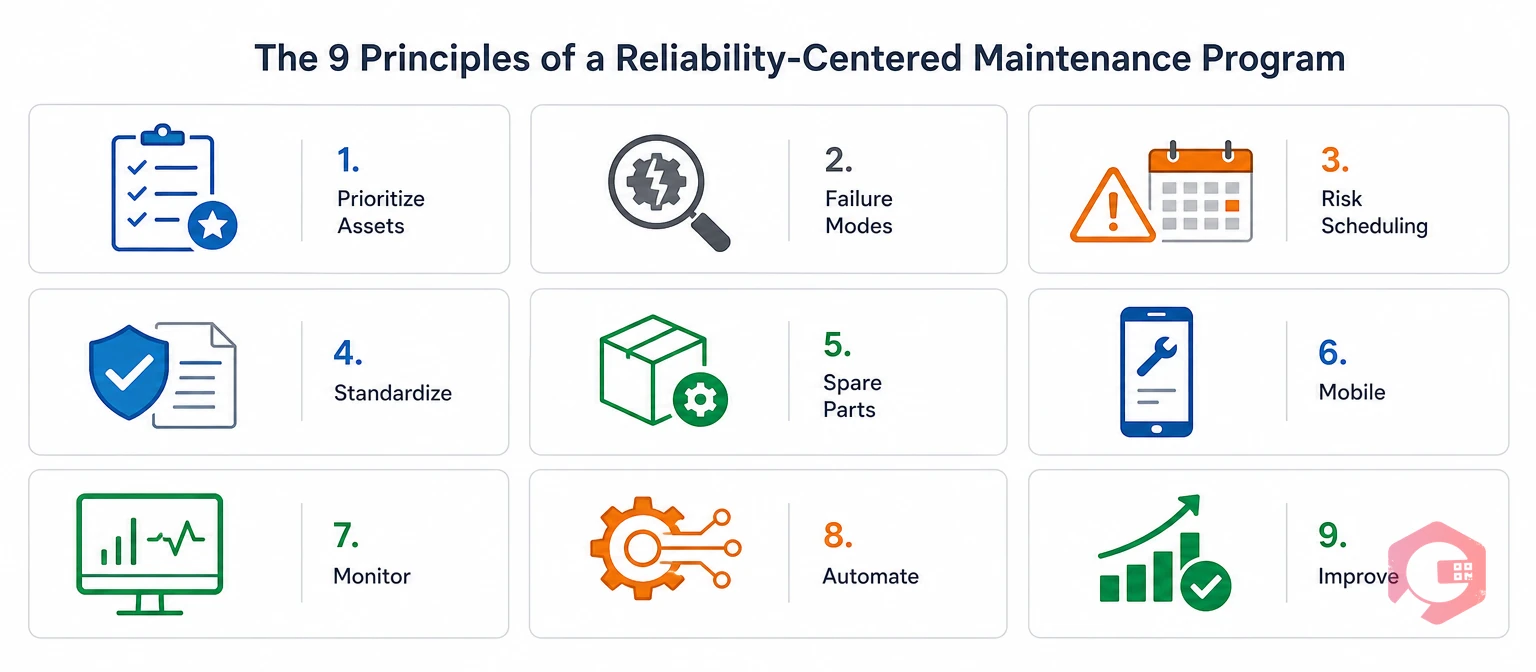
Here's a quick-reference summary of all 9 principles and how Cryotos CMMS supports each one:
A standard PM program often runs on a fixed calendar applied evenly across assets. RCM starts with asset criticality and failure modes, then builds the PM schedule and procedures around actual risk, so effort concentrates where a failure would hurt the most.
You can start RCM analysis on paper or in a spreadsheet, but tracking asset hierarchy, failure history, PM schedules, spare parts, and KPIs at scale gets unmanageable fast without a CMMS. A system like Cryotos keeps all 9 principles connected in one place instead of scattered across tools, so data from one principle automatically feeds the next.
Most teams see PM compliance and scheduling improvements within the first few weeks of switching to a CMMS. Measurable reductions in downtime and repair time usually show up over 2-3 months, once enough maintenance history builds up to refine schedules and procedures.
Start with the assets that would cause the most downtime, safety risk, or cost if they failed today. Build out the asset hierarchy and criticality ranking for that group first, then expand the program to lower-priority equipment once the process is working.
An effective RCM-based PM program comes down to maintaining the right assets, at the right time, with the right strategy. Cryotos CMMS brings asset criticality ranking, risk-based scheduling, digital SOPs, spare parts visibility, mobile execution, real-time dashboards, and an AI-powered knowledge base into a single platform. Schedule a free demo to see how Cryotos fits your maintenance strategy.



Cryotos AI predicts failures, automates work orders, and simplifies maintenance—before problems slow you down.



