

Pharmaceutical RCM and CMMS integration means running your reliability centered maintenance decisions inside the same system that schedules, records, and signs off GMP maintenance work. RCM tells you which task each asset needs and why. The CMMS turns each decision into a controlled task, captures the evidence, and feeds failure data back into the next review.
Most pharma plants already have both pieces. The problem is that they rarely talk. RCM studies sit in spreadsheets, while the CMMS runs on OEM intervals nobody has questioned in years. This guide shows how to connect the two in a GMP setting, with a sample worksheet, a named framework, nine best practices, and a six-step rollout.
Key Takeaways
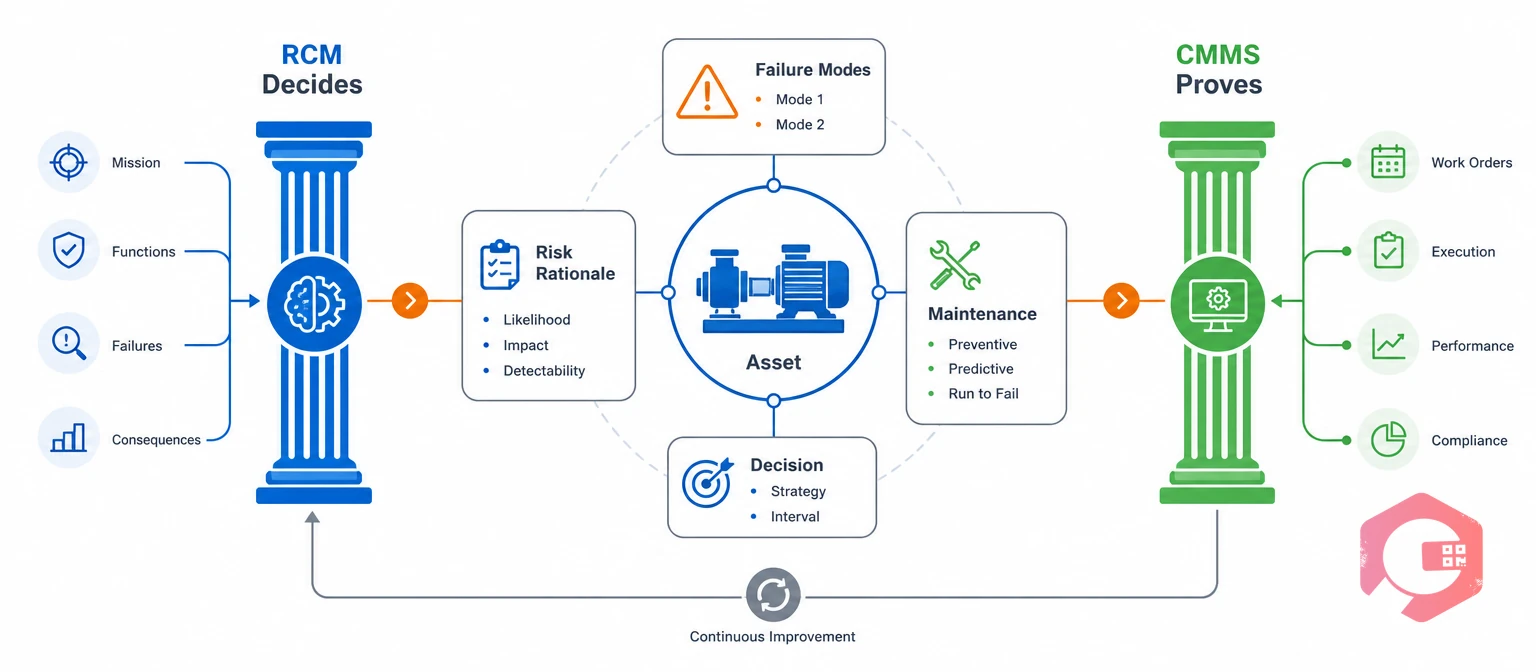
Pharmaceutical RCM is reliability centered maintenance applied to GMP equipment, utilities, and facilities. It asks what each asset must do, how it can fail, and what each failure means for product quality, patient safety, compliance, and supply.
Classic reliability centered maintenance was formalized in the SAE JA1011 standard. Any process that calls itself RCM must answer seven questions about functions, failures, failure modes, effects, consequences, proactive tasks, and default actions.
In pharma, the consequence that matters most is rarely lost output. It is a batch at risk, a deviation, or a failed audit. That shift is what makes pharmaceutical RCM different from RCM on a general factory floor.
Pharmaceutical RCM fails without a CMMS because the analysis never reaches the people doing the work. A study can be perfect on paper and change nothing on the floor.
A common mistake in most facilities is treating RCM as a one-time project. A consultant runs workshops, the team fills a large spreadsheet, and the findings go into a binder. Two years later, technicians still follow the original OEM intervals.
A team that can answer these four questions from one system is in a strong position. A team that has to search shared drives is not.
The original airline research behind RCM, the Nowlan and Heap study, found that most failures are not tied to age. That insight only pays off when your Computerized Maintenance Management System can schedule condition-based and on-condition tasks, not just calendar PMs. RCM without a CMMS is advice; RCM inside a CMMS is a controlled program.
CMMS-RCM integration works by linking five data layers so each RCM decision has a home in the system. When these layers connect, every scheduled task can be traced back to a failure mode and a risk rationale.
Each asset record carries its GxP classification, such as direct impact, indirect impact, or no impact. It also holds its qualification status and its link to the validated system or room. Good asset maintenance management software lets you filter the whole register by these flags.
Technicians pick a failure mode, cause, and action code when they close a work order. Codes should match the failure modes in your RCM worksheet, so field data maps straight back to the analysis.
Every PM, inspection, or calibration task stores the failure mode it protects against. When a planner looks at a task, they see why it exists and who approved it.
A new interval or checklist goes live only after QA approval. The CMMS keeps the version history and the electronic signature for each change.
Completed work, out-of-tolerance results, and deviations link to the asset. These records become the input for the next RCM review.
The goal of this structure is traceability in both directions. An auditor can start from a task and reach the risk rationale, or start from a failure and reach the task that should have caught it.
Want a quick baseline before your first review? Run your asset history through the free failure rate calculator to see which GMP assets fail most often.
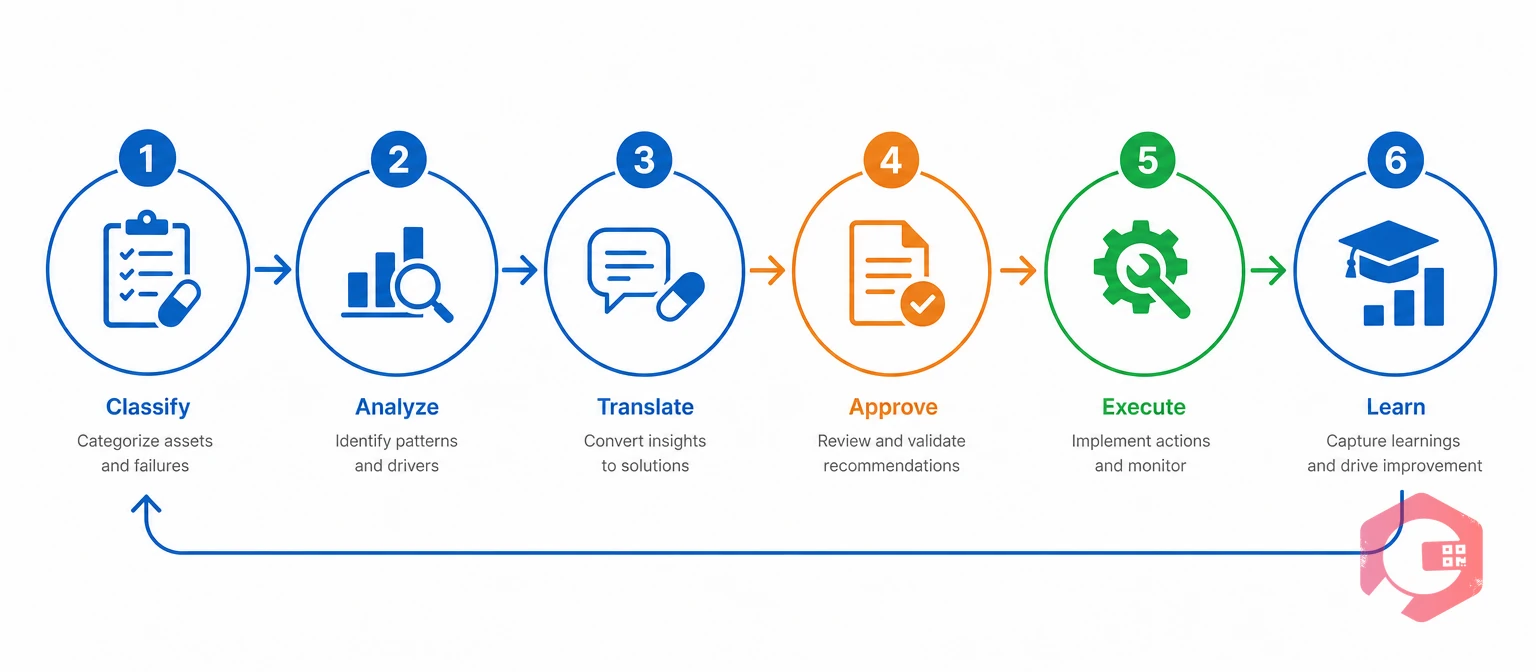
The Validated Reliability Loop Framework is a six-stage cycle for running pharmaceutical RCM inside a CMMS. Each stage has a clear owner and leaves a record, so the loop holds up under GMP inspection.
The Validated Reliability Loop Framework:
A failure mode is the specific way an asset loses its ability to perform a required function. In the Analyze stage, teams usually use failure mode and effects analysis (FMEA), which fits well with the risk tools named in ICH Q9.
In a general factory, a planner can change a PM interval on Monday. In a GMP plant, that same change can trigger a finding if it skips change control. The Approve stage is what makes pharmaceutical RCM defensible during an inspection. Without it, every RCM gain is a compliance risk.
An RCM worksheet is a table that links each failure mode to its effect, its consequence, and the chosen task. The sample below shows how a pharma team might fill one in for common GMP assets, with the CMMS record each decision creates.
| Asset | Function | Failure Mode | GxP Consequence | Chosen Task | CMMS Record |
|---|---|---|---|---|---|
| Steam autoclave | Reach and hold sterilizing temperature | Door gasket leak or drain trap failure | Failed cycle, sterility assurance at risk | Gasket inspection per cycle count; trap check monthly | Meter-based PM with leak test readings |
| Cleanroom air handling unit | Hold pressure cascade and air changes | HEPA filter loading or fan belt wear | Room excursion, batch impact assessment | Differential pressure trending; belt check quarterly | Condition alarm plus scheduled PM |
| WFI distribution loop | Deliver water at set temperature and quality | Pump seal leak or heat exchanger fouling | Microbial or endotoxin risk | Seal inspection; temperature and conductivity trending | Inspection route with acceptance limits |
| Tablet press | Compress tablets to weight and hardness | Punch and die wear | Out-of-spec tablets, rejected batch | Tooling inspection by stroke count | Usage-based PM linked to tooling log |
| Freeze dryer | Hold vacuum and shelf temperature | Vacuum pump oil breakdown | Cycle failure, lost high-value batch | Oil analysis and vacuum leak rate test | Condition task with trend chart |
| Office area exhaust fan | Ventilate non-GMP space | Motor bearing failure | No product or patient impact | Run-to-failure with a stocked spare | Corrective work order only |
Notice that the last row is a valid RCM outcome. Pharmaceutical RCM does not mean more maintenance everywhere. It means the right amount on each asset, with the reason written down.
Several of these tasks rely on live readings. Condition monitoring software can pull pressure, temperature, and runtime data into the asset record and raise a work order when a value drifts.
An integrated CMMS-RCM program keeps decisions live, while a standalone study tends to fade after the workshops end. The table below compares the two on the points that matter most in a GMP plant.
| Factor | Standalone RCM Study | Integrated CMMS-RCM |
|---|---|---|
| Where decisions live | Spreadsheet or consultant report | Task library linked to each failure mode |
| Path to the floor | Manual re-entry, often skipped | Approved tasks go live as scheduled work orders |
| Change control | Handled separately, easy to miss | Built into the task approval workflow |
| Failure data | Free-text notes, hard to analyze | Coded failure modes that map to the worksheet |
| Audit response | Rationale rebuilt from old files | Rationale, approvals, and history on the asset record |
| Review cycle | Rare, usually after a major failure | Scheduled and triggered by deviations or trends |
The pattern is consistent across most facilities. The study itself is rarely the weak point; the handoff into daily work is. Integration fixes the handoff.

The best practices below come from the issues maintenance teams in GMP plants run into most often. Each one is small on its own, but together they keep pharmaceutical RCM working long after the first study.
Start with product contact, sterility, and data integrity risk. Then add supply impact and repair cost. This keeps RCM effort on the assets an inspector will ask about first.
Agree on a short list of failure modes, causes, and actions for each asset class. If the codes come after the study, field data will never line up with the analysis.
Each task should record the failure mode it addresses, the RCM decision, and the approval reference. When an auditor asks "why this interval?", the answer is one click away.
Treat a PM interval change like any other GMP change. Assess impact, get QA approval, and record the effective date in the CMMS.
Follow a risk-based approach, such as GAMP 5, to validate the system. Focus testing on the features that hold GMP records: e-signatures, audit trails, and task version control.
If a failure mode shows signs before it happens, a condition task usually beats a fixed overhaul. It also avoids early failures caused by needless intrusive work.
Split systems create gaps. When calibration lives next to preventive maintenance software, a failed calibration can trigger a maintenance check on the same asset straight away.
Every equipment-related deviation should point to a failure mode. Over time, this shows which RCM decisions need a second look.
Set a review cycle for each criticality tier, such as yearly for high-impact assets. Also trigger a review after any repeat failure or major deviation.
Plants that follow these practices tend to see results within a few review cycles. Maintenance teams using Cryotos have reported up to 30% reduction in unplanned downtime and 25% faster repair turnaround once tasks, records, and reviews ran in one place.
You can implement CMMS-RCM integration in six steps, starting with one system or suite and then scaling. A pilot keeps the change control load manageable and gives you proof for the rest of the site.
Choose one area, such as the purified water system or a sterile filling suite. It should have known failures, decent records, and strong interest from QA.
Confirm every asset in the pilot area has the right tag, location, GxP class, and qualification status. Retire duplicates and fill gaps before any analysis.
Include a reliability engineer, a senior technician, a QA representative, a validation specialist, and a production user. QA involvement from day one saves weeks of rework at the approval stage.
Work through functions, failure modes, effects, and task choices for the top five to ten assets. Record each decision in a format that maps directly to CMMS task fields.
Raise one change control for the pilot package. Once approved, load the tasks, checklists, and acceptance limits, and let work order management handle assignment, sign-off, and records.
Track the KPIs below for two or three quarters. Share the results with QA and site leadership, then roll the same method out to the next system.
Say a site picks its purified water loop as the pilot. The team finds that the loop has 14 PM tasks, mostly copied from the OEM manual. Three of them protect against the same pump seal failure, while nothing checks the UV lamp hours that drive microbial risk.
The team raised one change control for the package, loaded the new tasks, and linked each one to its failure mode. The result was fewer tasks overall, better coverage of real risk, and a clear rationale for every change.
Most sites that sustain pharmaceutical RCM treat this rollout as a repeatable routine, not a one-off project. Each new area gets easier because the codes, templates, and approval path already exist.
The right KPIs show whether pharmaceutical RCM is improving reliability without adding compliance risk. Track a short list and review it at every RCM cycle.
Task traceability rate is the share of active maintenance tasks that link to a documented failure mode. It is a simple, inspection-friendly way to show that your PM plan is based on risk, not habit.
No, regulators do not require RCM by name. They do require written maintenance procedures, set intervals, records, and risk-based decisions under ICH Q9. RCM is one of the clearest ways to show that your maintenance intervals are based on documented risk.
Yes, as long as the change goes through formal change control. Document the failure mode, the risk assessment, and the supporting data, then get QA approval. Record the new interval and its effective date in your CMMS.
Yes, if it holds GMP records such as completed work orders, signatures, or calibration results. Most plants follow a risk-based approach like GAMP 5. Testing focuses on audit trails, electronic signatures, and task version control.
A focused pilot on one system usually takes two to four months, including analysis and change control. The analysis itself often takes only a few weeks. Approval and task loading take the rest, so early QA involvement matters.
No, full analysis is best saved for direct-impact and high-risk assets. Lower-risk utilities and non-GMP assets can use a lighter review or run-to-failure with spares. Ranking assets first keeps your team's time on the assets that matter most.
In general manufacturing, RCM mainly protects throughput and cost. In pharma, it also protects product quality, patient safety, and data integrity. That adds GxP classification, change control, and validated records to every step of the process.
Pharmaceutical RCM delivers when every decision becomes a controlled, traceable task with real failure data behind it. Schedule a free demo to see how Cryotos links GxP asset records, RCM-based task libraries, and audit-ready work orders in one maintenance platform.



Cryotos AI predicts failures, automates work orders, and simplifies maintenance—before problems slow you down.



