

You should run acceptance tests on critical spare bearings when a failed spare would stop production, take months to replace, or come from a source you cannot fully trace. For low-risk spares, a paperwork and visual check is enough. This selective approach protects critical spare parts without wasting technician time or using up bearing life.
Below, you will find what an acceptance test covers, why spares degrade on the shelf, a four-factor framework for deciding, and a realistic scenario showing how Cryotos closes the gap. It suits maintenance managers, reliability engineers and storeroom planners who must defend their spare-stock decisions.
Key Takeaways
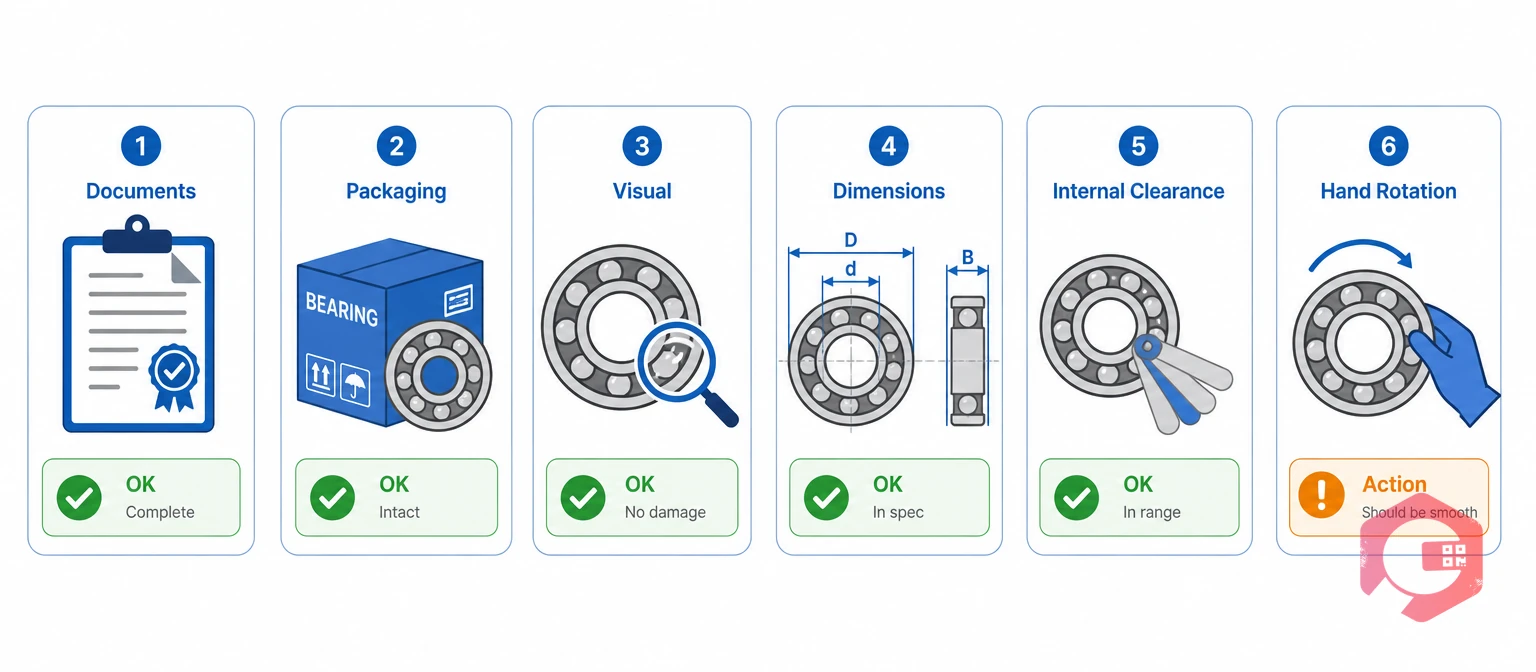
An acceptance test for a critical spare bearing is a documented check that the part matches its order and is undamaged before it is shelved. It sits between receiving and storage, and the result stays on record against the part.
Bearings are made to published standards, such as ISO 492 for tolerances and ISO 5753 for internal clearance. That gives you a specification to test against. A practical test for rolling-element bearings, much like acceptance testing in engineering projects, covers six non-destructive checks:
ISO 55000 asset management and failure mode and effects analysis (FMEA) both direct effort to the highest risks. That is why only critical spares need this level of checking. Hardness and metallurgical tests damage the part, so reserve them for sample audits of suspect lots. An acceptance test confirms identity and condition; it does not prove fatigue life.
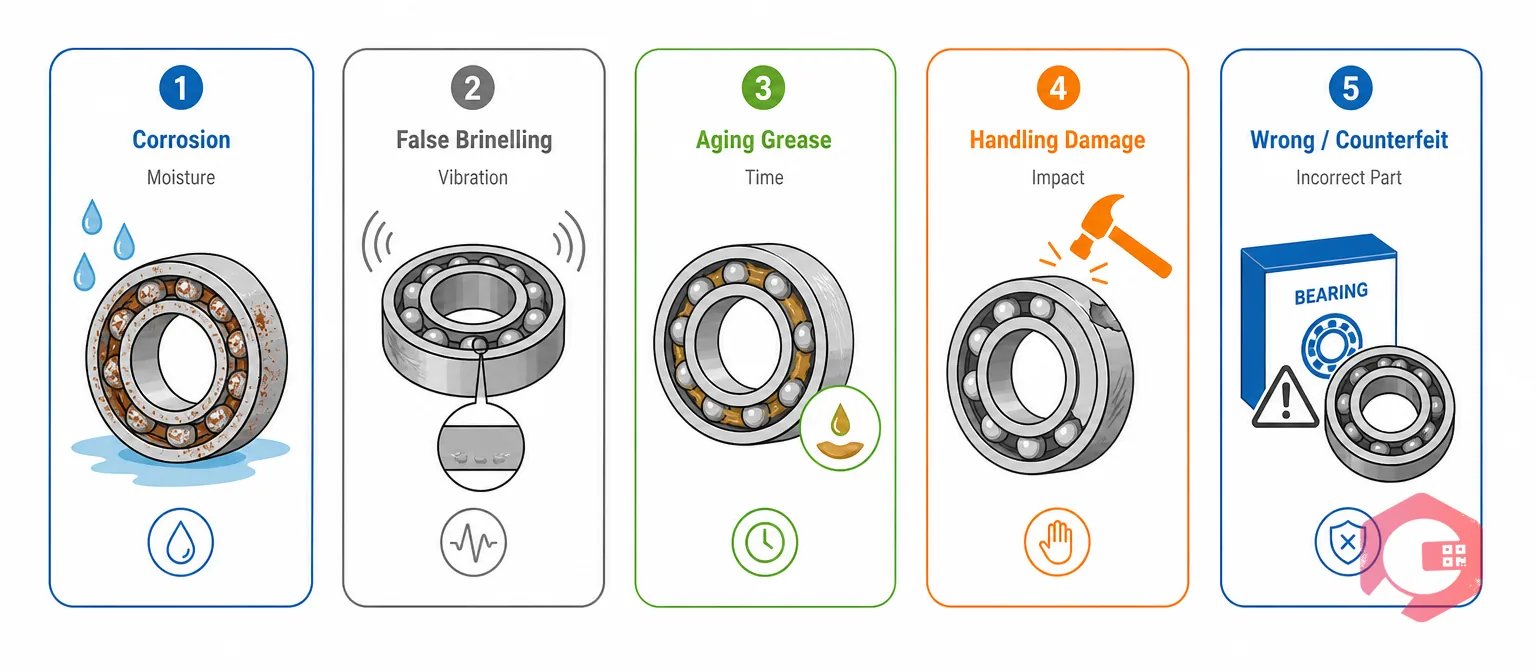
Spare bearings degrade in storage because moisture, vibration, aging grease and handling damage keep acting on a part that never runs. A bearing can look perfect in its box and still be unfit to install.
False brinelling is wear on a raceway caused by vibration while the bearing is not rotating. Most maintenance teams find this kind of damage at the worst moment: during a shutdown, with the old bearing already pulled.
Storage conditions, not only supplier quality, decide whether a critical spare is ready on the day you need it.
Not sure how often your bearings fail? Use the MTBF calculator to turn your failure history into a number you can score.
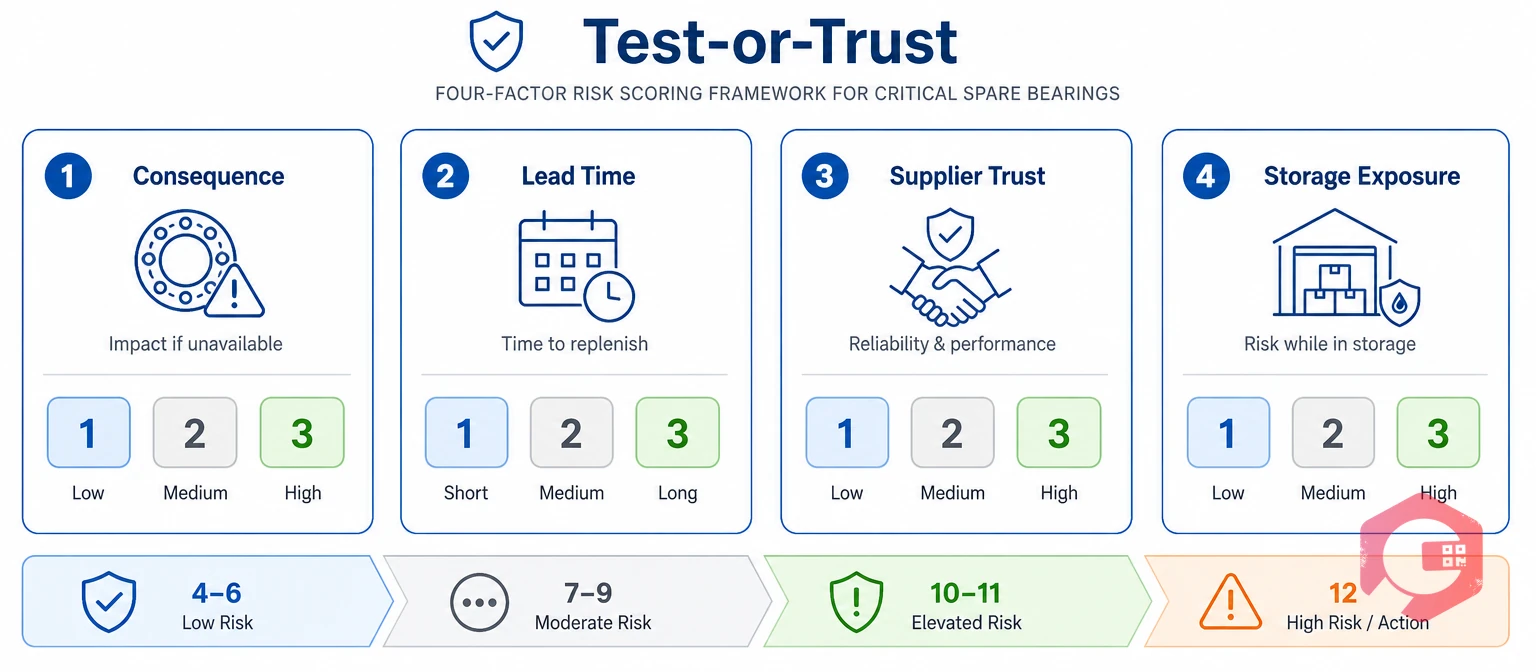
Test a critical spare bearing when its risk score is 7 or higher; below that, trust a documented receiving check. The score comes from four factors, each rated from 1 (low risk) to 3 (high risk).
The Test-or-Trust Framework:
Add the four scores. A total of 4–6 needs a Level 1 receiving check, 7–9 needs a Level 2 acceptance test, and 10–12 calls for Level 3 verification. Any safety-critical spare gets at least Level 2, whatever its total.
Two quick examples show how the scoring works:
The same four factors work for other critical spare parts, and they give you a written reason for every testing decision.
Use a Level 1 receiving check for every spare, a Level 2 acceptance test for critical spare bearings, and Level 3 verification only for high-risk lots. The table shows what each level covers and where it fits.
| Check level | What it covers | Use it for | Effort |
|---|---|---|---|
| Level 1: Receiving check | Paperwork, part number, packaging, visual condition, markings | Every spare; scores of 4–6 | Minutes |
| Level 2: Acceptance test | Level 1 plus dimensions, internal clearance, hand rotation, photo record | Critical spare bearings; scores of 7–9 | Under an hour |
| Level 3: Verified lot | Level 2 plus supplier witness, certificate audit or outside lab check on a sample | New suppliers, suspected counterfeits, scores of 10–12 | Days |
Level 3 costs the most time. Keep it for new suppliers, suspected counterfeits and safety-critical assets, because matching effort to risk keeps testing affordable.
The major challenge: the plant had no record of its critical spare bearing’s condition, so nobody knew it was unfit until the shutdown. This scenario is a composite of patterns common in process plants, not a single named customer.
A continuous-process plant held a large gearbox bearing among its critical spare parts. It had sat on an open shelf near a compressor line for several years, logged only in a paper register.
How Cryotos solved it: a Computerized Maintenance Management System (CMMS) such as Cryotos ties testing, storage and failure history to each spare.
The test still takes time, and some defects only show up in service. What changes is that the team knows the condition of every critical spare before the shutdown starts. Maintenance teams using Cryotos have reported up to 30% reduction in unplanned downtime and 25% faster repair turnaround.
Avoid any test that adds contamination, wear or damage to a bearing you have not yet used. Poor testing can leave a critical spare part in worse condition than it arrived.
A good acceptance test leaves the bearing as clean, dry and ready as it was in the box. The Society for Maintenance & Reliability Professionals publishes maintenance and reliability guidance, including metrics for stores and spares, that can help you set storeroom standards.
No. Rate each spare on consequence, lead time, supplier trust and storage exposure, then apply the matching check level. Low-risk bearings that are easy to replace need only a paperwork and visual check, while critical spare bearings earn a full acceptance test.
Follow the manufacturer’s shelf-life guidance first, especially for sealed, grease-filled bearings. Many teams also inspect critical spares at least once a year, and again after any move, flood, fire or nearby construction.
Yes, if it is done poorly. Spinning with compressed air, opening seals, dirty handling and long rig runs can all shorten bearing life. Stick to clean, non-destructive checks and re-preserve the bearing afterward.
Record the part number, lot or date code, test date, tester, measured dimensions and clearance, photos and storage bin. Attach the record to the part and to the asset it protects. The next person can then trust it without retesting.
A critical spare part is a component that stops production or creates safety risk if it fails and cannot be sourced quickly. Routine spares are cheap, available locally and low in consequence.
Critical spares only protect uptime when you know their condition. Schedule a free demo to see how Cryotos tracks tests, storage checks and shelf life for all your critical spare parts.


Cryotos AI predicts failures, automates work orders, and simplifies maintenance—before problems slow you down.



