Put a spare part on consignment or vendor-managed inventory when running out would stop a critical asset and your own stock would cost too much or arrive too slowly. Keep other parts under your own control, or buy them on demand. The right answer depends on the part, not the supplier.
This guide gives a four-filter screen, a sourcing matrix by part type, and a short checklist of what to agree with the supplier. It also shows how a maintenance system keeps supplier stock visible.
Key Takeaways
Consignment stock is stock the supplier owns until you use it. You pay only when a part is issued. Vendor-managed inventory (VMI) is an arrangement where the supplier monitors your stock and refills it. See the general overviews of consignment and VMI for background.
Two questions separate the models. Who owns the stock? Who decides when to refill it? You can use either model alone or both together.
| Model | Who Owns the Stock | Who Manages Refills |
|---|---|---|
| Consignment | Supplier, until you use the part | Often you |
| Vendor-managed inventory | You or the supplier, set by contract | Supplier, within agreed limits |
| Both together | Supplier | Supplier |
| Your own stock (min/max) | You | You |
Most spare parts programs mix models. A critical motor may sit on consignment while bearings are refilled by the supplier and fasteners stay in simple bins.
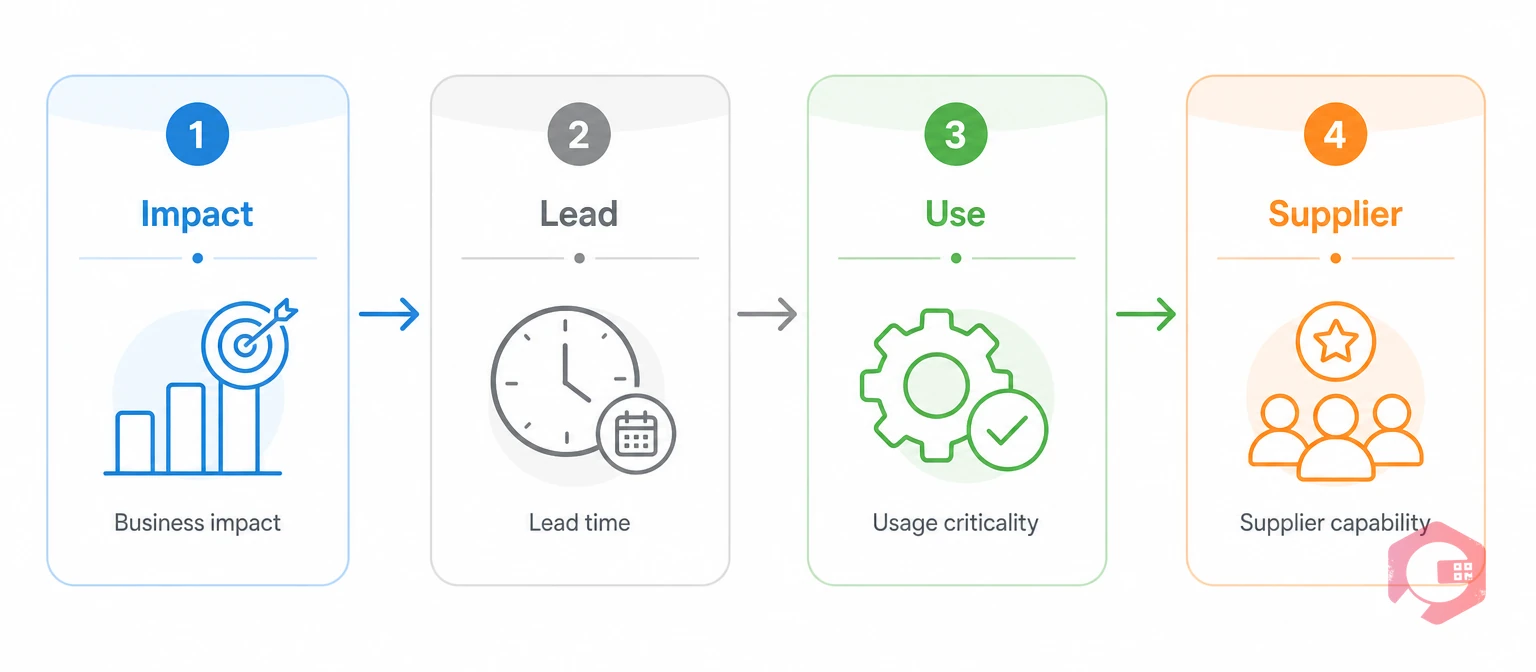
The Four-Filter Parts Screen asks four questions about each part class. Together the answers point to a sourcing model.
The Four-Filter Parts Screen Framework:
A critical spare is a part whose absence would stop a key asset. The first filter decides how much protection a part needs. The other three decide the cheapest way to provide it. Your safety stock rules and critical spares list set the buffer size.
This matrix gives a starting point for each part class. The examples are typical, not fixed rules, so check them against your own criticality and lead-time data.
| Part Class | Typical Examples | Suggested Model | Watch-Out |
|---|---|---|---|
| Critical insurance spares | Large motors, gearboxes, drives | Consignment on site, or a shared pool | Holding fees; who bears loss or damage |
| Critical fast movers | Bearings, seals, filters, belts | Vendor-managed inventory with a fill-rate target | Supplier stockout with no warning |
| Low-value bulk items | Fasteners, fittings, gaskets, lubricants | Vendor-managed inventory or supplier-refilled bins | Agree how stock is counted |
| Common electrical parts | Contactors, fuses, relays | Vendor-managed inventory or consignment via a distributor | Price changes and substitutions |
| Shelf-life items | Some seals, adhesives, batteries | Consignment with supplier-owned rotation | Who owns expired stock |
| Low-impact, low-use parts | Rarely used standard items | Buy on demand | Hidden emergency buys |
| Unique or single-source parts | Obsolete or custom components | Own stock | Do not rely on a supplier who may vanish |
| Parts needing traceability | Calibrated or safety-related items | Case by case, with traceability terms | Missing batch records |
Moving only the easy, low-value parts is a common mistake. It cuts counting work but leaves the parts that stop production unprotected.
Here is an illustrative example. A plant puts a costly gearbox on consignment, lets the supplier refill bearings and seals, and keeps unique shafts in its own storeroom. Each part gets the model that fits its impact, lead time and use.
Wondering how much waiting for parts costs you? Try the unplanned downtime calculator.

Agree the rules in writing before the first delivery. Review them with your procurement, finance and legal teams, because ownership, tax and accounting treatment depend on your contract and location.
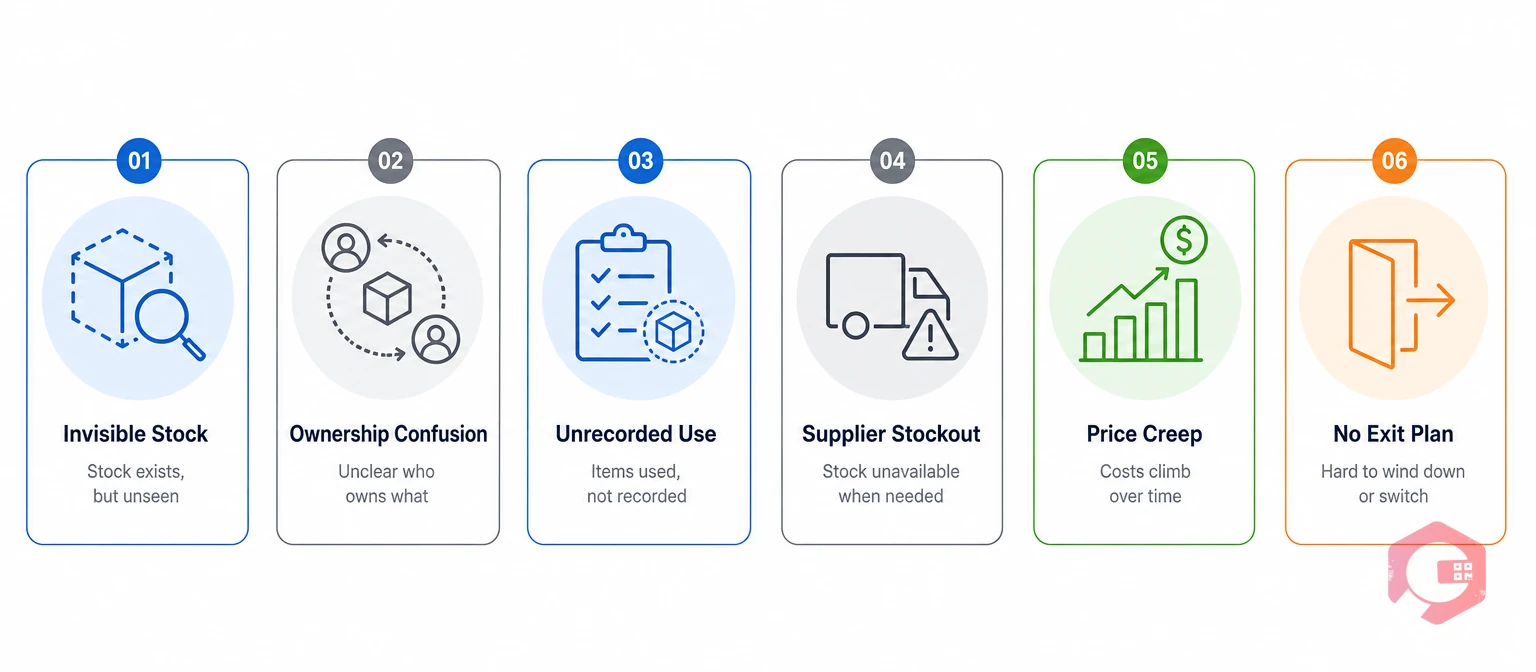
Many problems come from poor visibility, not from the supplier. Most maintenance teams meet at least one of these in the first year.
Track results by part class, not only in total. A few measures show whether uptime is better protected.
SMRP metrics give maintenance teams shared definitions for inventory and reliability, so use them as a reference when you set targets. Review the numbers each quarter, and move a part to another model when the data says so.
A Computerized Maintenance Management System supports consignment and vendor-managed inventory by keeping supplier stock visible and recording every use. It does not run the supplier's refills. Cryotos is a maintenance platform, not a supplier portal, so agree how the supplier shares stock data.
Maintenance teams using Cryotos have reported up to 30% reduction in unplanned downtime and 25% faster repair turnaround. Both results depend on parts being ready when the job starts, which is what these arrangements aim to protect.
Some needs, such as supplier-facing stock portals or automatic refill orders sent to the supplier, may need a supplier system or a custom setup. Ask your software vendor how each is handled.
Consignment is about ownership: the supplier owns the stock until you use it. Vendor-managed inventory is about control: the supplier decides when and how much to refill. The two can be combined, so the supplier owns, monitors and refills the stock on site.
High-value, rarely used parts with long lead times are the best fit, especially when a missing part would stop a critical asset. Shelf-life items can also suit consignment when the supplier owns the stock rotation. Parts that are unique or single-source should usually stay in your own stock.
Yes, when the supplier proves a high fill rate, keeps stock on site and has a fallback plan. Steady critical parts such as bearings and seals are good candidates. Keep a safety buffer of your own for parts where a miss would be costly.
The supplier usually owns it until you use or issue it, and you pay at that point. Terms vary by contract, so confirm the exact trigger with your finance and legal teams.
Give consigned stock its own storeroom or location. Scan each part out against a work order, and count it on a set schedule. Then compare issued parts with the supplier's statement each period.
It can cut your counting and ordering effort, and it may free cash when the supplier owns the stock. Prices, fees and fill rates decide the net result, so compare total cost and not just stock value.
Vendor-managed inventory works best when the stock stays visible. Schedule a free demo to see how Cryotos tracks spare parts, issues and stock alerts in one place.


Cryotos AI predicts failures, automates work orders, and simplifies maintenance—before problems slow you down.