

Agentic AI in maintenance is a system where autonomous agents interpret equipment signals, reason over operational data, and take permitted actions through enterprise tools to complete a workflow. Unlike a rule engine that fires an alert, an agentic system turns an anomaly into a complete, validated work request. It checks asset criticality, open work, spare parts, and technician skills — without a human stitching those steps together.
The bottleneck in most maintenance operations is not detection. It is the time between detection and a complete, executable work order reaching the right technician. Agentic AI in maintenance compresses that gap from hours to minutes, consistently, across every asset class.
Key Takeaways
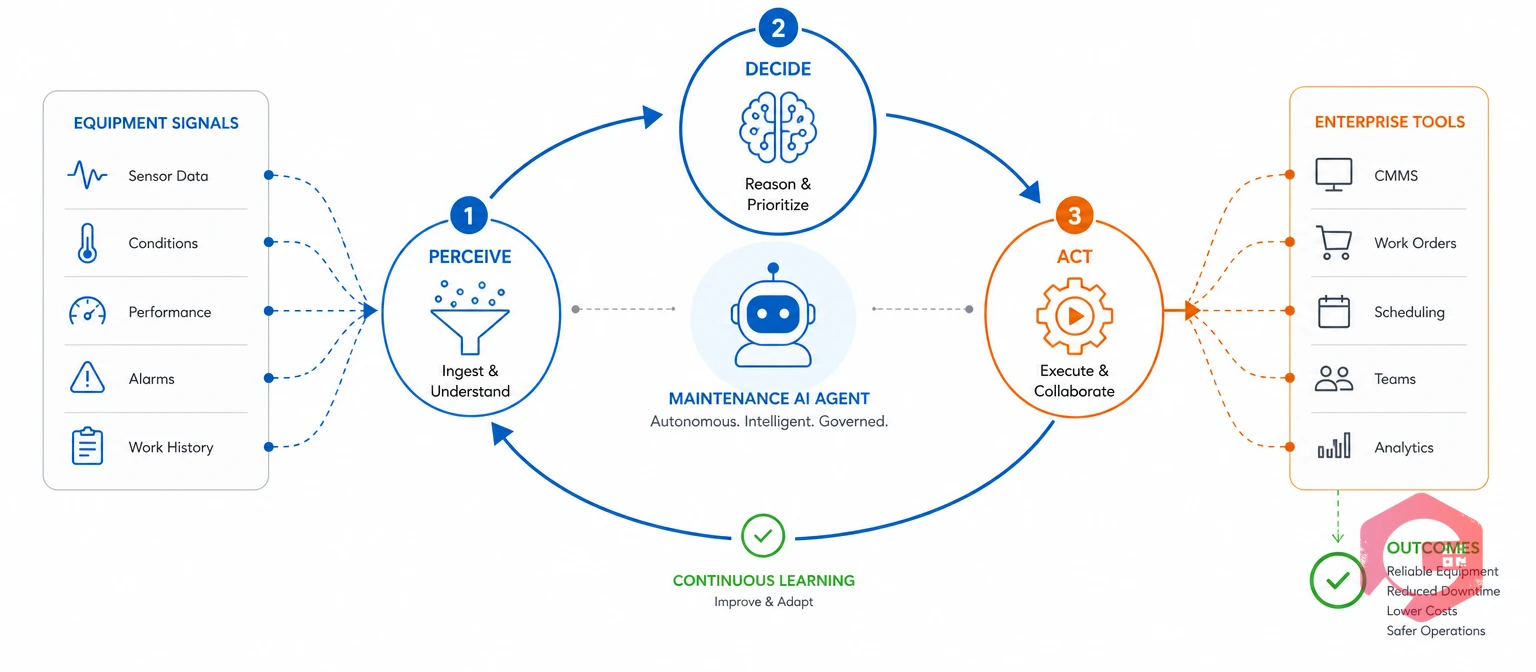
Agentic AI is an AI system that combines a goal, contextual reasoning, memory or state, tool use, and a feedback loop to act on the world — not just describe it. In a maintenance context, the agent does not stop at generating a recommendation. It calls your Computerized Maintenance Management System, your ERP, your scheduling tool, your parts database, and your messaging system to move work forward.
An autonomous maintenance agent is an AI system that perceives a goal, calls permitted enterprise tools, and adapts based on results.
The difference between conventional AI and agentic AI in maintenance comes down to action. A predictive model tells you a bearing has a 73% failure probability in two weeks. An agentic system then:
Three properties define a genuine agentic workflow in maintenance:
NIST's AI Risk Management Framework (AI 600-1) makes clear that agentic systems in high-consequence environments require lifecycle governance, documented risk treatment, human oversight, and context-appropriate evaluation — all directly applicable when an agent can change maintenance records or trigger equipment actions.
The work order connects the fault request, the asset, the failure mode, the job plan, labor, materials, permits, schedule, execution evidence, downtime, and closeout codes. That structure makes it the most practical transaction for governing what maintenance agents can and cannot do.
When an agent acts through the work order management lifecycle, every recommendation and system action gets logged, reviewed, measured, and tied to an operational outcome. The same structure limits uncontrolled automation — the agent receives only the data, tools, permissions, and approval paths assigned to its specific role.
This is why the work order — not the sensor or the model — is the right place to govern agentic AI in maintenance. Agents that act outside work order structure create audit gaps, accountability confusion, and recovery problems when something goes wrong. Major field service platforms agree: Salesforce Agentforce for Field Service connects autonomous agents directly to work order workflows, reflecting an industry-wide convergence on the work order as the orchestration point for agent actions.
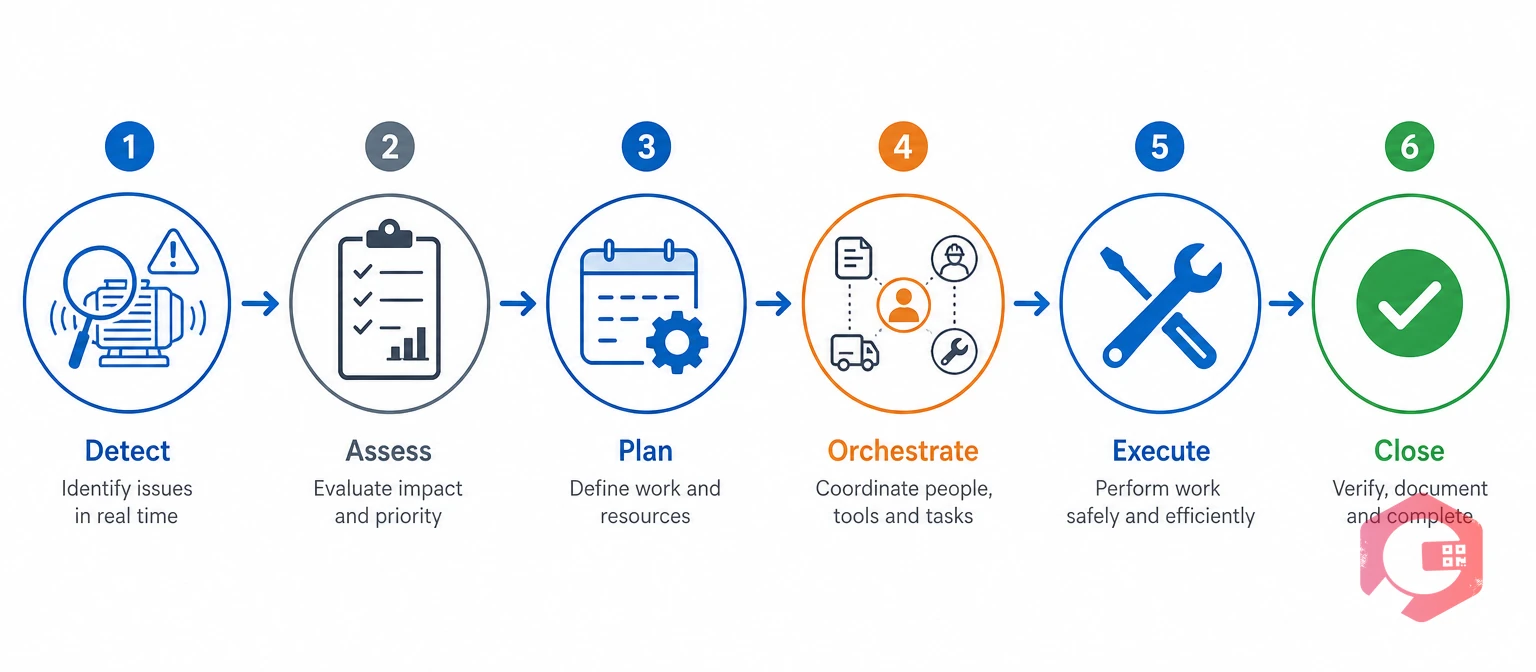
The 6-Stage Agentic Work Order Loop is the core operational framework for agentic AI in maintenance that governs how autonomous agents move from fault detection to verified closeout. Each stage has a defined scope, permitted actions, and a human checkpoint for decisions above the agent's autonomy threshold.
The value of the 6-Stage Loop is not speed alone. It is consistency. Every work request goes through the same six stages with the same checks, regardless of shift, technician experience, or how busy the operations team is that day.
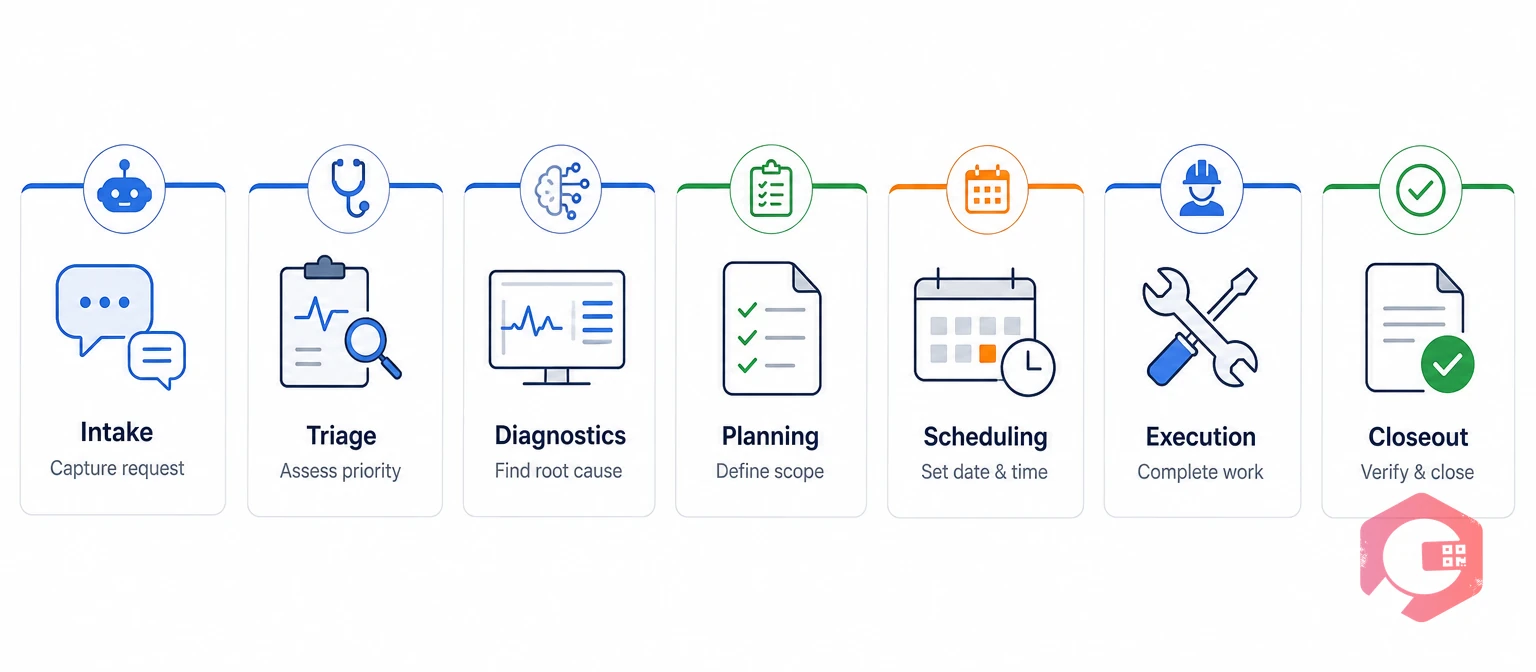
Agentic maintenance in practice is not one AI doing everything. It is a set of specialized agents, each with a bounded scope, handing off to each other through governed APIs and approval gates. Here are the seven roles that a mature agentic maintenance program uses:
Cryotos supports many of these agentic workflows through its AI-powered knowledge base and workflow automation software, connecting intake, triage, planning, and closeout in a governed digital workflow that maintenance teams can configure without code.
Most maintenance organizations evaluating agentic AI in maintenance measure value in three areas: speed, quality, and capacity. Agentic AI delivers against all three — but only when the implementation is governed correctly.
The time between detecting a fault and having a complete, executable work order in the right queue drops from hours to minutes. Maintenance teams using structured digital workflow automation with Cryotos report up to 25% faster repair turnaround — and agentic workflows reduce that further by removing the manual assembly work from planners.
An agent following the 6-Stage Agentic Work Order Loop applies the same checks every time: it verifies duplicate detection, links the correct asset, confirms parts availability, and flags permit requirements before scheduling. Human planners working under time pressure skip steps. Agents do not.
When an agent handles routine triage, job plan drafting, and closeout quality checks, planners spend their time on decisions that require human judgment — complex failure diagnosis, safety trade-offs, and contractor negotiations. That is a more sustainable use of skilled maintenance labor than data entry and status chasing. Cryotos customers report up to 30% reduction in unplanned downtime once work order processes are governed and automated consistently.
Ready to see how Cryotos supports governed work order automation? Explore Cryotos Work Order Management to see how the platform structures intake, planning, and closeout across asset classes.
Organizations that get agentic AI in maintenance right start narrow and expand deliberately. The ones that struggle either start too broad — trying to automate the entire maintenance lifecycle at once — or too shallow, deploying an agent that handles one low-value step and never scales.
A practical implementation sequence for agentic AI in maintenance looks like this:
One critical risk to manage is automation bias — the tendency for maintenance staff to accept agent recommendations without scrutiny under time pressure. Train your team to challenge agent outputs, preserve diagnostic competence, and track overrides as a leading indicator of both agent quality and team engagement.
A standard CMMS rule fires a fixed action when a condition is met — for example, creating a work order when a meter reading exceeds a threshold. An agentic AI system evaluates that trigger against multiple data sources, reasons about the best response given current context, selects from a range of permitted actions, executes through enterprise systems, and continues adapting as conditions change. The agent makes decisions; the rule executes a script.
Through explicit action boundaries: define which systems the agent may read or change, allowed parameters, approval gates for high-consequence actions, hard policy constraints, and emergency-stop behavior. Every consequential action should pass through a tool registry that validates parameters before execution. Safety-critical decisions — equipment shutdown, regulatory disposition, and actions beyond delegated authority — always require human approval regardless of agent confidence.
A governed asset hierarchy connecting locations, equipment, components, criticality ratings, failure modes, meters, work history, spare parts, and production context. Without clean master data, the agent cannot correctly link requests to assets, assess criticality, or confirm parts availability. Agentic AI does not fix poor data quality — it amplifies it. Measure data readiness before deployment and send unresolved conflicts to accountable data owners.
Measure agent quality (grounded-answer rate, correct asset classification, duplicate detection precision), workflow performance (request-to-work-order time, planning completeness, schedule compliance), maintenance outcomes (MTTR, emergency work ratio, repeat failures), and verified financial value (gross benefit minus total operating cost). Segment results by agent version, site, asset class, and autonomy level so aggregate averages do not hide poorly performing use cases.
Yes. The most practical approach connects agentic agents to your existing CMMS through governed APIs, letting the agents act as intelligent workflow layers on top of your current system. They read from and write to the CMMS without replacing it. This preserves your existing data, processes, and integrations while adding autonomous orchestration on top of the work order lifecycle.
Maintenance organizations ready to move from reactive firefighting to governed autonomous workflows need a system that handles the full work order lifecycle — from intake through closeout — with the auditability agentic AI requires. Schedule a free demo to see how Cryotos connects AI-powered work order management with the governance controls that keep autonomous maintenance safe and accountable.



Cryotos AI predicts failures, automates work orders, and simplifies maintenance—before problems slow you down.



