Model Context Protocol is the missing link for AI in maintenance because it gives AI assistants a standard, secure way to read live maintenance data and act on it. Most maintenance AI pilots don't fail because the model is weak. They fail because the model can't reach the work orders, assets, and spares data it needs.
Model Context Protocol (MCP) fixes that gap. A maintenance system publishes its data and actions once, and any MCP-compatible assistant can use them. This guide explains why AI stalls without a context layer, how MCP compares with custom integrations, the governance it needs, and a phased way to roll it out. It also shows how a Computerized Maintenance Management System (CMMS) becomes the context layer for every AI tool your team uses.
Key Takeaways
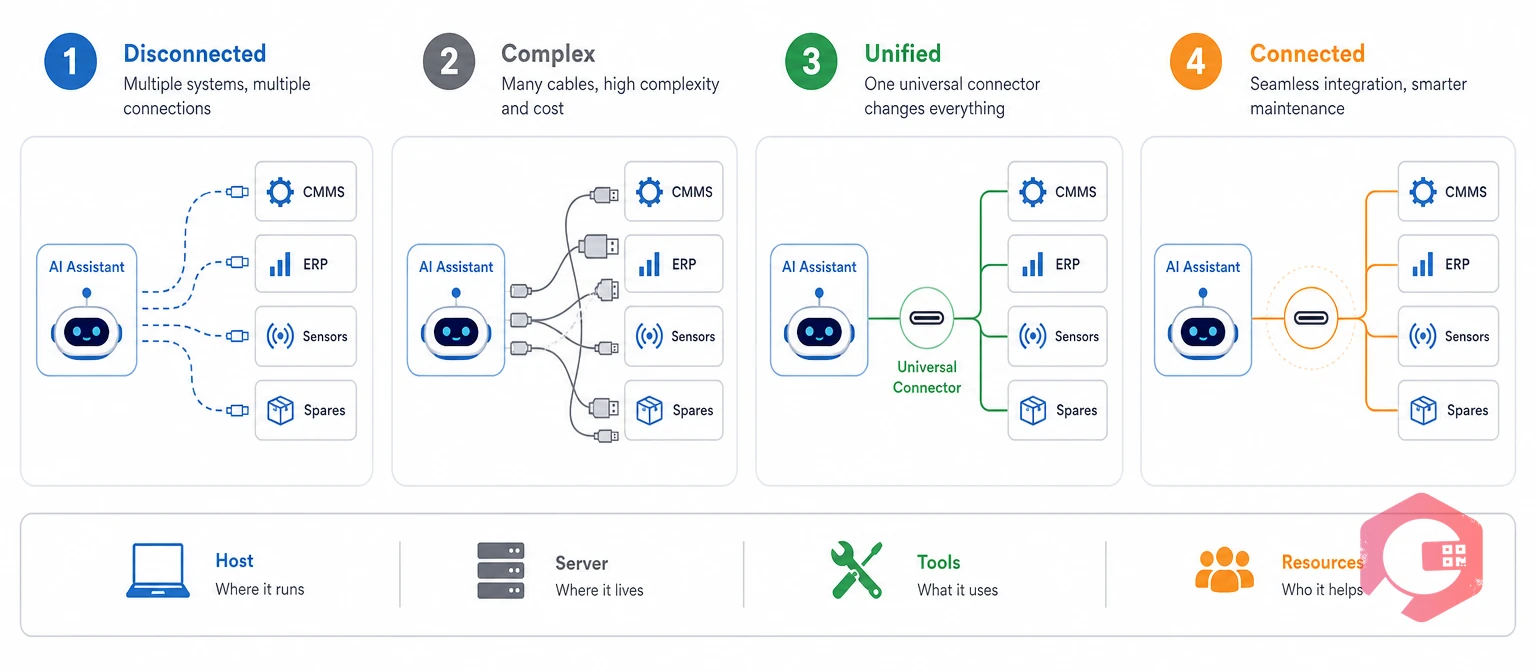
Model Context Protocol is an open standard that defines how AI applications connect to external data sources and tools. Anthropic introduced it in November 2024, and major AI platforms added support during 2025. You can read the official MCP specification and the original MCP announcement for the technical detail.
A simple way to picture it: MCP is to AI what USB-C is to devices. One connector shape replaces a drawer full of custom cables.
Asset management standards like ISO 55000 ask teams to base asset decisions on reliable, current information. MCP is the plumbing that puts that information in front of an AI assistant when someone asks a question.
AI in maintenance stalls at the integration step, not the model step. The model can reason well, but it only knows what it can see.
Most maintenance teams have seen this pattern. A pilot looks impressive in a demo, then fades because nobody wants to feed it data by hand every morning. A context layer is the connection that lets an AI assistant read and use live business data instead of pasted copies. Without one, AI stays a side project.
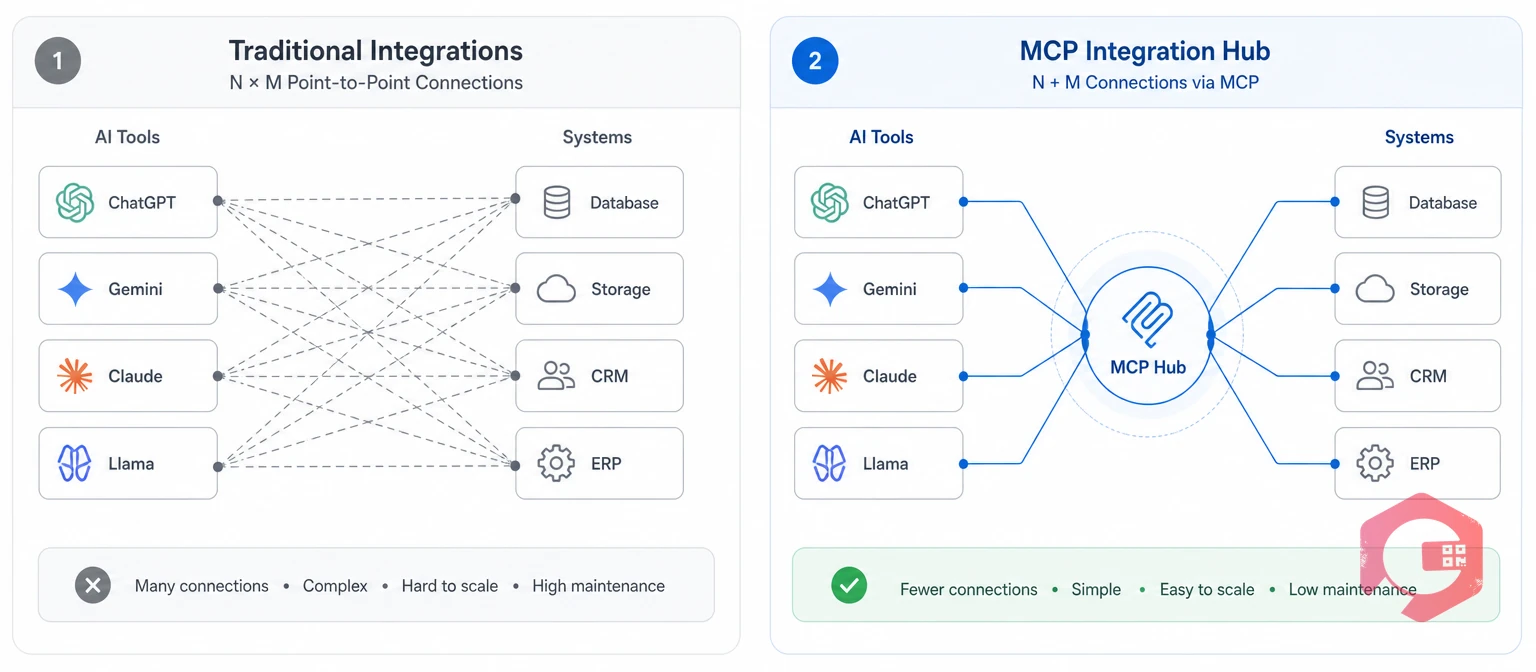
Point-to-point integrations connect each AI tool to each system with custom code. Model Context Protocol connects every system once, through a shared standard.
| Factor | Point-to-Point Integrations | Model Context Protocol |
|---|---|---|
| Integrations needed | One per AI tool per system (3 tools x 5 systems = 15) | One MCP server per system, reused by every tool |
| Data freshness | Often batch exports or scheduled syncs | Live reads at the moment of the question |
| Ability to act | Custom code for every action | Standard tools for create and update actions |
| Choice of AI assistant | Tied to whichever tool was integrated | Any MCP-compatible assistant |
| Upkeep | Breaks when either side changes its API | Maintained once by the system vendor |
| Security review | Every integration reviewed separately | One access model per server to review |
For a maintenance team, the practical result is simple. The AI assistant stops being a separate tool and becomes a new way to use the data you already trust.
Want your team's repair history searchable in plain language today? Explore the Cryotos AI-powered knowledge base.
Model Context Protocol makes the most difference when one question needs both a read and an action. Here's how that looks across five common maintenance roles.
The biggest gains come when one assistant talks to several MCP servers at once. A question like "Which failed pumps have spares in stock and an open purchase order?" needs the CMMS and the ERP together. An ERP integration already links those records inside Cryotos, and MCP lets an assistant ask across them in one step.
Sensor data joins the picture the same way. IIoT devices already stream runtime, vibration, and temperature values into many plants. Readings from IoT meter reading give the assistant condition context, so it can explain an alert using the asset's own history.
MCP makes AI access easy, so the controls around it matter as much as the connection. Maintenance data drives safety and spending decisions.
A common mistake is giving an assistant an admin account because it's quicker to set up. That turns one wrong instruction into a site-wide problem. Scoped, per-user access keeps the blast radius small.
Governance also builds adoption. When supervisors can see exactly which records an answer came from, and who approved each change, they stop treating the assistant as a black box. Trust grows with every answer they can check.
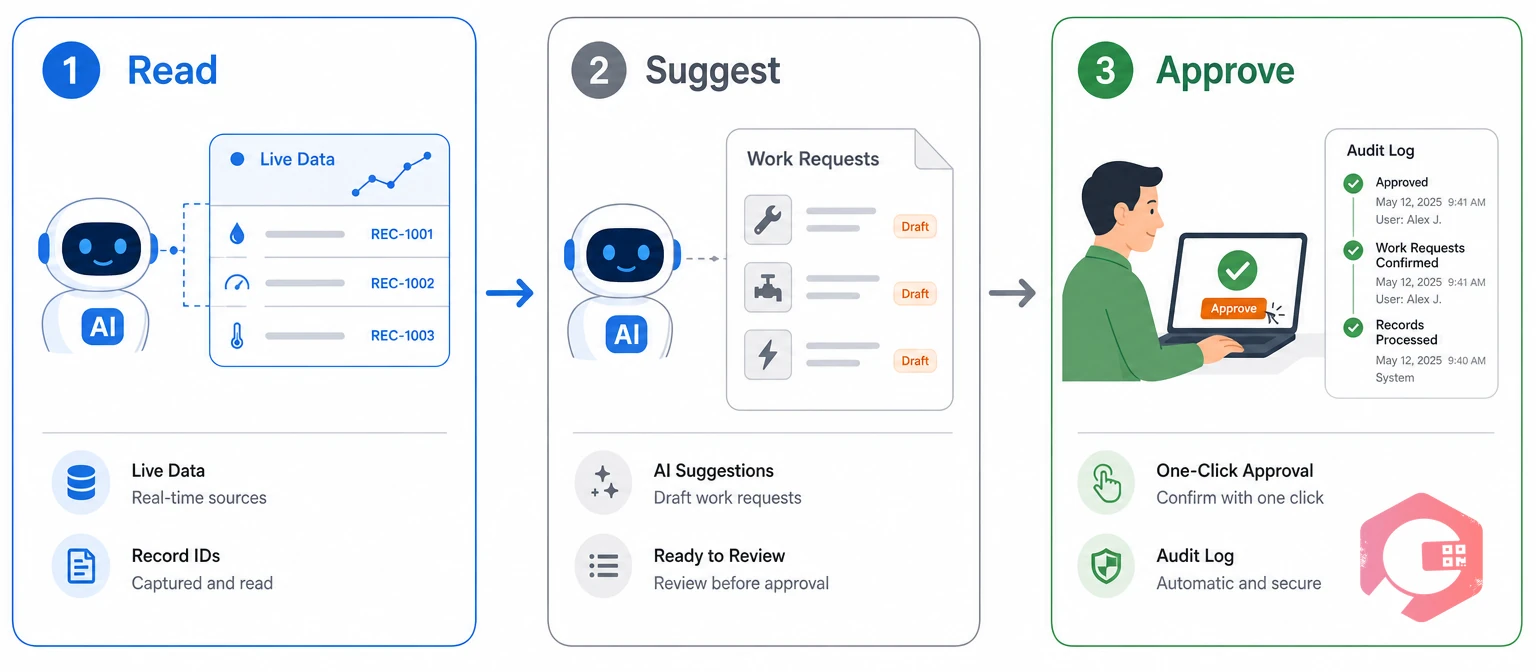
The safest way to adopt Model Context Protocol is to expand what the AI may do in three stages. Each stage earns trust before the next one starts.
The Read-Suggest-Approve Framework:
Most plants can move through all three stages in about 8 to 12 weeks. Spend one to two weeks cleaning asset names, priorities, and user roles. Run a three to four week read-only pilot at one site, then add assisted writes for another three to four weeks.
Track four numbers during the pilot: time to log a fault, planner hours per week, report preparation time, and how often AI answers matched the CMMS in spot checks. This approach fits naturally into any Industry 4.0 roadmap, because it builds on data you already collect.
Cryotos already holds the context maintenance AI needs, and its MCP connection lets AI assistants use that context directly. The CMMS stays the system of record, while any MCP-compatible assistant becomes a new front door to it.
Maintenance teams using Cryotos have reported up to 30% reduction in unplanned downtime and 25% faster repair turnaround. Putting that data one question away from every planner and technician speeds up the decisions behind those results.
Because MCP is an open standard, clients keep their choice of AI assistant. A plant that prefers one assistant today can switch later without rebuilding its maintenance integration.
Model Context Protocol is an open standard that lets AI assistants connect to business systems in one consistent way. Instead of custom code for each connection, a system publishes one MCP server that any compatible assistant can use to read data or run approved actions.
Most AI tools can't see live maintenance records, so they work on pasted or exported data. Records are also spread across the CMMS, ERP, sensors, and email. Without a standard connection, answers go stale and the AI can't take action.
It can be, with the right controls. Use per-user sign-in, start with read-only access, require human approval for changes, and log every action. Keep safety-critical steps like lockout and permits outside the AI's write access.
No. MCP is a connection standard, not a maintenance system. Your CMMS still stores, routes, and tracks the work, while MCP lets AI assistants read that data and suggest or complete approved actions.
Most plants can move from setup to approved actions in about 8 to 12 weeks. That covers data cleanup, a read-only pilot at one site, and a phase of assisted actions with human approval.
AI in maintenance only pays off when it can see and use live maintenance data. Schedule a free demo to see how Cryotos connects your work orders, assets, and spares to the AI assistants your team already uses.

Cryotos AI predicts failures, automates work orders, and simplifies maintenance—before problems slow you down.