
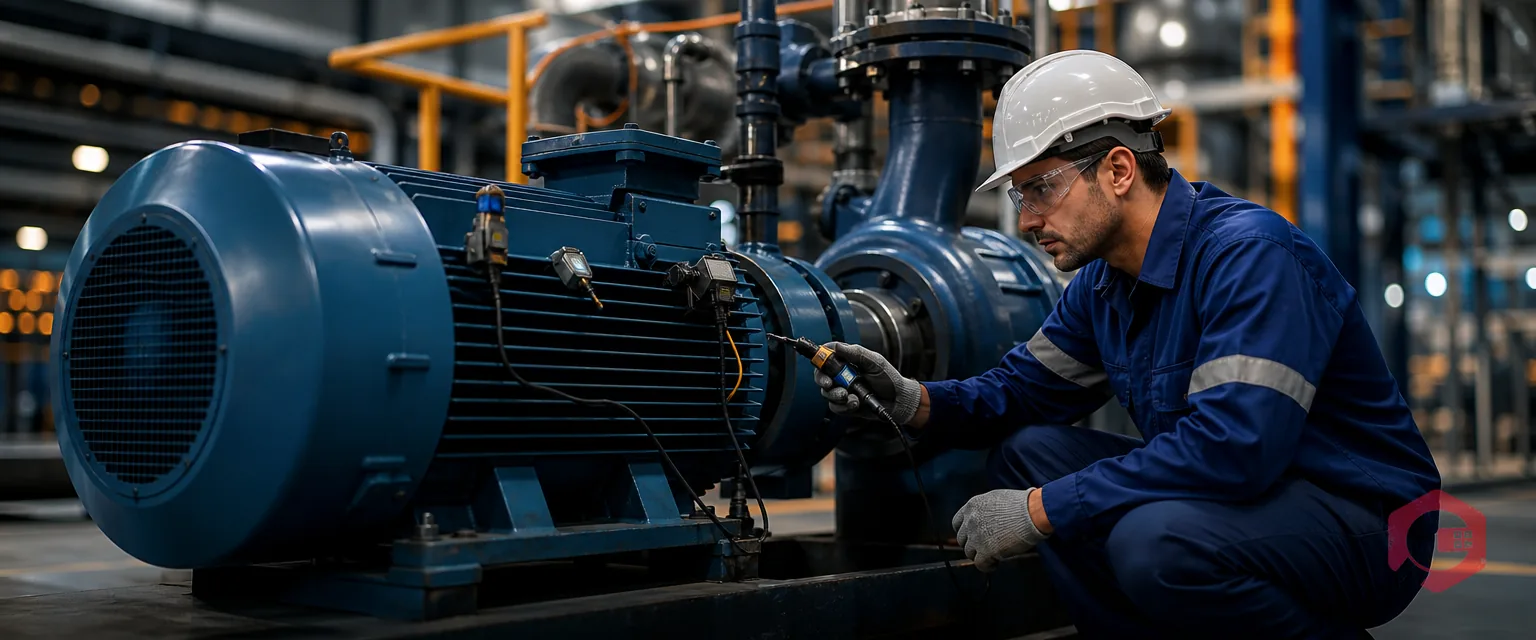
AI-based anomaly detection in maintenance uses machine learning to spot unusual patterns in equipment sensor data. It flags problems before they cause unplanned downtime. Unlike fixed-threshold alarms, AI models learn what "normal" looks like for each asset under its real operating conditions. When a reading drifts from that baseline, the system sends an alert — often weeks before a breakdown. McKinsey research shows AI-driven predictive maintenance can cut unplanned downtime by 30–50% and extend machine life by 20–40%. This guide covers how AI anomaly detection works step by step, how it compares to traditional monitoring, and how a Computerized Maintenance Management System ties it all into your daily workflow.
Key Takeaways
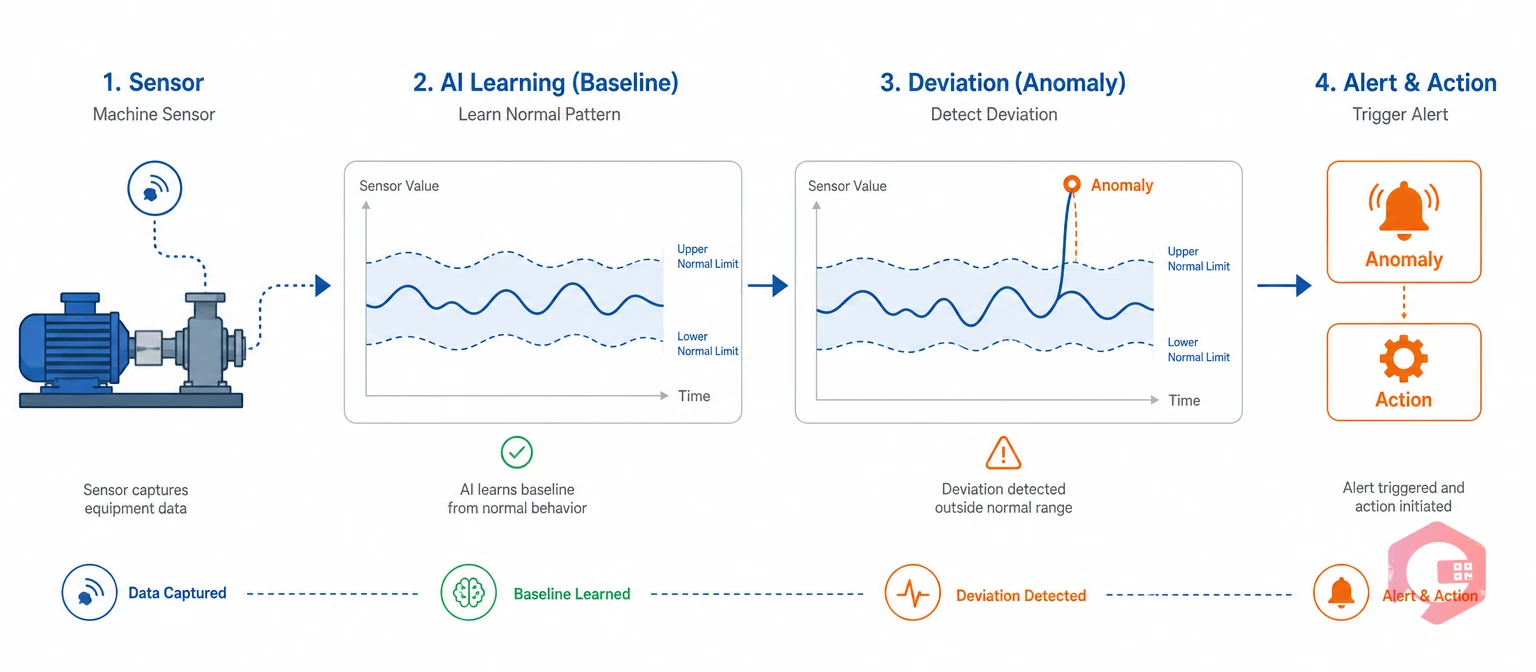
AI-based anomaly detection is a predictive maintenance method that uses machine learning to spot deviations from normal equipment behavior in real time. It goes beyond static rules by building dynamic models of how each asset runs under its specific load, environment, and process conditions.
Here is a simple example. Traditional monitoring triggers an alarm when vibration goes above a flat limit — say, 10 mm/s. AI detection works differently. It learns that a specific motor at a given load normally vibrates at 3.2 mm/s ± 0.4. A reading of 5.1 mm/s gets flagged even though it sits well below the generic threshold.
This lines up with ISO 55000 asset management principles, which push for data-driven decisions across the asset lifecycle. Teams that adopt AI anomaly detection stop fighting fires and start catching problems early.
The result is fewer emergency work orders, longer asset life, and lower total maintenance costs — measurable outcomes that compound over time.
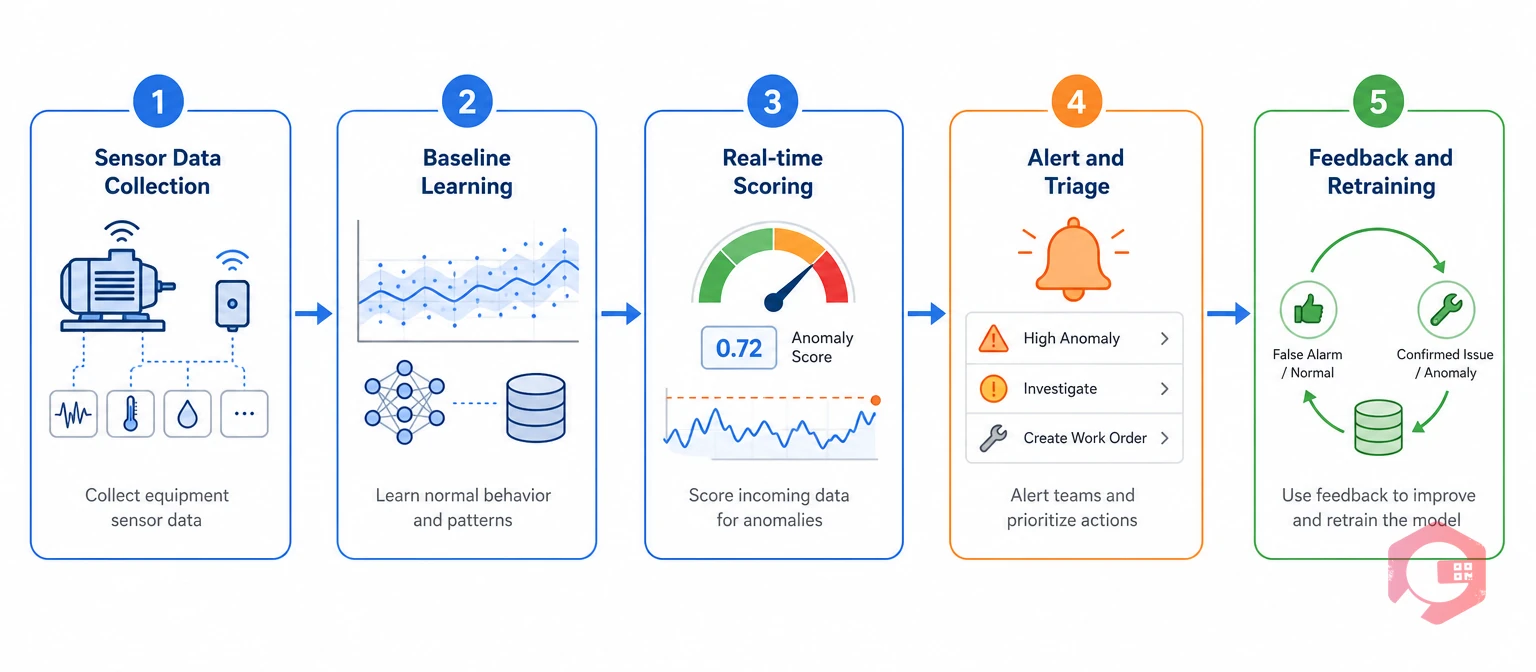
AI anomaly detection follows a clear pipeline. It takes raw sensor data and turns it into alerts your team can act on. Most setups use five stages. Each one maps directly onto workflows your team already runs.
The Five-Stage Anomaly Detection Pipeline:
Cryotos integrates directly with SCADA, PLC, and IoT edge devices through its IoT meter reading module, feeding real-time sensor data into the alert pipeline and converting anomalies into trackable work orders automatically.
An autoencoder is a neural network that learns to rebuild normal input data; when the rebuild error jumps, the input is likely an anomaly. Autoencoders work best in multi-sensor setups where you do not know the failure patterns ahead of time.
Other popular methods include isolation forests (good for tabular data), LSTM neural networks (great for time-series patterns in rotating gear), and one-class SVMs (useful for single-asset models with small datasets). Most real-world systems stack two or more of these methods for stronger, layered detection.
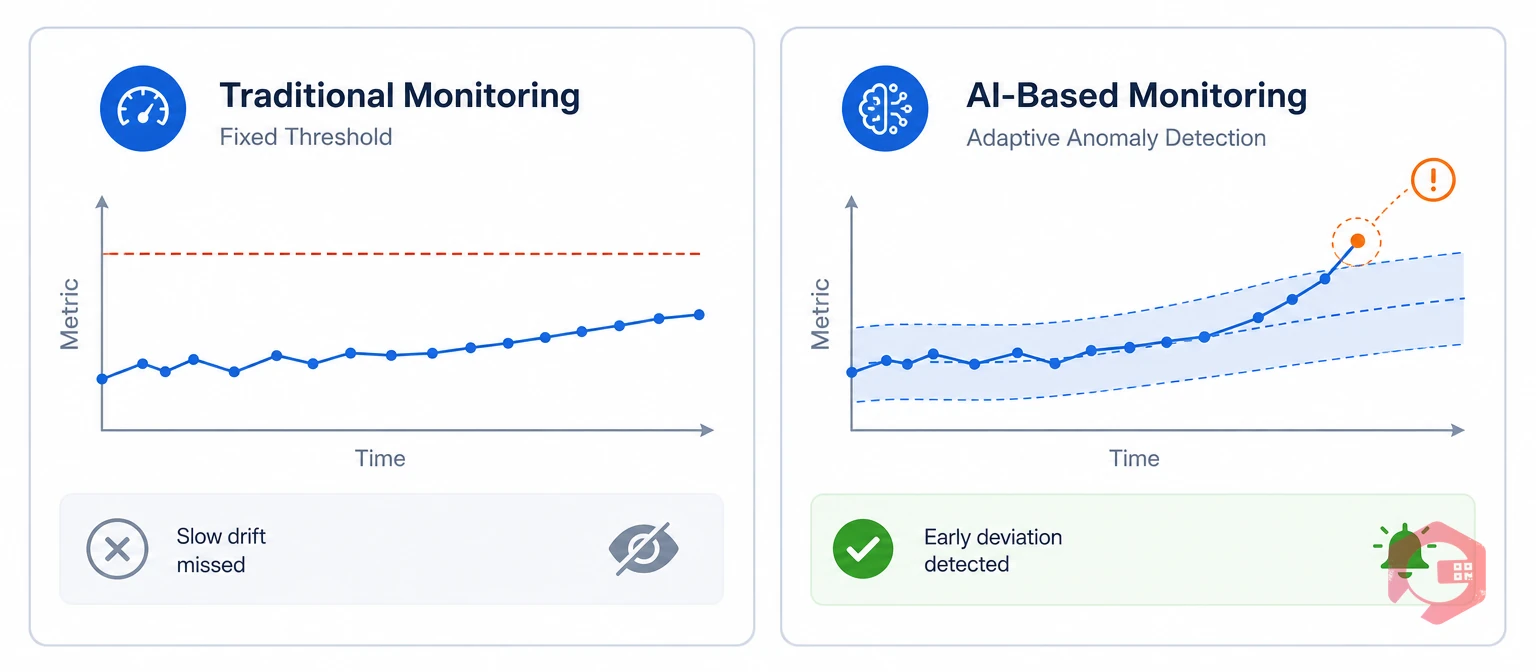
Traditional threshold monitoring is a rule-based approach where alarms fire when a sensor reading crosses a fixed limit set by hand. It works for simple, binary faults. But it misses slow wear patterns and asset-specific changes that AI catches weeks earlier.
| Feature | Traditional Threshold Monitoring | AI-Based Anomaly Detection |
|---|---|---|
| Detection Approach | Fixed limits set manually by engineers | Dynamic baselines learned from actual asset data |
| Asset Specificity | Same threshold for all assets of the same type | Unique model per asset, accounting for operating context |
| Early Warning Lead Time | Hours to days (catches only obvious faults) | Weeks to months (detects subtle degradation trends) |
| False Positive Rate | High — one threshold cannot fit all conditions | Decreases over time with technician feedback loops |
| Maintenance Needed | Manual threshold tuning after every process change | Self-adjusting through continuous retraining |
| Best For | Simple binary faults (over-temperature, over-pressure) | Gradual wear, multi-variable degradation, rotating equipment |
Most facilities that successfully transition to AI-based condition monitoring keep their existing threshold alarms as a safety net while layering AI detection on top for early warning.
Calculate your current equipment reliability baseline with the free MTBF Calculator from Cryotos — it helps you quantify the improvement AI anomaly detection can deliver.
AI anomaly detection applies across any environment where equipment health directly affects operations. The common thread is high-value assets generating continuous sensor data.
CNC machines, injection molding presses, and conveyor systems produce rich vibration and current data. AI models detect bearing wear 2–4 weeks before failure by tracking subtle shifts in vibration frequency and amplitude. They also catch motor winding degradation from current signature changes and hydraulic pressure drops that signal seal wear.
In one common scenario, an autoencoder model trained on six months of healthy spindle data flags a 12% rise in reconstruction error. That small signal gives the maintenance team a three-week window to plan a bearing swap during a scheduled shutdown — avoiding an emergency line stop that could cost thousands per hour.
HVAC compressors, elevators, and chillers run in repetitive cycles. Those cycles create ideal training data for ML models. Anomaly detection flags abnormal energy draw, motor vibration drift, and refrigerant performance drops before tenants notice comfort issues.
Facility teams that layer AI detection onto their BMS (building management system) often find they can extend PM intervals on healthy units and redirect labor to the assets that truly need attention.
Pump cavitation, heat exchanger fouling, and pipeline micro-leaks are high-cost failure modes. AI catches them through acoustic, pressure, and temperature sensors. According to industry benchmarks from SMRP, organizations applying predictive analytics report 10–25% cuts in overall maintenance spend.
Refrigeration temperature drift beyond safe bands, conveyor belt tension changes, and CIP (clean-in-place) cycle deviations directly affect food safety compliance. AI detection catches these shifts before they trigger product recalls or regulatory findings.
AI-based anomaly detection delivers measurable improvements across every maintenance KPI that matters to operations leadership.
Predictive maintenance ROI is cumulative. The longer an AI model runs, the more it learns from technician feedback. Its predictions get sharper over time. That means cost savings compound year over year. Most teams see the biggest gains between months 6 and 18 as the model matures past its initial training phase.
A CMMS is the operational layer that converts AI anomaly alerts into completed maintenance actions. Without it, anomaly detection produces data that sits in dashboards without driving repairs, parts orders, or scheduling changes.
When an anomaly is flagged, the CMMS creates a work order on its own. That work order includes sensor context, failure odds, and a recommended fix. Technicians get alerts on their phone, email, or WhatsApp and can act right away. No manual data entry, no lost sticky notes.
Every past work order, root cause analysis, and repair record stored in the CMMS feeds back into the AI model. The more failure history you have, the better the model gets at spotting new patterns. A CMMS with five years of data gives an AI model a major head start over one that starts from scratch.
Anomaly trend data tells you when to change your preventive maintenance intervals. Assets running clean get longer intervals between PMs. Assets showing early wear get faster attention. This shift from calendar-based to condition-based scheduling saves labor hours and reduces unnecessary part swaps.
Cryotos provides real-time downtime tracking dashboards that show exactly how AI-driven anomaly detection improves MTTR, MTBF, and overall equipment availability — giving you hard numbers to justify the investment to leadership.
Anomaly detection in predictive maintenance uses machine learning to find sensor readings that stray from an asset's normal pattern. When the system spots a shift, it alerts the maintenance team to check the asset before it breaks. This is one of several condition-based methods that swap time-based schedules for data-driven decisions.
AI models train on historical sensor data from healthy equipment to learn normal behavior patterns. When live readings diverge from those patterns — even subtly — the system flags the deviation and assigns a severity score. This gives maintenance teams a lead time of days to weeks for planned intervention.
The most common types are vibration sensors, temperature probes, pressure gauges, current clamps, and acoustic sensors. The best mix depends on your asset types and the failure modes you want to catch. Most CMMS platforms with IoT support accept data from any sensor that sends a digital signal.
Yes. Modern CMMS platforms like Cryotos connect with SCADA, PLC, and IoT edge devices to ingest sensor data directly. When an anomaly is detected, the CMMS auto-generates a work order with full context — sensor history, probable failure mode, and recommended action — so technicians can respond immediately.
Absolutely. AI anomaly detection is especially valuable for small teams because it prioritizes which assets need attention first. Instead of running scheduled inspections across every machine, a small team can focus only on the assets the AI has flagged, making the most of limited labor hours.
AI-based anomaly detection gives maintenance teams the early warning system they need to stop reacting to breakdowns and start preventing them. Schedule a free demo to see how Cryotos connects IoT sensor data, anomaly alerts, and automated work orders into one maintenance platform.
Cryotos AI predicts failures, automates work orders, and simplifies maintenance—before problems slow you down.



