
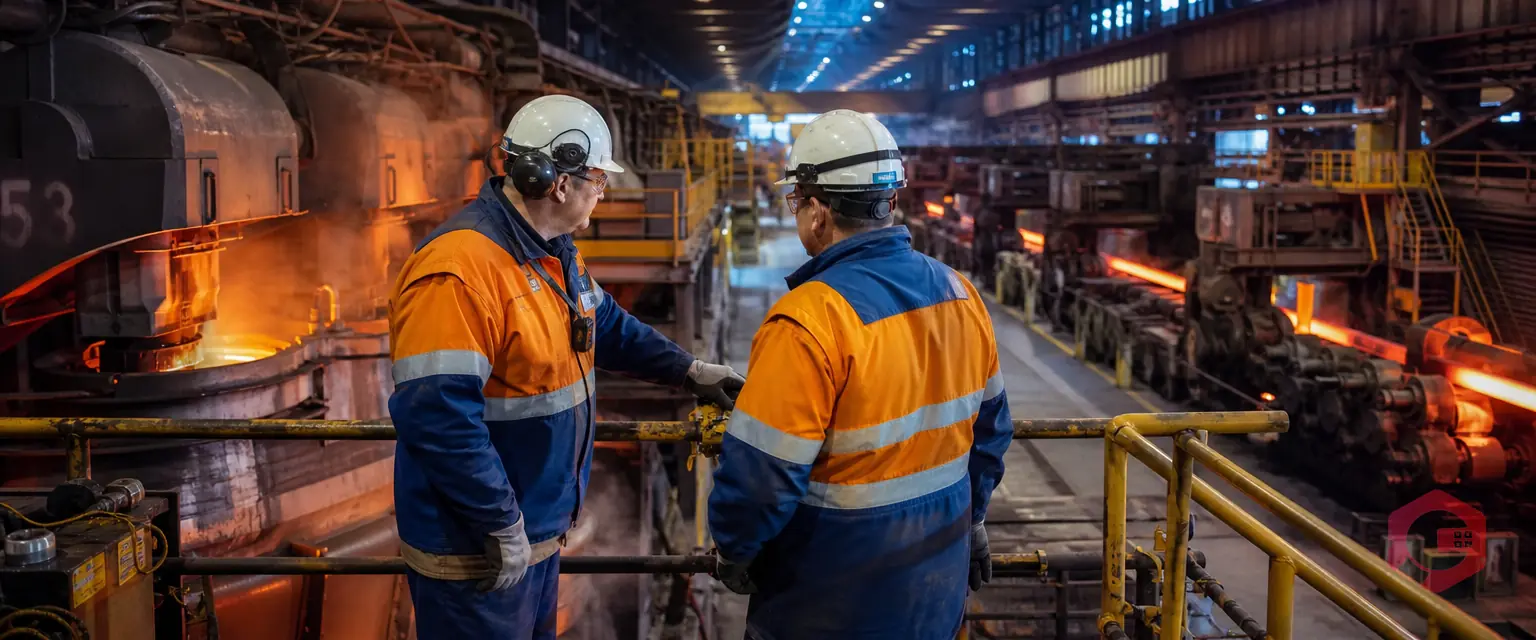
Predictive maintenance for aluminum smelters and rolling mills is the practice of using real-time condition data — vibration signatures, thermal imaging, oil analysis, and process current monitoring — to detect equipment failures before they happen, rather than waiting for breakdown or running fixed calendar-based intervals. In aluminum production, the cost of getting this wrong is severe: a single pot failure in a smelter potline can cost $200,000–$500,000 in lost production, relining labour, and energy waste, while a rolling mill stand bearing failure mid-run can scrap an entire high-value coil. According to the International Aluminium Institute, aluminum production is one of the most energy-intensive industrial processes on earth — and equipment condition is a direct lever on both uptime and energy efficiency.
This guide covers the asset-specific predictive maintenance strategies that work in these extreme environments, the sensor-to-CMMS workflow that turns data into action, and how maintenance teams are applying these approaches across potlines and rolling mills today.
Key Takeaways
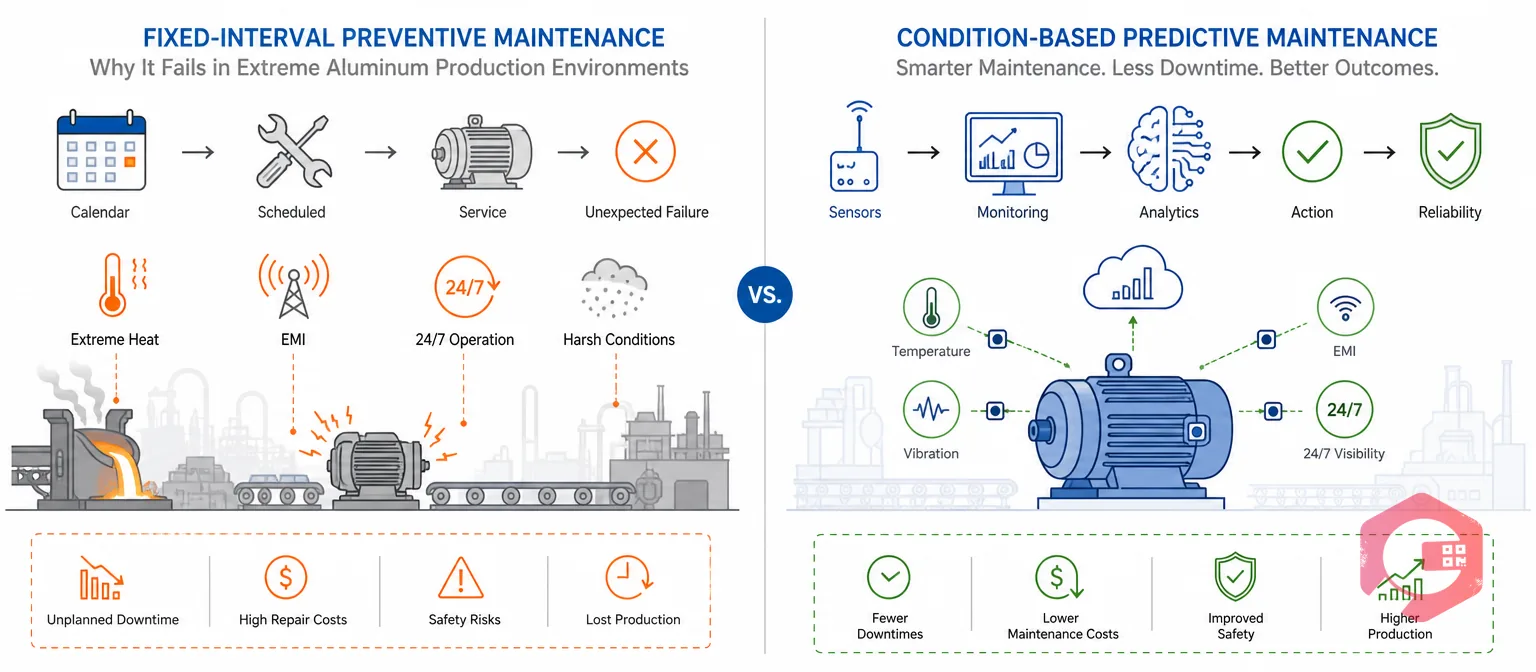
Fixed-interval preventive maintenance is designed for average operating conditions — aluminum plants do not operate under average conditions. Calendar-based PM schedules assume that equipment degrades at a steady, predictable rate. In a potroom or hot rolling mill, that assumption breaks down in ways that lead to either over-maintenance (replacing components that still have useful life) or under-maintenance (missing the accelerated wear that occurs during production peaks, temperature excursions, and process upsets).
Aluminum reduction cells operate at 950–980°C and run continuously. Stopping a pot for maintenance is not a neutral act — a cold pot takes weeks to return to full production and costs hundreds of thousands in energy and production loss. Every maintenance decision in the potroom is therefore made under the constraint that the pot must keep running, which means that condition monitoring must be good enough to predict failure windows with enough lead time to plan a controlled intervention.
Electromagnetic interference from the potline busbars — which carry tens of thousands of amperes — disrupts standard vibration monitoring equipment. Maintenance teams in this environment need monitoring systems specifically rated for high-EM environments, and their preventive maintenance software must be configured to treat potline assets differently from conventional plant equipment. ISO 10816-rated vibration severity thresholds, for example, must be adjusted for the baseline EM noise floor in the potroom rather than applied from a standard industrial reference.
Rolling mill failures are expensive in two ways: production loss and quality loss. A backup roll bearing failure mid-production run on a cold rolling mill not only stops the line — it can result in surface defects on the strip already in the mill that scrap an entire coil of high-value aerospace or automotive plate. The economics of rolling mill maintenance therefore justify aggressive PdM investment: the cost of a single avoidable bearing failure often exceeds a year of monitoring programme costs.
Hot rolling mill stands run at 500–600°C strip temperatures with constant high-cycle loading on roll necks, drive spindles, and hydraulic screw-down systems. Cold mills add precision surface quality requirements that mean even minor bearing wear causing vibration above a few microns can produce strip that fails flatness specifications. Standard PM approaches — change bearings every N hours — produce inconsistent results because actual wear rate depends heavily on strip grade, rolling schedule, and coolant system performance, none of which calendar intervals account for.

Predictive maintenance in aluminum plants requires asset-specific monitoring approaches. The right sensor type, threshold basis, and alert-to-response chain varies by asset class. Here are the highest-value targets and what works for each.
Pot tending machines are the mobile maintenance workhorses of the potroom, and their failure is immediately production-critical because they are the only means of performing anode changes, metal tapping, and bath adjustment across the potline. PTM drive motors and travel drive systems are monitored with FFT vibration analysis — bearing defect frequencies, gear mesh frequencies, and rotor imbalance signatures are all detectable weeks before failure. Hydraulic pressure transducers on PTM lifting and clamping systems track cycle-to-cycle pressure profiles that indicate seal wear and valve degradation before a hydraulic failure strands the machine mid-operation.
Rectifier transformers in a smelter potline carry the full direct current load of the reduction cells — their failure is a potline shutdown event. Thermal imaging of busbar connection points detects resistance drift caused by oxidation or mechanical loosening before the connection generates enough heat to fail. Dissolved Gas Analysis (DGA) on the transformer oil identifies internal insulation degradation through the gas signatures that pyrolysis of insulating materials produces — IEEE C57.104 provides the concentration thresholds for each gas type. Maintenance teams conducting DGA sampling attach results to the transformer's asset record in the vibration analysis and condition monitoring module, where threshold exceedances trigger corrective work orders automatically.
Backup roll bearings in a rolling mill stand carry the full separating force of the rolling process — forces measured in thousands of tonnes. Acoustic emission (AE) sensors detect subsurface fatigue cracks in bearing raceways long before they are audible or visible, typically providing 200–400 hours of warning time in well-configured systems. FFT envelope analysis on roll neck accelerometers extracts bearing defect frequencies, allowing teams to track defect progression and schedule roll changes during planned breaks rather than in response to failure. Teams that track MTBF for mill stand bearings consistently find that AE-based PdM extends bearing life by 30–60% compared to time-based replacement.
Rolling mill main drive gearboxes are among the most expensive components in the plant to replace, with lead times on replacement gear sets measured in months. Oil particle count analysis tracks wear metal particles in the lubricating oil using ISO 4406 cleanliness codes as gear teeth and bearings degrade. A rising particle count, particularly of ferrous particles in the 14–21 micron range, is a leading indicator of gear tooth fatigue months before any vibration change is detectable. Combining oil analysis with FFT vibration monitoring provides two detection channels: the oil catches early-stage fatigue wear, and vibration catches advanced degradation.
Mid-article check: If your team is tracking mill stand bearing MTBF manually, use the Cryotos MTBF Calculator to establish your baseline before configuring PdM alert thresholds.
The monitoring technologies used in aluminum plants must be matched to the specific failure mode each asset exhibits. The table below maps each technique to the assets and failure modes where it delivers the highest detection value:
| Monitoring Technology | What It Detects | Asset Applied To | Alert Threshold Basis |
|---|---|---|---|
| Vibration analysis (FFT) | Bearing defects, imbalance, misalignment | PTM drive motors, FTC fans, mill stand bearings | ISO 10816 severity zones + site baseline |
| Acoustic emission (AE) | Early-stage bearing spalling, crack propagation | Backup roll bearings, spindle assemblies | Baseline RMS with % exceedance trigger |
| Infrared thermal imaging | Busbar connection resistance drift, transformer hot spots | Busbars, rectifier transformers, mill drive motors | Absolute temperature + delta-T vs. ambient |
| Oil particle count (ISO 4406) | Wear metal contamination in gearbox and hydraulic oil | Rolling mill gearboxes, hydraulic screw-down systems | ISO cleanliness code exceedance by particle size range |
| Dissolved Gas Analysis (DGA) | Internal insulation degradation in oil-filled transformers | Rectifier transformers | IEEE C57.104 gas concentration limits by fault type |
| Process current signature analysis | Anode condition, cathode bottom wear, ledge formation | Reduction cells (pots) | Statistical control limits on cell resistance and noise |
Each predictive maintenance technology produces a different type of alert — a vibration severity change, a DGA gas concentration exceedance, or an oil particle count jump. The question for every maintenance team is: what happens when that alert fires? Without a structured response system, alerts go into dashboards that nobody checks at 2 a.m. when the reading spikes.
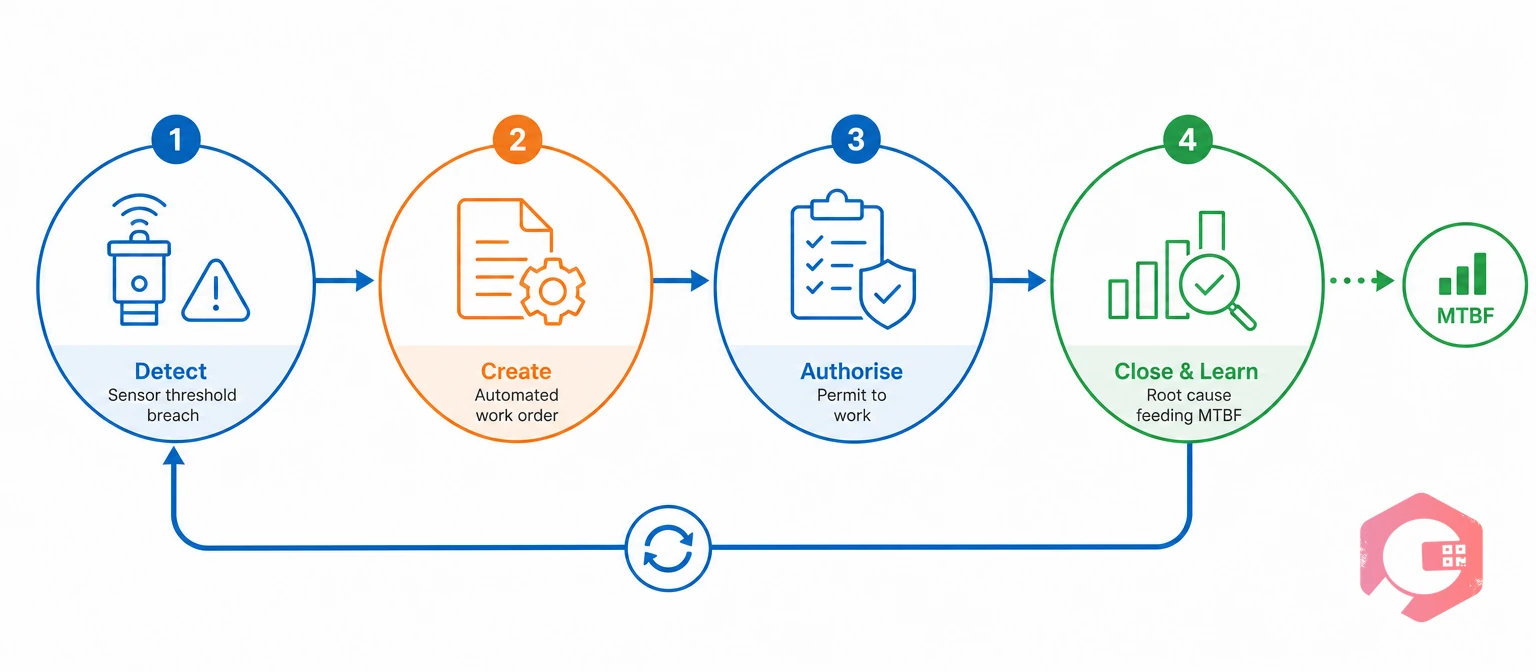
The PdM Four-Stage Response Loop is the operational framework that connects a sensor reading to a resolved maintenance action in aluminum plant operations. It covers four stages that every alert must pass through before the loop is complete:
The PdM Four-Stage Response Loop:
Maintenance teams that operate this predictive maintenance loop consistently — with real-time sensor ingestion, automated work order creation, permit enforcement, and closed-loop root cause tracking — report significantly lower reactive maintenance ratios than operations that use monitoring dashboards without CMMS integration. The US Department of Energy estimates that best-practice PdM programmes in heavy industry reduce maintenance costs by 25–30% compared to time-based PM alone.
Cryotos is a Computerized Maintenance Management System built for the operational complexity of heavy manufacturing environments — including the asset hierarchy depth, safety workflow requirements, and condition monitoring integration demands of aluminum smelters and rolling mills.
Cryotos connects to condition monitoring systems via API, converting threshold breach alerts into corrective work orders automatically. When a vibration monitoring platform such as SKF @ptitude or Emerson AMS generates an alert for a PTM drive motor, Cryotos creates the work order without dispatcher intervention — with the asset record, alert reading, and inspection checklist pre-filled. The technician receives the assignment on their mobile device immediately, with the full maintenance history of that asset available at the point of response. Maintenance teams using Cryotos have reported up to a 30% reduction in unplanned downtime and 25% faster repair turnaround after configuring IoT-triggered work order creation for their critical assets.
Potroom and hot mill maintenance requires certified technicians — ATEX-qualified electricians, hydraulic specialists with high-pressure certifications, hot metal zone entry clearance. Cryotos enforces this through its skill matrix: condition-triggered work orders for restricted zones are only routed to technicians with current certifications for that asset type and location. Expired certifications automatically remove a technician from eligibility without a manual check.
The workflow automation chains permit approval as a mandatory pre-condition for potroom and hot mill work orders — creating an auditable, timestamped safety record for every planned entry into restricted zones. This is not a workaround bolted onto the maintenance workflow; it is a native step in the CMMS process.
The Cryotos maintenance KPI dashboard surfaces the metrics that matter in an aluminum plant PdM programme: reactive-to-planned ratio by asset category, MTBF trends by potline or mill stand, PdM work order accuracy rates (percentage of alerts that confirm an actual defect on inspection), and permit-to-work cycle times. These metrics are generated automatically from CMMS work order data — no manual aggregation required — making the monthly predictive maintenance programme review a reporting exercise rather than a data-gathering exercise.
Preventive maintenance replaces components at fixed time or usage intervals regardless of their actual condition. Predictive maintenance uses real-time condition data — vibration, temperature, oil analysis, process current — to determine when a specific component needs attention based on its actual degradation state. In a smelter, where stopping a pot for maintenance carries an enormous cost and environmental impact, the ability to plan interventions based on measured condition rather than calendar dates is the difference between a controlled 8-hour planned shutdown and an uncontrolled pot failure requiring weeks of recovery.
Backup roll bearings benefit most from vibration monitoring in rolling mills because they carry the full separating force of the rolling process and their failure mode — subsurface fatigue leading to spalling — produces characteristic bearing defect frequencies in the FFT spectrum long before visible damage develops. Drive spindle assemblies and main drive gearboxes are the next highest-value targets. Work roll bearings are typically replaced on a roll change cycle rather than monitored individually, but backup roll bearings, which stay in the mill stand across multiple roll changes, are ideal vibration monitoring candidates with payback periods typically under 12 months.
CMMS integration with condition monitoring systems works through API connections that the CMMS maintains with monitoring platforms such as SKF @ptitude, Emerson AMS, OSIsoft PI, or the plant process historian. When a sensor reading crosses a configured threshold in the monitoring system, it sends an alert event to the CMMS API, which creates a corrective work order automatically. The work order includes the asset ID, the alert reading and threshold, the timestamp, and the pre-assigned inspection checklist for that alert type. The technician receives the work order on mobile and the CMMS tracks response time, repair outcome, and root cause — closing the loop from detection to resolution.
Permit-to-work systems in potrooms control access to high-hazard zones — areas with molten metal exposure, high-voltage DC bus systems, and fluoride gas risk. Even when a PdM alert correctly identifies a fault and a work order is created, the work cannot proceed until a formal permit is issued and approved by the responsible authority. Integrating permit-to-work with CMMS work orders ensures that the maintenance response to a sensor alert automatically triggers the permit initiation process — the work order cannot advance to "in progress" without permit approval. This prevents both unauthorised entry and the opposite failure: alerts that generate work orders that sit unactioned because technicians are waiting for permit approval that nobody initiated.
Predictive maintenance in aluminum smelters and rolling mills is not a single technology — it is a system of monitoring inputs, condition thresholds, response workflows, and safety controls that together determine whether a detected anomaly becomes a prevented failure or a production crisis. Schedule a free demo to see how Cryotos connects your condition monitoring data to automated work orders, permit-to-work, and PdM KPI tracking in a single platform built for heavy manufacturing environments.
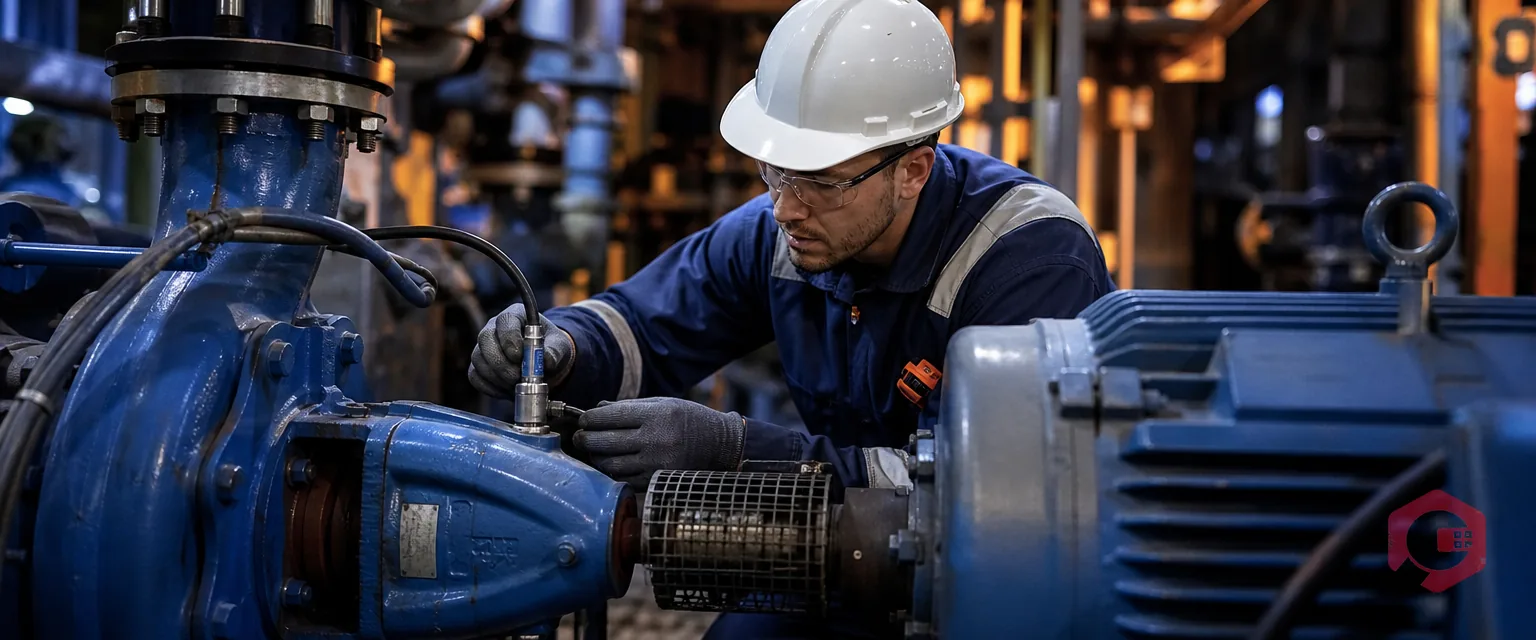

Cryotos AI predicts failures, automates work orders, and simplifies maintenance—before problems slow you down.



