

Condition-based maintenance triggers fail for a handful of predictable reasons. A threshold gets copied from a manual instead of real data. There's no warning tier before the critical alert. Nothing filters out a single noisy reading. A person still has to notice the alert and open the ticket by hand. Or nobody owns the job of checking the threshold after go-live. Most condition-based maintenance triggers break down for more than one of these reasons at once.
Key Takeaways
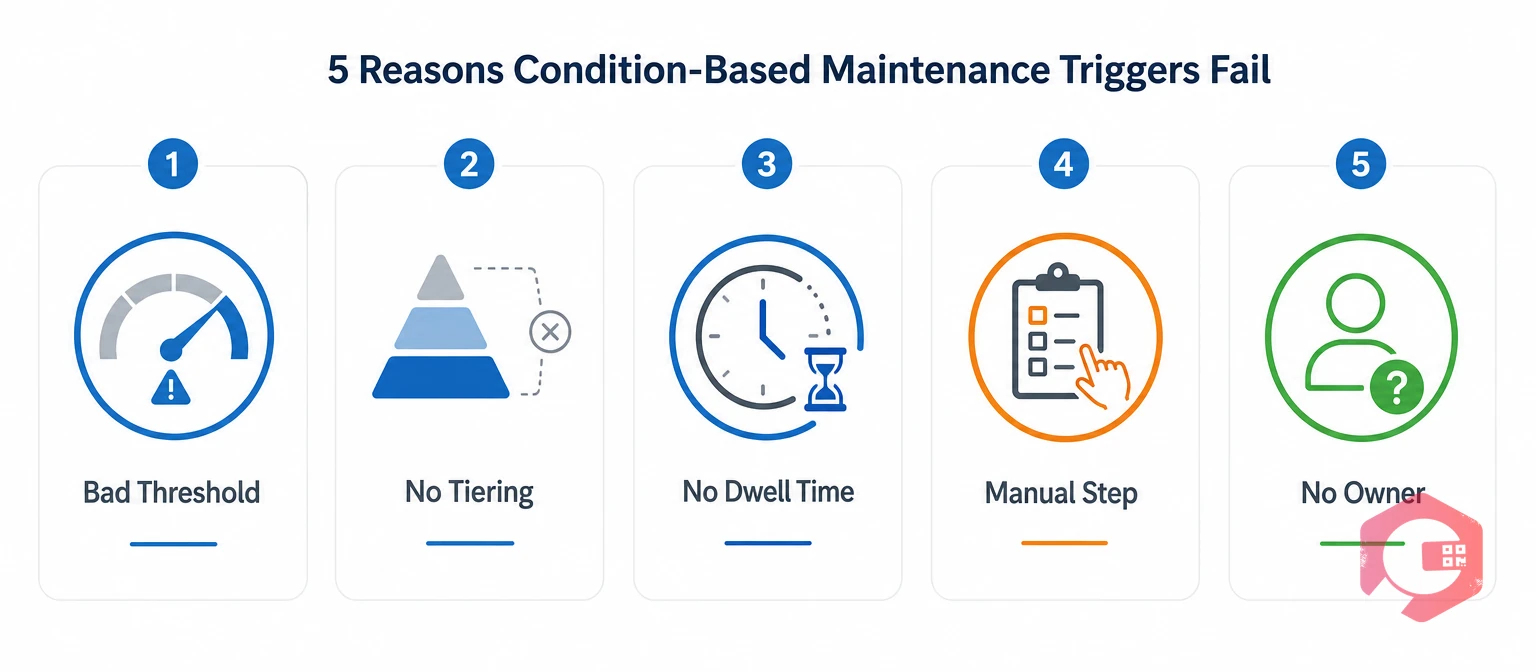
Condition-based maintenance triggers fail when the threshold, the tiering, or the path to the work order breaks down. The sensor is rarely the real problem. Teams tend to blame the hardware first. A review built on ISO 55000 asset management principles usually turns up the same handful of causes instead.
Most teams running condition-based maintenance hit at least two of these causes at once. That's why a trigger that "isn't working" usually needs a structured audit, not a single fix.
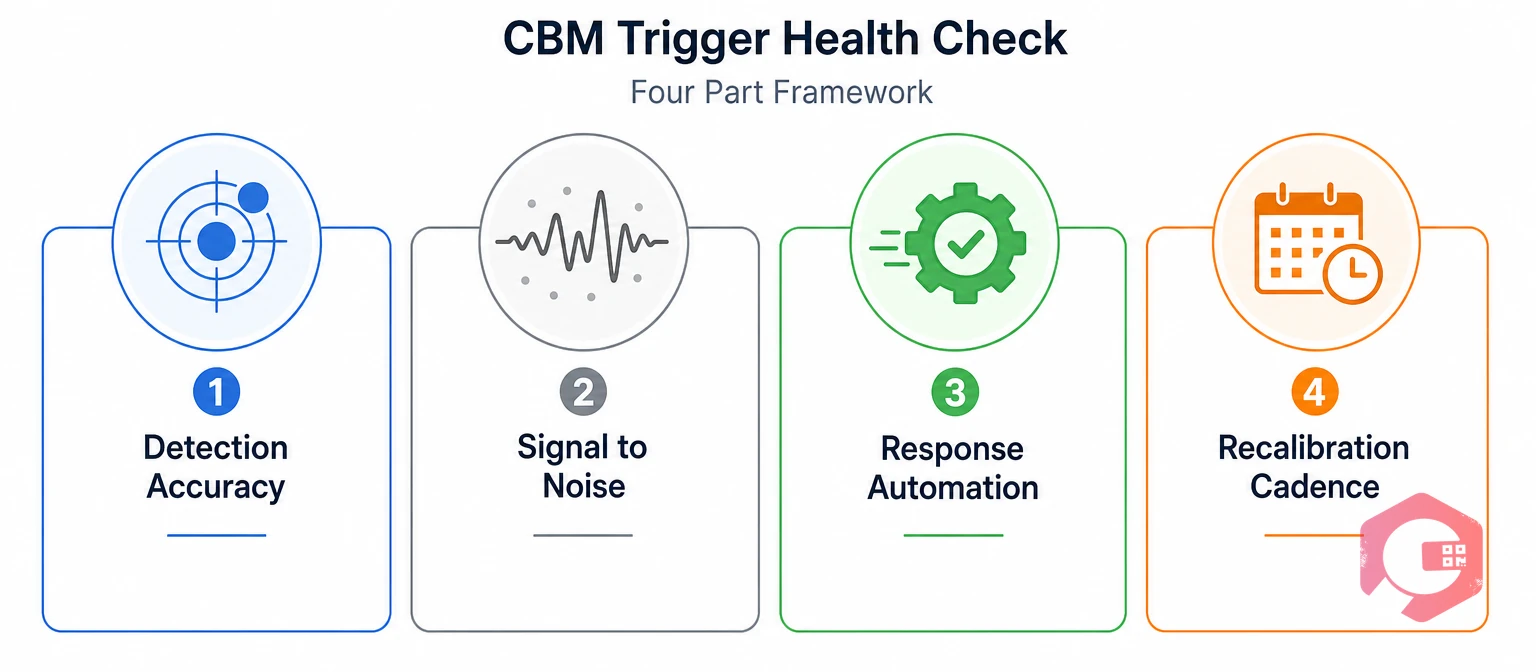
The CBM Trigger Health Check: a 4-part way to score condition-based maintenance triggers before you assume the sensor is at fault. It covers detection accuracy, signal-to-noise ratio, response automation, and recalibration cadence. A weak score on any one part eventually causes a failure.
Score every condition-based maintenance trigger against all four before assuming the sensor is at fault. A trigger that's weak on even one element will eventually flood the team with noise, or miss the failure it was built to catch.
The P-F interval is the reference point behind Detection Accuracy. It's the gap between the first sign of wear and actual failure. A threshold set too close to the failure point barely beats reactive maintenance. One set too early just adds noise.
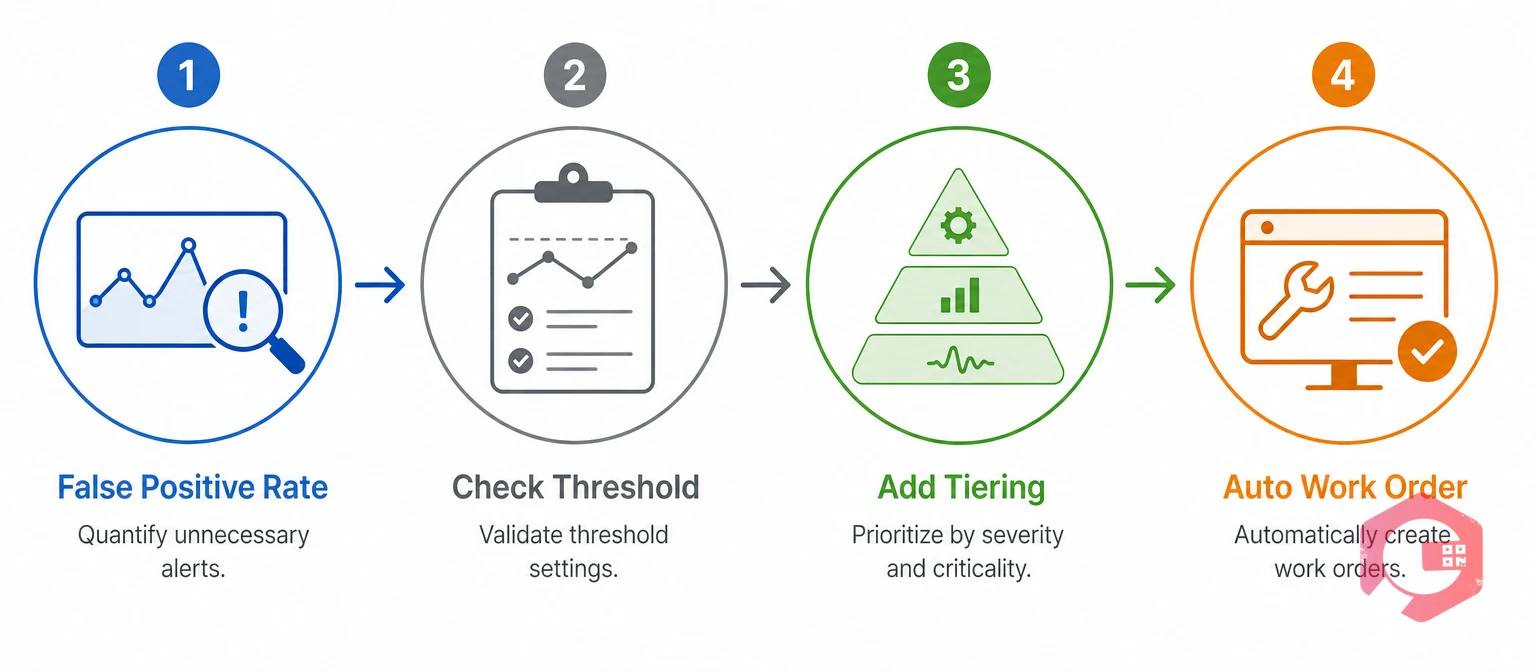
Auditing condition-based maintenance triggers means checking four things in order: the false-positive rate, the evidence behind the threshold, the tiering, and the path to the work order. Most teams find the fault in the first two steps.
Pull every work order the trigger created over the last 60 to 90 days. Tag each one: genuine fault found, no fault found, or fault found too late. A false-positive rate above 15-20% points to a threshold problem before anything else.
Ask where the number came from. An OEM default or a guess from a meeting isn't evidence. Replace it with 2-4 weeks of baseline data from this specific asset under normal conditions.
Split a single hard threshold into a lower "warning" level and a higher "critical" level. Require the reading to hold past the threshold for a set duration before a work order fires. This one change removes most of the noise that trains technicians to ignore alerts.
If a person still has to check a dashboard and raise a ticket by hand, the trigger isn't automated yet. Wire the confirmed threshold breach directly into work order management. The checklist, priority, and assignee should already be attached when it lands in the queue.
Before rebuilding a trigger from scratch, check what the numbers already say with the MTTR calculator. A rising repair time on an asset with an active trigger is often the first sign the threshold fires too late.
Match the symptom your team is seeing to its most likely cause before you change anything on live condition-based maintenance triggers. This keeps a threshold fix from turning into a guessing game.
| Symptom | Likely Root Cause | Fix | Priority |
|---|---|---|---|
| Same fault triggers 10+ times a week on one asset | No hysteresis or dwell-time gate on the threshold | Add a minimum duration before the trigger fires and a reset band below the trigger value | High |
| Technicians close most triggered work orders as "no fault found" | Threshold copied from an OEM manual instead of this asset's baseline | Log 2-4 weeks of normal-operation data and reset the threshold from the observed baseline | High |
| A real failure happened with no trigger firing first | Threshold too loose, or the wrong parameter watched for this failure mode | Re-map the sensor to the real failure mode and tighten the threshold using recent failure data | Critical |
| Technicians stopped responding to alerts within weeks of rollout | Every trigger carries the same priority, so nothing stands out | Split triggers into tiers such as Warning and Critical with separate response times | Medium |
| Sensor data arrives but no work order gets created | A manual step sits between the reading and the CMMS ticket | Wire the threshold rule to auto-generate a work order with checklist and assignee | High |
| Thresholds haven't changed since go-live over a year ago | No owner assigned to review trigger performance | Assign a named owner and a recurring monthly or quarterly review | Medium |
Most teams find two or three rows of this matrix apply to the same asset at once. That's why a single-fix approach rarely holds for long.
Review a condition-based maintenance threshold on a fixed schedule. Check it monthly for the first 90 days after any change, then quarterly after that. Don't wait for a failure or a flood of false alarms to force the review. Reliability-centered maintenance practice sets the on-condition task interval at roughly half the P-F interval for the failure mode being watched. The same logic applies to how often you check the threshold itself.
Every review should answer three questions. How many triggers fired? How many led to a genuine fix? Did any failure happen without a trigger firing first? Most facilities find that operations change enough — new products, different loads, seasonal shifts — that a threshold locked in at go-live drifts out of line within two or three quarters.
Tie recalibration into condition monitoring review meetings instead of treating it as a separate task. Document why each threshold changed. That record turns the next audit into a five-minute check instead of a fresh start.
Cryotos closes the gap between a confirmed sensor reading and a dispatched work order. That's the exact link where most condition-based maintenance triggers break down. Meter-based rules auto-generate a work order the moment a threshold is crossed. The checklist, priority, and assignee are already attached, so there's no manual step for a technician to skip.
Maintenance teams using Cryotos have reported up to 30% reduction in unplanned downtime and 25% faster repair turnaround after tightening their trigger and escalation setup. That kind of improvement usually comes from fixing the same gaps covered in the audit above. Add tiering. Close the manual gap. Review thresholds on a schedule instead of never.
The downtime tracking module gives the MTTR and MTBF data needed for Step 1 of the audit, without pulling reports by hand. Role-based routing makes sure a critical-tier trigger reaches the right technician instead of a general queue. Still deciding between a full IoT rebuild and fixing what you already have? Cryotos also supports feeding sensor and meter data in as periodic readings, so you don't need a whole new monitoring platform to get started.
Most false alarms come from a threshold with no dwell-time or hysteresis. A single noisy reading fires the same alert as a sustained fault. Add a minimum duration before the trigger fires, plus a reset band below the trigger value, and most nuisance alerts disappear without missing real ones.
Check its false-positive rate over the last 60 to 90 days. If more than 15-20% of triggered work orders close as "no fault found," the threshold needs work. The same is true if a failure ever happened without the trigger firing first. Reset the threshold from real baseline data instead of an OEM default.
Review them monthly for the first 90 days after any change. Move to quarterly once the condition-based maintenance triggers have proven stable. Operating conditions shift enough — new products, loads, or seasons — that a threshold set once at go-live typically drifts within two or three quarters.
Condition monitoring just collects sensor or meter data on an asset. A working trigger connects that data to a threshold, a tiering scheme, and an automatic work order. Monitoring without those three pieces just produces a dashboard nobody acts on.
In most cases, yes. Most failing triggers have a threshold, tiering, or automation problem, not a sensor problem. All three get fixed in software: reset the threshold from baseline data, add warning and critical tiers, and wire the trigger directly to a work order.
A condition-based maintenance trigger is only as good as the threshold, tiering, and automation behind it. Schedule a free demo to see how Cryotos turns a noisy, half-automated trigger into one your team actually trusts.



Cryotos AI predicts failures, automates work orders, and simplifies maintenance—before problems slow you down.



