
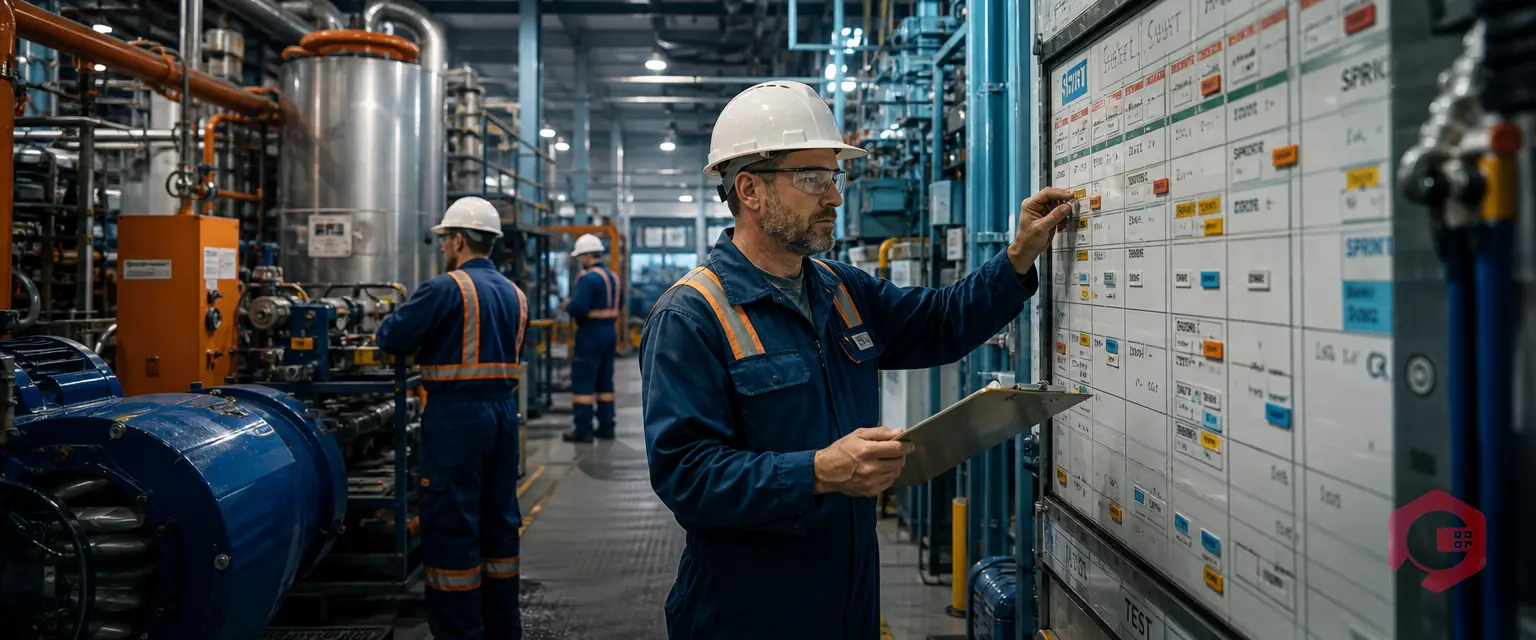
AI maintenance resource planning is the use of predictive analytics and machine learning to match maintenance labor supply against real work demand, so plants schedule the right technician, with the right skill, at the right time. Instead of reacting to breakdowns with whoever is available, teams use AI to forecast workload, flag skill gaps before a shift starts, and route work orders to balance hours across the crew. Done well, it directly attacks the two symptoms that burn out maintenance departments: chronic overtime and staffing bottlenecks that leave critical jobs waiting.
Key Takeaways
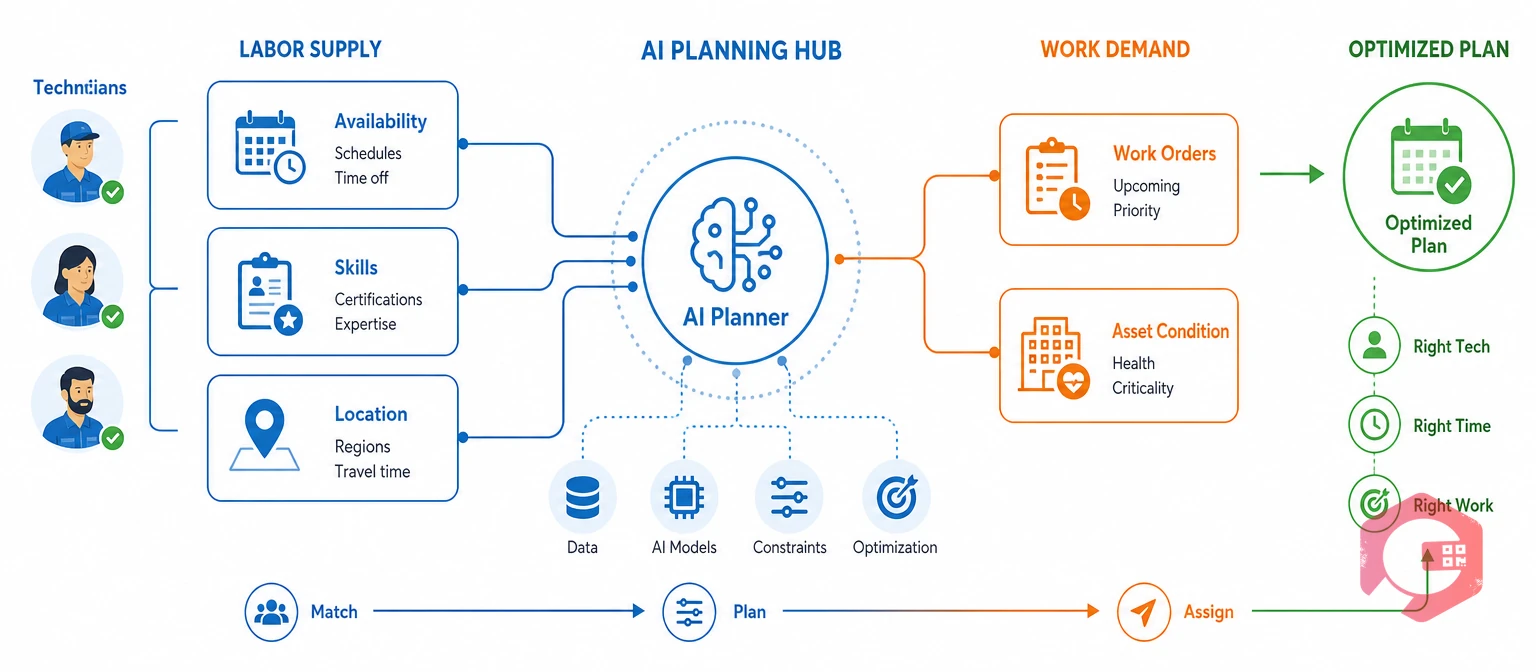
AI maintenance resource planning is the practice of using predictive algorithms to align technician availability, skills, and location with upcoming maintenance workload. It pulls data from work order history, asset condition, and PM schedules to project labor demand days or weeks ahead, rather than staffing reactively once a breakdown hits the queue.
Most facilities plan resources with spreadsheets and a supervisor's memory of who is good at what. That works fine at low volume. It falls apart the moment demand spikes — a seasonal shutdown, a compliance audit, an aging asset that starts failing more often — because nobody has visibility into the coming workload until it's already overdue.
Operations that successfully cut overtime treat maintenance resource planning as a continuous forecasting problem, not a weekly scheduling chore. That shift in mindset, more than any single tool, is what separates plants that run lean staffing without burnout from plants stuck in a permanent overtime cycle.
Traditional workforce scheduling assumes labor demand is roughly steady week to week, so it optimizes for shift coverage: who clocks in, who covers a vacation, who takes the weekend rotation. Maintenance workload is not steady. A single failing bearing can add eight hours of unplanned work to a schedule that was already full.
AI-based resource planning treats that volatility as the normal condition, not the exception. Instead of building one schedule and reacting when it breaks, the model continuously re-forecasts demand and re-optimizes the assignment plan as new work orders, sensor alerts, or absences come in — which is why teams describe it as a planning layer rather than a scheduling tool.
Maintenance overtime spirals because reactive work displaces planned work, and displaced planned work becomes tomorrow's reactive work. OSHA's research on worker fatigue shows that extended shifts and chronic overtime raise the risk of on-the-job injuries, which means the overtime meant to catch up on work orders actually increases the odds of new incidents that create more work orders.
Three patterns show up again and again in facilities battling this cycle:
Most facilities that fix this problem start by digitizing Computerized Maintenance Management System data so that work order patterns become visible instead of anecdotal — you cannot forecast a workload you cannot see.
These planning gaps land on a shrinking pool of experienced technicians. The U.S. Bureau of Labor Statistics projects steady demand growth for industrial machinery mechanics even as experienced technicians retire faster than apprenticeship programs can replace them. Fewer qualified hands available for the same workload means every scheduling mistake costs more, because there is no bench of backup technicians to absorb it.
Facilities that ignore this trend keep trying to solve a labor-supply problem with more overtime, which only accelerates burnout among the technicians they can least afford to lose.
A staffing bottleneck is any point where available technician hours cannot meet maintenance demand at the required skill level. The cost shows up in three places: idle equipment waiting on the right technician, overtime premiums paid to close the gap, and burnout-driven turnover that shrinks the qualified labor pool further.
The math is unforgiving. A technician earning time-and-a-half for 10 hours of weekly overtime costs roughly 15% more per productive hour than a technician working straight time — and that number ignores fatigue-related errors, rework, and the recruiting cost of replacing a technician who quits from burnout.
Maintenance teams using Cryotos have reported up to 30% reduction in unplanned downtime and 25% faster repair turnaround after connecting AI-based scheduling to their CMMS data, largely because fewer emergency jobs mean fewer overtime shifts to begin with.
Bottlenecks rarely announce themselves in advance. A maintenance KPI dashboard that tracks overtime hours by crew and by asset makes the pattern visible weeks before it turns into a staffing crisis.
Most finance teams see the overtime line item but miss the second-order costs sitting beside it. Rework from fatigue-driven mistakes, the recruiting and onboarding cost of replacing a technician who burns out, and the production losses from equipment that waited too long for the right specialist rarely get tagged back to a staffing bottleneck — they show up as separate line items that look unrelated. Facilities that track overtime hours alongside PM compliance and unplanned downtime in the same dashboard start to see how tightly these numbers move together.
See how much overtime your crew could recover with better scheduling using the wrench time calculator.

The 4-Pillar AI Resource Planning Model:
Facilities that adopt all four pillars together see faster results than those that adopt forecasting alone, because scheduling without skills-matching just moves the bottleneck instead of removing it. Each pillar reinforces the others — accurate demand forecasting means nothing if the assignment engine still routes work to the wrong technician, and skills-based assignment loses value fast if overtime governance is not catching the risk it creates in the first place.
AI forecasts maintenance labor demand by analyzing historical work order volume, asset failure patterns, and PM due dates to project how many technician-hours a facility will need in a given week. The model gets more accurate over time as it ingests more work order history and condition data.
Reliable forecasts depend on clean inputs. Most implementations draw from four data sources:
Once the model projects labor demand, it compares that number against scheduled headcount and flags the gap. A facility running 420 forecasted technician-hours against 380 available hours knows on Monday, not Friday, that it needs to either pull in overtime deliberately, shift a PM, or call in a contractor — a decision made with a week of lead time instead of zero.
Skill-based work assignment routes each work order to the technician whose certifications, training, and asset familiarity best match the job, rather than to whoever is next in the queue. This single change eliminates a large share of the rework and delay that drives up maintenance overtime.
When work orders get assigned by availability alone, a technician unfamiliar with a specific PLC or a particular pump model spends extra hours troubleshooting what a specialist would close in twenty minutes. That extra time either becomes overtime for that technician or pushes the next job later, creating a domino effect across the shift.
AI-based assignment tools score technicians against each work order using certification records, past repair history on that asset, and even proximity if the facility spans multiple buildings. Asset tracking data feeds this matching engine directly, since a technician's history with a specific asset is one of the strongest predictors of how fast they will resolve the next issue on it.
Skill-based assignment also protects newer technicians from being thrown into jobs beyond their training level, which reduces safety incidents and the rework that follows a botched repair.
The AI matching engine is only as accurate as the skills data behind it, which means most facilities need to build or refresh a technician skills matrix before rollout — a simple grid mapping each technician to the equipment types, certifications, and specialty repairs they can handle. Facilities that have never formalized this data often discover gaps during the exercise itself: a technician certified on a piece of equipment nobody realized needed a certification, or a skill nobody documented because the one person who had it never left long enough for anyone to notice its absence.
This matrix does not need to be complex to be useful. A basic proficiency scale — trained, competent, expert — against each major asset class gives the AI model enough signal to make noticeably better assignment recommendations than a system with no skills data at all.
The core difference between reactive scheduling and AI-driven resource planning is timing: reactive scheduling assigns labor after a problem appears, while AI-driven planning assigns labor before demand peaks. That difference in timing is what separates a maintenance team that controls its overtime budget from one that is controlled by it.
| Factor | Reactive Scheduling | AI-Driven Resource Planning |
|---|---|---|
| Planning horizon | Same-day or next-day | 1-4 weeks ahead |
| Technician match | Whoever is available | Skill and history-based |
| Overtime trigger | Approved after the fact | Flagged before the shift |
| PM impact | Frequently deferred | Protected in the forecast |
| Data source | Supervisor memory | Work order and asset history |
The gap widens with facility size. A single-site operation can sometimes get by on a supervisor's intuition; a multi-site operation with dozens of asset types cannot, which is why larger facilities see the sharpest overtime reductions when they move to AI-driven planning.
The transition rarely happens all at once. Most maintenance teams run a hybrid model for several months — AI-generated recommendations reviewed and approved by a human supervisor — before trusting the system enough to automate lower-risk assignments outright. That transition period is normal and worth planning for rather than rushing.
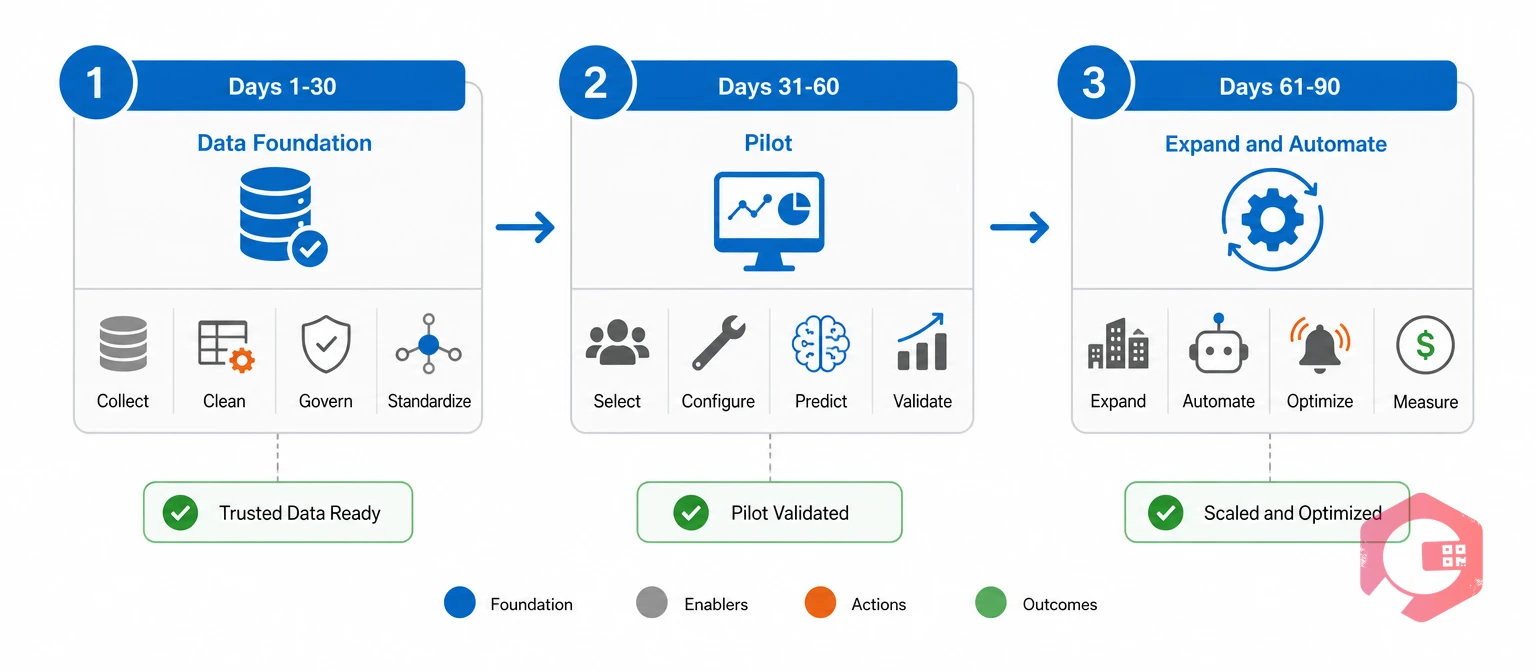
Most facilities can move from manual scheduling to AI-driven resource planning in about 90 days by phasing the rollout across data cleanup, pilot testing, and full deployment. Trying to flip the switch facility-wide on day one is the most common reason these projects stall.
Consolidate work order history, technician certifications, and PM schedules into a single system. AI forecasting is only as good as the data behind it, so this phase matters more than any other. Standardizing maintenance checklists during this window also cleans up inconsistent job duration data that would otherwise distort the forecast.
Assign one person to own data quality for this phase — usually a planner or reliability engineer. Facilities that skip this step and let data entry stay decentralized across multiple supervisors almost always need to redo the cleanup a second time once the forecast starts producing obviously wrong numbers.
Run AI-based forecasting and assignment on a single crew or a single class of critical assets before rolling it out plant-wide. This limits risk, gives supervisors a chance to trust the recommendations, and surfaces data gaps while they are still cheap to fix.
Pick a crew with a supervisor open to trying new tools rather than the most resistant team in the building. Early wins from a receptive pilot group create the internal case study that makes the plant-wide rollout in the next phase far easier to sell.
Extend the pilot across the full facility and turn on automated overtime alerts so managers see risk before approving a shift, not after. At this stage, routing new work requests through workflow automation keeps the forecast current without manual re-entry every time a job comes in.
Set a review cadence — most facilities check forecast accuracy against actual work order volume every two weeks during this phase, adjusting the model's inputs as gaps show up. Facilities that follow this phased approach typically see their first measurable overtime reduction by the end of the pilot phase, well before full rollout is complete.
Technician buy-in for AI resource planning depends on framing the tool as protection against unfair overtime distribution, not as surveillance of individual performance. Rollouts that skip this framing face quiet resistance — technicians who feel watched will find ways to work around a system rather than with it.
According to Prosci's change management research, projects with strong change management are far more likely to meet their objectives than those that treat adoption as an afterthought. Maintenance resource planning is no exception — the algorithm can be flawless and still fail if the crew does not trust its recommendations.
Most facilities that skip change management planning end up re-training their crew on the tool a second time after adoption stalls — building trust up front costs less than fixing distrust later.
The clearest signal that AI resource planning is working is a sustained drop in overtime hours per technician alongside a stable or improving PM compliance rate. Track these together — a drop in overtime that comes with a drop in PM compliance usually means work is being deferred, not eliminated.
Facilities using preventive maintenance software with built-in reporting can pull most of these KPIs automatically instead of reconstructing them from spreadsheets every month.
The most common mistake facilities make when adopting AI resource planning is turning on automated scheduling before the underlying work order data is clean enough to trust. A forecast built on inconsistent job durations and missing technician records produces recommendations nobody follows, which kills confidence in the tool before it has a chance to prove itself.
Facilities that skip the pilot phase and push AI resource planning across every crew at once lose the ability to isolate what is working from what is not. When something goes wrong — and something usually does in the first few weeks — it becomes far harder to diagnose whether the issue is data quality, model tuning, or technician pushback.
Many facilities sit on years of overtime and work order history in their CMMS without ever analyzing it before starting an AI resource planning project. That history is the fastest way to validate whether the forecasting model is producing sensible numbers, and skipping it means flying blind through the first several weeks of the pilot.
Overtime governance rules — who can approve overtime, at what threshold, and under what conditions — need to exist before the AI system starts flagging risk. Facilities that build the forecasting and assignment pieces first and bolt on governance later usually end up with alerts nobody acts on, because there is no clear owner or process tied to the warning.
A standard CMMS tracks work orders and schedules after they are created, while AI maintenance resource planning adds a forecasting layer that predicts labor demand and recommends staffing decisions before work orders pile up. Most facilities run AI resource planning as a capability layered on top of their existing CMMS rather than as a separate system, which is why the data foundation phase of a rollout matters so much.
Results vary by facility, but teams that combine demand forecasting with skill-based assignment commonly report double-digit percentage reductions in overtime hours within two to three months of full rollout, driven mainly by fewer emergency jobs and faster technician-to-task matching. Facilities with messier starting data usually see slower initial gains until the forecast has enough history to work from.
Usually not. Most staffing bottlenecks come from mismatched skills and poor visibility into upcoming demand rather than an actual headcount shortage, so many facilities recover meaningful capacity from their existing crew before considering new hires. A facility that finds it still needs to hire after implementing AI resource planning at least now has forecast data to justify exactly how many additional technician-hours are required.
At minimum, a facility needs work order history with technician and duration data, current PM schedules, and technician certification records. Facilities with at least six months of consistent work order data see the most accurate forecasts from day one, though the model continues improving as more history accumulates.
Small teams benefit too, though the payoff scales with complexity. A five-technician crew still gains from skill-based assignment and overtime alerts, even if the forecasting model has less historical data to draw from than a large multi-site operation. The core principle — planning labor before demand hits rather than after — helps at any crew size.
Staffing bottlenecks and overtime spirals rarely fix themselves — they compound until a planned approach interrupts the cycle. Schedule a free demo to see how Cryotos turns work order history and technician data into a resource plan that keeps your crew ahead of the workload instead of chasing it.



Cryotos AI predicts failures, automates work orders, and simplifies maintenance—before problems slow you down.



