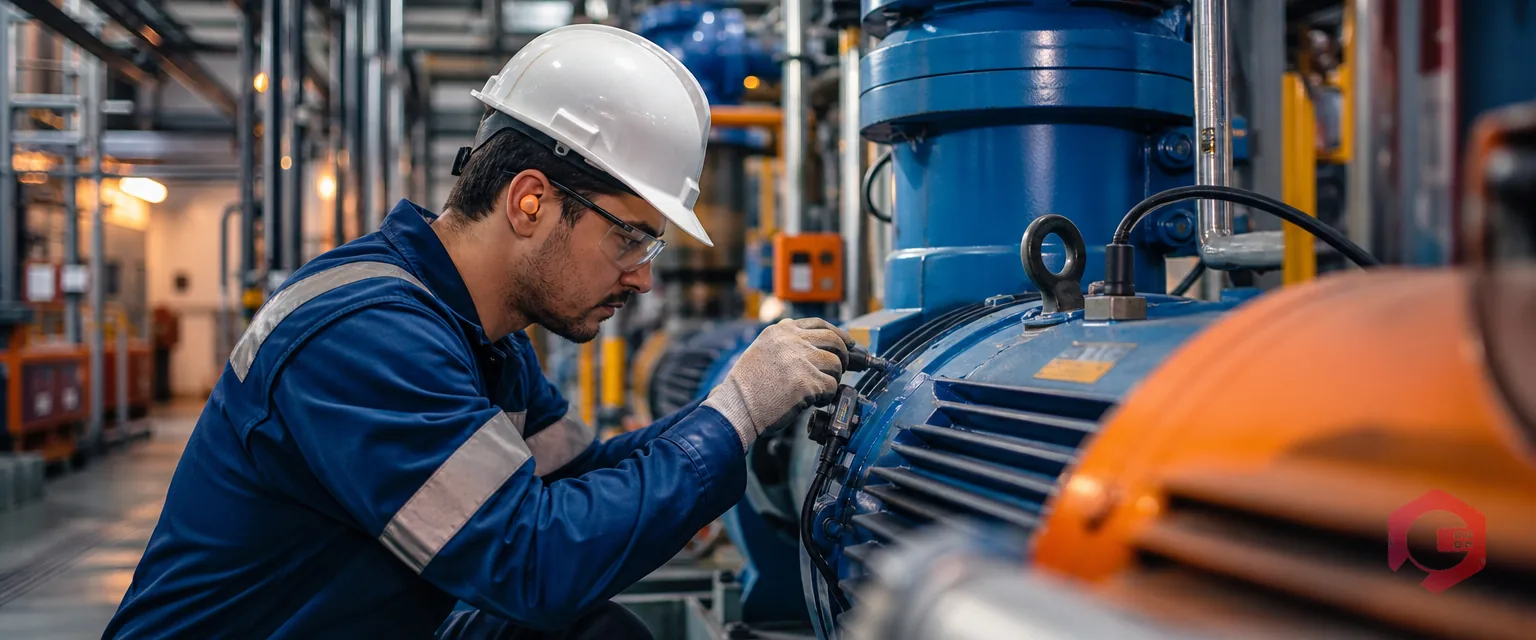
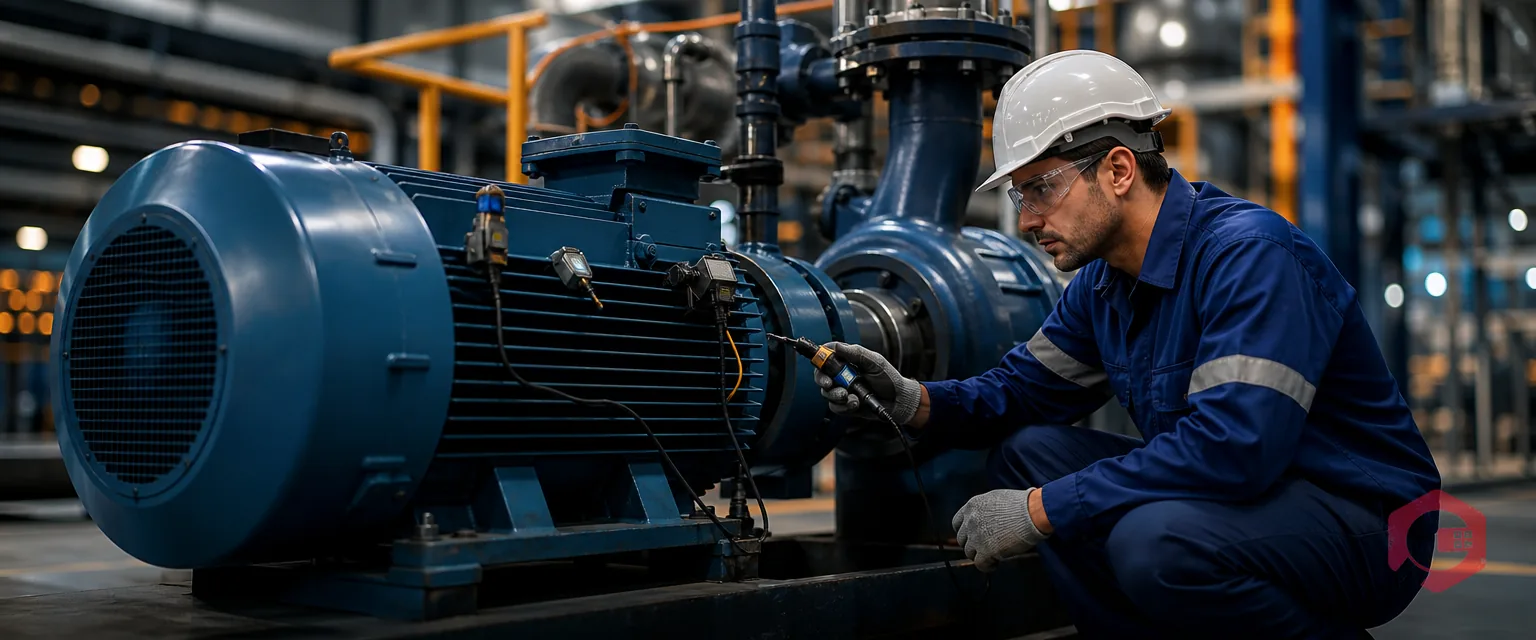
AI-powered predictive maintenance for steel mills uses machine learning algorithms and IoT sensors to detect equipment anomalies before they cause failures. Unlike traditional scheduled maintenance, it continuously analyzes real-time data from critical assets — blast furnaces, rolling mills, and electric arc furnaces — and triggers work orders only when actual degradation is detected. According to a McKinsey report on steel industry digitalization, predictive maintenance can reduce unplanned downtime by up to 50% and cut maintenance costs by 10–25% in heavy manufacturing.
Steel plants run on razor-thin margins. A single unplanned blast furnace shutdown can cost between $50,000 and $300,000 per hour in lost production. Yet most steel facilities still rely on calendar-based PMs or reactive break-fix cycles that leave money — and tons of steel — on the table. This guide covers everything plant managers need to know: how AI predictive maintenance works, which equipment it covers, real implementation steps, and how a CMMS like Cryotos ties it all together.
What Is Predictive Maintenance in Steel Manufacturing?
Predictive maintenance (PdM) in steel manufacturing is a condition-based strategy that uses real-time sensor data, AI models, and historical failure patterns to forecast when specific equipment is likely to fail — and schedules maintenance before that failure occurs. It moves steel plants away from the costly extremes of "fix it when it breaks" and "maintain it on a fixed schedule regardless of actual condition."
To understand why this matters, it helps to see how the three maintenance approaches compare in a steel plant context:
Reactive vs. Preventive vs. Predictive: A Steel Plant Comparison
Reactive Maintenance — Fix equipment after it fails. Low upfront cost but catastrophic in steel plants where a single furnace failure can halt an entire production line for 12–48 hours. Most expensive in total cost.
Preventive Maintenance — Service equipment on fixed schedules (every 30 days, every 500 operating hours). Reduces some failures but results in over-maintenance — replacing parts that still have 40% of their life left.
Predictive Maintenance — Maintain equipment based on its actual condition, monitored continuously. Sensors detect vibration spikes, thermal anomalies, or lubrication degradation weeks before failure. Work orders trigger automatically.
According to the U.S. Department of Energy's O&M Best Practices Guide, predictive maintenance delivers a 10:1 return on investment compared to reactive strategies, with 25–30% reduction in maintenance costs and a 70–75% reduction in breakdowns.
Why Steel Mills Need AI-Powered Predictive Maintenance
Steel production is one of the most asset-intensive industries on the planet. Blast furnaces operate at temperatures exceeding 1,500°C. Rolling mills run at speeds over 100 km/h. Electric arc furnaces draw tens of thousands of amperes. These are not environments where monthly inspections or basic sensors are enough.
The Real Cost of Unplanned Downtime in Steel Production
The financial stakes of equipment failure in steel are uniquely severe. Consider these industry benchmarks:
Blast furnace unplanned shutdown: $50,000–$300,000 per hour in lost production, depending on plant capacity.
Hot rolling mill stoppage: Typically causes 4–8 hours of downstream idle time across connected production units.
Average steel plant OEE: Industry average sits at 65–75%. World-class facilities using predictive maintenance push this above 85%.
Maintenance spend: Steel plants typically spend 15–25% of their total operating budget on maintenance. AI PdM can bring this down to 10–15%.
Traditional sensors and manual rounds simply can't capture the volume and velocity of data that modern steel equipment generates. AI models — trained on thousands of failure events — can identify patterns that no human technician would catch during a 30-minute inspection round.
Key Equipment AI Monitors in a Steel Plant
Not all steel plant equipment benefits equally from AI predictive maintenance. The highest ROI comes from high-criticality, high-failure-cost assets. Here's where steel plants are seeing the biggest gains:
Blast Furnace Monitoring
The blast furnace is the heart of an integrated steel plant. AI monitoring focuses on:
Refractory lining wear — Thermal imaging and heat flux sensors track lining thickness in real time. AI models predict remaining lining life to within ±15 days, enabling planned relining campaigns instead of emergency shutdowns.
Tuyere and bustle pipe integrity — Pressure and flow sensors detect tuyere blockages and leaks that reduce blast efficiency by up to 8%.
Cooling stave temperature — Anomalous cooling patterns detected 3–6 weeks before stave failure, preventing catastrophic shell damage.
Hot Rolling Mill & EAF Monitoring
Rolling mills and Electric Arc Furnaces (EAFs) — increasingly central to green steel production — require different sensor packages:
Rolling mill roll bearings — Vibration analysis using accelerometers detects bearing fatigue 2–4 weeks before failure. A single unplanned bearing replacement on a hot strip mill takes 6–12 hours of downtime.
EAF electrode arms — Current and power factor monitoring catches electrode imbalances that waste energy and accelerate wear. AI optimization can reduce electrode consumption by 5–8%.
Hydraulic systems — Pressure decay analysis detects seal degradation in rolling mill hydraulics weeks before visible leaks develop.
As the World Steel Association's digital transformation report notes, EAF-based steel production is growing rapidly as part of the industry's decarbonization push — making EAF maintenance intelligence an increasingly critical capability.
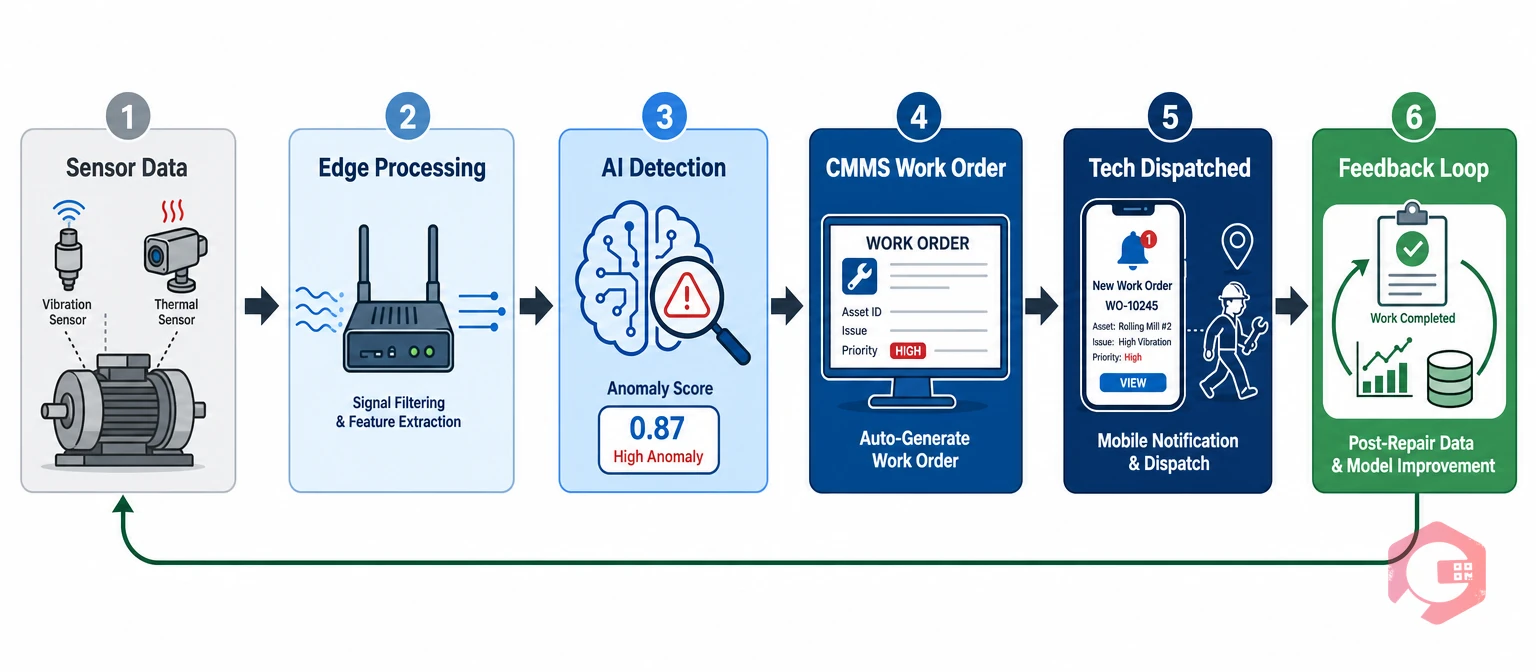
How AI Predictive Maintenance Works: Sensor to Work Order
Many steel plant managers understand the concept of predictive maintenance but aren't sure how the data actually flows from a vibrating bearing to a technician's work order. Here's the complete workflow:
Step-by-Step: From Data Collection to Maintenance Action
Step 1 — Sensor data collection: Vibration sensors, thermal cameras, ultrasonic detectors, current transducers, and pressure transmitters continuously capture equipment condition data — typically at 1,000–50,000 samples per second for vibration analysis.
Step 2 — Edge processing: Data is filtered and compressed at the edge (on-site gateway or PLC) before transmission. This reduces bandwidth from gigabytes to kilobytes per minute while preserving fault-relevant signal features.
Step 3 — AI anomaly detection: Machine learning models — typically trained on 12–24 months of historical sensor data plus known failure signatures — score each reading against normal operating baselines. Anomaly scores above threshold trigger alerts.
Step 4 — CMMS integration: When an anomaly is confirmed, the AI platform pushes a work order request directly into the CMMS, pre-populated with asset ID, fault type, severity level, and recommended action.
Step 5 — Technician dispatch: The maintenance team receives the work order via mobile app, reviews the sensor data visualization, gathers the right spare parts from inventory, and executes the repair — before failure occurs.
Step 6 — Feedback loop: Post-repair data is fed back into the AI model, continuously improving prediction accuracy. Plants typically see model accuracy improve from 70% to 90%+ within 18 months of operation.
This sensor-to-work-order loop is what separates true AI predictive maintenance from basic condition monitoring. The intelligence doesn't just alert — it acts.
Top Benefits of AI Predictive Maintenance for Steel Mills
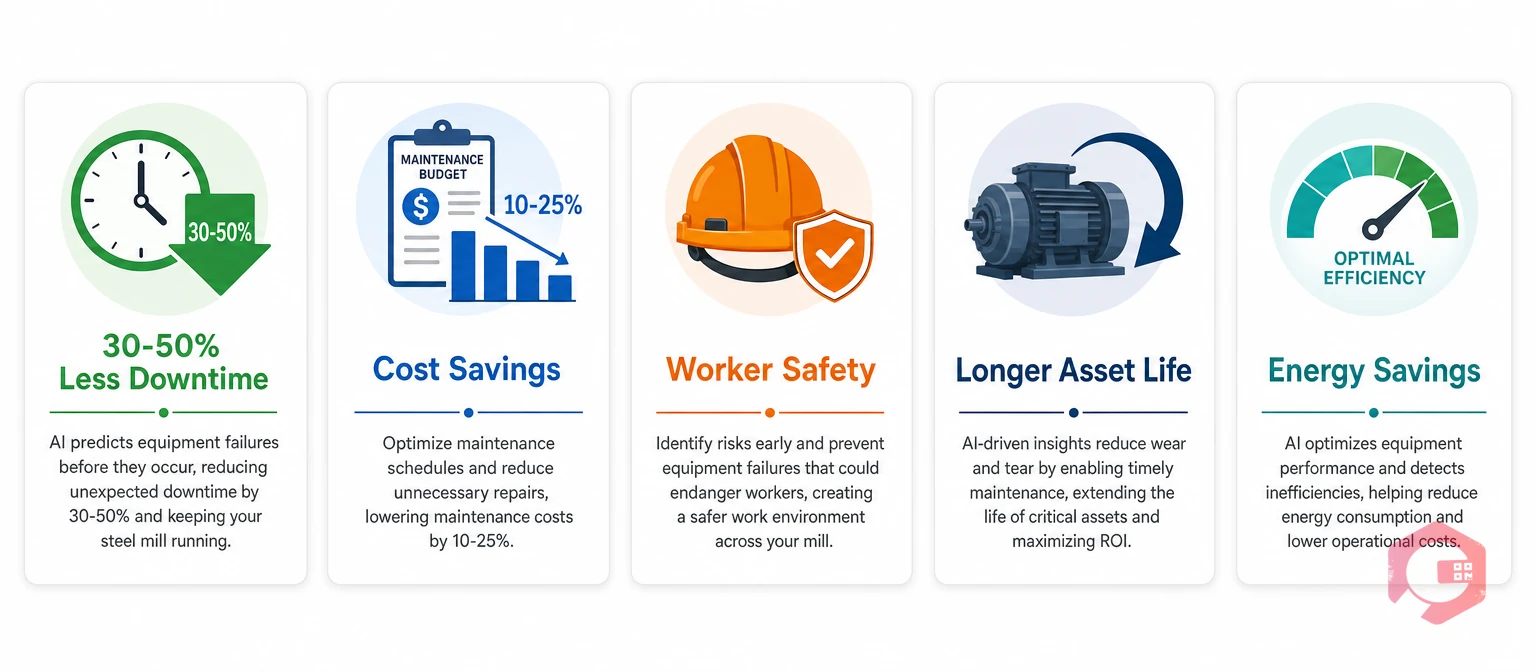
Steel plants that implement AI predictive maintenance consistently report gains across four dimensions: uptime, cost, safety, and sustainability.
30–50% reduction in unplanned downtime — When failures are predicted 2–6 weeks out, maintenance can be scheduled during planned production pauses rather than forcing emergency shutdowns.
10–25% reduction in total maintenance costs — Fewer emergency repairs, less over-maintenance, and optimized spare parts usage compound quickly. A mid-sized steel plant spending $20M annually on maintenance can save $2–5M per year.
Improved worker safety — Predictive maintenance reduces the likelihood of catastrophic failures. The OSHA steel industry safety guidelines emphasize equipment integrity as a primary safety control.
Extended asset lifespan — Steel plants report 15–20% longer asset life cycles after implementing AI PdM programs.
Energy efficiency gains — A misaligned rolling mill drive uses 8–12% more power than a properly aligned one. AI monitoring catches these inefficiencies before they compound.
ESG and sustainability support — Lower unplanned downtime means fewer emergency energy burns and scrap generation, directly supporting carbon reduction targets.
How to Implement AI Predictive Maintenance in Your Steel Plant
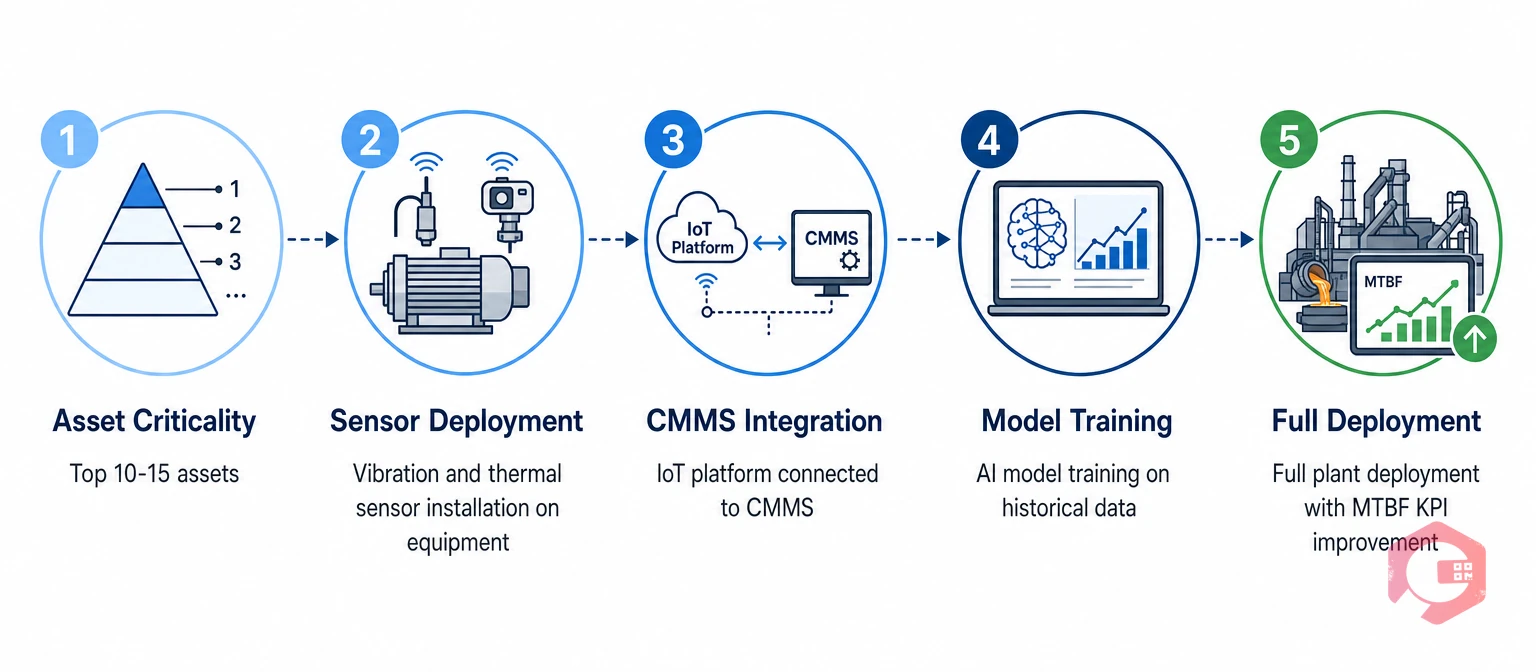
Implementation doesn't require replacing your entire maintenance operation overnight. The most successful steel plant deployments follow a phased approach:
Phase 1 — Asset criticality ranking: Identify the top 10–15 highest-criticality assets in your plant. Start with blast furnace cooling systems and hot strip mill drives.
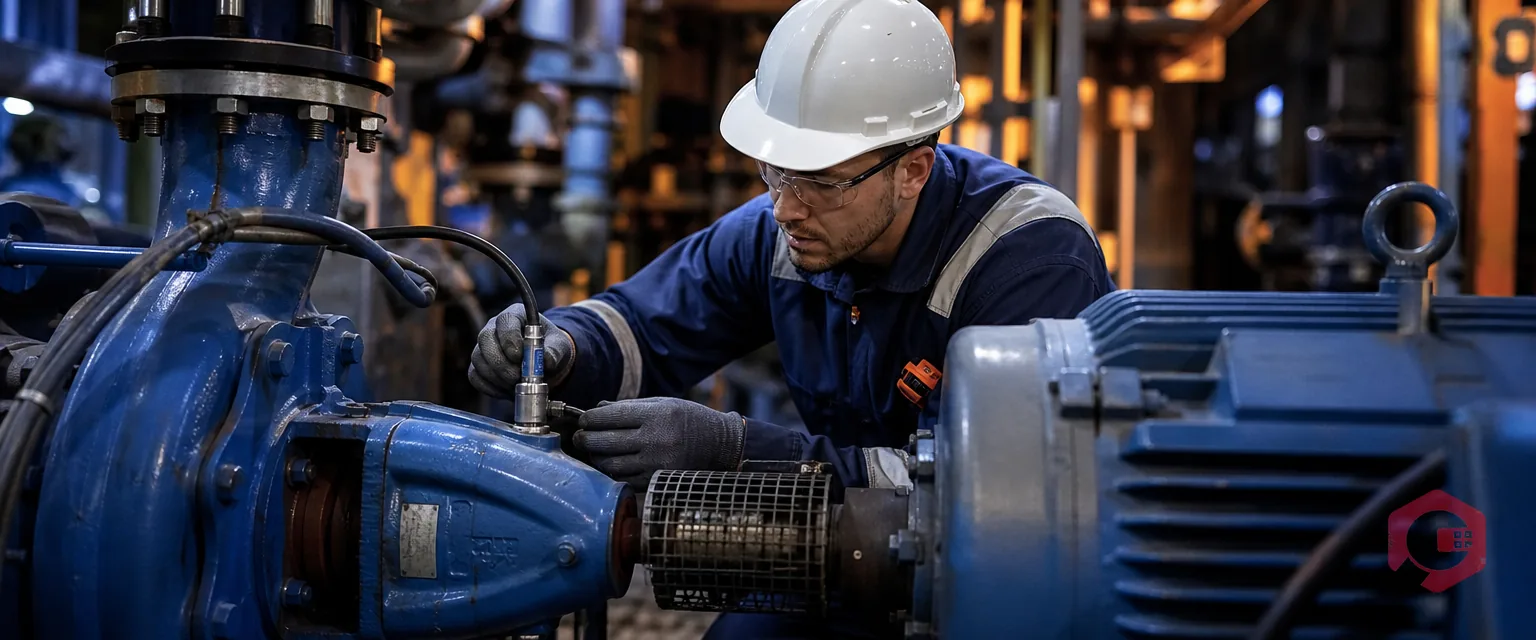
Phase 2 — Sensor deployment: Install vibration sensors, thermal sensors, and current transducers. Budget $500–$5,000 per monitored asset.
Phase 3 — CMMS integration: Connect your IoT platform to your CMMS software so that sensor alerts automatically generate work orders.
Phase 4 — Model training: Allow the AI system 3–6 months to learn equipment baselines. Run PdM alongside existing maintenance programs during this period.
Phase 5 — Full deployment: Expand sensor coverage, refine thresholds, and shift maintenance schedules to condition-driven. Track MTBF and MTTR as primary KPIs.
According to a Deloitte Smart Factory analysis, steel plants following a structured phased implementation achieve positive ROI within 14–18 months.
How Cryotos CMMS Powers Predictive Maintenance in Steel
Cryotos CMMS is purpose-built for industrial maintenance operations, making it a natural fit for steel plants building out their predictive maintenance programs.
IoT integration: Cryotos connects directly to SCADA systems, PLCs, and IoT edge devices. When sensor thresholds are breached, the platform auto-generates work orders with no manual data entry required.
AI-assisted work order creation: Using generative AI, Cryotos creates detailed work orders from voice commands or photo analysis — ideal for steel plant environments.
Real-time asset tracking: Cryotos asset management gives plant teams instant access to full equipment history, maintenance logs, and warranty data via QR code scan.
Downtime management module: Cryotos tracks unplanned downtime with KPIs including MTTR, MTBF, and availability percentage by department and asset.
Inventory synchronization: PdM alerts trigger automatic spare parts inventory checks, flagging stockouts before the technician arrives at the equipment.
Preventive maintenance scheduling: Cryotos preventive maintenance handles dynamic PM scheduling based on operating hours or production cycles for assets not yet on IoT monitoring.
Steel plants using Cryotos report up to 30% reduction in unplanned downtime and 25% faster repair times.
Frequently Asked Questions
What sensors are used for predictive maintenance in steel mills?
The most common sensors include vibration accelerometers, thermal imaging cameras, ultrasonic sensors, current transducers, and pressure transmitters. Most deployments start with vibration and thermal sensors on the highest-criticality assets, then expand coverage over 12–18 months.
How long does it take to implement AI predictive maintenance in a steel plant?
A phased deployment typically takes 12–18 months from initial sensor installation to full AI model maturity. Meaningful predictive alerts start appearing at month 4–6. Full ROI is typically realized within 14–24 months.
What is the ROI of AI predictive maintenance for steel plants?
Industry data shows a 10:1 return on investment for mature predictive maintenance programs. A steel plant spending $20M annually on maintenance can typically save $2–5M per year through AI PdM.
Can AI predictive maintenance work alongside existing SCADA systems?
Yes. Most AI PdM platforms integrate with existing SCADA, PLC, and DCS infrastructure via standard protocols (OPC-UA, MQTT, Modbus). The AI layer sits on top of your existing infrastructure — no replacement required.
What is the difference between condition monitoring and predictive maintenance?
Condition monitoring tells you the current state of an asset. Predictive maintenance uses AI to analyze trends in that data and forecast future failures. In a well-designed system, condition monitoring feeds predictive models, which trigger automated work orders in the CMMS.
AI-powered predictive maintenance is no longer a future capability for steel plants — it's a competitive requirement. Cryotos CMMS gives steel plant maintenance teams the IoT integration, AI-assisted work order management, and real-time asset intelligence they need to make the shift from reactive to predictive. Book a free demo with Cryotos to see how predictive maintenance works in a steel plant environment.